

<!– Preview-only styling. DELETE this
block before pasting into WordPress. –>
body{max-width:780px;margin:0 auto;padding:24px;font:17px/1.65 Georgia,serif;color:#1c1c1c}
h1{font-size:2em;line-height:1.2}h2{margin-top:1.9em;font-size:1.45em}h3{margin-top:1.7em;font-size:1.18em}
img{max-width:100%;height:auto}figure{margin:1.6em 0}
.wp-caption-text{font:italic 14px/1.4 Georgia,serif;color:#666;margin-top:.4em}
.a2o-specs{font:14px/1.5 Helvetica,Arial,sans-serif;background:#f5f5f3;padding:10px 14px;border-left:3px solid #c9a227}
.a2o-keytakeaway{background:#f5f5f3;padding:16px 20px;border-left:3px solid #c9a227}
table{border-collapse:collapse;width:100%;font:14px/1.5 Helvetica,Arial,sans-serif}
th,td{border:1px solid #ddd;padding:8px;text-align:left;vertical-align:top}th{background:#f5f5f3}
Ever walked past a building that made you do a double-take — not because it was ugly, but because it looked like it had stepped out of a dream? That is surrealist architecture: the tendency that treats buildings as sculptures pulled from the subconscious, where walls dissolve, staircases climb to nowhere and a chapel can be see-through.
Surrealist architecture isn’t weirdness for its own sake. It is a deliberate rebellion against boxy, rational buildings that treat people like machines. Descended from André Breton’s 1924 Surrealist Manifesto, it asks a simple question: what if a building could capture that floating feeling between asleep and awake?
The result is architecture that makes you feel something first and think about function second — a museum that seems to be breathing, a church you can see through, a car park that looks like five architects had a fever dream and built it anyway. Several of the designers below sit firmly among the most influential architects in history.
Who is the most famous surrealist architect?
There is no single figure. Frederick Kiesler and Salvador Dalí established the vocabulary; Frank Gehry and Zaha Hadid brought it into mainstream practice; and MVRDV, MAD Architects, Wutopia Lab and Santiago Calatrava carry it forward today. Edward James, a poet rather than an architect, built one of its purest examples at Las Pozas.
Was Salvador Dalí an architect?
No — Dalí was a painter, but he designed buildings and interiors, most famously the Dream of Venus pavilion for the 1939 New York World’s Fair, and his own Teatre-Museu in Figueres. His melting, biomorphic imagery shaped how later architects imagined form more than any single structure he built.
Is Antoni Gaudí a surrealist architect?
Not strictly — Gaudí died in 1926, two years after the Surrealist Manifesto, and worked from nature, geometry and Catholic symbolism rather than the subconscious. But Dalí championed his work, and his organic forms and trencadís tiling remain a direct influence on architects working in a surrealist register, Calatrava included.
What is surrealist architecture?
Surrealist architecture is a design approach that applies the logic of dreams to buildings, using organic or impossible forms, unexpected materials and disorienting spatial sequences. Descended from André Breton’s 1924 Surrealist Manifesto, it prioritises emotional and psychological impact over conventional function, without abandoning function altogether.
What makes a building surrealist rather than just unusual?
Intent. An unusual building may simply be sculptural; a surrealist one deliberately borrows dream logic — melting, floating, dissolving or inverting the forms we expect — and asks the viewer to question what is real. The strangeness carries meaning rather than serving as decoration.
How is surrealist architecture different from postmodern architecture?
Postmodernism quotes history with irony — a classical pediment at the wrong scale on an office block. Surrealism quotes the subconscious instead, making the whole building behave like a dream. Postmodernism is a cultural in-joke; surrealism is an attempt to build the feeling of being half asleep.
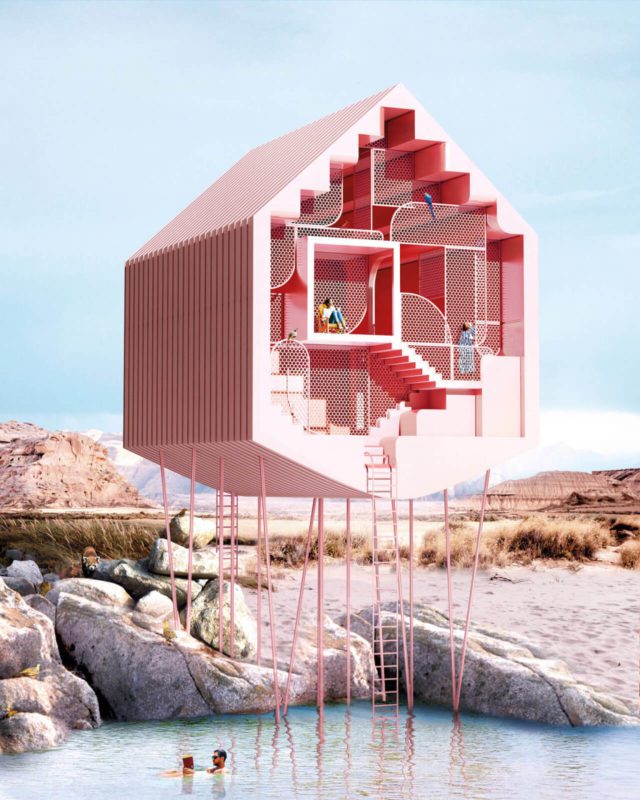
©DesignWanted
What Is Surrealist Architecture?
Surrealist architecture is design that borrows the logic of dreams rather than the logic of function: organic or biomorphic forms, impossible geometries, unexpected material combinations and spatial sequences that unsettle rather than reassure. It aims at emotional impact first — the building works, but it startles before it serves.
The dream logic behind the movement
In 1924, Breton published The Surrealist Manifesto and argued that dreams and waking life should stop being treated as separate territories. He called the merged state “surreality” — a place where a melting clock and a grocery list are equally valid.
For architects, that was permission. Instead of asking how a building should function, they began asking how it should feel. Concrete got treated like clay, steel like ribbon, intuition like a structural principle. The outcomes look impossible because in a sense they are: buildings that appear to grow from the ground, stairs that spiral into nothing, walls that disappear.
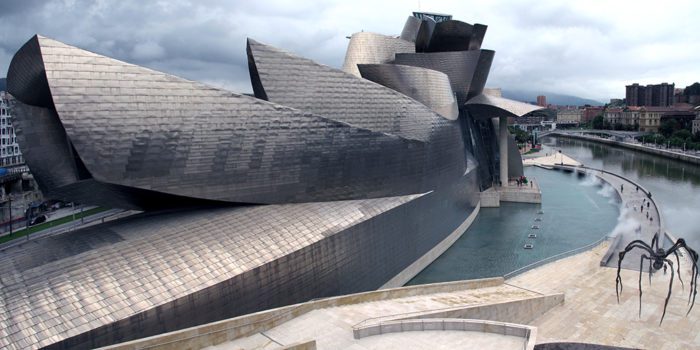
Frank Gehry, Guggenheim Museum Bilbao, ©Emilio I. Panizo
This was never art for art’s sake. Surrealism prized content over pure form, which made it the rebellious cousin of Cubism’s formal discipline. Salvador Dalí, Frederick Kiesler and later Frank Gehry all treated it as licence to build dreams — and the momentum is only growing, as parametric design and digital fabrication let younger architects build forms that would once have stayed on paper.
What makes a building truly surrealist?
- Dreamlike forms that defy logic — volumes that look like they are melting, floating or mid-transformation.
- Unexpected material behaviour — glass that reads as fabric, concrete that flows like water, steel that appears weightless.
- A question rather than a statement — what if a wall weren’t solid? What if a roof could lift?
- Emotional impact over efficiency — it works as a building, but it moves you before it serves you.
- The double-take — you have to look twice, because the form defeats your brain’s pattern recognition.
Surrealism, Modernism and Postmodernism Compared
| Movement | Governing idea | Typical move |
|---|---|---|
| Modernism | Rationality; form follows function | Strip ornament, expose structure, standardise |
| Postmodernism | History and irony; architecture as language | Quote a classical order, at the wrong scale, with a wink |
| Surrealism | The subconscious; dream logic made buildable | Melt, float, invert or dissolve the expected form |
Also read: 6 Architecture Icons That Define Postmodernism from the 20th Century
10 Surrealist Architecture Examples That Feel Like Dreams Made Real
1. The Imprint | MVRDV, Seoul, South Korea
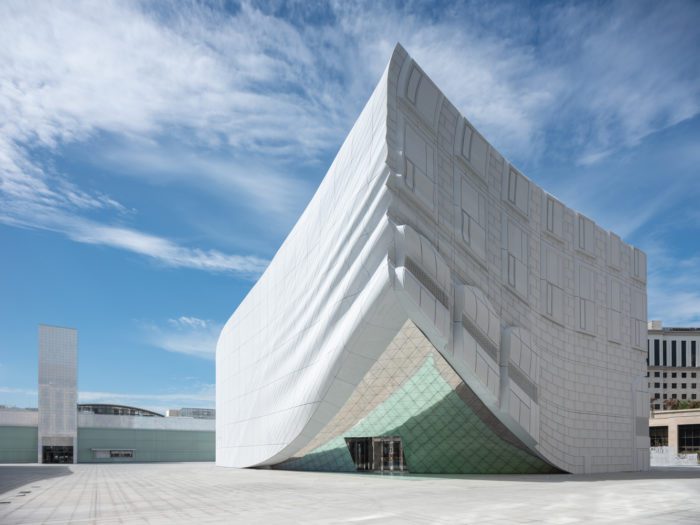
MVRDV faced an awkward problem on the Paradise City site near Incheon: how do you add two windowless entertainment buildings — a nightclub and a performance hall — next to an existing complex without either mimicking it or ignoring it? The surrealist answer was to imprint the neighbouring façades onto the new ones as a cast relief.
The result reads as a ghost of its neighbours: windowless white volumes whose surfaces ripple with the imprint of windows and mullions that aren’t there, cast from moulds taken on site. A gold-leaf entrance and a tilted upper face catch the light and make the buildings appear to shift as you move. It is a building that doesn’t compete with its context — it remembers it, dreamily.
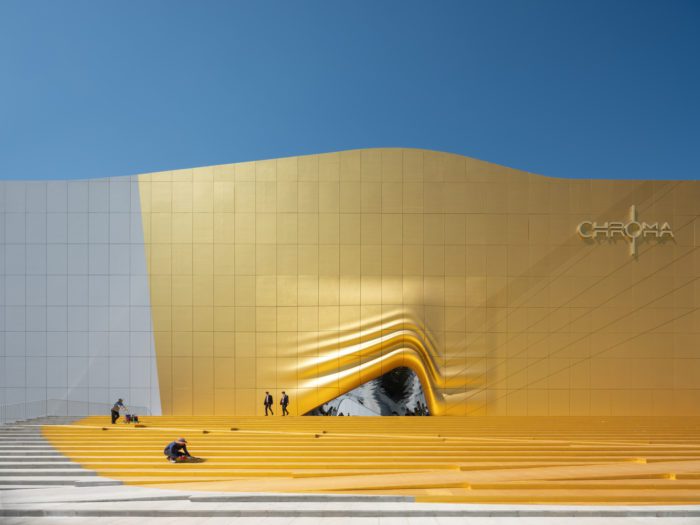
©Ossip van Duivenbode
For more on how architects treat the outer skin as the whole argument, see the beauty of colorful facades in contemporary architecture.
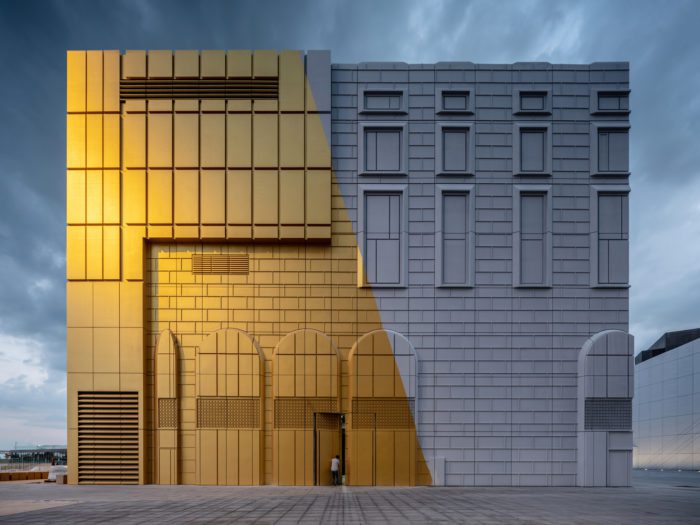
©Ossip van Duivenbode
©Ossip van Duivenbode
2. Miami Museum Garage | WORKac, Nicolas Buffe, Clavel Arquitectos, K/R and J. MAYER. H, Miami, USA
©Imagen Subliminal
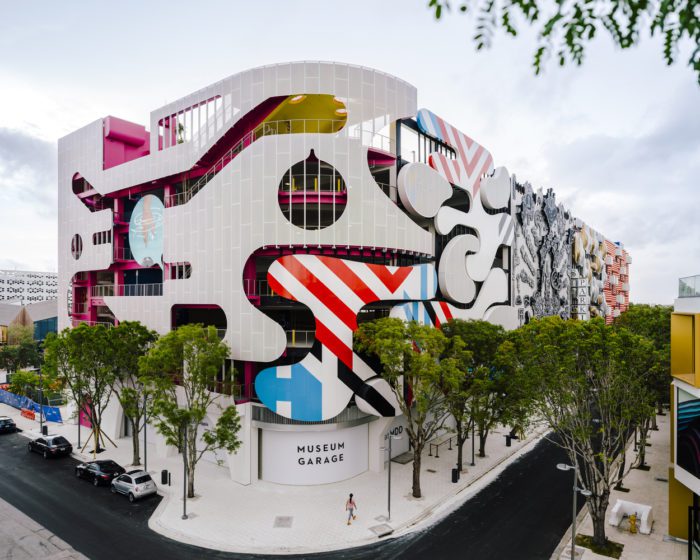
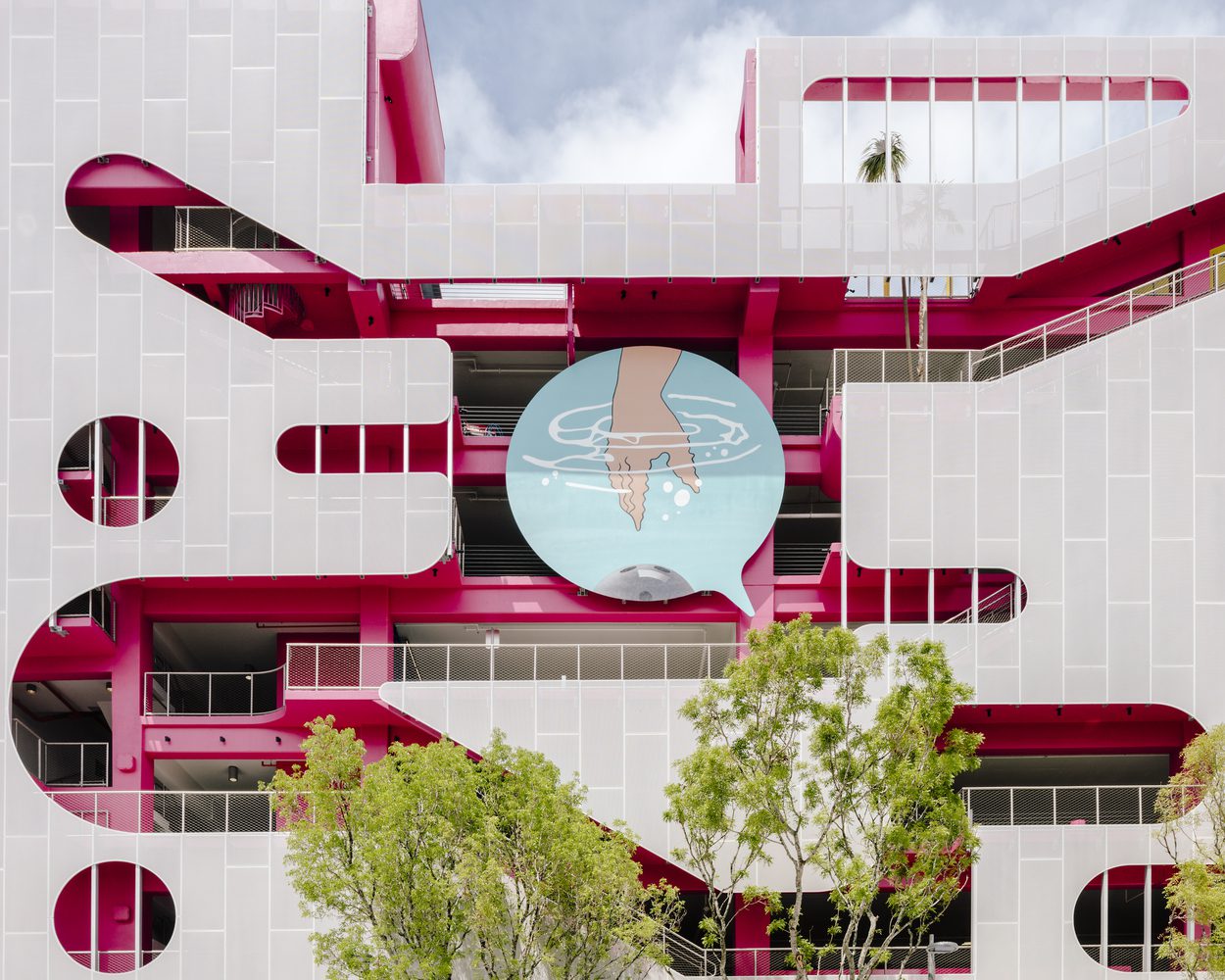
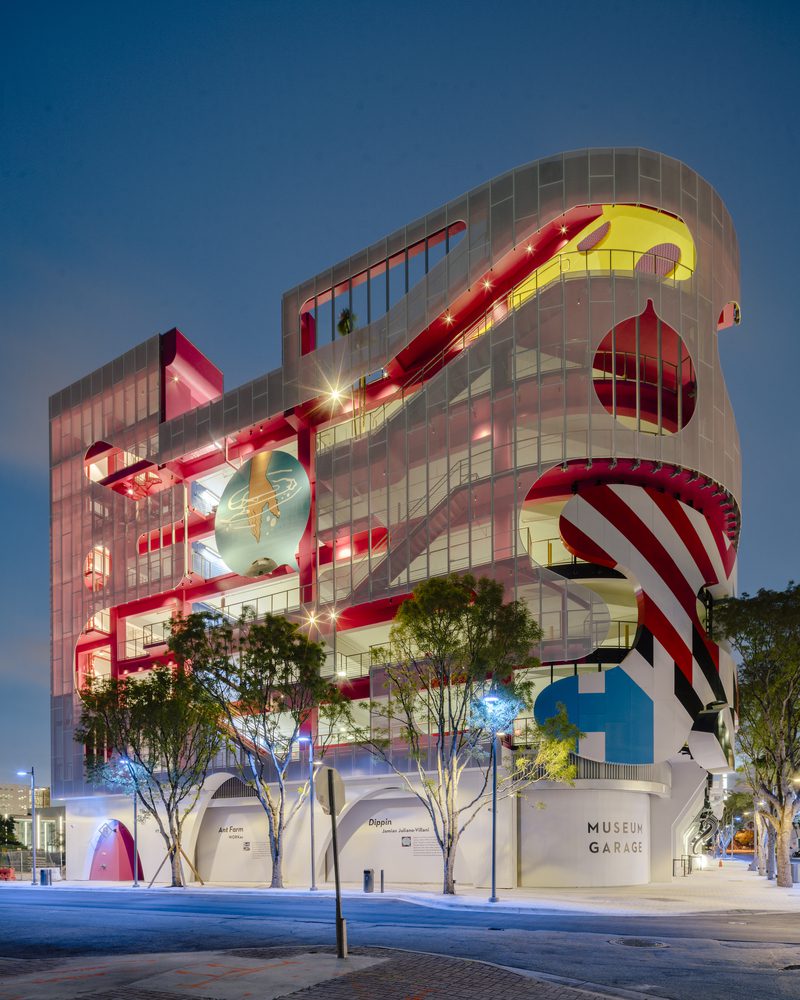
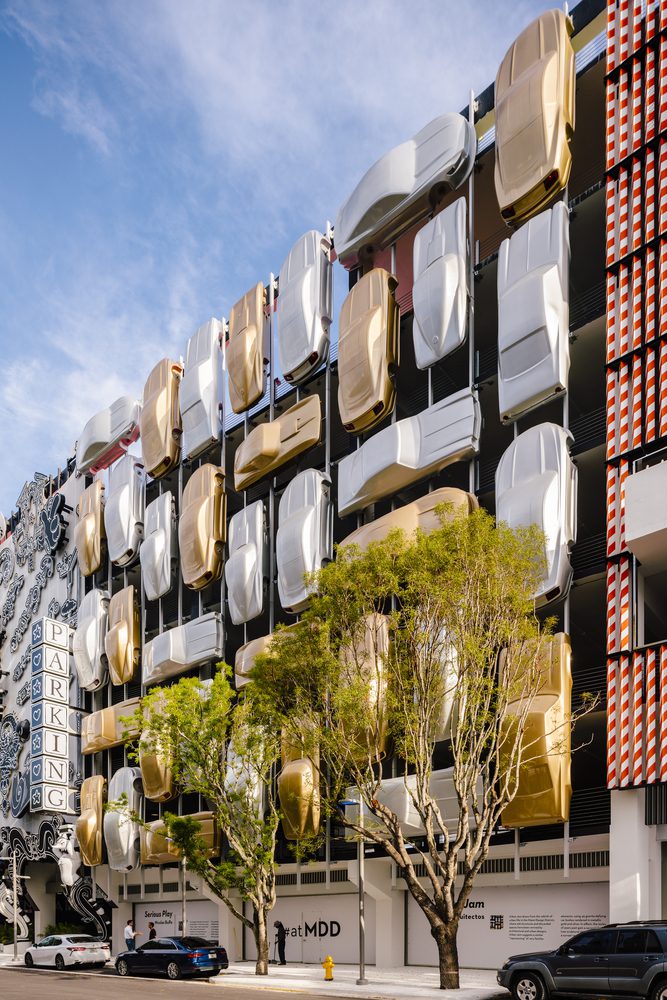
This is what happens when five firms play the surrealist parlour game Exquisite Corpse — each player adding to a drawing without seeing what the others have done. Curator Terence Riley gave each practice a slice of the Miami Museum Garage façade and told them not to coordinate.
The result is a fever dream in concrete and colour. One bay stacks cartoonish black-and-white line drawings; another jams a row of salvaged car bodies into the wall; another is pure geometric abstraction. Each section is a non sequitur, a visual punchline delivered without a set-up — a car park that forgot it was supposed to be boring.
©Imagen Subliminal
©Imagen Subliminal
©Imagen Subliminal
While you’re in Florida, see the rest of our Miami architecture handbook.
3. Ordos Art & City Museum | MAD Architects, Ordos, China
AutoWB: 2.02; 1.00; 1.10, Kelvin=10000, Tint=0.0161
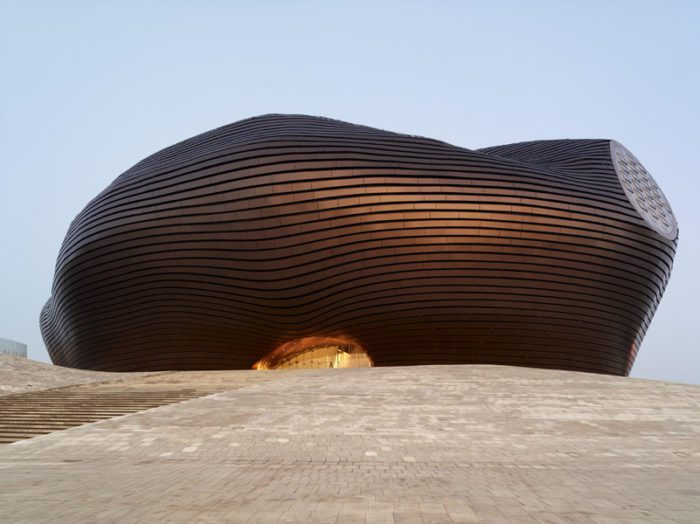
MAD Architects looked at a stretch of the Gobi and designed something that appears to have landed there. Completed in 2011, the Ordos Art & City Museum answers the rigid grid of the surrounding masterplan with a form that is entirely organic — a polished metallic dune that seems to have drifted into position overnight.
In a district that was empty desert a few years earlier, the building generates its own reality: interior canyons, stairs that climb towards light rather than towards rooms, and a skin that reflects sand and sky until the volume half-dematerialises. It isn’t a building in the desert so much as a dream about one.
4. Reading Between the Lines (the See-through Church) | Gijs Van Vaerenbergh, Borgloon, Belgium
©Kristof Vrancken
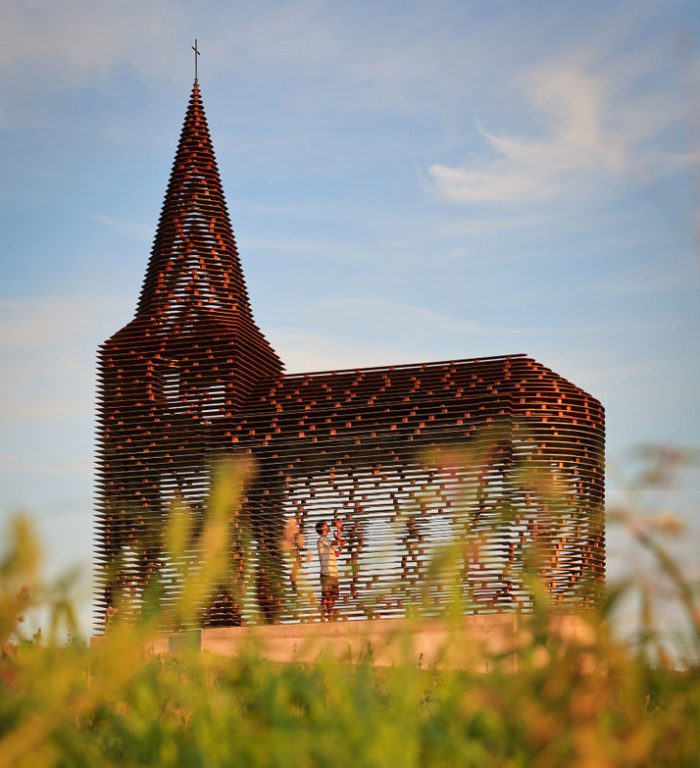
Architects: Pieterjan Gijs and Arnout Van Vaerenbergh · Completed: 2011 · Structure: 100 stacked layers of Corten steel, roughly 2,000 columns, about 30 tonnes, 10 m high
This is a church that is only conditionally there. Built for Z33’s PIT art-in-public-space programme in Borgloon, it takes the silhouette of a small Limburg chapel and slices it into a hundred horizontal layers of weathered steel, spaced apart by some two thousand short columns.
From certain angles it reads as a solid building. Move fifty metres and it thins into a drawing of one, the landscape showing straight through the walls. Inside, sunlight falls through the gaps in hard horizontal bands. The piece asks what actually makes a church a church — the walls, or the space they define — and then removes the walls to see what survives.
5. Sharp Centre for Design | Will Alsop, Toronto, Canada
Credit mention must accompany all printed material.
Photo Credit to read: interiorimages.ca
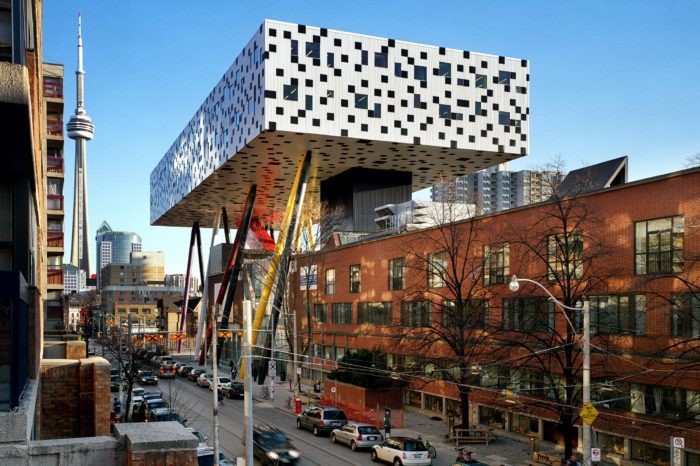
Will Alsop took an existing art school and parked a pixelated tabletop on top of the city instead. Completed in 2004 for OCAD University, the Sharp Centre for Design hovers roughly 26 metres above the street on twelve brightly coloured steel legs that look borrowed from a cartoon.
The black-and-white pixel skin sets the block against its low-rise neighbours, while lifting the volume clear of the ground preserved the park beneath and kept pedestrian routes open. That is surrealism with a business case attached: the building manages to be a serious academic institution and a piece of civic mischief that shouldn’t be able to stand up.
For more on structures that argue with gravity, see 5 long span structures with awesome roofs.
6. Heydar Aliyev Center | Zaha Hadid Architects, Baku, Azerbaijan
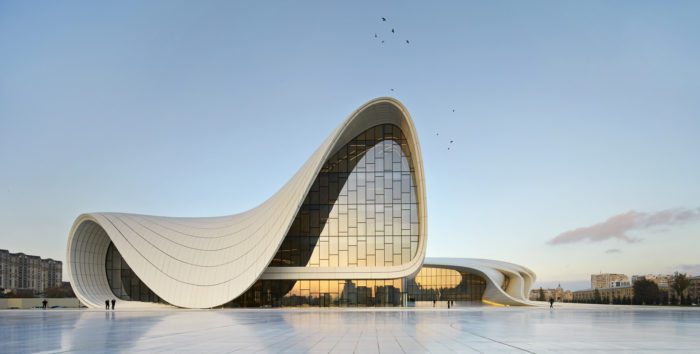
©Hufton+Crow
Zaha Hadid didn’t design a building here so much as a manifesto in reinforced concrete and GFRP. Opened in 2012, the Heydar Aliyev Center lifts out of the surrounding plaza as one continuous surface that refuses to admit a single sharp corner, and won Design of the Year in 2014.
The structure flows: the ground becomes wall, the wall becomes roof, and no junction announces itself. White curves guide you through spaces that feel simultaneously intimate and endless. Breton’s idea of merging dream with reality rarely got built at this scale — or this convincingly. See more from Zaha Hadid Architects.
7. Dream Within Dream | Wutopia Lab, China
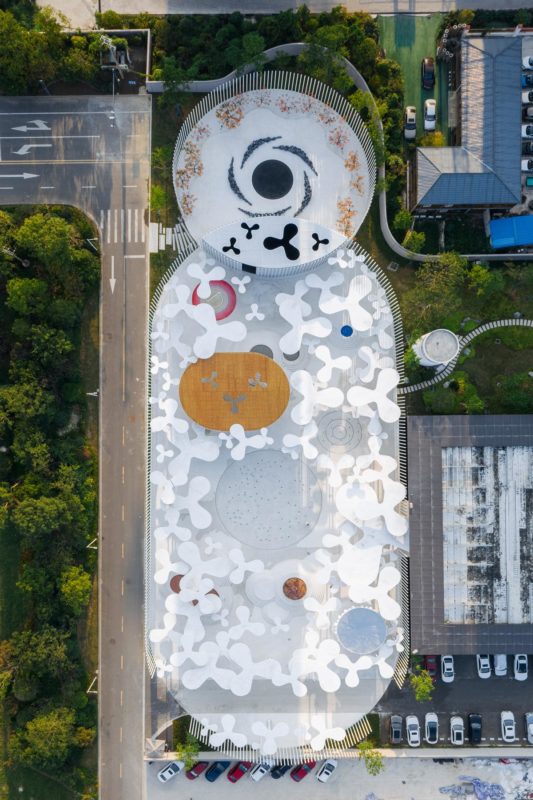
©CreatAR Images
Wutopia Lab founder Yu Ting took a recurring dream his daughter described — a forest — and built it. The scheme assembles an abstract woodland from 108 white steel structures of varying heights, then threads a complete miniature landscape through it: caves, hillsides, waterways, rocks, peaks, waterfalls and small theatres.
The whole thing exists inside a dreamscape rather than a site. The white steel “trees” throw dappled shadows that move through the day, so spaces appear and vanish as you walk. It is surrealist architecture at its most personal — one person’s dream rebuilt at 1:1 so that everyone else can walk through it.
8. Las Pozas | Edward James, Xilitla, Mexico
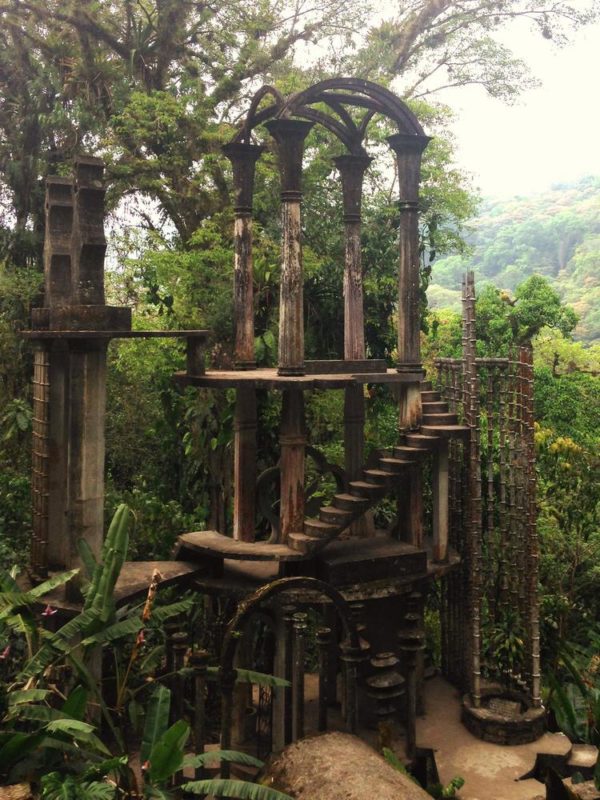
©Victor Delaqua
Edward James, the English poet and patron who bankrolled much of Dalí’s and Magritte’s output, eventually stopped collecting surrealism and started pouring it. From the late 1940s until his death in 1984 he built Las Pozas on a former coffee plantation in the Mexican cloud forest: dozens of concrete structures scattered across roughly 80 acres of waterfalls and jungle.
Bridges stop in mid-air. Staircases spiral upward and simply end. Pavilions have floors at incompatible levels and doors that open onto foliage. Nothing is organised by function, ornament or narrative — the place exists to be wandered through and got lost in, which is precisely the point.
9. TWA Flight Center | Eero Saarinen, New York, USA
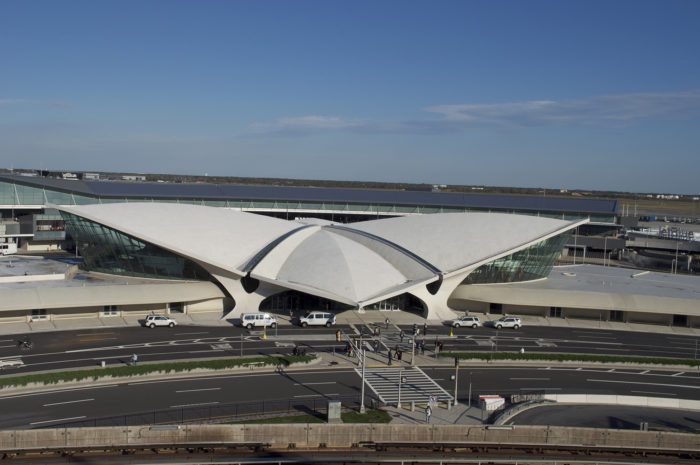
©Kai Brinker
Saarinen’s TWA terminal proves surrealism can hide in plain sight. On paper it is a functional airport building, opened at Idlewild in 1962 — a year after Saarinen’s death. In practice, the four thin-shell concrete vaults read as wings caught mid-beat, and the interior flows in curves that make stairs, balustrades and information desks feel like parts of a single organism.
It understands that a terminal is not merely somewhere to catch a plane but a threshold between ground and sky, ordinary and possible. Saarinen built that liminal moment in concrete and glass; since 2019 the head house has flown again as the TWA Hotel, which means you can now sleep inside it.
For more mid-century optimism made structural, see 7 recognizable Googie buildings in Los Angeles.
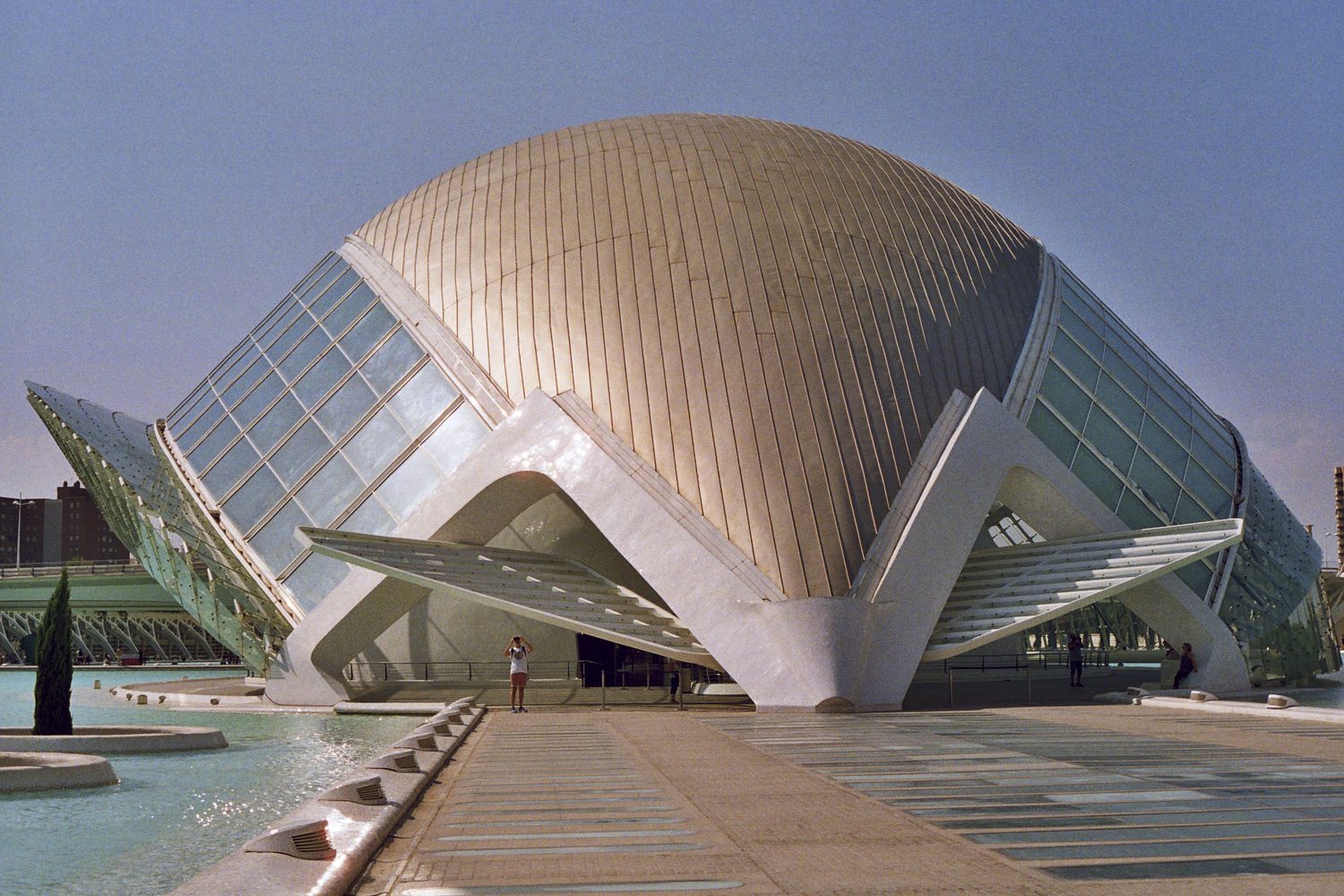
10. City of Arts and Sciences | Santiago Calatrava, Valencia, Spain
©Anthony Saroufim
Santiago Calatrava took roughly 350,000 square metres of the drained Turia riverbed and turned it into a science-fiction set. Built out in stages from the late 1990s — with Félix Candela collaborating on the L’Oceanogràfic shells — the City of Arts and Sciences reads like a fleet of skeletal vessels beached beside a historic city.
White concrete, steel ribs and broken-tile trencadís cladding — a direct nod to Gaudí — produce surfaces that shift constantly in the Mediterranean light, and shallow reflecting pools double every form so the complex appears to float. Calatrava’s proof is scale: surrealism can be delivered at the size of a district and still feel uncanny rather than merely large.
Planning a trip around buildings like these? Start with the architecture tourist’s manifesto.
Why Surrealist Architecture Matters More Than Ever
In a landscape of copy-paste development and sterile glass towers, surrealist architecture is a reminder that buildings are allowed to be strange. It refuses the assumption that architecture must be sober and rational to be taken seriously, and it keeps producing the spaces people actually remember.
The point was never odd shapes. It is experience — architecture that leaves you curious and slightly off balance, that makes children point and adults slow down. As parametric design, digital fabrication and new composites close the gap between the sketch and the built thing, yesterday’s impossible drawings are becoming this decade’s construction documents.
And in an era when every building can be seen on a screen before you visit it, surrealism still delivers the one thing a photograph can’t: the moment of genuine surprise when the thing in front of you refuses to behave.
Can surrealist architecture be functional?
Yes. The TWA Flight Center operated as a working airport terminal and is now a hotel; the Heydar Aliyev Center hosts concerts and exhibitions; the Sharp Centre is a functioning design school. Surrealist architecture doesn’t sacrifice function — it makes the experience of that function memorable.
Where can you see surrealist architecture?
Several of the examples here are open to visitors: Las Pozas in Xilitla, Reading Between the Lines in Borgloon, the City of Arts and Sciences in Valencia, the Heydar Aliyev Center in Baku, and the TWA Hotel at JFK. The Miami Museum Garage can be seen from the street in the Design District.
Key takeaways: surrealist architecture descends from Breton’s 1924 manifesto and treats dream logic as a design method — biomorphic form, impossible geometry, dissolving mass. Its landmark works run from Edward James’s jungle follies at Las Pozas to Zaha Hadid’s Heydar Aliyev Center and Calatrava’s City of Arts and Sciences. It is not anti-functional; it simply insists that a building move you before it serves you.

Ruba Ahmed, a senior project editor at Arch2O and an Alexandria University graduate, has reviewed hundreds of architectural projects with precision and insight. Specializing in architecture and urban design, she excels in project curation, topic selection, and interdepartmental collaboration. Her dedication and expertise make her a pivotal asset to Arch2O.