

Ten of the most memorable names of fictional cities and settlements in film and fiction are Orbit City, the Emerald City, Kingsbury, Hogsmeade, Rivendell, Atlantis, Shangri-La, Tomorrowland, Asgard and Cloud City. This guide is for architecture students and designers who use invented places as precedents: for each city we note the work it comes from, the real architecture or landscape behind it where that is documented, and what makes it easy to picture. A short analysis at the end reads all ten through Kevin Lynch’s five elements of the city image.
Many readers arrive looking for names of fictional cities for a story or a design studio brief. A good invented city is more than a name: it needs a clear edge, a few landmarks and districts that feel different from one another. The settings below show how film-makers and novelists achieve that.
Ten fictional cities and the architecture behind them
Some imaginary cities are places we are glad to keep imaginary. Wonderland, with no reliable laws of physics, would be a hard place to live. The ten below are the opposite: settings that readers and audiences have wished were real, listed with the source work so you can study them properly.
1. Orbit City, The Jetsons
Orbit City is the home of the family in The Jetsons, the Hanna-Barbera cartoon first broadcast in 1962. Its buildings sit on tall single columns high above the ground, and George Jetson commutes by a flying car that folds into a briefcase. The look borrows directly from the Googie architectural style of post-war Southern California: saucer roofs, boomerang shapes and bright colours inspired by car culture and the space age.

Photo by Warner Bros./Courtesy of Getty Images.
The closest built relative is the Theme Building at Los Angeles International Airport, completed in 1961 by a team led by Pereira & Luckman with Paul R. Williams and Welton Becket: a saucer-like restaurant raised on four arched legs, exactly the kind of structure Orbit City multiplies into a skyline.
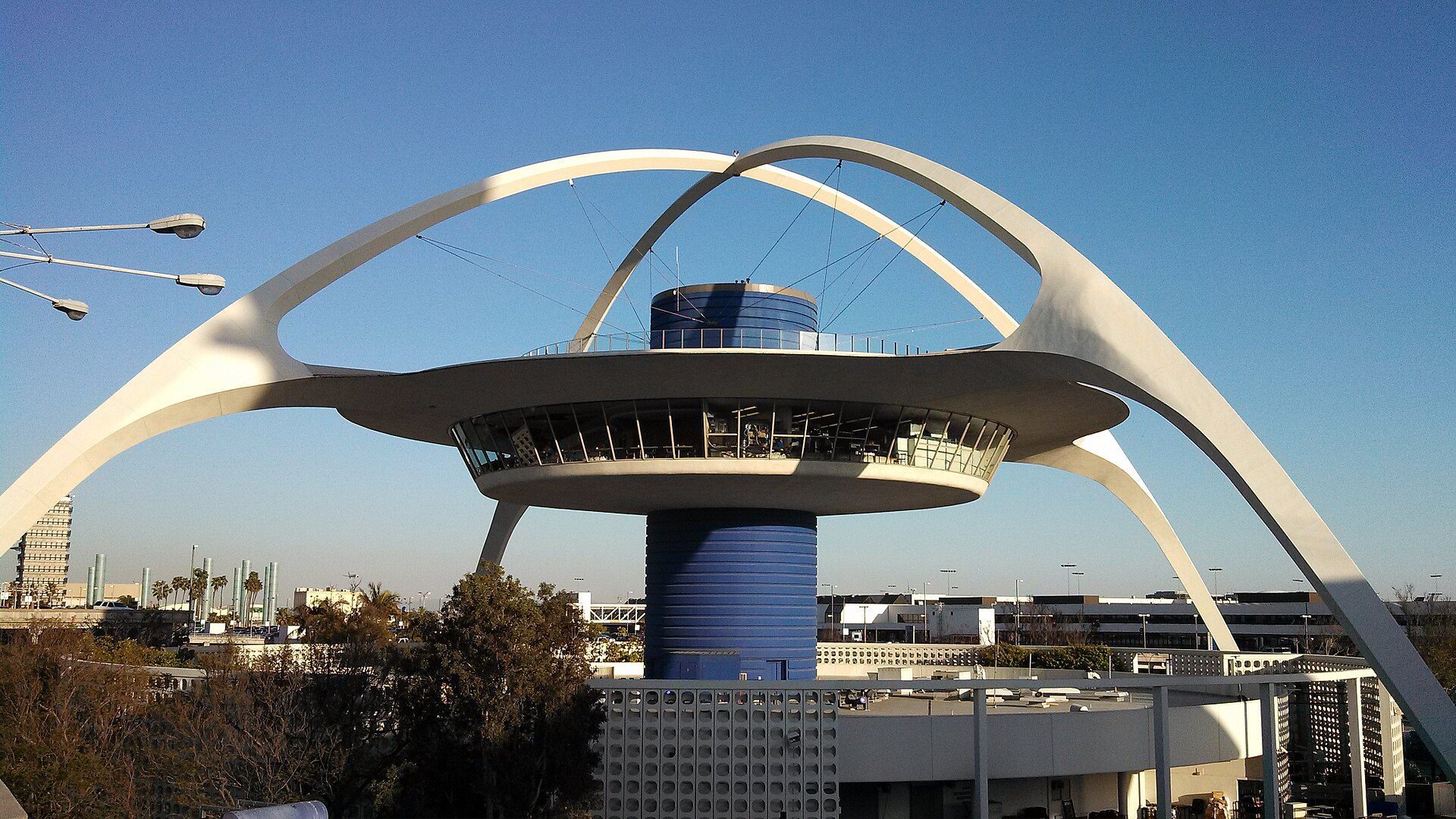
The Theme Building at Los Angeles International Airport (1961), a Googie landmark close in spirit to Orbit City. Photo: brewbooks, CC BY-SA 2.0, via Wikimedia Commons. brewbooks from near Seattle, USA, source, CC BY-SA 2.0
2. The Emerald City, The Wizard of Oz
The Emerald City comes from L. Frank Baum’s 1900 novel The Wonderful Wizard of Oz, made famous by the 1939 MGM film in which Dorothy, the Scarecrow, the Tin Woodman and the Cowardly Lion follow the yellow brick road to meet the Wizard. In the book the city’s overwhelming greenness is partly a trick: visitors are made to wear green-tinted spectacles. That illusion does not make the city any less memorable; a single colour and a single approach road give it one of the strongest identities in fiction.
Also Read: How Visions of Futuristic Architecture Have Transformed in 100 Years

©Diamond Art Club
3. Kingsbury, Howl’s Moving Castle
Kingsbury is the capital of Ingary, the kingdom of Diana Wynne Jones’s 1986 novel Howl’s Moving Castle, a land where, in the book’s words, “seven-league boots and cloaks of invisibility really exist”. In Hayao Miyazaki’s 2004 Studio Ghibli film the city becomes a wealthy capital of ornate, gold-topped buildings, and the hero’s moving castle may appear at any moment.

©Ghibli Wiki-Fandom
The film’s small-town streets are widely reported to draw on Colmar and Riquewihr in Alsace, which the Ghibli team visited while preparing the film: half-timbered houses, steep roofs and canals such as Colmar’s Petite Venise.
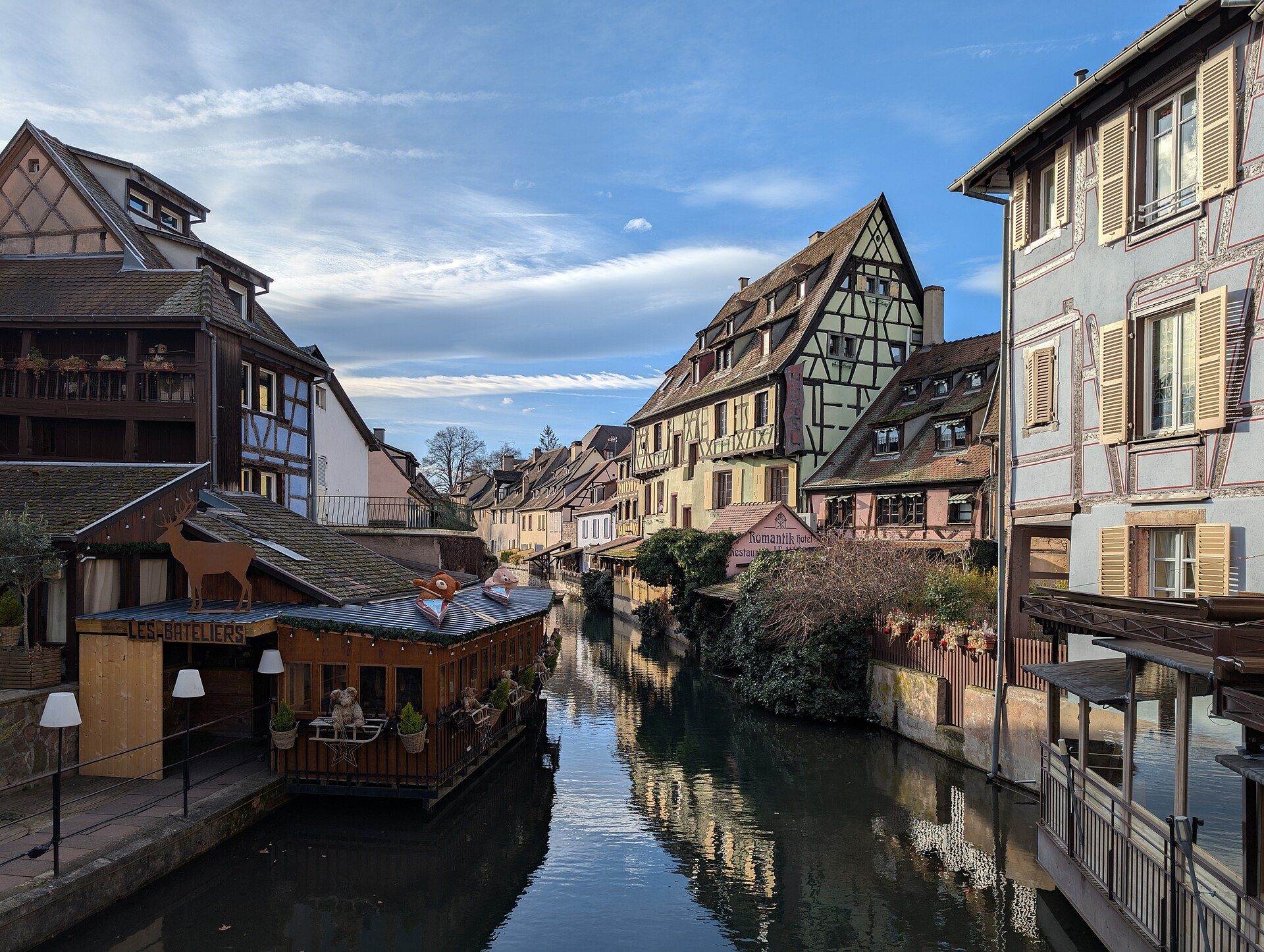
Half-timbered houses along the canal in Colmar's Petite Venise, Alsace, one of the towns reported as a reference for Howl's Moving Castle. Photo: Gzen92, CC BY-SA 4.0, via Wikimedia Commons. Gzen92, source, CC BY-SA 4.0
4. Hogsmeade, Harry Potter
Hogsmeade is a village rather than a city, but in J.K. Rowling’s books it is described as the only all-wizarding village in Britain. It has cottages, shops and pubs such as Honeydukes and Zonko’s Joke Shop, and the Shrieking Shack, said to be haunted. Hogwarts students arrive at Hogsmeade station; first-years cross the lake to the castle by boat, while older students take the road in carriages.

©Potterandmore.com
5. Rivendell, The Lord of the Rings
Rivendell, “the Last Homely House East of the Sea”, is the Elven refuge of J.R.R. Tolkien’s Middle-earth, hidden in a narrow valley in the foothills of the Misty Mountains. Peter Jackson’s films show it as slender pavilions and bridges among waterfalls, with flowing, nature-inspired ornament that many viewers read as a version of Art Nouveau.

© J.S. Clingman, The One Wiki To Rule Them All-Fandom
The valley itself has a real source. In a 1967 letter to his son Michael, Tolkien wrote that Bilbo’s journey from Rivendell over the Misty Mountains was based on his own walking trip in Switzerland in 1911. That trip took him into the Lauterbrunnen valley, which is widely cited as the model for Rivendell’s steep walls and waterfalls, although Tolkien did not name the valley in that letter.
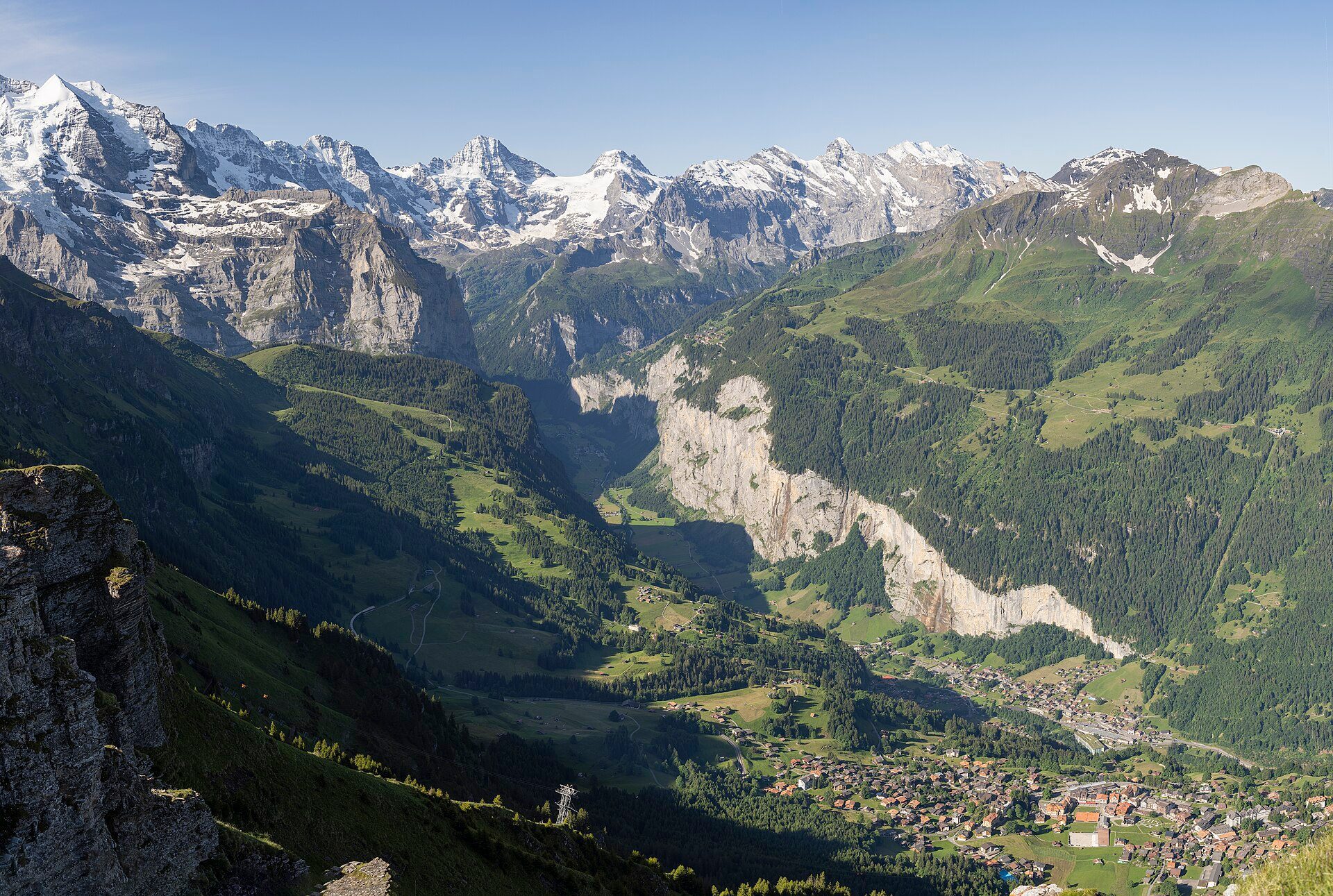
The Lauterbrunnen valley in the Bernese Oberland, widely cited as the model for Rivendell. Photo: Chensiyuan, CC BY-SA 4.0, via Wikimedia Commons. Chensiyuan, source, CC BY-SA 4.0
6. Atlantis, Atlantis: The Lost Empire
Atlantis first appears in Plato’s dialogues Timaeus and Critias, written in the fourth century BC, as a powerful island state that sank into the sea. Plato describes it as a city of concentric rings of land and water, which is why so many reconstructions draw it as a circular plan. Most historians treat it as a philosophical story rather than a lost real place, as the summary of the scholarship explains.

©Disney Wiki-Fandom
Disney’s 2001 animated film Atlantis: The Lost Empire follows Milo Thatch, a linguist and cartographer, to a city kept alive below the sea by a powerful crystal. The film gives Atlantis a stylised ancient look; other illustrators picture it as a classical Greek city in the manner of the Acropolis, and others again as a technologically advanced metropolis. That openness is part of its appeal: Plato’s text fixes the plan but leaves the buildings to the imagination.

©Disney Plus
7. Shangri-La, Lost Horizon
Shangri-La is the hidden valley and lamasery of James Hilton’s 1933 novel Lost Horizon, set high in the mountains of Tibet. Cut off from the outside world, its people live calm lives of unusual length, which made the name a byword for an earthly paradise. The idea is often linked to Shambhala, the hidden kingdom of Tibetan Buddhist tradition. Shangri-La returns in later works, including the 2004 film Sky Captain and the World of Tomorrow.

©The Miller, Sky Captain And The World of Tomorrow Wiki
8. Tomorrowland, Tomorrowland (2015)
The city in Disney’s 2015 film Tomorrowland, directed by Brad Bird, looks like the future but exists in another dimension. It was founded as a place where scientists, artists and inventors could work free of politics and bureaucracy. Its skyline is a cluster of pale, curving towers with green terraces, linked by elevated transit loops, around a multi-level water park, and the whole city seems to float on water.

©Carlos Laya
9. Asgard, Thor (2011)
Asgard is the home of the gods in Norse mythology. Marvel’s Thor films picture it as a realm floating in space, with gleaming towers, carved-rock buildings and tall spires gathered around Odin’s palace, whose vertical golden fins resemble giant organ pipes. Artists have drawn Asgard in many ways from the old Norse sources, but the film version is now the one most people recognise.

©Marvel Movies-Fandom
10. Cloud City, Star Wars
Cloud City floats high in the atmosphere of the gas planet Bespin and first appeared in The Empire Strikes Back (1980). The Star Wars galaxy has other famous settlements, from the planet-wide capital Coruscant to the underwater Gungan city of Otoh Gunga, but Cloud City is the one most viewers would like to visit. It is a mining colony for Tibanna gas that tries to stay independent and out of the Empire’s sight. Its upper levels hold a tourist district of hotels and casinos; below them are housing, offices, industrial areas, refineries and finally the engines that keep it aloft.

©Wookieepedia-Fandom
Why these names of fictional cities stay in the memory: a design reading
Why do some invented places stick while others fade? The urban designer Kevin Lynch offers a useful test. In The Image of the City (MIT Press, 1960), based on studies of Boston, Jersey City and Los Angeles, he argued that people build mental maps of a city from five kinds of element: paths, edges, districts, nodes and landmarks. He called a city’s capacity to produce a clear mental image its “imageability”.
Applied to the ten settings, the test shows a pattern. Each relies on one or two very strong elements rather than on detail everywhere. The Emerald City is almost pure path and landmark: one road, one green destination. Cloud City and Orbit City are defined by an edge, the drop into the sky below. Rivendell is defined by a valley, and Atlantis by Plato’s concentric rings. The table below sets this out for all ten names of fictional cities on our list; it is our own reading, not a published classification.
| City | Source work (first appearance) | Real place or style behind it | Strongest Lynch element |
|---|---|---|---|
| Orbit City | The Jetsons (1962) | Googie architecture, Southern California | Edge (city raised above the ground) |
| Emerald City | The Wonderful Wizard of Oz (1900) | None documented | Path and landmark (yellow brick road to a green city) |
| Kingsbury | Howl's Moving Castle (novel 1986; film 2004) | Colmar and Riquewihr, Alsace (reported for the film) | District (gold-topped royal quarter) |
| Hogsmeade | Harry Potter books (from 1999) | None documented | Node (station and high street) |
| Rivendell | The Hobbit (1937) | Lauterbrunnen valley, Switzerland (widely cited) | Edge (narrow valley walls) |
| Atlantis | Plato, Timaeus and Critias (4th century BC) | None; Plato's own invention in most scholars' view | Edge (concentric rings of land and water) |
| Shangri-La | Lost Horizon (1933) | Linked to the Shambhala tradition | Edge (isolated mountain valley) |
| Tomorrowland | Tomorrowland (2015 film) | None documented | Path (elevated transit loops) |
| Asgard | Norse mythology; Marvel's Thor (2011) | Norse sources | Landmark (Odin's palace) |
| Cloud City | The Empire Strikes Back (1980) | None documented | Edge (floating platform above the clouds) |
Source: Kevin Lynch, The Image of the City (MIT Press, 1960) for the five elements; source works as cited in the article; element assignment is Arch2O's own reading (as of 24 October 2026).
Using fictional cities as precedents in design studios
Students often use fictional settings to start a concept, and the list above suggests three practical lessons that go beyond collecting names of fictional cities:
- Start from one dominant element. A single strong edge, path or landmark makes a place legible faster than many weak ones. Test a concept by asking which of Lynch’s five elements a visitor would remember first.
- Look for the real source. Many convincing settings borrow from real places: Googie roadside buildings for Orbit City, Alsatian towns for Kingsbury, an Alpine valley for Rivendell. Studying the real precedent gives you measurable proportions that a film still cannot.
- Section before skyline. Cloud City is described as a stack of uses from casinos to engines. Drawing a vertical section of an invented city forces decisions on servicing and circulation that a perspective hides.
For real-world comparisons of scale, see our overview of the largest city in the world and these views of fifty cities seen from above, which show how real edges, districts and landmarks read at a glance.
Conclusion
Stories in film, television and novels give us places we can never visit, and that is part of their charm. Whether you need names of fictional cities for a story or precedents for a studio project, the strongest of them share the same lesson: a clear edge, a memorable route and one unforgettable landmark. So, which of these ten would you choose to live in, or to visit on your next holiday?

Sources and further reading
- Kevin Lynch, The Image of the City, MIT Press, 1960 (summary).
- L. Frank Baum, The Wonderful Wizard of Oz, 1900 (Project Gutenberg text).
- J.R.R. Tolkien, letter to Michael Tolkien, 1967 (Tolkien Estate).
- Theme Building, Los Angeles International Airport (overview).

Yosra is an architect, writer, and teacher. She is always into learning something new. Her life motto is: "A jack of all trades is a master of none, but oftentimes better than a master of one.” One day she will travel the world and visit its architectural wonders. In the meanwhile, she contends herself with reading and writing about them.