

Here is how Blade Runner 2049 was filmed using an LA replica: much of the ruined Los Angeles seen in the 2017 film was not computer-generated from scratch but built as large physical models by Wētā Workshop in Wellington, New Zealand, then photographed in layers and combined with digital effects. According to Wētā Workshop’s project page, the team built three miniature environments: a Los Angeles cityscape around an LAPD tower, parts of the Trash Mesa, and the pyramid-shaped Wallace towers. This article explains what was built, how it was shot, and what architects and model-makers can learn from it.
What Wētā built: the replica city
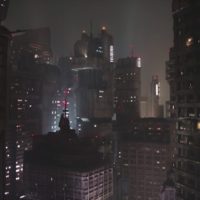
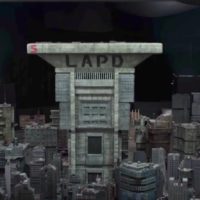
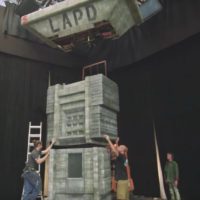
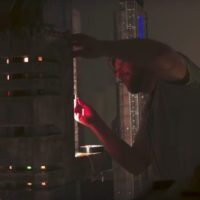
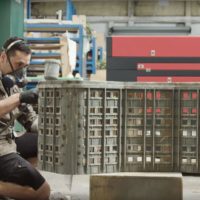
Wētā’s account describes 38-odd structures in total. The largest was the LAPD building, a model 4.5 m (about 15 ft) tall, built at Wētā’s Miramar Peninsula facility and moved to the stage in three pieces. The pyramid-shaped Wallace towers were built around steel frames and were heavy enough that they could only be moved by crane. The Trash Mesa, a vast ruin on the edge of the city, was built at 1:87 scale and assembled on a stage at Avalon Studios in Lower Hutt, where it nearly filled the floor. Shooting of the miniatures began in October 2016, while the main production filmed in Hungary.
Large models like these are sometimes nicknamed “bigatures” in the film industry, because they are miniatures only in scale; physically, many are taller than the people building them. Like the miniature bird palaces of Ottoman Istanbul, they show how much architectural detail can be packed into a small building.

Courtesy of Weta Workshop Design Studio
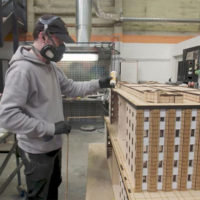
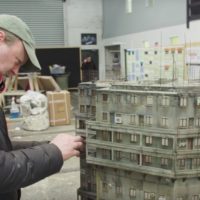
The buildings around the LAPD tower were finished by hand. The Motion Picture Association’s feature on the film reports that each of these buildings took about a week to make, including painting, staining and weathering. The miniatures art director, Steven Saunders, described a miniature as a composition of “tiny little vignettes, tiny little stories, tiny little places”, all of which have to work together for the whole model to read as a city.

Courtesy of Weta Workshop Design Studio
The same MPA feature says the Wallace tower was built at 1:600 scale, which would make the real building more than two miles (about 3.2 km) tall. The exact real-world height of the fictional tower is not stated consistently in published sources, so treat it as approximate.
How the miniatures were filmed
The miniatures were photographed by Wētā’s own film unit, directed by special-effects photographer Alex Funke, who had shot miniatures for The Lord of the Rings. (The film’s main director of photography was Roger Deakins.) Funke has pointed out that a miniature behaves like any real set: real lights fall on real surfaces, with the same reflections and the same problems to solve.
Wētā describes three techniques that made the replica convincing:
- Multiple passes: each miniature was filmed several times with different lighting and practical effects, such as smoke and haze, so that every element could be controlled separately.
- Layered shots: Funke described the result as “a huge and very complicated sandwich” of layers, which the visual-effects team then combined into the finished shot.
- Digital additions: the visual-effects supervisor John Nelson and producer Karen Murphy received the shots in Budapest, where digital elements such as the flying Spinner cars were added. The film won the Academy Award for Best Visual Effects in 2018.
Construction mixed precise 3D modelling and laser-cutting with traditional model-making craft, according to Wētā. That combination, digital accuracy for the structure and hand finishing for surface and age, is the same one used in many architectural model workshops today.
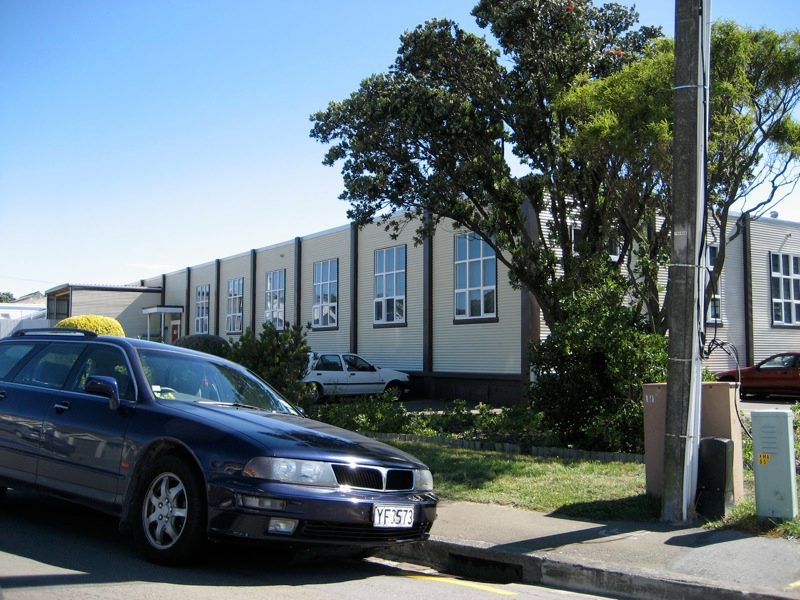
One of the Wētā Workshop buildings in Miramar, Wellington, New Zealand. Photo: Duane Weller, CC BY 2.0, via Wikimedia Commons. Duane Weller, source, CC BY 2.0
Scale explained: a worked example
Scale is the key idea behind how Blade Runner 2049 was filmed using an LA replica, and behind any physical model.A scale of 1:600 means 1 unit on the model equals 600 units in reality. The table below converts the scales mentioned in published accounts of the film into model-to-reality lengths. It is Arch2O’s own calculation, using simple multiplication, so you can check any figure yourself.
| Scale | 1 cm on the model equals | 1 m on the model equals | Example |
|---|---|---|---|
| 1:87 | 87 cm | 87 m | Trash Mesa (scale per Wētā Workshop) |
| 1:600 | 6 m | 600 m | Wallace tower (scale per MPA); a 3.2 km tower would be a model about 5.4 m tall |
| 1:48 (comparison only) | 48 cm | 48 m | Common architectural model scale (1/4 in = 1 ft). The 4.5 m LAPD model would represent a 216 m tower at this scale; Wētā does not publish the LAPD model's scale |
Source: Arch2O calculation; scales from Wētā Workshop project page and MPA feature (Nov 2017) (as of 2026-11-01).
Two lessons follow. First, a smaller scale ratio (1:87) allows much more surface detail per real metre than a large one (1:600), which is why the Trash Mesa could show individual debris while the Wallace tower relied on its silhouette and lighting. Second, the camera has to match the scale: lenses, camera height and even the speed of smoke and dust must be scaled for the model to look full-size on screen.
What architects and model-makers can learn
- Composition over completeness: Saunders’s “tiny vignettes” idea applies to presentation models. A model reads as real when small, local stories (signs, wear, clutter) are placed where the eye lands, not spread evenly everywhere.
- Weathering sells scale: a week of hand finishing per building shows how much of the realism comes from surface age rather than geometry.
- Light is part of the model: filming in passes is a reminder to test a model under the lighting it will be photographed in. Arch2O’s guide to architectural photography of patterns shows how strongly light shapes what a camera records.
- Digital and physical together: laser-cut accuracy plus hand craft is a workflow any studio with a laser cutter can use.
For more films where architecture and set design play a central role, see Arch2O’s list of architecture movies every architect should watch.
-
- Courtesy of Weta Workshop Design Studio
-
- Courtesy of Weta Workshop Design Studio
-
- Courtesy of Weta Workshop Design Studio
-
- Courtesy of Weta Workshop Design Studio
-
- Courtesy of Weta Workshop Design Studio
-
- Courtesy of Weta Workshop Design Studio
-
- Courtesy of Weta Workshop Design Studio
Sources and further reading
The main sources are Wētā Workshop’s own project page, the Motion Picture Association feature “How Blade Runner 2049 Used Miniatures to Build the Future” (November 2017) and ArchDaily’s report on the model world. Together they give the clearest picture of how Blade Runner 2049 was filmed using an LA replica: a physical city, built by hand and machine, then photographed layer by layer.

Jane Doe is an American architectural editor with a deep-rooted passion for design and the built environment. She holds a degree in Architecture from Columbia University, where she developed a strong foundation in both architectural theory and urban studies. With over a decade of editorial experience, Jane specializes in shaping content that bridges architecture, urbanism, and cultural discourse. Her work spans leading design publications, exhibition texts, and digital platforms, where she is known for her clear, engaging narratives and her ability to translate complex spatial ideas for a broad audience. Jane is particularly interested in issues of equity, sustainability, and the evolving role of cities in a changing world.