

How long would it take to climb the world’s tallest skyscrapers?
At a steady pace of about 20 seconds per floor, with no long rests, climbing all 163 floors of Burj Khalifa, the tallest of the world’s tallest skyscrapers, would take roughly 54 minutes, and most of the other top-ten towers would take 32-43 minutes. Real times vary hugely: trained tower runners are far quicker, and most people would need rests. This article keeps our original elevators-versus-stairs infographic and adds a dated, sourced table of the ten tallest completed buildings with an estimated climbing time for each, explaining exactly how the estimate was made.
Method: data source, criteria and as-of date
- Buildings: the ten tallest completed buildings by height to architectural top, as listed on Wikipedia’s list of tallest buildings (which follows the Council on Tall Buildings and Urban Habitat criteria), read on 4 November 2026. Buildings under construction, such as the Jeddah Tower, are excluded.
- Floors: above-ground floor counts from the same list.
- Climbing time: an assumption, not a measurement: floors x 20 seconds, a steady pace for a fit adult. Floor heights, stair layouts and public access differ, and many towers do not allow stair climbs except during organised events.
Ranked table: the world’s tallest skyscrapers and estimated climbing times
| Rank | Building | City | Height (m) | Floors above ground | Completed | Estimated climb at 20 s/floor |
|---|---|---|---|---|---|---|
| 1 | Burj Khalifa | Dubai | 828 | 163 | 2010 | about 54 min |
| 2 | Merdeka 118 | Kuala Lumpur | 678.9 | 118 | 2024 | about 39 min |
| 3 | Shanghai Tower | Shanghai | 632 | 128 | 2015 | about 43 min |
| 4 | Makkah Royal Clock Tower | Mecca | 601 | 120 | 2012 | about 40 min |
| 5 | Ping An Finance Centre | Shenzhen | 599.1 | 115 | 2017 | about 38 min |
| 6 | Lotte World Tower | Seoul | 554.5 | 123 | 2017 | about 41 min |
| 7 | One World Trade Center | New York | 541.3 | 104 | 2014 | about 35 min |
| 8 | Guangzhou CTF Finance Centre | Guangzhou | 530 | 111 | 2016 | about 37 min |
| 9 | Tianjin CTF Finance Centre | Tianjin | 530 | 97 | 2019 | about 32 min |
| 10 | CITIC Tower | Beijing | 527.7 | 109 | 2018 | about 36 min |
Source: Heights, floors and years: Wikipedia List of tallest buildings (CTBUH criteria), read 4 Nov 2026; climb times are an Arch2O estimate (floors x 20 s) (as of 4 November 2026).
The estimates show why tall buildings depend on lifts: even at a steady pace, reaching the top of a supertall tower by stair takes the best part of an hour. In practice, stair cores in such towers are designed for emergency evacuation downwards, with refuge floors and pressurised stairs, not for daily climbing.
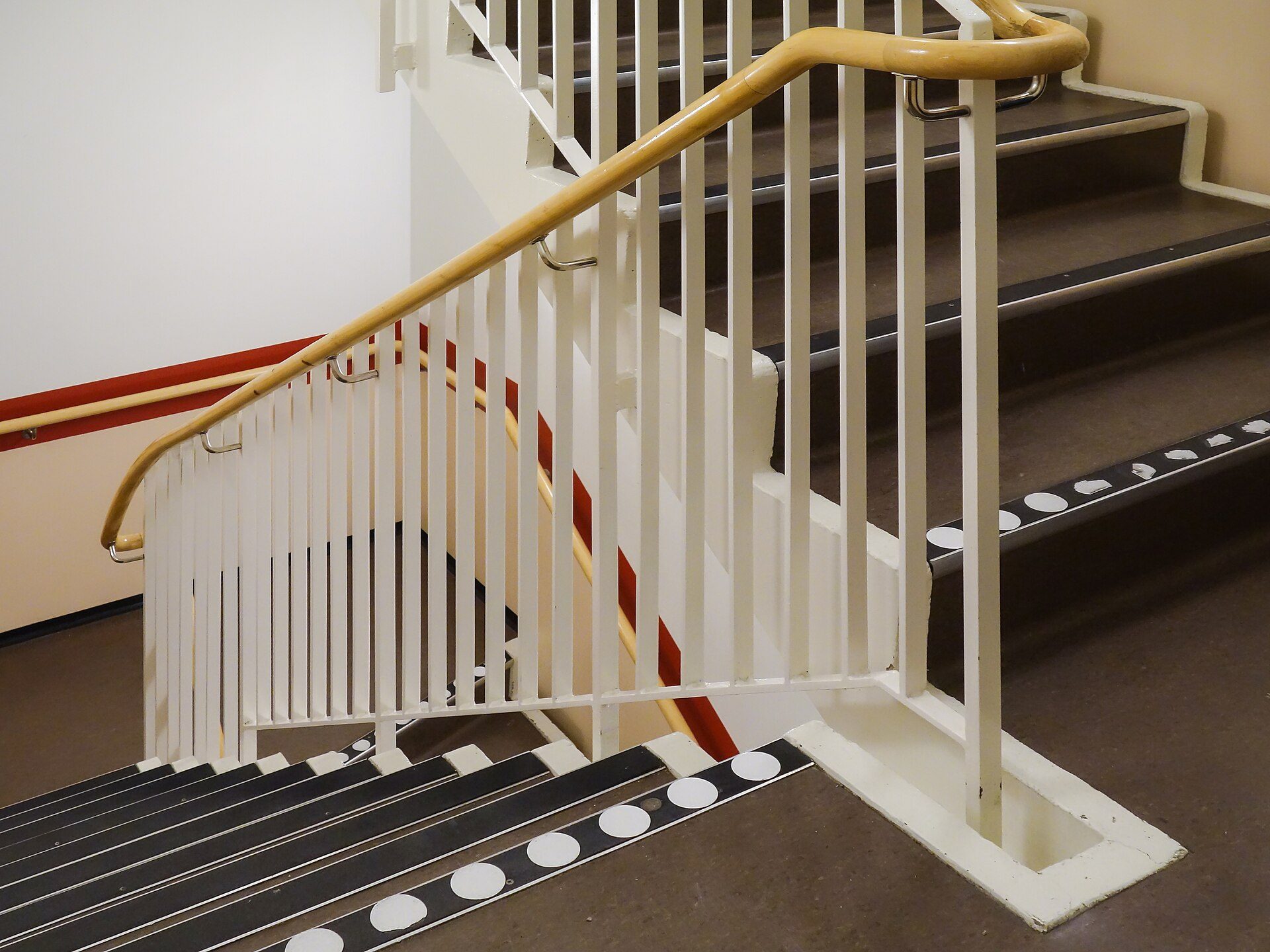
A hospital stairwell in Trollhättan, Sweden: stair cores in tall buildings are designed mainly for evacuation, not daily climbing. Photo: W.carter, CC0, via Wikimedia Commons. Image: W.carter (Creative Commons Zero)
The architect’s long-living dream has always been to beat gravity. Numerous construction techniques and technologies have been devised throughout history to deem this possible. Architects were always keen on trying out all the latest in the field in order to achieve their ultimate visions, and though they have not entirely beaten gravity, they have come close enough. Soaring skyscrapers, with unprecedented heights, are shaping the skylines of world cities.
With the current tallest building, Burj Khalifa, reaching a total height of 828 m, and the Jeddah Tower, now under construction again and aiming to pass 1,000 m, with completion reported for late 2028, we can confidently say “we’ve gone far”. However, to build such heights you need to find a convenient method to get to their top, and the most practical one we have come upon, till now, is using elevators.
The idea of the “elevator” may date back to ancient Rome and Vitruvius, but elevators, as we know them, were invented by American industrialist Elisha Otis in 1852. Ever since then, elevators have been a subject of development and innovation that go in parallel with the continuously rising heights of buildings.
The latest elevators aim at being faster, to take on the massive heights in the shortest time possible, while keeping their passengers safe and comfortable. One of the world’s fastest elevators, developed by Hitachi, is in the CTF Finance Centre in Guangzhou, China. It can get to the tower’s 95th floor in 58 seconds.
Now, imagine the electricity is cut off; there are no generators, or there are no elevators at all. How would you get up there? How could you reach the 95th floor? When we face such problems with low-rise buildings, we just take the stairs, but can you imagine taking the stairs to the 95th floor? Assuming you can survive the trip up there, how long would it take you? The infographic below, by Nationwide Lifts, compares elevators and stairs; note that its figures date from when it was first published, while the table above gives current heights.
Skyscrapers Infographic: Elevators vs Stairs


Infographic
Find out how long it would take you to get to the top floors of the world’s tallest skyscrapers if you take the stairs and be grateful to elevators, Mr. Otis, and fellow mechanical and electrical engineers.
Sources and further reading
- List of tallest buildings (heights, floors and completion years, read 4 November 2026).
- CTBUH Skyscraper Center, the reference database for tall-building heights.
- Gulf Business on the Jeddah Tower’s late-2028 target (October 2026).
- More on the world’s 27 highest buildings.
Decision summary: heights change as new towers complete, so always check the as-of date of any ranking. Next step: if you want to try a stair climb, look for an organised tower-running event, where stairs are open and safety is managed.
This article is part of our guide to the tallest buildings in the world.

Yosra is an architect, writer, and teacher. She is always into learning something new. Her life motto is: "A jack of all trades is a master of none, but oftentimes better than a master of one.” One day she will travel the world and visit its architectural wonders. In the meanwhile, she contends herself with reading and writing about them.