

Buildings with glass facades often use fritted glass to control light, heat and privacy: glass printed with a pattern of ceramic enamel (dots, lines or images) that is fused into the surface when the glass is toughened. The frit pattern reduces glare and solar heat gain, adds privacy and colour, and, when spaced correctly, helps prevent birds from flying into the glass. This guide, for architects and students, explains how fritted glass works and what to specify, sets out its properties in a table, and shows seven well-known buildings with fritted glass facades, from a Chinese library to MVRDV’s Glass Farm.
A façade says a lot about a building: what the architect wants to express and what happens inside. Among the many façade cladding materials, fritted glass lets designers keep the transparency of glass while controlling how much light, heat and view passes through. Ancient Egyptian and Mesopotamian craftsmen worked with frit, a ground glassy material used for beads and glazes, but printing ceramic frit onto large architectural glass panes is a modern technique that has become common in contemporary facades.
How fritted glass works
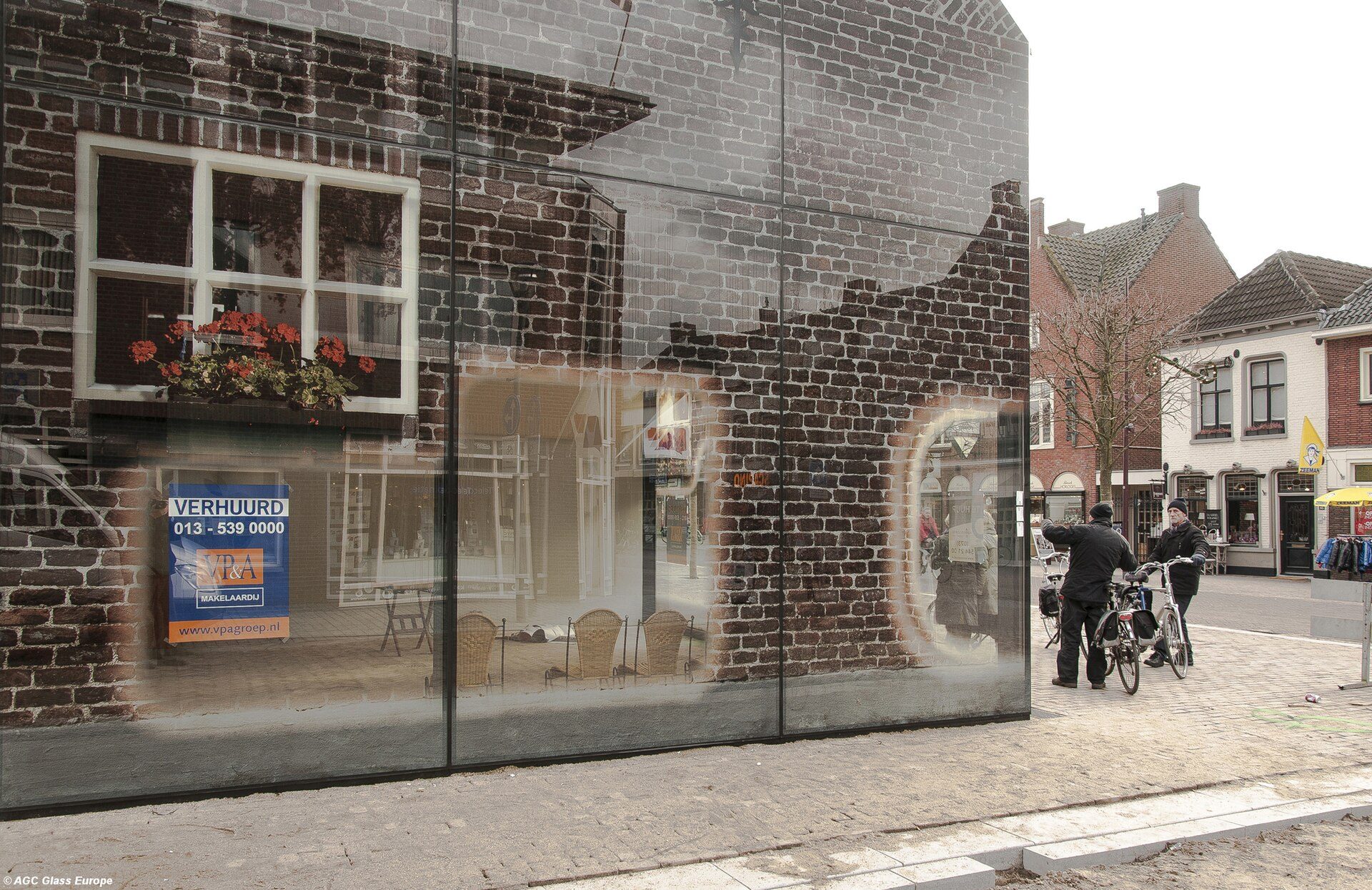
Close-up of the Glass Farm in Schijndel (MVRDV): a photographic image of a farmhouse printed onto the glass with ceramic frit. Photo: AGC Glass Europe, CC BY 2.0, via Wikimedia Commons. AGC Glass Europe, source, CC BY 2.0
Manufacturers apply ceramic enamel to float glass by screen printing, roller coating or digital printing, then heat the glass during tempering or heat strengthening, which fuses the enamel permanently into the surface. The pattern is defined by its colour and its coverage, usually between about 20% and 60% of the glass area for standard dot and line patterns. Higher coverage blocks more light and heat; the pattern can be combined with tinted or low-emissivity glass in an insulating unit to tune energy performance.
| Property | Typical range or effect | Design note |
|---|---|---|
| Process | Ceramic enamel printed or rolled on, fused during tempering or heat strengthening | Permanent, does not peel; glass is toughened or heat-strengthened |
| Coverage | Standard patterns about 20-60% of the area | Higher coverage = less light and solar heat |
| Solar heat gain | Reduced in proportion to coverage and colour | Combine with low-e/tinted glass in insulating units |
| Glare | Reduced, especially with darker frits | Light frits can appear bright from inside in some skies |
| Daylight colour | Unlike tinted glass, does not tint the light | Keeps true colours inside |
| Privacy and views | Partial screening; views remain between dots or lines | Use gradients where privacy varies with height |
| Bird safety | Visible patterns reduce collisions | Many US guides use the 2×4-inch rule; outer surface most effective |
Source: Pilkington, Viracon and Tecnoglass product information; Oldcastle and Syracuse Glass technical notes; Portland and University of Pennsylvania bird-safe guidelines (accessed 24 October 2026) (as of 24 October 2026).
Colour matters inside as well as outside: dark frits tend to reduce glare, while light frits and some patterns can look bright from inside under certain sky conditions, so test samples in the actual orientation. For buildings with glass facades, always take performance values, such as light transmittance and solar heat gain coefficient, from the specific product’s data sheet rather than from general rules.
7 buildings with glass facades made of fritted glass
Here are seven well-known buildings with fritted glass facades from around the world, and what the frit does for each.
1) Dazhou Public Library, Sichuan, China

Courtesy of China Southwest Architectural Design and Research Institute – Photography: ARCH-EXIST
Designed by China Southwest Architectural Design and Research Institute, the library’s reading room is wrapped in a double glass wall to control daylight. The outer layer is fritted and the inner layer frosted, softening the light for reading, and the double layer also helps to reduce noise.
Related: The beauty of contemporary architecture revealed through colourful facades
2) The Temple House, Chengdu, Sichuan, China

Courtesy of Make Architects – Photography: John Madden
The Temple House, a hotel in Chengdu owned by Swire Hotels and designed by Make Architects, opened in 2015. Its two wings face the city, while the facades around the inner courtyard use curtain walls of fritted glass, whose pattern softens views and reflects daylight into the courtyard.

Courtesy of Make Architects – Photography: John Madden
3) John and Frances Angelos Law Center, Baltimore, Maryland, USA

Courtesy of Behnisch Architekten + ASG – Photography: Brad Feinknopf
Designed by Behnisch Architekten with Ayers Saint Gross for the University of Baltimore, the law center has three distinct facades. The library façade is mainly fritted glass, which shades the interior from solar heat while keeping daylight and views.
Related: Introduce colours to your architectural facade using materials other than paint

Courtesy of Behnisch Architekten + ASG – Photography: Brad Feinknopf
4) Durham Performing Arts Center, North Carolina, USA
Designed by Szostak Design, the theatre’s main façade is a curtain wall of clear and fritted glass that reveals the activity of the foyers to the street, especially at night, while the frit moderates sun and glare.

Photography By Tom Arban
5) Glass Farm, Schijndel, Netherlands

Photography By MVRDV
For the market square of Schijndel, MVRDV designed a building in the shape of a traditional farmhouse. The photographer Frank van der Salm photographed the region’s historic farms, and a composite of these images was printed onto the glass façade using frit, a technique the architects compared to stained glass. The building houses shops, restaurants and other public uses.
Also read: 10 of the most iconic buildings of modern architecture
6) The Diana Center at Barnard College, New York, USA

photography by © Albert Vecerka/Esto
The student centre by Weiss/Manfredi has a façade of coloured glass panels combined with fritted glass. Changes in reflectivity and hue make the façade look different with the light and the weather.

photography by © Albert Vecerka/Esto
7) Bridge for Laboratory Sciences, Vassar College, Poughkeepsie, New York, USA

Courtesy of The American Architecture Awards
Designed by Ennead as part of Vassar’s Integrated Science Commons, the Bridge building spans a stream valley. One of its facades is a curtain wall of fritted glass, whose pattern makes the glass visible to birds and so reduces collisions.


Specifying fritted glass: a short checklist
If you are designing buildings with glass facades, these points help you specify frit well:
- Choose the pattern and coverage from solar, glare and view requirements, then check the product’s data sheet values.
- Decide which glass surface carries the frit: an outer surface is most effective for bird safety, an inner surface protects the enamel.
- For bird-friendly glazing, follow local guidance; many US guidelines use the “2×4 rule” (gaps no wider than 2 inches horizontally or 4 inches vertically).
- View full-size samples on site, inside and outside, in different light.
- Coordinate frit with low-e coatings and insulating units, and check the rules on safety glass and energy performance in your jurisdiction.
Sources and further reading
- Pilkington: screen-printed (fritted) glass product description
- City of Portland: bird-safe building guidance
- University of Pennsylvania: bird-friendly design guidelines (2021)
- BD+C: designing for the birds

Daniel Mercer is a Coffee Break section editor at Arch2O, currently based in Berlin, Germany. With a background in architectural history and design journalism, Daniel holds a Master’s degree from the University of Edinburgh, where he focused on modern architecture and urban theory. His editorial work blends academic depth with a strong grasp of contemporary design culture. Daniel has contributed to several respected architecture publications and is known for his sharp critique and narrative-driven features. At Arch2O, he highlights innovative architectural projects from Europe and around the world, with particular interest in adaptive reuse, public infrastructure, and the evolving role of technology in the built environment.