

A luxury doomsday bunker is a hardened shelter, usually underground or inside a former military structure, fitted out like a high-end home so that wealthy owners could live in it for months or years during a war, pandemic or disaster. The best-documented examples are in the United States and Europe: missile silos and munitions depots in Kansas, South Dakota and Germany, a Cold War complex in the Czech Republic, and custom steel shelters. This article covers what these bunkers are, their history and design, ten documented projects with every price labelled as reported, asking or undisclosed (with date and source), and the criticism they attract. It gives no private addresses.
The theme sits somewhere between underground houses and security engineering. Marketing for these projects promises seclusion behind lavish facades and visionary design, but most are compact, windowless spaces closer in size to the world’s smallest houses than to a mansion, even when their budgets approach those of the most expensive houses in the world.

© Terravivos/Observer Design
What are doomsday bunkers?
Doomsday bunkers, also called survival shelters, are structures designed to keep occupants alive through catastrophic events such as nuclear attack, natural disasters, pandemics or civil unrest. They rely on protection (earth cover, reinforced concrete or steel), self-sufficiency (stored water, food, power and filtered air) and controlled access. A luxury doomsday bunker adds the comforts of a high-end home: larger private units, designed interiors, pools, gyms, cinemas and simulated windows.

© ABIBOO Studio
Historical background
People have dug refuges for thousands of years, but the modern bunker comes from the Cold War, when governments built command shelters and encouraged households to build fallout shelters against nuclear attack. Switzerland went furthest: its civil protection law requires a protected place for every inhabitant near their home, and the Federal Office for Civil Protection counts about 370,000 private and public shelters with roughly nine million places, more than the population. When the Cold War ended, many military structures were decommissioned, and several of the luxury projects below reuse them.

Image Courtesy of The Atlantic
Essential features of doomsday bunkers
Whatever the budget, a working shelter needs the same systems. Robust concrete or steel construction and earth cover provide protection. Air filtration (often with chemical, biological and nuclear filters) and overpressure keep contaminants out. Water storage or wells, stored food, waste treatment and backup power make the shelter self-sufficient, while storage space, sleeping areas, sanitation and medical supplies support daily life. Communications, blast doors and security complete the list. Converted missile silos are stacked vertically around a central core, as the cutaway below shows.

© NPR
How values in this article were verified
Prices for bunkers are rarely public, and many figures online are repeated from old press releases. In this article each figure is labelled as one of three types: a reported price (a sale or offer price stated in a named publication), an asking or developer price (stated by the seller), or undisclosed. Each carries the source and the year it was reported, in US dollars or euros as published. None has been adjusted for inflation, and current prices may be different.
| Project | Type | Value | Value type | Year reported | Source |
|---|---|---|---|---|---|
| Survival Condo, Kansas, USA | Converted Atlas missile silo | $1m half-floor / $2m full floor; later $1.5m / $3m | Reported prices | c. 2014-2016; 2018 | The Pitch; BusinessDen (2018 reprint) |
| Vivos xPoint, South Dakota, USA | Converted munitions depot, 575 bunkers | About $35,000 + about $1,000/yr ground fee (bare) | Reported developer price | 2019-2022 | Business Insider and others |
| Vivos Europa One, Germany | Converted Cold War complex | From $2.5m; also EUR 2m and $5m quoted | Reported, conflicting | 2019-2020 | Business Insider; Luxuo; others |
| The Oppidum, Czech Republic | Redeveloped 1980s facility | Undisclosed | Undisclosed | – | CNN Style |
| Trident Lakes, Texas, USA | Planned earth-sheltered resort | About $300-330m project budget | Reported developer budget | 2016-2017 | Texas Monthly |
| Fortitude Ranch, USA | Membership survival communities | Membership fees set by operator | Not quoted | – | Operator |
| Atlas Survival Shelters, USA | Prefabricated steel shelters | Per model, from manufacturer | Not quoted | – | Manufacturer |
| Hardened Structures, USA | Custom engineered shelters | Not published | Undisclosed | – | Firm |
| Safe House, Poland (KWK Promes) | Transforming secure house (not a bunker) | Not published | Undisclosed | – | Architect |
| Wanaka lodge proposal, New Zealand | Unbuilt lodge (not a bunker) | Consent refused 2022; appeal dismissed 2024 | Status, no value | 2022-2024 | Crux |
Source: Publications named in each row; none independently verified with sellers; values not inflation-adjusted (as of 29 October 2026).
The rise of the luxury doomsday bunker: ten documented projects
Since around 2008, developers have marketed shelters to wealthy buyers, and demand has been reported to rise after major crises such as the 2020 pandemic. The projects below are those for which architecture, ownership or operation can be checked in published sources.
1. Survival Condo, Kansas, USA
Developer Larry Hall bought a decommissioned Atlas missile silo in Kansas in 2008 and converted it into a 15-level “survival condo” extending about 200 ft (61 m) underground, with apartments stacked around the silo core, a pool, a cinema, a library and hydroponic food growing. Reported prices: about $1 million for a half-floor and $2 million for a full floor in early coverage (around 2014–2016, The Pitch), and about $1.5 million for a half-floor of around 900 sq ft and $3 million for a full floor of around 1,800 sq ft in a 2018 report reprinted by BusinessDen. LED “windows” show filmed outdoor views.


2. Vivos xPoint, South Dakota, USA
Vivos converted a former US Army munitions depot in South Dakota into a community of 575 earth-covered concrete bunkers. Reported price: about $35,000 plus an annual ground fee of about $1,000 for each bare bunker, with fitting-out costing extra (figures reported in 2019–2022 coverage, including Business Insider). Owners furnish their own bunkers, so the interior shown here is one fitted-out example.

© Copyright Terravivos.com
3. Vivos Europa One, Germany
Vivos also markets Europa One, a former Cold War military complex in eastern Germany, as a shelter with private apartments and shared facilities. Reported prices vary widely: private apartments from about $2.5 million (Business Insider, 2019), €2 million in another listing, and a figure of $5 million in a 2020 report. The differences show why such prices should be treated with caution.


4. The Oppidum, Czech Republic
Marketed as a “billionaire bunker”, The Oppidum is described by CNN as a facility begun in 1984 as a joint Soviet and Czechoslovak project, later redeveloped with luxury apartments, a spa, a pool and a garden. Reported size: about 323,000 sq ft in total, with a smaller living area quoted elsewhere. Price: undisclosed. Some reports note that only renderings of the interior have been published.


5. Trident Lakes, Texas, USA
Announced in 2016 near Ector in north Texas, Trident Lakes was planned as a resort of around 500 earth-sheltered condominiums on about 700 acres, with lagoons, a golf course, polo fields and shooting ranges. Reported project budget: about $300–330 million (2016–2017, Texas Monthly). Its current state of completion could not be confirmed.

© Payne Wingate
6. Fortitude Ranch, United States
Fortitude Ranch takes a different model: a membership network of rural survival communities with fortified buildings, underground shelter space, stored supplies and farmland, run by staff on site. It is closer to a prepper cooperative than a luxury residence; membership fees are published by the operator and change over time.


7. Atlas Survival Shelters, Texas, USA
Atlas Survival Shelters manufactures prefabricated steel shelters, from corrugated-pipe bunkers to larger box shelters, that are buried on the buyer’s own land and fitted out to order. Prices are set per model by the manufacturer; the luxury versions are custom fit-outs of the same steel shells.


8. Hardened Structures, Virginia, USA
Hardened Structures is an engineering and design firm that plans custom blast- and fallout-resistant shelters and safe rooms, often integrated into large private houses. Its designs, like the one below, typically show connected steel or concrete modules with separate entry, plant and living areas. Project prices are not published.

© Hardened Structures
9. Safe House, Okrzeszyn, Poland (KWK Promes)
Not a bunker but often listed with them, Safe House by Robert Konieczny’s KWK Promes is a two-storey concrete house whose movable walls, shutters and gate close it into a solid block when the owners are away or under threat. Its mobile shutters, up to 2.8 m high, open up to 180 degrees, and a roll-down gate of white anodised aluminium doubles as a projection screen. It shows a design approach to security based on transformation rather than burial.


10. The Wānaka lodge proposal, New Zealand (Kengo Kuma and Associates)
New Zealand is often described in the press as a “bolthole” for billionaires. The best-documented example is a grass-roofed lodge designed by Kengo Kuma and Associates for a company owned by the investor Peter Thiel near Wānaka: five buildings for up to 30 guests on a 193-hectare site. It is a lodge rather than a bunker, and it was never built: commissioners acting for the Queenstown Lakes District Council refused consent in August 2022, and the Environment Court dismissed the appeal in May 2024, as reported by Crux.

© Kengo Kuma and Associates via Queenstown Lakes District Council
Often listed, but not shelters: floating islands
Floating “island” concepts such as Orsos Island appear in many bunker lists. They are luxury floating homes or yachts, not protected shelters, and are included here only to explain why they do not belong in a list of bunkers.

© Autoevolution
Entries removed from this list
Earlier versions of this article listed “The Elysium” in New Zealand, “The Citadel” in France, “The Quantum Ark” in Japan, “The 10th Planet” in Montana and “The Quantum Underground” in Switzerland. No reliable published source could be found for any of them, so they have been removed. The images that accompanied them do not show those projects and are retained only for the editor’s review.

© Wikimedia Commons
Switzerland does have real converted bunkers, including former army installations reused for data storage, museums and accommodation, built on the country’s extensive civil defence network described above.

© Adotrip
Images in this part of the page are retained from the earlier version of the article; the editor should confirm or replace their subjects before publication.


Any image here that does not show a documented shelter project should be removed rather than captioned as one.

© Arnd Wiegmann / Reuters
Criticism and ethical considerations
Luxury bunkers attract criticism on several grounds. They make visible the gap between those who can buy private safety and those who rely on public services, and critics argue that the money would do more good in public resilience, health care and climate adaptation. Engineers and emergency planners also question how well a private bunker would work in a real long-term crisis, given its dependence on stored supplies, maintenance, staff and the cooperation of people outside. Countries such as Switzerland show the public alternative: shelter provision as a civic requirement rather than a private luxury.
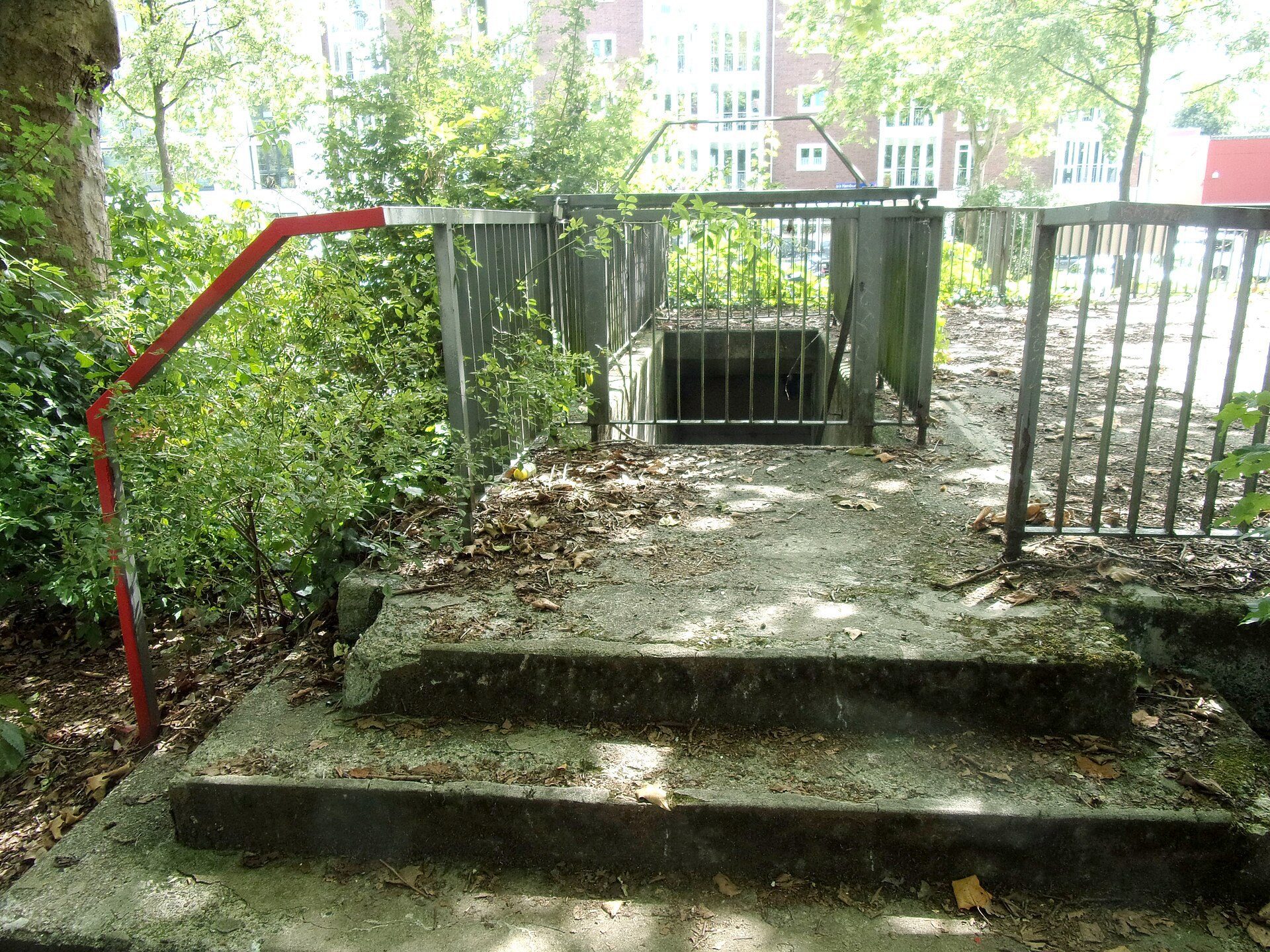
The stair entrance to a public deep bunker and civil defence facility on Doormannsweg, Hamburg: Cold War shelters were built for the public, not as private retreats. Photo: Pauli-Pirat, CC BY-SA 4.0, via Wikimedia Commons. Pauli-Pirat, source, CC BY-SA 4.0
Final thoughts
The luxury doomsday bunker is real but smaller and less documented than its marketing suggests. The verifiable projects are mostly conversions of Cold War military structures and custom steel shelters, prices are often old or contradictory, and several widely shared “bunkers” turn out to be fiction. For designers, the interesting questions are technical (air, water, light, psychology in windowless space) and ethical (private versus public resilience), rather than the finishes.
Sources and further reading
- Swiss Federal Office for Civil Protection, Shelters for the population.
- The Pitch, Survival Condo profile.
- CNN Style, Doomsday luxury bunkers.
- Texas Monthly, Dispatch from Ector.
- Crux, Wānaka lodge rejected again.

Aly Bayoumi is an editor with a sharp eye for detail and a deep commitment to clarity and precision. Passionate about architecture and design, he sees every project as an opportunity to shape compelling narratives that bring creative visions to life. With a focus on accuracy and engaging storytelling, Aly combines editorial expertise with a dedication to elevating the voices and ideas that shape the built environment.