

“Sky bridge”, “skywalk” and “elevated walkway” usually bring to mind a narrow glass walkway strung between two commercial towers, built so that people can get from one meeting to the next without travelling down to street level and back up again. Architects have used bridges for far more inventive reasons than that — they have even built bridges for bikers.
In the 1960s, sky bridges were treated as radical urban surgery: a way of pulling city circulation into a third dimension. Planners such as Victor Gruen argued for lifting pedestrians clear of traffic altogether, and elevated networks spread from Minneapolis to Hong Kong with wildly varying results. A few achieved a genuinely fluid connection between buildings. The rest turned a short walk into an act of nerve.
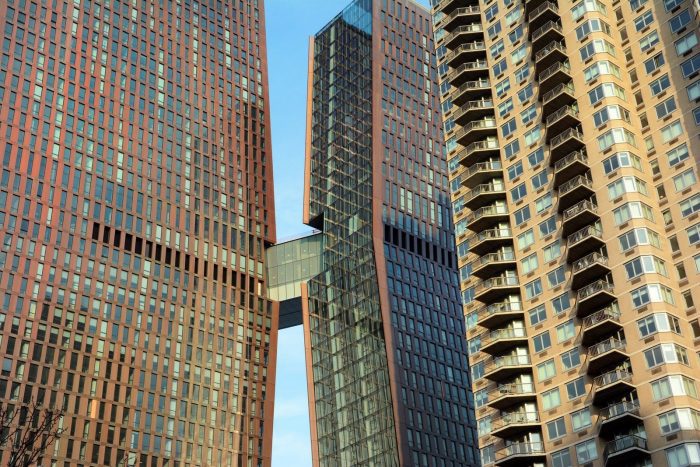
Photo: Getty Images/Bo Zaunders
Today sky bridges turn up in airports, malls, transit hubs and hospitals, where they work quietly as thoroughfares. Some architects push them much higher, straddling the upper floors of some of the tallest structures in the world — and at that height a bridge stops being circulation and becomes the reason the building is remembered. Several of the designers behind the projects below appear on any list of the most influential architects in history.
Over the past decade the element has come back into fashion. Some structures use the elevated walkway purely as a means of circulation. Others treat it as a separate building in its own right — a horizontal volume with pools, gardens and restaurants, hoisted 250 metres into the air.
What is the purpose of a sky bridge?
A sky bridge lets people move between buildings without going down to street level, which shortens journeys, shelters pedestrians from weather and traffic, and frees ground space. In residential and mixed-use towers it also hosts shared amenities — pools, gyms, gardens, restaurants — and can double as an emergency escape route between towers.
What is the difference between a sky bridge and a skywalk?
The terms are used interchangeably, but in common usage a sky bridge is a single high-level connection between towers in one development, while a skywalk or skyway describes a low-level network of enclosed walkways linking many buildings across a city district, usually one or two storeys above the street.
Which building has the highest sky bridge in the world?
The Crystal at Raffles City Chongqing, completed in 2019, is generally cited as the highest sky bridge connecting multiple towers, at roughly 250 metres above ground and 300 metres long. The Petronas Towers skybridge holds a narrower record: the highest two-storey bridge, at 170 metres.
What Is a Sky Bridge?
A sky bridge is an enclosed or open elevated walkway that connects two or more buildings above street level, allowing people to cross between them without descending to the ground. Sky bridges range from simple glazed tubes a few storeys up to multi-level structures carrying pools, gardens, restaurants and building services.
Sky bridge vs skywalk vs skyway: the terms overlap heavily. In everyday use, skywalk and skyway tend to describe low-level, city-scale pedestrian networks linking many buildings across streets, while sky bridge (or skybridge) usually describes a single high-level link between towers in one development.
Sky Bridges at a Glance
| Project | Location | Bridge height | Bridge length | Status |
|---|---|---|---|---|
| Petronas Towers | Kuala Lumpur | 170 m | 58.4 m | Built, 1998 |
| Linked Hybrid | Beijing | Floors 12–18 | Ring of 8 bridges | Built, 2009 |
| Sky Habitat | Singapore | Levels 14, 26, 38 | 3 bridges | Built, 2015 |
| American Copper Buildings | New York | 91 m | 30 m | Built, 2017 |
| InTempo | Benidorm | From floor 38 | Inverted cone | Built, completed 2021 |
| The Cloud | Seoul | 27th floor | 10-storey volume | Cancelled 2013 |
| Cross # Towers | Seoul | Two levels | 2 bridges | Unbuilt |
| The Big Bend | New York | Full height | Concept | Concept only |
8 Interesting Works of Architecture With Stunning Skywalks
1. Petronas Towers, Kuala Lumpur
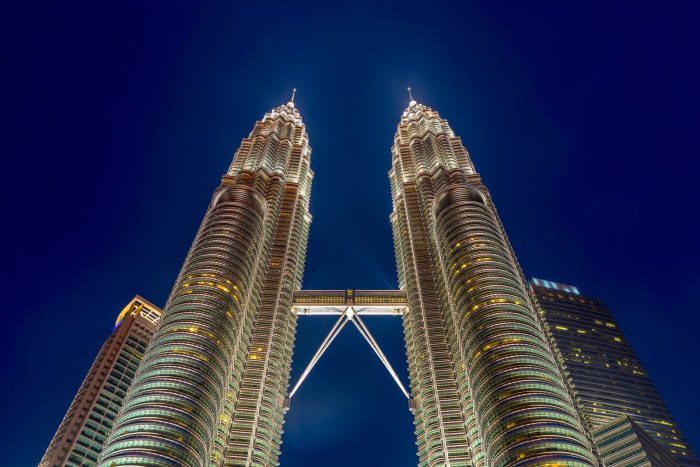
Photo: Getty Images/Alan Copson
Architect: Cesar Pelli · Completed: 1998 (opened 1999) · Bridge: 58.4 m long, 170 m above ground, floors 41–42
The Petronas Towers carry the most recognisable sky bridge on earth, and the one most often copied in silhouette. The double-deck span sits at the 41st and 42nd floors and is widely described as the highest two-storey bridge in the world. It is not rigidly fixed to either tower: the deck rests on a two-legged arch rising from the 29th floor, and the connections at each end are designed to move so the bridge can accommodate the towers swaying independently in the wind.
Its second job is life safety. If a fire or emergency strikes one tower, occupants can cross to the other rather than descend 40 floors. The lower deck is open to visitors in limited daily numbers, which makes it one of the few sky bridges on this list the public can actually walk across.
2. Linked Hybrid, Beijing
Photography: Iwan Baan
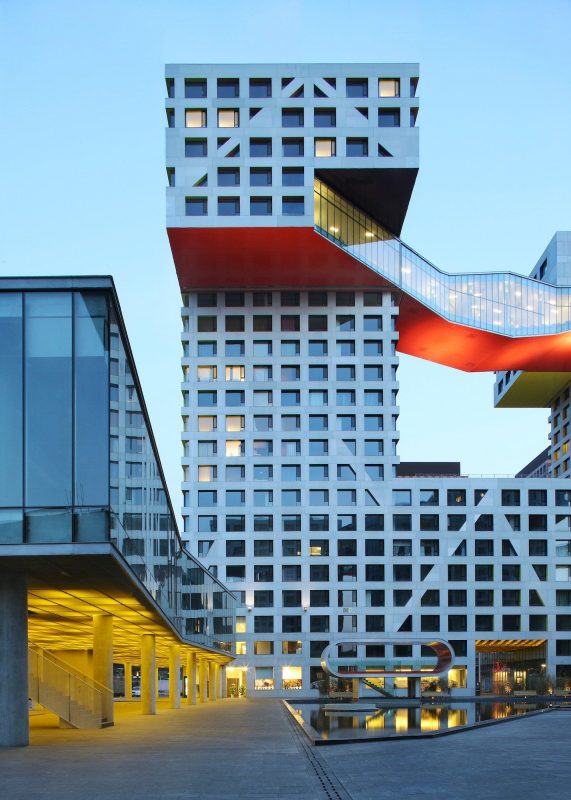
Architect: Steven Holl Architects · Completed: 2009 · Bridge: a ring of eight bridges between the 12th and 18th floors
Linked Hybrid is the most ambitious argument on this list that a sky bridge can be public space rather than a corridor. Eight residential towers and a hotel tower stand in a ring, tied together by a loop of bridges carrying a swimming pool, a fitness room, a café, an art gallery, an auditorium and a salon. The idea was a second, elevated street level — a “city within a city” of roughly 220,000 m² and more than 700 apartments.
The environmental engineering is just as notable: 655 geothermal wells sunk 100 m below the foundations handle heating and cooling, and greywater is recycled into a central pond that freezes into a public ice rink in winter. The complex was named CTBUH Best Tall Building Overall in 2009.
3. Sky Habitat, Singapore
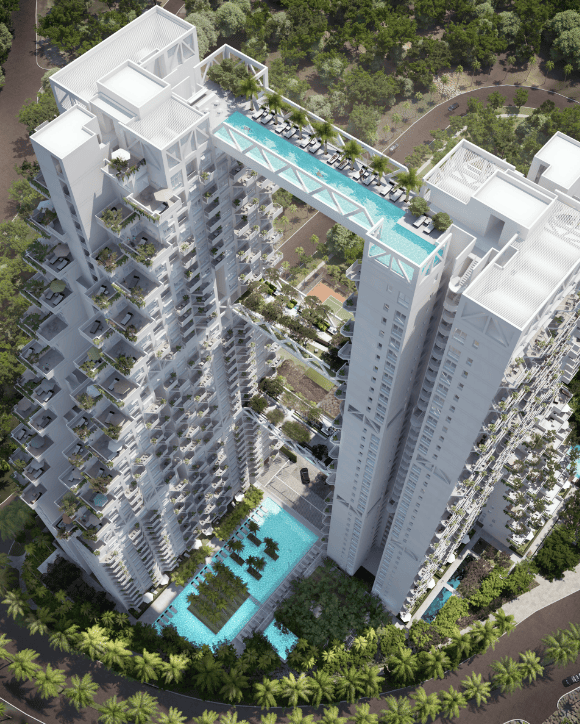
Photo: Getty Images
Architect: Safdie Architects · Completed: 2015 · Bridge: three sky gardens at levels 14, 26 and 38
Sky Habitat takes the stepped, porous logic of Habitat 67 and stretches it vertically across two 38-storey towers holding 509 apartments in the Bishan district. Three broad bridges, framed in white steel trusses, link the towers at levels 14, 26 and 38.
The lower two are landscaped circulation routes — “streets in the air” with planting and seating, so residents can meet without returning to the ground. The uppermost bridge carries an open-air swimming pool 38 storeys up. Splitting the mass into two towers also matters in a tropical climate: the gap lets breezes pass through the block and daylight reach deep into the apartments.
4. American Copper Buildings, New York
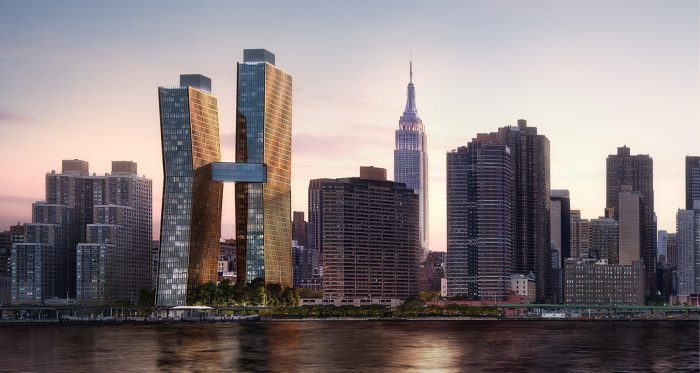
Via Field Condition, Pavel Bendov
Architect: SHoP Architects · Completed: 2017 · Bridge: 30 m long, 91 m above ground, floors 27–29
Named for the more than 5,000 copper panels that will slowly weather to green, these two angled rental towers lean towards each other and meet in a three-storey glazed skybridge — the first major bridge of its kind built in Manhattan in roughly eight decades.
Inside are a 75-foot lap pool, a hot tub, a lounge and part of a large shared amenity floor. The bridge also does unglamorous work: it houses mechanical plant serving both towers, which freed the east tower’s roof for a second pool. The glazing carries an aluminium mesh interlayer that cuts solar gain while keeping the view of the East River and Midtown intact.
5. InTempo, Benidorm
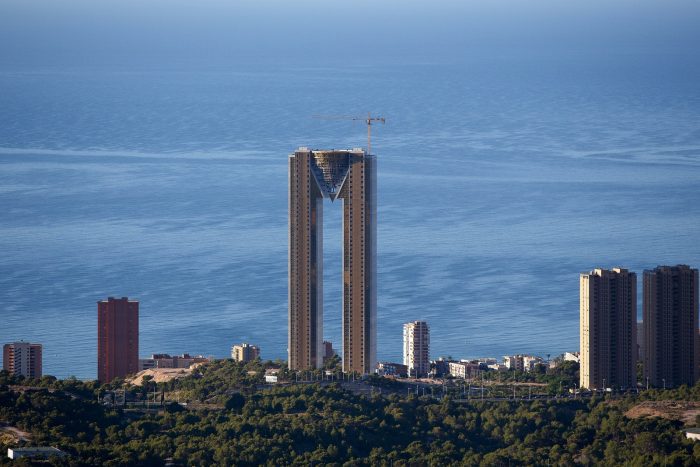
Via Zarateman / Wikimedia Commons
Architect: Pérez-Guerras Arquitectos e Ingenieros · Location: Benidorm, Spain · Completed: 2021 · Height: 47 storeys, c. 200 m
InTempo is the strangest entry here because its “bridge” is an inverted cone, beginning around the 38th floor and stitching two symmetrical towers into a single M-shaped silhouette — Spain’s tallest residential building and one of the few high-rises anywhere shaped like an arch.
It is also a cautionary tale. Presented in 2006 and started in 2007, the tower was scheduled for 2009, then stalled by the 2008 crash, bankruptcy and changes of ownership before being finished around 2021. In 2013 the Spanish press reported that the scheme had grown from 20 storeys to 47 without the lift design keeping pace. The developer disputed the strongest version of that story — that the building had no lifts at all — and the shafts were subsequently reworked, but the episode became one of the most-repeated construction anecdotes of the decade.
Unbuilt Sky Bridges That Still Changed the Conversation
Three of the most influential sky bridge designs of the last fifteen years were never built. They are included here because they set the terms — a bridge as a habitable volume, as public program, as an argument about how tall buildings should behave.
6. The Cloud, Seoul
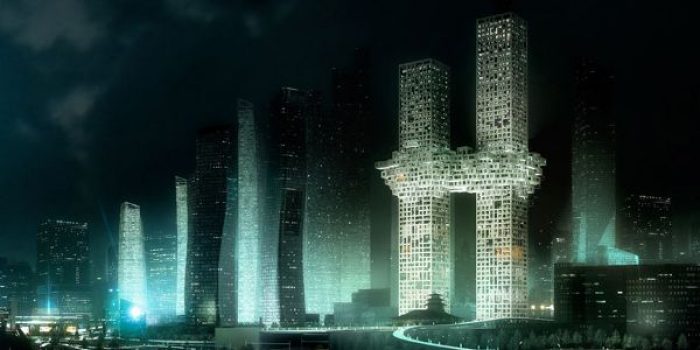
Courtesy of Luxigon/MVRDV
Architect: MVRDV · Location: Seoul, South Korea · Status: unveiled 2011, cancelled 2013
MVRDV’s Cloud proposed two towers of 260 m and 300 m joined at around the 27th floor by a ten-storey pixelated volume — roughly 14,000 m² of sky lounge, wellness and conference centre, fitness studio, pools, restaurants and cafés, with patios, decks and gardens on top. The ground floor was to be left open as public garden.
The design drew immediate international criticism for resembling the World Trade Center towers during the 2001 attacks; the practice apologised and said the resemblance had not been intended or noticed during design. The wider Yongsan Dreamhub masterplan collapsed financially and the project was cancelled in 2013.
7. Cross # Towers, Seoul
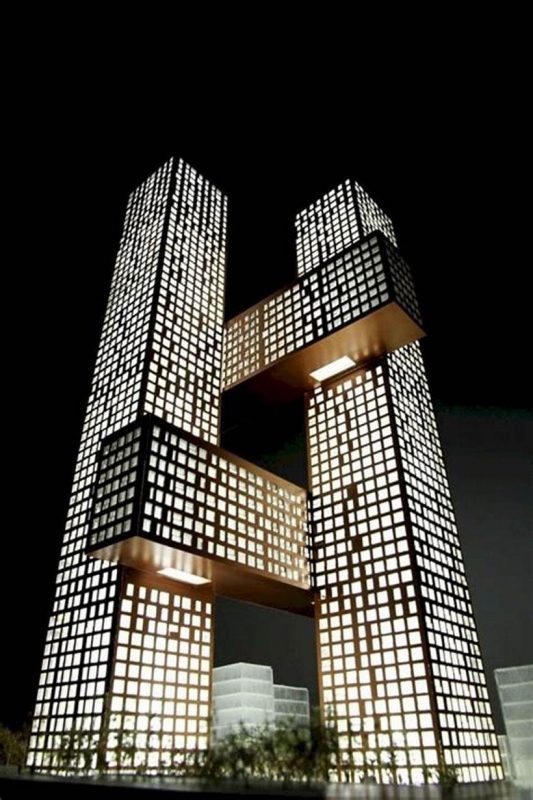
Courtesy of MIR
Architect: BIG · Location: Seoul, South Korea · Status: unbuilt
Designed for the same Yongsan district, the Cross # Towers interlock vertical and horizontal masses so that two bridges read as a single knotted figure from a distance. Both bridges were to carry accessible rooftop gardens, with the interiors programmed for different age groups rather than left as circulation — the bridge as the development’s community centre, lifted into the skyline.
8. The Big Bend, New York
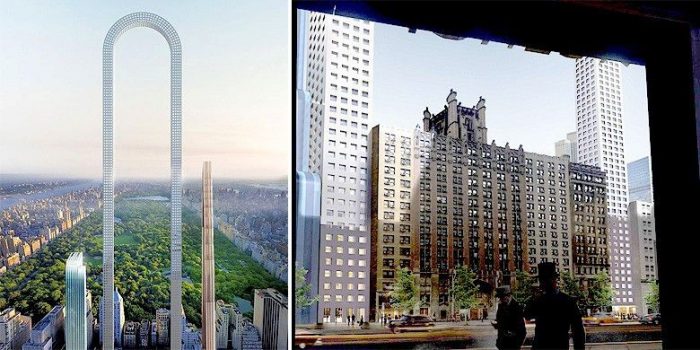
Courtesy of Oiio Architecture Studio
Architect: Oiio Studio · Location: New York · Status: concept, 2017
Oiio’s Big Bend takes the idea to its logical extreme: instead of two towers with a bridge, a single slender tower bent into a hairpin, so that the whole building becomes the bridge. Measured along its curve it would run roughly 1,200 m, making it the longest building in the world rather than the tallest.
It depends on lift technology capable of running horizontally and around curves — and it was published less as a development proposal than as a comment on Manhattan’s height race and the economics of Billionaires’ Row.
3 More Sky Bridges Worth Knowing
Since this list first appeared, the centre of gravity for sky bridge design has shifted decisively towards Asia and the Gulf, and the scale has jumped from a link to a horizontal building.
The Crystal, Raffles City Chongqing
Safdie Architects’ Crystal, completed in 2019, is a 300 m-long glass-and-steel “horizontal skyscraper” suspended 250 metres above the confluence of the Yangtze and Jialing rivers. It sits across four towers and cantilevers towards two more, carrying gardens with more than a hundred trees, a 50 m pool, restaurants, a hotel lobby and a glass-floored observation deck. The middle segments were prefabricated at ground level and hoisted into place with hydraulic strand jacks — it is the highest sky bridge linking multiple towers anywhere.
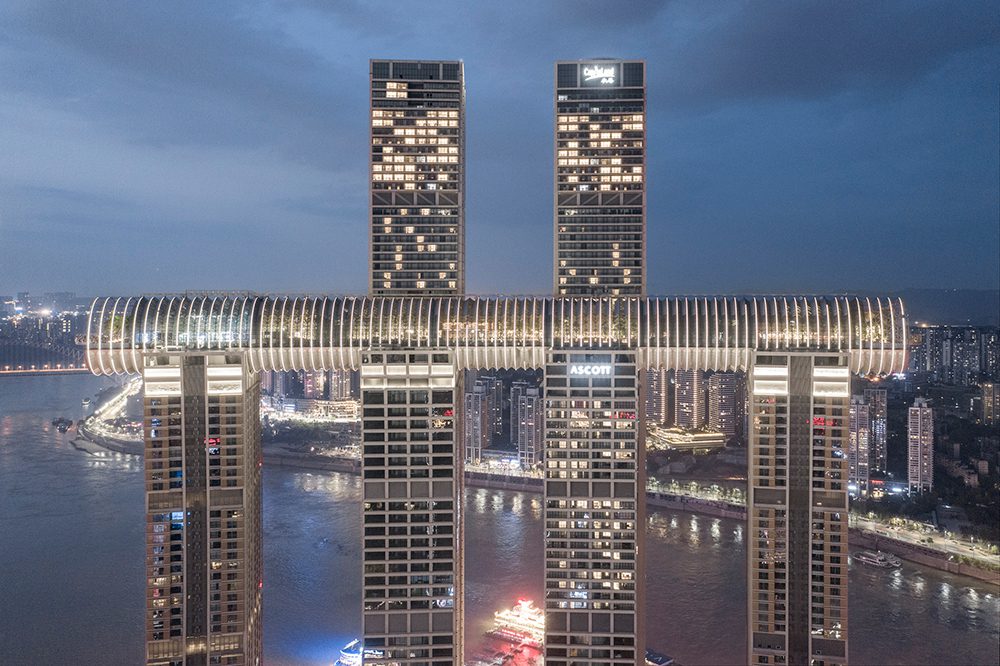
The Crystal, Raffles City Chongqing
The Link, One Za’abeel, Dubai
Opened in February 2024, Nikken Sekkei’s Link is a four-storey, 230 m-long concourse slung 100 m above a live six-lane highway between two towers. Its 67.277 m overhang was recognised by Guinness World Records as the world’s longest cantilever in a building, taking the title from Marina Bay Sands. The steel structure was lifted in two phases across 16 days without closing the road beneath, and is topped by an infinity pool.
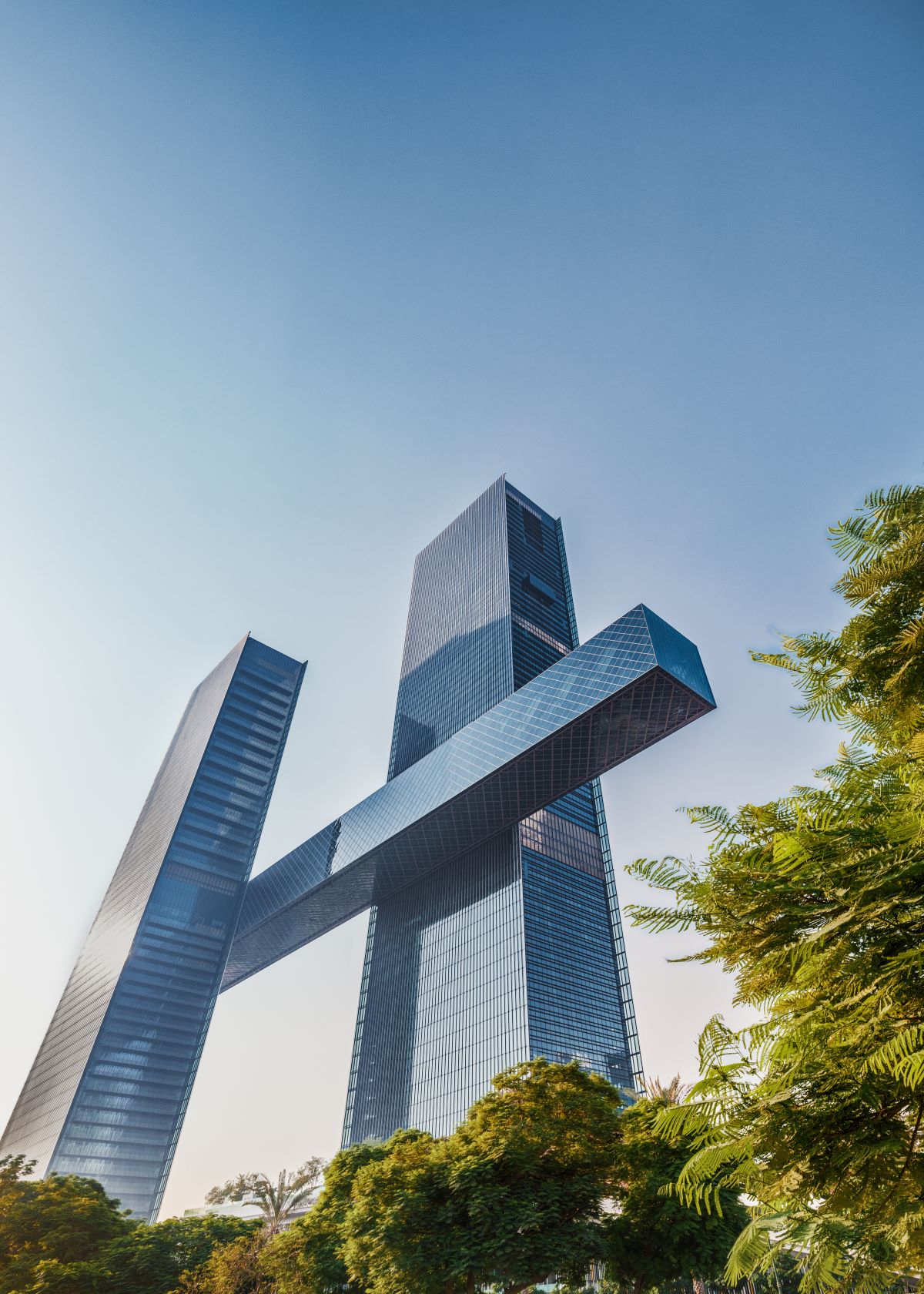
The Link, One Za’abeel, Dubai
Marina Bay Sands SkyPark, Singapore
The reference point for all of them. Marina Bay Sands (2010) laid a 340 m boat-shaped deck across the tops of three towers roughly 200 m up, with a 66.5 m cantilever and an infinity pool that became one of the most photographed pieces of architecture of the decade — and proved that a sky bridge could be the commercial engine of an entire development.
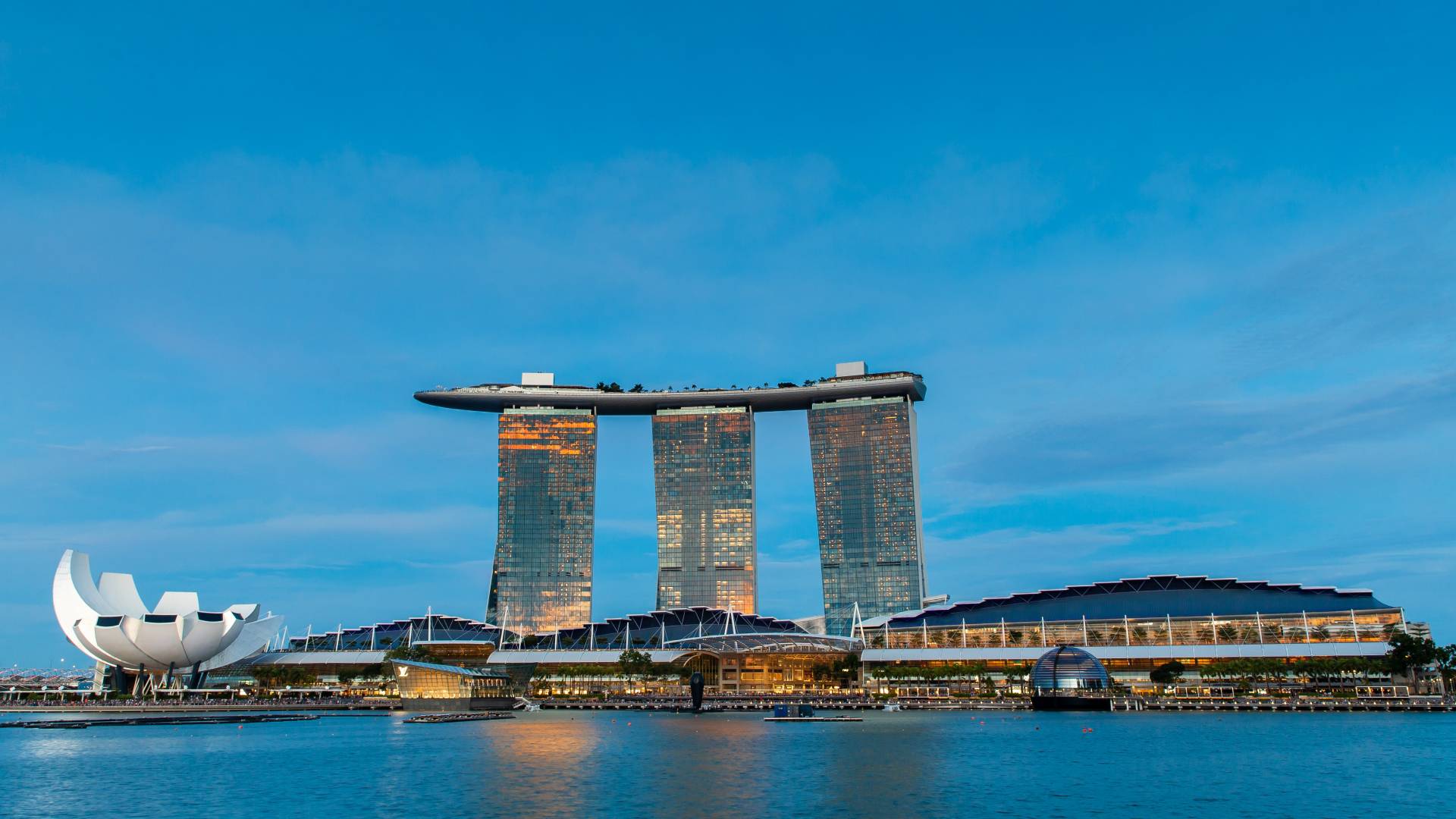
Marina Bay Sands SkyPark, Singapore
How Sky Bridges Are Actually Built
Three problems separate a sky bridge from an ordinary bridge, and they explain why so few get built.
Movement. Two tall towers do not sway in unison. A rigid connection between them would tear itself apart, so high-level bridges are typically supported on hinges, sliding bearings or expansion joints that let the span shift relative to the towers under wind and seismic load. The Petronas arrangement — a bridge carried on an arch, free to move at both ends — is the textbook case.
Erection. There is no crane at 250 m that can lift a 1,000-tonne segment across a gap. The standard method is to build segments on the ground, then raise them with hydraulic strand jacks, as at Raffles City Chongqing and One Za’abeel — a sequence measured in days, with the streets or rivers below still in use.
Use and ownership. A bridge crossing between two buildings crosses a property line and often public airspace, which raises questions of fire strategy, evacuation, security, access rights and maintenance liability. These are frequently harder to solve than the structure, and are the main reason most cities have fewer sky bridges than their skylines suggest they could support.
How high is the Petronas Towers sky bridge?
The Petronas skybridge sits 170 metres above ground, spanning 58.4 metres between the 41st and 42nd floors of the twin towers. Visitors can access the lower deck on guided tours, with daily ticket numbers limited; the upper deck is reserved for building tenants.
Are sky bridges safe?
Yes — high-level bridges are engineered for wind, thermal movement and, where relevant, seismic load, using hinged or sliding connections that let the span move with the towers rather than resist them. Several, including the Petronas skybridge, are designed specifically as evacuation routes between towers.
Can the public walk on sky bridges?
Some. The Petronas skybridge, the Marina Bay Sands SkyPark observation deck, The Crystal at Raffles City Chongqing and The Link at One Za’abeel all offer public or ticketed access. Bridges in residential buildings, such as Sky Habitat or the American Copper Buildings, are for residents only.
Why don’t more buildings have sky bridges?
Cost and legal complexity, more than engineering. A bridge between two buildings crosses ownership boundaries and often public airspace, and it complicates fire strategy, security, access rights and long-term maintenance. It also only pays for itself when both towers belong to a single development, which is why most sky bridges appear in master-planned complexes.
Why Sky Bridges Are Back
The bridge has stopped being a convenience and become the argument. In dense cities where the ground plane is already spoken for, lifting shared space into the air is one of the few ways left to give a tower something more than a lobby — and the projects that do it well, from Beijing to Chongqing, treat the span as a building rather than a corridor. For more high-rise experiments in the same spirit, see our roundup of extraordinary tower designs.
Key takeaways: a sky bridge is an elevated connection between buildings above street level. The Petronas skybridge (170 m) remains the most famous and the highest two-storey example; The Crystal at Raffles City Chongqing (250 m, 300 m long) is the highest linking multiple towers; and The Link at One Za’abeel holds the record for the longest cantilever in a building at 67.277 m.

Mireille Chevalier is a projects editor and architectural writer from Lyon. With a dual background in architecture and history, she brings a contextual lens to design criticism and theory