

Terrazzo floors are made of marble, granite, glass or other chips set in a cement or resin binder, poured in place (or precast), then ground and polished to a smooth finish. Cement systems suit new build and exterior work; thin epoxy systems suit interiors, upper floors and renovations where depth and weight are limited. This guide is for architects, specifiers and homeowners: it compares the main systems by thickness and weight using the National Terrazzo & Mosaic Association (NTMA) reference data, explains joints and divider strips, and gives a maintenance routine, followed by seven interiors that use the material well.
Terrazzo has been in use for centuries and its popularity ebbs and flows; it reappears in dreamy-looking interiors today. Modern terrazzo descends from the marble mosaics and “Venetian pavement” laid in Venice by the mid-16th century, according to the NTMA’s Terrazzo Systems Reference Guide (2023), which credits mosaic workers from the Friuli region. Italian craftsmen brought the trade to the United States in the late 19th century, and it spread from around 1920 once electric grinding machines and metal divider strips made installation faster. The stars of the Hollywood Walk of Fame, for example, are set in terrazzo.

Fishtank Cafe l Office AIO. © Wen Studio
What are terrazzo floors?
Terrazzo is a poured-in-place or precast composite material used for floors, stairs, bases and wall panels. It combines aggregate chips (marble, quartz, granite, glass and other materials) with either a cementitious binder (Portland cement, sometimes polymer-modified) or a resin binder, usually epoxy.
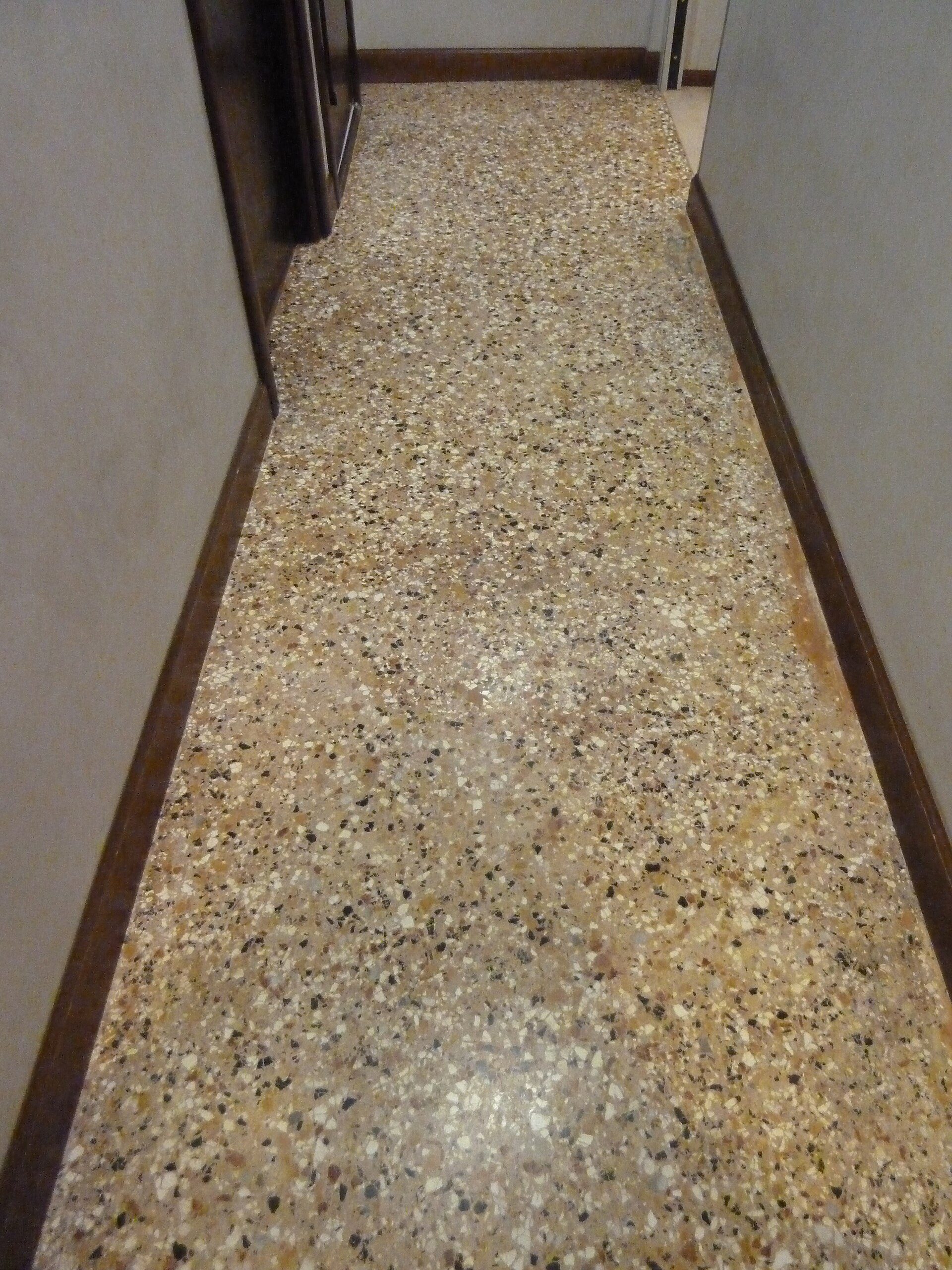
A traditional terrazzo floor at Ca' Favretto, Venice, where the technique developed. Photo: Abxbay, CC BY-SA 3.0, via Wikimedia Commons. Abxbay, source, CC BY-SA 3.0
Metal strips are often used to divide areas or to change the color or material of a design. After curing, the surface is ground and polished to expose the chips evenly, then sealed. The word “terrazzo” is also used loosely for any surface that imitates the speckled look, including porcelain tiles, engineered stone and vinyl; these are different products with different performance.

House in La Garriga l Isla Architects. © Luis Díaz Díaz
Different types of terrazzo floors
The NTMA groups poured terrazzo into resin and cement systems. The main difference is how each one relates to the concrete slab below: thin systems are bonded to the slab and depend on it for flatness and crack control, while the sand cushion system is separated from the slab and can absorb minor movement.
| System | Binder | Total thickness | Approx. weight | Relation to slab | Typical use |
|---|---|---|---|---|---|
| Epoxy (thin-set) | Epoxy resin | 3/8 in nominal (about 10 mm); 1/4 in option | 3-4 lb/ft2 (about 15-20 kg/m2) | Bonded; depends on slab flatness; flexible membrane optional | Interiors, upper floors, renovations, multi-colour designs |
| Polyacrylate | Polymer-modified cement | 3/8 in nominal (about 10 mm) | 4.5 lb/ft2 (about 22 kg/m2) | Bonded; depends on slab flatness and crack control | Interiors; replacing vinyl or carpet without level changes |
| Monolithic | Portland cement | 1/2 in nominal (about 13 mm) | 5-7 lb/ft2 (about 24-34 kg/m2) | Bonded with bonding agent; depends on slab quality | Interiors where time and budget are critical |
| Bonded | Portland cement | 1-3/4 to 2-1/4 in (about 45-57 mm) incl. 1/2 in topping | 18-22 lb/ft2 (about 88-107 kg/m2) | Sand-cement underbed bonded to slab | Interior and exterior; recessed slabs |
| Sand cushion | Portland cement | 2-1/2 to 3 in (about 64-76 mm) incl. 1/2 in topping | 25-30 lb/ft2 (about 122-146 kg/m2) | Isolated from slab (sand, isolation sheet, wire mesh) | Interiors; resists crack mirroring |
| Rustic | Portland cement | 1/2 to 6 in, depending on base system | Depends on system | Sand cushion, bonded or monolithic base | Exterior textured, non-ground surfaces |
Source: National Terrazzo & Mosaic Association, Terrazzo Systems Reference Guide 2023 (metric conversions by Arch2O, rounded) (as of 2026-11-01).
Epoxy terrazzo is the thinnest and lightest system and, according to the NTMA, has the greatest tensile, compressive and flexural strength of any terrazzo system, a wide colour range and lower maintenance cost because the resin is almost impermeable. It is an interior system. Monolithic terrazzo is a 1/2 in (about 13 mm) cement topping bonded straight to a flat, high-quality slab and is described by the NTMA as the most economical. Bonded terrazzo adds a sand-cement underbed to fill a recess, so it depends less on slab flatness. The sand cushion system, with wire reinforcement, an isolation sheet and a dusting of sand under the underbed, is the thickest and heaviest but best at stopping slab cracks from mirroring through to the surface.
Also Read: Polished Concrete: When Beauty, Strength, and Simplicity Converge.
Joints and divider strips
Divider strips do two jobs that are often confused. Strips placed over the joints in the concrete slab act as control joints; the NTMA says strips not located over slab joints are purely decorative and do not level the floor or prevent cracks. For bonded systems it refers designers to ACI 302.1 for slab joint placement and recommends that slab joints run off every corridor intersection and corner. In practice, the terrazzo layout should be drawn together with the slab joint plan, not after it. Where an epoxy floor goes over a cracked or jointed slab, a flexible membrane (specified as an extra) can absorb some horizontal movement.
Why terrazzo?
Durability
Green buildings favour finishes that last, and terrazzo is chosen mainly for its long service life in high-traffic public buildings such as airports, hospitals, government buildings and schools. The NTMA describes it as the lowest life-cycle-cost flooring available; that is an industry claim, and any comparison for a real project should use local installation and cleaning costs over the expected life.
Older terrazzo floors can often be reground, repaired and resealed rather than replaced. The US General Services Administration publishes procedures for matching new bonded terrazzo to historic floors, which shows how repairable the material is.

San Diego International Airport. © Terrazzo & Marble
Cleanliness and maintenance
A properly sealed terrazzo floor has no grout joints to trap dirt, which is why it is popular in hospitals and food areas. Epoxy terrazzo is essentially non-porous; cement terrazzo is more porous and relies on a sealer, which the NTMA recommends applying immediately after final polishing and renewing as needed. Routine cleaning uses neutral cleaners rather than harsh chemicals.
Seamless floors also help where wheelchairs, beds and trolleys are moved. Tile and brick joints make rolling loads bumpy and noisy, while terrazzo’s continuous surface is smoother to cross.

© Terrazzo & Marble
Design options
A wide colour palette and water-jet-cut divider strips allow logos, patterns and wayfinding lines to be built into the floor. Colour transitions can reinforce themes or guide people through large buildings, which is why many airports use epoxy terrazzo with pictorial designs.
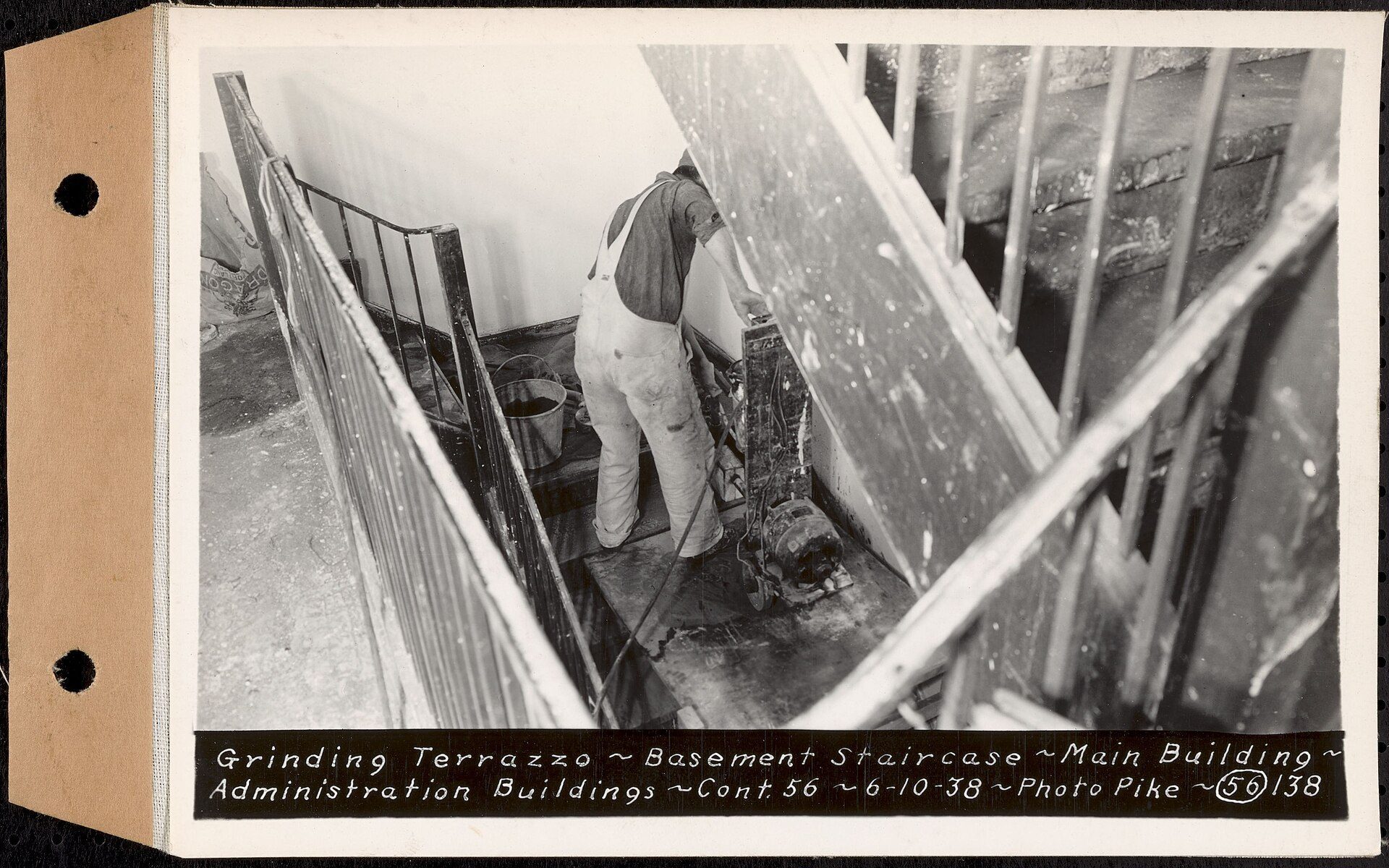
Grinding terrazzo on a basement staircase, Administration Buildings, Belchertown, Massachusetts, 10 June 1938. Photo: Metropolitan District Water Supply Commission (Massachusetts), public domain, via Wikimedia Commons. Image: Massachusetts. Metropolitan District Water Supply Commission, Pike, Stuart D., 1910-1978 (Public domain (verified))
The finish is created on site: after the topping cures, it is ground in stages with progressively finer abrasives, grouted to fill small voids, polished and sealed. This wet, multi-pass process is part of the cost and programme, and it should be planned before other finishing trades arrive.
Is terrazzo expensive?
Poured terrazzo usually costs more to install than tile or vinyl, but prices vary too much by country, system and design to quote a meaningful figure here. The NTMA lists the main price factors: design complexity, the number of colours, local labour rates, the quantity and type of divider strips, the size and source of aggregate, the size of the areas and project, phasing and logistics, and whether it is new construction or renovation. Ask a terrazzo contractor for budget pricing early, and compare options on whole-life cost (installation, cleaning, resealing and replacement) rather than installed price alone.
Maintenance routine
The NTMA custodian’s guide sets out a minimum routine for terrazzo floors, summarised below.
| Frequency | Task |
|---|---|
| Daily | Dust mop to remove grit; hand-clean scuffs and stains with neutral cleaner diluted in warm water |
| Weekly | Damp mop with neutral cleaner; scrub heavily soiled floors with a buffing machine; rinse before the solution dries; auto-scrubbers for large areas |
| First 2-3 months | Scrub new floors once or twice a week while construction dust settles |
| As required | Strip old sealer and finish coats; reseal with a water-based terrazzo sealer to the maker's instructions |
Source: NTMA Terrazzo Systems Reference Guide 2023, 'The Care of Terrazzo' (as of 2026-11-01).
The same guide warns against degreasers, bleach, vinegar, ammonia and other household chemicals, against acidic or alkaline cleaners and crystallising salts, and against surface waxes or all-purpose sealers that can make the floor slippery. Polished hard floors can also be slippery when wet; check slip-resistance requirements in your jurisdiction (for example ANSI A326.3 in the US or pendulum testing under BS 7976 in the UK) and specify the finish accordingly, especially at entrances.
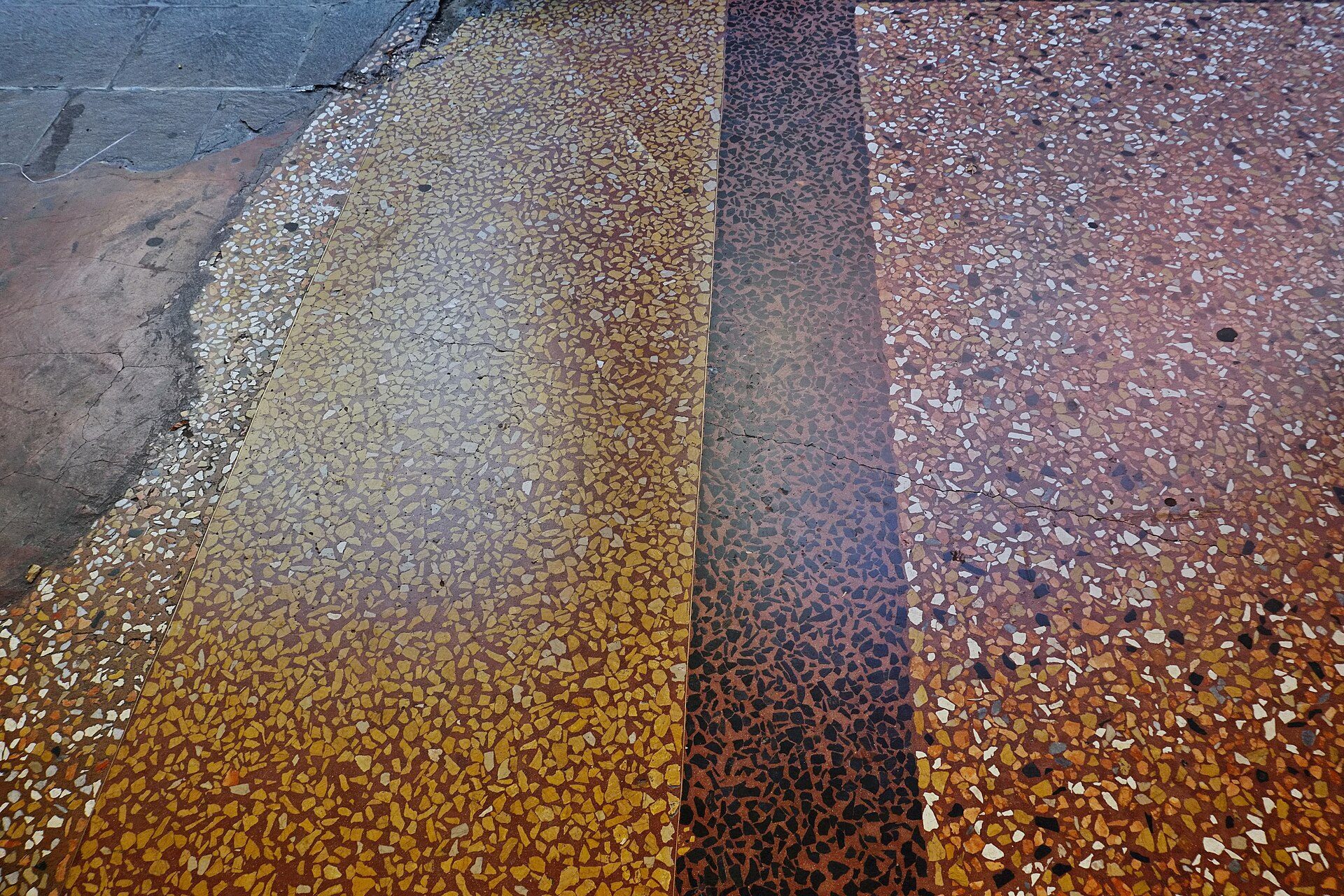
Terrazzo floor of a portico on Via Castiglione, Bologna, with bands of different chip colours. Photo: Armin Kleiner, CC BY-SA 4.0, via Wikimedia Commons. Armin Kleiner, source, CC BY-SA 4.0
Where terrazzo performs less well: thin bonded systems will mirror cracks from a poor slab; epoxy is not recommended for exterior use; cement systems are heavy for lightweight upper floors; and stains from oils or acids can be hard to remove from cement terrazzo if the sealer has worn away.
7 gorgeous examples of terrazzo floors
Terrazzo floors add character to homes as well as to hospitals, cafés and restaurants. These seven interiors, all previously published on Arch2O, use the material in different ways.
1) Brown Box | Limdim House Studio
Terrazzo floors and surfaces, curved walls and arched nooks create a calm atmosphere in this home in Vietnam. The designers used terrazzo across the whole floor, starting at the kitchen island and flowing outward. Its hard, low-sheen surface suits a warm, humid climate where carpets and some timber floors are harder to maintain.

© Do Sy
2) House B-L | Graux & Baeyens Architecten
Belgian practice Graux & Baeyens Architecten refurbished and extended a farmhouse to make a family home for one of the partners. The terrazzo flooring throughout the house, especially in the spacious living room, supports the natural colour scheme and provides a quiet setting for the artwork and sculptural furniture.

© Jeroen Verrecht
3) Repossi Place Vendôme | OMA
OMA’s 2016 jewellery store for Repossi in Paris is a reminder that not every terrazzo-looking floor is terrazzo. The salt-and-pepper floors are a mix of aluminium foam and resin, with the voids filled with resin to make a walkable surface. Linear display cases are made from reflective slats that rotate like shutters, and the walls are lined with the same industrial metal.

© Cyrille Weiner
Check OMA’s latest project: Tiffany Landmark | OMA
4) Goguette au Louvre | Cut Architectures
A slender metal screen announces the restaurant’s name at the entrance. Inside, guests are guided through the space by a white-coated metal counter and a large terracotta volume that houses refrigerators on one side and a dining area on the other, and an earthy terrazzo floor ties the scheme together.

© Cyrille Weiner
5) parkHAUS | studioHAUS
parkHAUS is a roughly 7,000 sq ft (about 650 m²) open-plan villa in Pune, India, completed in 2018. Semi-precious stones such as quartz, jasper and aventurine were hand-set into a cement terrazzo floor, giving each room a subtle sparkle against the clean white walls and sculpted furniture.

© Ritesh Ramaiah
6) House in Achladies | Lydia Xynogala
Aquamarine terrazzo floors run through this Greek house on a slope above the sea. Architect Lydia Xynogala combined it with marble and plaster render to echo the building traditions of the area.

© Yiorgis Yerolymbos
7) Green Option Food Court | Studio Ramoprimo
The concept presents healthy food in a relaxed setting with plenty of seating for eating, lounging and socialising. A continuous poured terrazzo floor with varied stone grains and tones of grey helps distinguish the stepped and raised areas used for different parts of the programme.

© Ramoprimo
Also Read: 14 of The World’s Best Modern Coffee Shops Designs You’ll Ever See.
Final thoughts
Choose terrazzo floors when you want a long-lasting, repairable, low-joint surface and can plan the slab, joints and grinding programme around it. Use epoxy where depth, weight or colour range matter indoors; use a cement system for exteriors and where the budget favours monolithic work; choose sand cushion where the slab is likely to move. If you are comparing hard finishes for walls and exteriors as well, our guide to facade materials covers the options. Confirm system details, thicknesses and costs with the current NTMA specification and a specialist contractor before you specify.
Sources and further reading
- National Terrazzo & Mosaic Association, Terrazzo Systems Reference Guide (2023): systems, thicknesses, weights, price factors, history and care.
- NTMA, Thinking of Specifying a Terrazzo Floor?: interior and exterior system choice.
- US General Services Administration, Installing a new bonded terrazzo floor to match historic terrazzo.
- Architectural Record, Repossi Place Vendôme by OMA (2016).
- ArchDaily, parkHAUS / studioHAUS.

Daniel Mercer is a Coffee Break section editor at Arch2O, currently based in Berlin, Germany. With a background in architectural history and design journalism, Daniel holds a Master’s degree from the University of Edinburgh, where he focused on modern architecture and urban theory. His editorial work blends academic depth with a strong grasp of contemporary design culture. Daniel has contributed to several respected architecture publications and is known for his sharp critique and narrative-driven features. At Arch2O, he highlights innovative architectural projects from Europe and around the world, with particular interest in adaptive reuse, public infrastructure, and the evolving role of technology in the built environment.