

No house is completely disaster proof, but disaster proof homes, more accurately disaster-resilient homes, are designed so that a specific hazard does as little harm as possible: they are raised above flood and wave levels, anchored and braced against wind and earthquakes, built with a safe room for tornadoes, or clad in materials that resist fire. This guide, for homeowners, students and designers, reviews six built houses and concepts, explains the design principle behind each, and shows how the rules differ by hazard and by country.
Architects have long responded to crises, from innovative shelters for the homeless to houses designed to survive floods and earthquakes. A safe home starts with knowing which hazard it must face: a house built for a flood zone is not automatically safe in an earthquake.
List of disaster proof homes
1. Tsunami House, Camano Island, Washington, United States
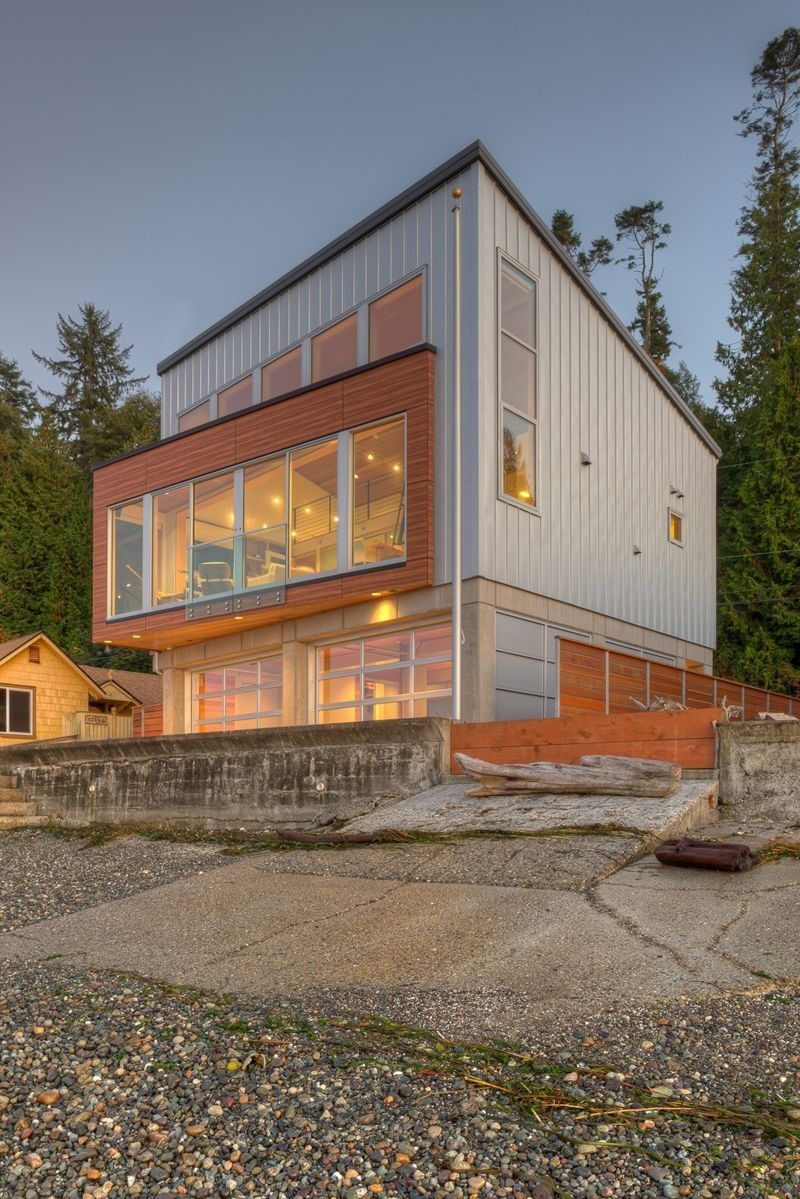
Designs Northwest Architects built this waterfront house on Camano Island in a high-velocity flood zone, after the floodplain map for the site was redrawn and the owners’ plan for a simple remodel was no longer allowed, as Seattle Magazine reports.
© Lucas Henning
The footprint is limited to 30 x 30 ft (about 9 x 9 m), and the 887 sq ft (82 m²) main living floor sits 5 ft (1.5 m) above grade on pilings, according to Architect magazine. The lower level is enclosed by breakaway walls, in fact industrial garage doors with fasteners designed to release under wave force, so that a storm surge can pass under the house without pushing it off its piles. The exterior is clad in durable, low-maintenance steel and concrete panels, with warm cedar inside. The name is a nickname: the house is designed for storm surge and high-velocity flooding under flood regulations, not tested against a tsunami.
2. Gregg Fleishman’s slotted plywood shelter
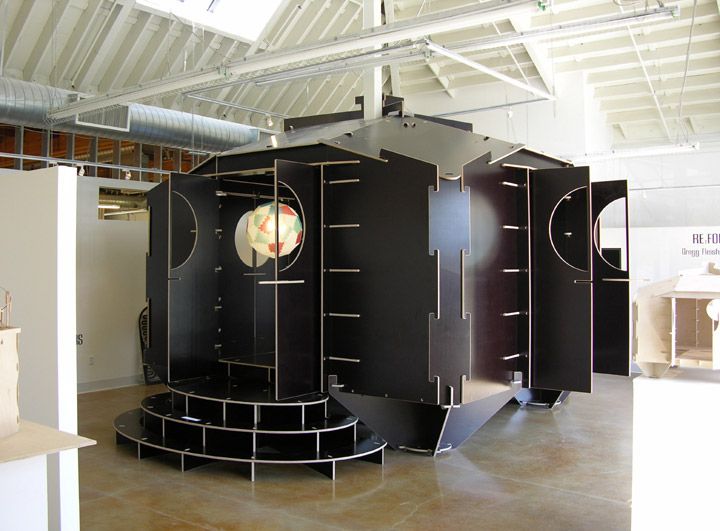
Gregg Fleishman is a Los Angeles architect who designs structures from router-cut plywood panels that slot and notch together with no screws, nails or bolts. His “Comeback Cube” system, described in his studio’s specification sheet, uses 9 ft (about 2.7 m) cubic modules that can be clustered and could serve as a temporary shelter or, with insulation and finishes, a permanent house.
Courtesy of Gregg Fleishman
The appeal for disaster relief is speed and logistics: flat panels ship easily and can be assembled by hand without tools or skilled trades. Whether a particular shelter will survive a strong earthquake or storm depends on engineering for the site, so treat it as a rapid shelter system rather than a certified disaster-proof house.
3. Vagabond’s orange tiny house
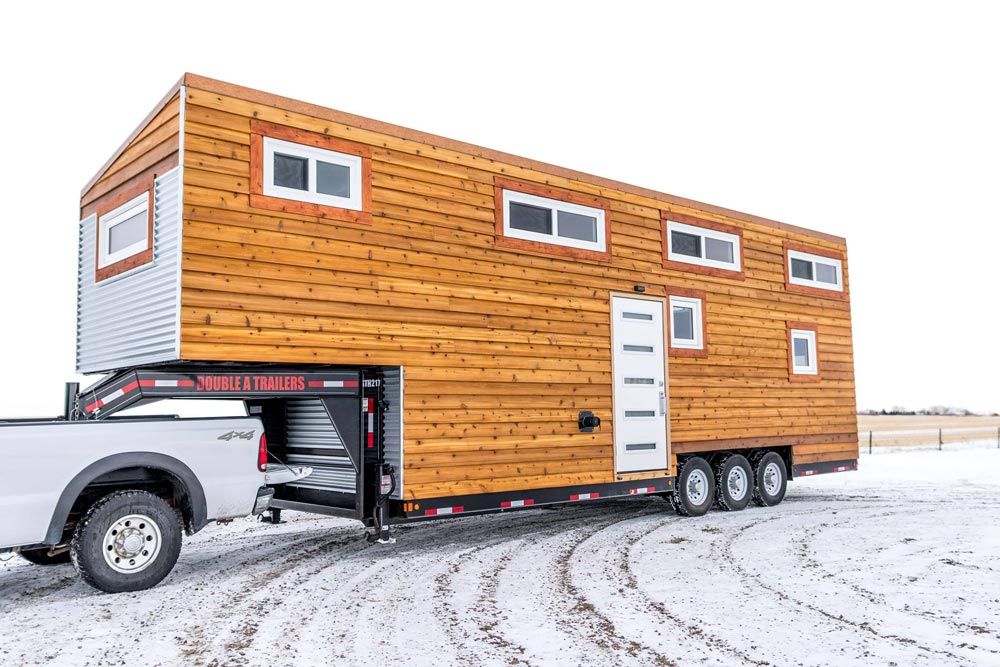
This tiny house on a trailer is built for life off the grid: it is ready for a small solar panel system and its own water supply, with a wood-burning stove for heat. According to Inhabitat, its panels are glued with a heavy-duty construction adhesive, its cedar cladding is treated with yakisugi (the Japanese technique of charring wood to make it more resistant to rot, insects and weather), and its roof is a reflective, metallic acrylic-coated Galvalume sheet over rigid insulation.
Courtesy of Vagabond
It is a resilient home rather than a disaster-proof one: being off-grid means it keeps working when utilities fail, and being on wheels means it can be moved out of harm’s way, but it is not designed for a specific flood, wind or earthquake standard.
4. Tornado-Proof House concept by 10 Design
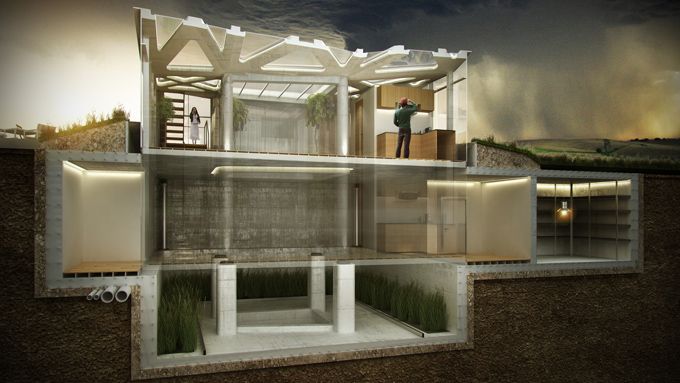
The architecture firm 10 Design proposed this concept, called Erupting Stability, in 2012. Like a turtle pulling its head into its shell, the house would retreat into a sunken base when sensors detect the high winds of an approaching tornado, as Dezeen reported.
Courtesy of 10 Design
Simple hydraulic levers would push the house in and out of the ground, and the roof would be sealed under waterproof doors. The proposed skin is translucent insulation sandwiched between layers of Kevlar. The designers imagined whole communities of such homes, each able to sound an alarm to warn its neighbours. It remains an unbuilt concept: no completed prototype has been reported.
The proven way to protect people from tornadoes is simpler: a safe room. In the United States, FEMA’s guidance for safe rooms (FEMA P-361, fifth edition, 2024, and FEMA P-320 for homes) is based on the ICC 500-2023 standard for storm shelters and aims at near-absolute protection from wind and wind-borne debris.
5. SkyDome dome home, Moscow region, Russia
Dome homes resist wind and snow well because a curved shell spreads loads evenly and offers no flat walls or overhangs for wind to catch. The Russian company SkyDome builds two-storey timber half-spheres on pile foundations, clad in treated solid pine with larch shingles and natural insulation, as Architect magazine describes.

Courtesy of Skydome
The company says the shape can carry up to 700 kg of snow per square metre, and that the absence of internal load-bearing walls allows free planning. These are manufacturer claims, not independent test results. Note that the dome homes often cited as meeting FEMA’s safe-room criteria are monolithic reinforced-concrete domes, a different construction from SkyDome’s timber panels.
6. Ophir, Christchurch, New Zealand
Ophir was designed by Architects‘ Creative for a family who lost their previous home in the Canterbury earthquakes, and was completed in 2015 on a new hillside site, according to ArchDaily. A textured concrete base anchors the house into the slope, and a lighter upper living level clad in black zinc, framed in exposed steel, appears to float above it, with views over the estuary to the Southern Alps.
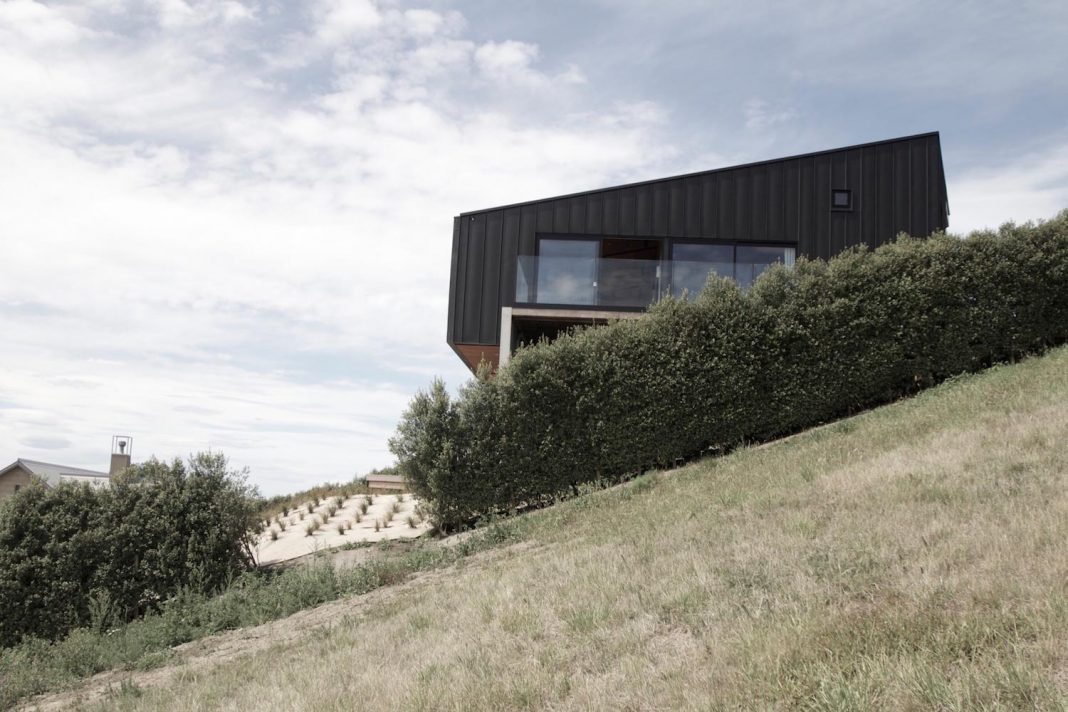
Courtesy of Charlotte Clements
The guest level below is clad in cedar. The terraces are placed to give shelter from prevailing winds, and the house is oriented for sun and cross-ventilation. The lesson is not that one material is earthquake proof, but that a rebuilt home can combine a stiff, well-founded base, a light upper structure and a clear load path, all designed to New Zealand’s building code.
Design principles by hazard
The six examples show that disaster proof homes are always designed for a named hazard. The table summarises the main strategy for each, and the diagram below shows them in section.
| Hazard | Main strategy | Example in this article | Example reference (United States) |
|---|---|---|---|
| Coastal flood / storm surge | Elevate on open piles; breakaway walls below | Tsunami House, Camano Island | NFIP; FEMA Technical Bulletin 9 (2021); ASCE 24 |
| Tornado | Safe room; continuous load path | 10 Design concept (unbuilt) | FEMA P-361 / P-320 (2024); ICC 500-2023 |
| Snow and wind | Compact curved shell; even load spread | SkyDome (manufacturer claims) | Local snow and wind loads in the building code |
| Earthquake | Light, regular, braced and tied structure; good foundation | Ophir, Christchurch | National seismic code (New Zealand Building Code for Ophir) |
| Utility failure / evacuation | Off-grid systems; mobility | Vagabond tiny house | – |
| Rapid shelter after a disaster | Flat-pack, tool-free assembly | Gregg Fleishman cube system | – |
Source: FEMA NFIP Technical Bulletin 9 (2021); FEMA high-wind publications (2024); project sources cited in the article (as of 24 October 2026).
Flood and coastal storm
Most disaster proof homes in flood zones follow one rule: raise the living floor above the design flood level on an open foundation of piles, posts or columns, and keep the space below free or enclosed only by breakaway walls, lattice or screens. In the United States, the National Flood Insurance Program requires exactly this in coastal V zones; FEMA’s Technical Bulletin 9 (2021) explains how breakaway walls must be designed to fail without damaging the house or its foundation.
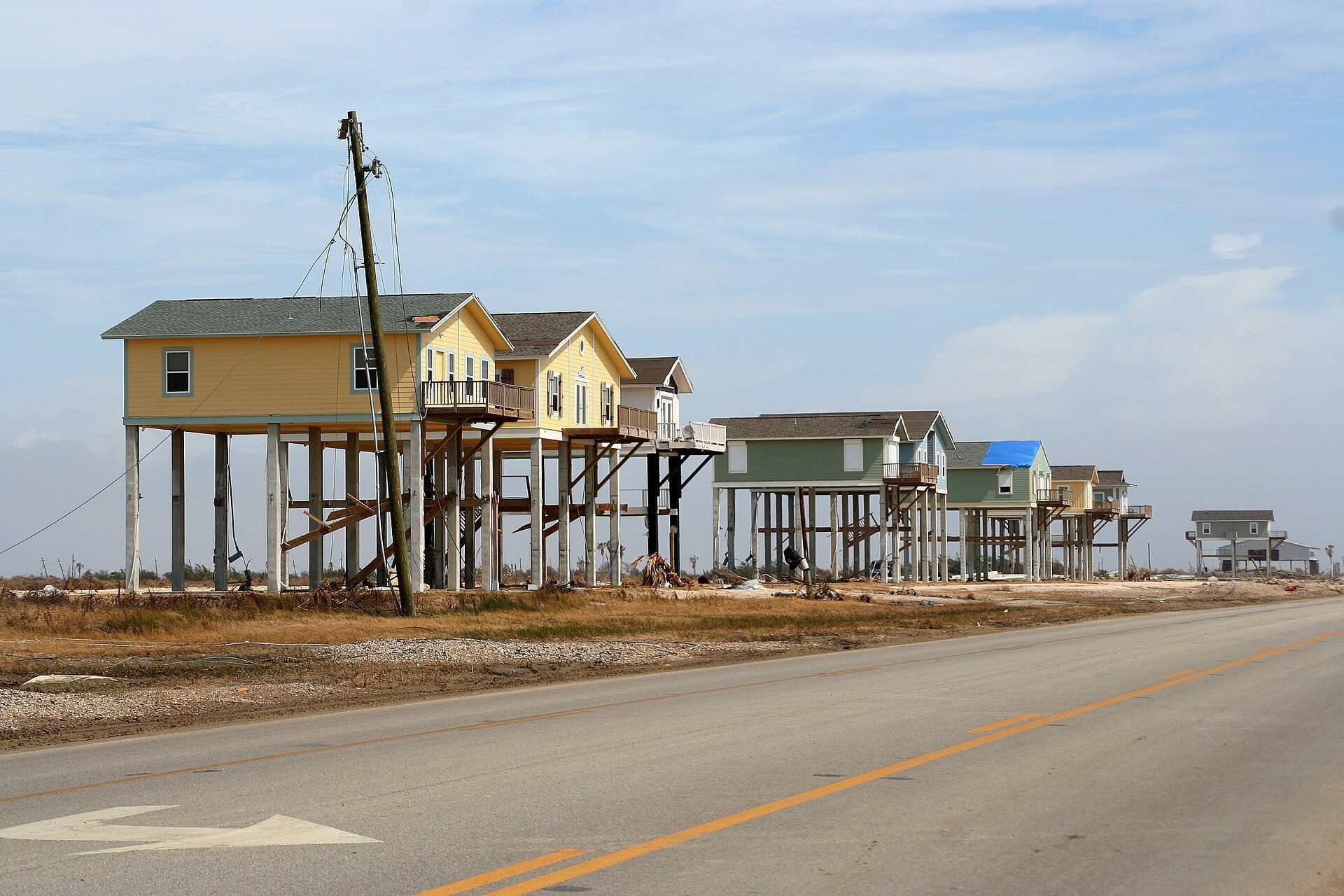
Houses raised on piles still standing on the Bolivar Peninsula, Texas, after Hurricane Ike's storm surge in 2008. Photo: Greg Henshall/FEMA, public domain, via Wikimedia Commons. Image: Greg Henshall (Public domain (verified))
Wind and tornado
Give the whole house a continuous load path from roof to foundation, with strong connections, impact-resistant openings and a simple, compact form. For tornadoes, add a safe room built to FEMA P-361/P-320 and ICC 500, because ordinary houses cannot be made tornado proof economically.
Earthquake
In earthquake zones, disaster proof homes depend on structure more than on materials. Keep the structure light and regular, brace it in both directions, tie walls, floors and roof together, and found it well. Movement between building parts must be allowed for where it is intended, for example with building expansion joints. Seismic design is set by the national code and the local seismic zone.
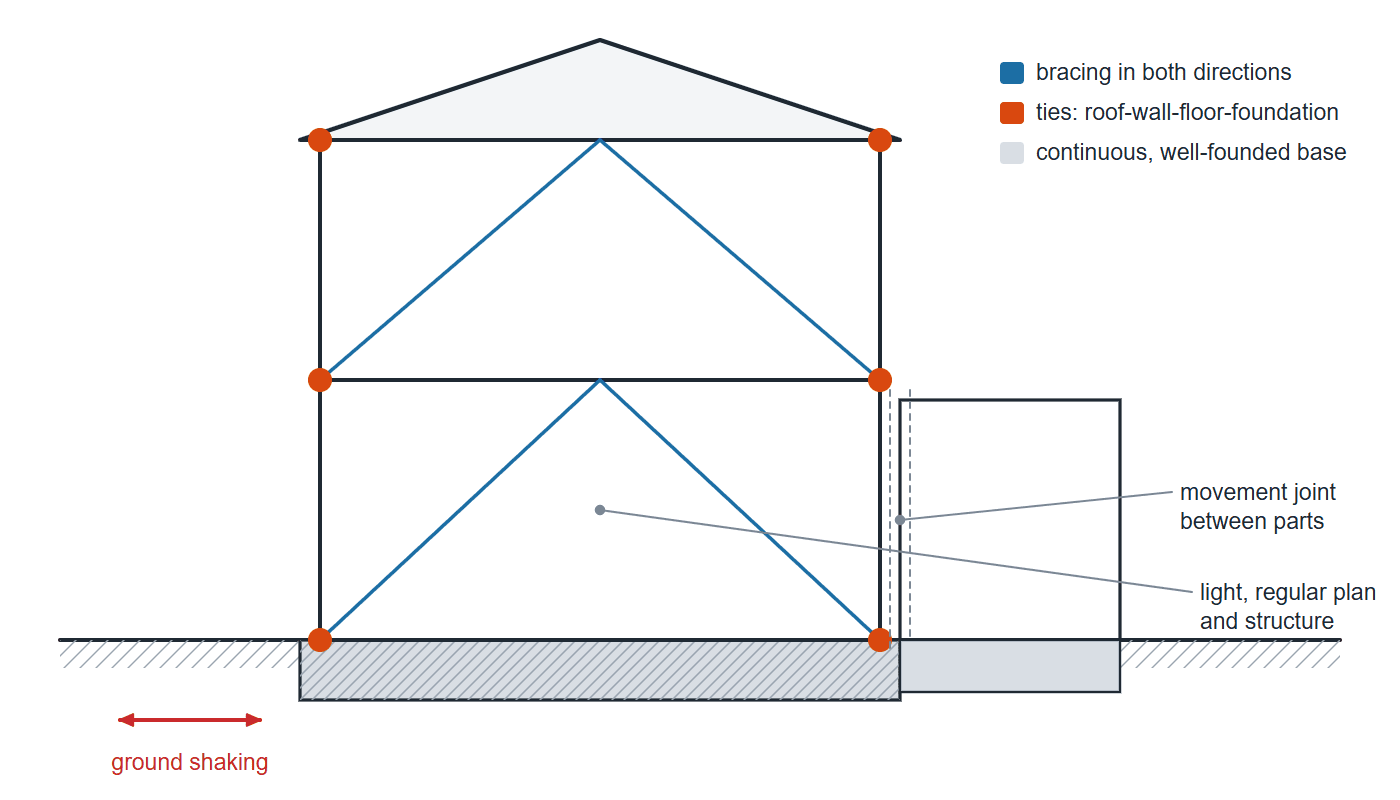
Earthquake strategies in one house section: a light, regular structure braced in both directions, walls, floors and roof tied together, a sound foundation, and joints where parts are meant to move independently. The national code and the local seismic zone set the actual design. Diagram: Arch2O
Variants and regional differences
Disaster proof homes therefore look different from region to region. The same principles produce different houses in different places because each country sets its own hazard maps and codes. In the United States, flood rules come from the National Flood Insurance Program and local floodplain ordinances, and tornado protection from FEMA guidance and ICC 500. Earthquake-prone countries such as New Zealand and Japan regulate seismic design nationally, while snowy regions specify snow loads by location. Always check the code adopted where you build: the standards and figures in this article are examples, not universal rules, and local codes govern.
Sources and further reading
- Architect magazine, Tsunami House project gallery.
- Seattle Magazine, A Camano Island home strong enough for a tsunami.
- Dezeen, Tornado Proof House by 10 Design (2012).
- ArchDaily, Ophir / Architects’ Creative.
- FEMA, NFIP Technical Bulletin 9: Breakaway walls (2021).
- FEMA, High wind and safe room publications (P-361 and P-320, 2024).

Urwa Shahid is an urban development professional with a Master’s in Urban Development Planning from UCL’s Development Planning Unit. With a foundation in architecture, she focuses on using design thinking to address complex urban challenges. Urwa has contributed to impactful projects, including work with the UN-Habitat Cities Investment Facility, where she supported sustainable city-building initiatives. Her approach blends architectural creativity with strategic urban planning, guided by her personal philosophy: “I like to use architecture to solve urban problems. Sketching is my style—architecture is not my goal.” Through international collaborations and academic excellence, Urwa brings a thoughtful, solution-oriented mindset to shaping inclusive and resilient urban spaces.