

Furniture designed by architects ranges from the 1929 Barcelona chair of Ludwig Mies van der Rohe and Lilly Reich to recent pieces by Zaha Hadid, OMA, UNStudio and J. MAYER H. Architects design furniture to complete their buildings, to test ideas about structure and material at a smaller scale, and because a chair is a quick, buildable prototype. This guide is for interior-design students and homeowners. It describes 15 pieces with their verified designers, dates and makers, corrects some myths about them, and ends with a dated reference table and practical points for using a statement piece in a room.
Some of these designs are playfully inspired by nature, while others are strictly functional. Many now define whole looks: our guide to classic interior design styles shows the styles they belong to, from mid-century modern to Art Deco. For the houses some of these architects designed, see our selection of famous architects’ family homes.
Furniture design by famous architects
1. Ludwig Mies van der Rohe and Lilly Reich: Barcelona chair (1929)
Ludwig Mies van der Rohe and the designer Lilly Reich created the Barcelona chair for the German Pavilion at the 1929 International Exposition in Barcelona, where Germany’s exhibition was opened in the presence of the Spanish king and queen; the chair is often described as a modern throne for that ceremony. Its crossed steel legs are commonly linked to the folding curule chairs of ancient Rome. The frame, originally bolted together and later made of polished stainless steel, carries leather-covered cushions on leather straps, and it needs more hand finishing than ordinary chairs. Knoll has produced it since the 1950s.

Barcelona Chair by Ludwig Mies Van der Rohe
The pavilion itself was demolished after the exposition and rebuilt on its original site in 1986; it is the clearest place to see the chair in the space for which it was designed by architects.
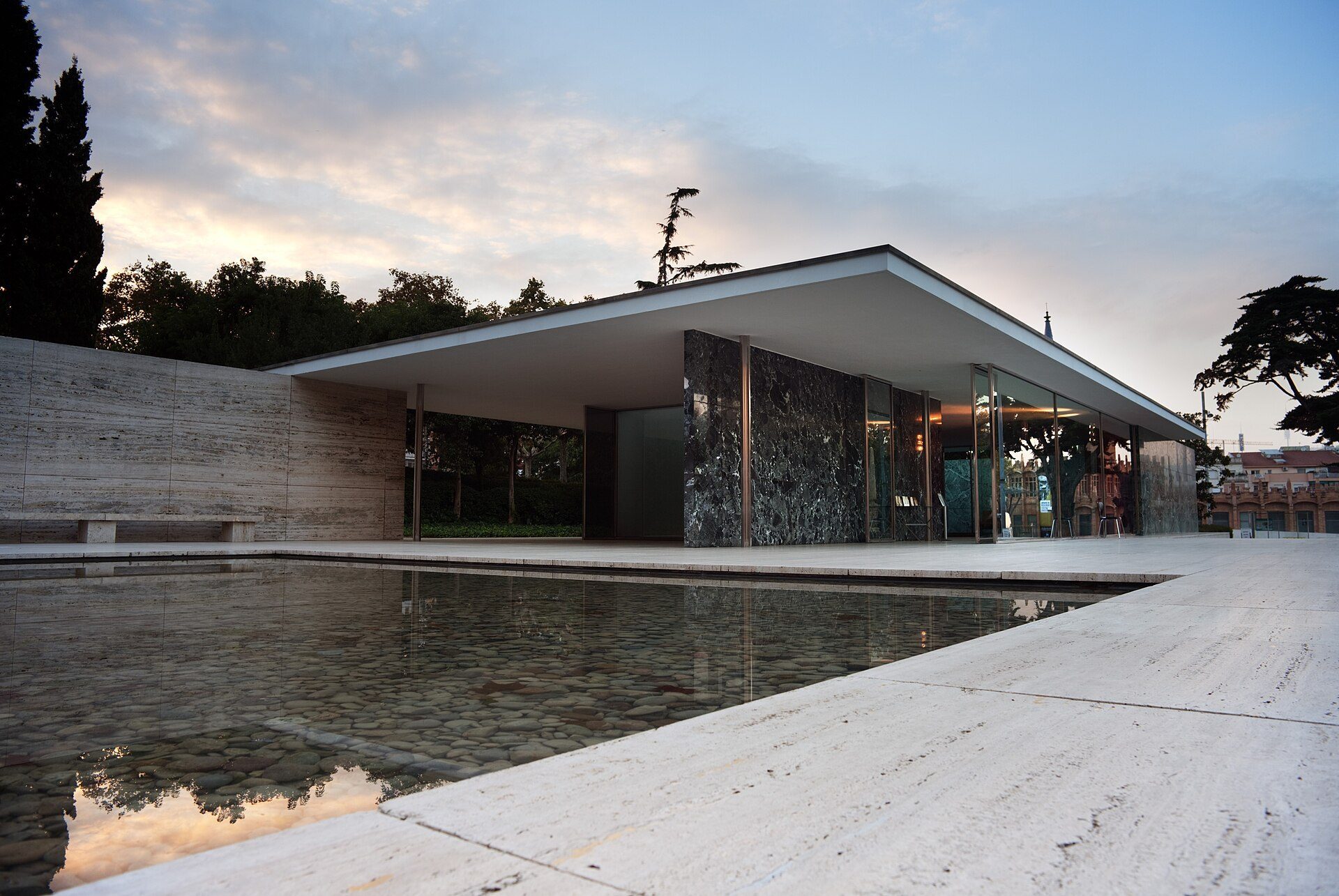
The Barcelona Pavilion, rebuilt in 1986 on the site of the 1929 German Pavilion by Mies van der Rohe and Lilly Reich. Photo: Ashley Pomeroy, CC BY 3.0, via Wikimedia Commons. Ashley Pomeroy at English Wikipedia, source, CC BY 3.0
2. Frank Gehry: Easy Edges rocking chair (early 1970s)
Before his buildings became famous, Frank Gehry launched Easy Edges (1969–1973), a range of low-cost furniture made from layers of corrugated cardboard laminated together, including the Wiggle side chair and a rocking chaise. The idea was mass-produced furniture from an industrial, inexpensive material; Gehry withdrew the line in the early 1970s, and Vitra later reissued the Wiggle chair.

Frank Gehry – “Rocking Chaise”
3. Eero Aarnio: Ball chair (1963)
The Ball chair, also called the Globe chair, is the one piece in this list not designed by an architect: Eero Aarnio is a Finnish interior and furniture designer. He designed it in 1963 and showed it at the Cologne furniture fair in 1966, where it became his international breakthrough. The fibreglass shell on a swivel base forms a room within a room, which explains its appeal to architects and set designers.

Eero Aarnio Ball Chair
4. OMA (Rem Koolhaas): adjustable table and chair, Tools for Life (2013)
Rem Koolhaas‘s office OMA designed the Tools for Life collection for Knoll, launched at the Salone del Mobile in Milan in April 2013 for Knoll’s 75th anniversary; the project was led at OMA by Ippolito Pestellini Laparelli. It treats furniture as a tool rather than a design statement: the collection includes a table whose top rises and falls at the push of a button and a chair that adjusts in the same way, so one piece can serve work and social use.

Furniture from OMA and Rem Koolhaas’s collection for Knoll
5. OMA: stacked swivelling counter, Tools for Life (2013)
The same collection includes a counter made of three stacked horizontal elements that swivel independently, so that it can be arranged as a bench, a table or a long shelf. The collection won a 2014 Architizer A+ Award for products.

Courtesy of OMA
6. Zaha Hadid: Mesa table (2007)
Mesa was designed for the Vitra Edition 2007, a series of experimental, limited-edition pieces shown on the Vitra Campus at Weil am Rhein. Its top and base are linked by a web of voids, so that the openings define the structure as much as the solid; the effect echoes the flowing forms of Hadid’s buildings. It was produced as a signed, numbered limited edition in glass-fibre-reinforced plastic and polyurethane.

© Eduardo Perez
7. Emmanuelle Moureaux: Mille-Feuille storage (2013)
Emmanuelle Moureaux, a French architect based in Tokyo known for her use of colour, designed the Mille-Feuille storage units for the German maker Schönbuch in 2013. Each unit is built by hand from stacked MDF layers painted in 8, 12 or 21 colours, depending on its size, and some of the layers open as hidden drawers. The layers are stacked precisely, and the shifting colours make each unit read as a striped block.

Mille-Feuille storage units by Emmanuelle Moureaux & Schonbuch
8. UNStudio: Gemini chair
UNStudio’s Gemini chair, made by Artifort, is an asymmetric seat: on one side its single surface curves down towards the floor, on the other it rises into an arm and backrest, so that the user can sit in different positions and directions. The chairs can be used singly or placed in pairs and groups.

9. UNStudio: MY Lounge Chair (2011)
UNStudio’s first chair was MYchair for Walter Knoll, launched in 2008. The MY Lounge Chair extended it into a family of seats and was first shown on Walter Knoll’s stand in Milan in 2011. It has a low reclining seat on a light steel frame.

10. UNStudio: SitTable (2010)
SitTable, designed for the Dutch brand Prooff and shown at the Interieur fair in Kortrijk in 2010, combines a table with seats built into its top, so that people can sit, lean or work at it in unconventional ways.

SitTable by UNStudio for Prooff
11. GRAFT: Fat Tony
Fat Tony by the Berlin architects GRAFT is a modular seating system: a kit of three cubic modules that can be rearranged into a sofa, an armchair, a chaise longue or a stool, so that it can be adapted to different rooms and uses.

Courtesy of Graft lab
12. GRAFT: double washbasin
GRAFT’s freestanding double washbasin treats the basin as an object in the middle of the bathroom rather than a fitting against the wall, so that two people can use it from either side.

13. J. MAYER H.: Lo Glo (2007)
J. MAYER H., the Berlin practice of Jürgen Mayer H., showed Lo Glo at the Vitra Edition 2007: a group of soft, pebble-like objects that glow in the dark, so that their function as a light is only revealed at night.

J. MAYER H. project team: Juergen Mayer H., Marcus Blum
14. J. MAYER H.: Soft Mosaic collection
The Soft Mosaic seats cover a soft, body-shaped form with small glass mosaic tiles, a material normally used for hard surfaces. Because glass mosaic is waterproof, the pieces suit wet areas such as spas and pool surrounds.

J. MAYER H. OBJECTS SOFT MOSAIC
15. Standard Architecture (Zhang Ke): Hidden Dragon sofa (2012)
Zhang Ke of the Beijing practice Standardarchitecture designed the Hidden Dragon sofa for Moroso’s installation “The Way of the Water Dragon” at Milan Design Week 2012. Asked to depict a dragon, he chose to make it hidden: the red sofa’s sinuous back rises and falls like a landscape and divides the seat into separate niches.

“Hidden Dragon” sofa for Moroso
The 15 pieces at a glance
The table lists the pieces of furniture designed by architects (and one designer) in this guide with their dates and makers, as found in the sources below. Where a date or maker could not be confirmed, the cell says so.
| No. | Piece | Designer | Year | Maker / edition |
|---|---|---|---|---|
| 1 | Barcelona chair | Ludwig Mies van der Rohe and Lilly Reich | 1929 | Knoll (current licensed maker) |
| 2 | Easy Edges rocking chaise | Frank Gehry | Early 1970s (series 1969–1973) | Easy Edges |
| 3 | Ball (Globe) chair | Eero Aarnio (designer) | 1963 | Shown in Cologne 1966; maker not confirmed here |
| 4 | Adjustable table and chair, Tools for Life | OMA (Rem Koolhaas; led by Ippolito Pestellini Laparelli) | 2013 | Knoll |
| 5 | Stacked swivelling counter, Tools for Life | OMA | 2013 | Knoll |
| 6 | Mesa table | Zaha Hadid | 2007 | Vitra Edition (limited) |
| 7 | Mille-Feuille storage | Emmanuelle Moureaux | 2013 | Schönbuch |
| 8 | Gemini chair | UNStudio (Ben van Berkel) | Not confirmed | Artifort |
| 9 | MY Lounge Chair | UNStudio | 2011 (MYchair 2008) | Walter Knoll |
| 10 | SitTable | UNStudio | 2010 | Prooff |
| 11 | Fat Tony | GRAFT | Not confirmed | Not confirmed |
| 12 | Double washbasin | GRAFT | Not confirmed | Not confirmed |
| 13 | Lo Glo | J. MAYER H. | 2007 | Vitra Edition |
| 14 | Soft Mosaic collection | J. MAYER H. | Not confirmed | Not confirmed |
| 15 | Hidden Dragon sofa | Zhang Ke, Standardarchitecture | 2012 | Moroso |
Source: Dezeen (Mesa 2007, Vitra Edition 2007, MYchair 2008, SitTable 2010, Tools for Life 2013); Emmanuelle Moureaux studio; Archello (Fat Tony); Designboom and Azure (Hidden Dragon 2012); Wikipedia (Easy Edges); Dwell/Artnet (Ball chair) (as of 30 October 2026).
Using a statement piece designed by architects at home
Most of these pieces were designed as objects to be seen from all sides, so they work best with space around them rather than pushed against a wall. A few practical points:
- Give it room: leave a clear walking route around a lounge chair or sculptural sofa, and do not place it where the route between doors cuts across it.
- Light it as an object: a low side light or a wall washer shows the profile of a shell chair or a glowing piece such as Lo Glo better than a single central ceiling light.
- Match the floor: heavy steel or stone pieces need protection pads on timber floors; rockers such as the Gehry chaise need a rug or a hard, level floor.
- Check the real thing: licensed manufacturers sell the authorised versions; many designs are still protected, so cheap copies may infringe design rights and rarely match the original’s materials.
Sources and further reading
- OMA for Knoll: Tools for Life (Dezeen, April 2013).
- Zaha Hadid: Mesa (Dezeen, June 2007).
- Emmanuelle Moureaux: Mille-Feuille, studio project page.
- UNStudio: SitTable for Prooff (Dezeen, October 2010).
- Frank Gehry: Easy Edges.


Muhammad Umair Siddiqui is an architect and former Arch2O assistant editor with expertise in urban design and architectural project management. Based in Pakistan, he brings strong skills in AutoCAD, 3ds Max, and Adobe Suite, combining technical proficiency with a deep understanding of design and planning principles.