

Most building collapses are not acts of nature: they follow human decisions such as an unchecked design change, extra floors added to a frame never designed for them, or warnings ignored once cracks appear. This article is for architects, engineers and students. It reviews ten of the deadliest and most instructive building collapses, corrects common errors in how they are retold, and draws out the design principles each one taught, from robustness against progressive collapse to the review of connection changes. Where standards are mentioned, the country and document are named; local codes always govern.
The architectural and structural engineering world is full of failures: some are minor, others are tragic and deadly.

©Mr. Williams Photography
10 Worst Building Collapses in the History of Architecture
The list mixes terrorism, construction fraud, geotechnical failure and design error. One entry, the Tacoma Narrows Bridge, is a bridge rather than a building, but its lesson about aerodynamics applies to tall and lightweight buildings too. Figures are from official inquiries or authoritative summaries linked in each entry.
1. Twin Towers, New York City, USA

©NIST/dpa/Picture Alliance
- Deaths: 2,753 at the World Trade Center (2,977 victims in all the 11 September attacks)
- Completed: 1970-73
- Collapsed: 11 September 2001
- Cause: aircraft impact followed by fire-weakened steel
The collapse of the Twin Towers is the deadliest of all modern building collapses. Each tower had a dense perimeter “tube” of steel columns and a central core, which let the structure redistribute loads after the impacts: both towers stood for 56 and 102 minutes after being hit. According to the US National Institute of Standards and Technology (NIST), the aircraft severed columns, stripped fireproofing from the floor trusses and columns, and spread jet fuel across several floors. The fuel itself burned off quickly; the multi-floor office fires that followed reached about 1,000 °C, weakening (not melting) the exposed steel until sagging floors pulled the perimeter columns inward and the upper block fell. Claims on the earlier version of this page about “90,000 gallons” of fuel and a “5,000-ton wind load” have been removed as unsupported.

Courtesy of Library of Congress, Prints & Photographs Division, Balthazar Korab Collection
2. Sampoong Department Store, Seoul, South Korea

©Commons Wikimedia
- Deaths and injuries: 502 killed, 937 injured
- Completed: 1989
- Collapsed: 29 June 1995
- Cause: structural overload and punching shear of the flat-slab floors
Sampoong is a case of criminal negligence. According to Britannica, planning permission was for a four-storey office block; the developer turned it into a department store during construction, cut columns to fit escalators, reduced column sizes and added a fifth floor. Heavy rooftop air-conditioning units added load. Cracks appeared in April 1995, but managers moved stock instead of closing the building. When the flat slabs punched through around the columns, the building fell in about 20 seconds with more than 1,500 shoppers and staff inside. It remains South Korea’s deadliest peacetime disaster, as the Korea Herald notes.
3. Lotus Riverside Block 7, Shanghai, China

©NIR ELIAS
- Deaths: 1 worker
- Status: newly built, not yet occupied
- Collapsed: 27 June 2009
- Cause: unbalanced soil pressure on the pile foundations
Block 7, one of 11 13-storey apartment buildings, toppled over almost intact at dawn. As the summary of the investigation explains, earth excavated for an underground garage on one side was piled high on the other side, next to a creek. Heavy rain saturated the pile, the creek bank gave way, and the sideways soil pressure snapped the precast piles. The building’s superstructure was sound, which is why it fell as one piece. Developers, contractors and officials were later prosecuted. The earlier version of this page wrongly blamed rain alone.

©Flickr
4. Edifício Liberdade and two neighbours, Rio de Janeiro, Brazil

©Seattle PI
- Deaths: 17 confirmed in the first days; later reports give 22 dead
- Collapsed: 25 January 2012 (evening)
- Cause: unauthorised renovation is the leading explanation
The 20-storey Edifício Liberdade near Rio’s Municipal Theatre collapsed in the evening, bringing down a ten-storey and a smaller neighbouring building and sending a wave of dust through the city centre. The collapse at night, when the offices were mostly empty, kept the toll from being far higher. A police inquiry pointed to office renovation works in which a column, pillars and structural walls were removed, and in 2024 a Rio court held the company responsible for the works liable, as Brazilian trade press reported, though some forensic engineers still consider the exact cause unresolved.
5. Hyatt Regency walkways, Kansas City, USA

©WJE
- Deaths and injuries: 114 killed, more than 200 injured
- Completed: 1980
- Collapsed: 17 July 1981
- Cause: a change to the hanger-rod connection that doubled the load on it
During a crowded tea dance, the fourth-floor walkway across the atrium tore loose and fell onto the second-floor walkway directly below, and both fell into the lobby. The original design hung both walkways from continuous rods; during shop-drawing preparation this was changed to two sets of rods, one from the ceiling to the fourth-floor walkway and another from that walkway down to the second. As the engineering ethics case record explains, the change doubled the load on the fourth-floor box-beam connection, which pulled through. The original detail was itself below the Kansas City code’s requirement, and the change was approved without a calculation. The engineers of record lost their licences.
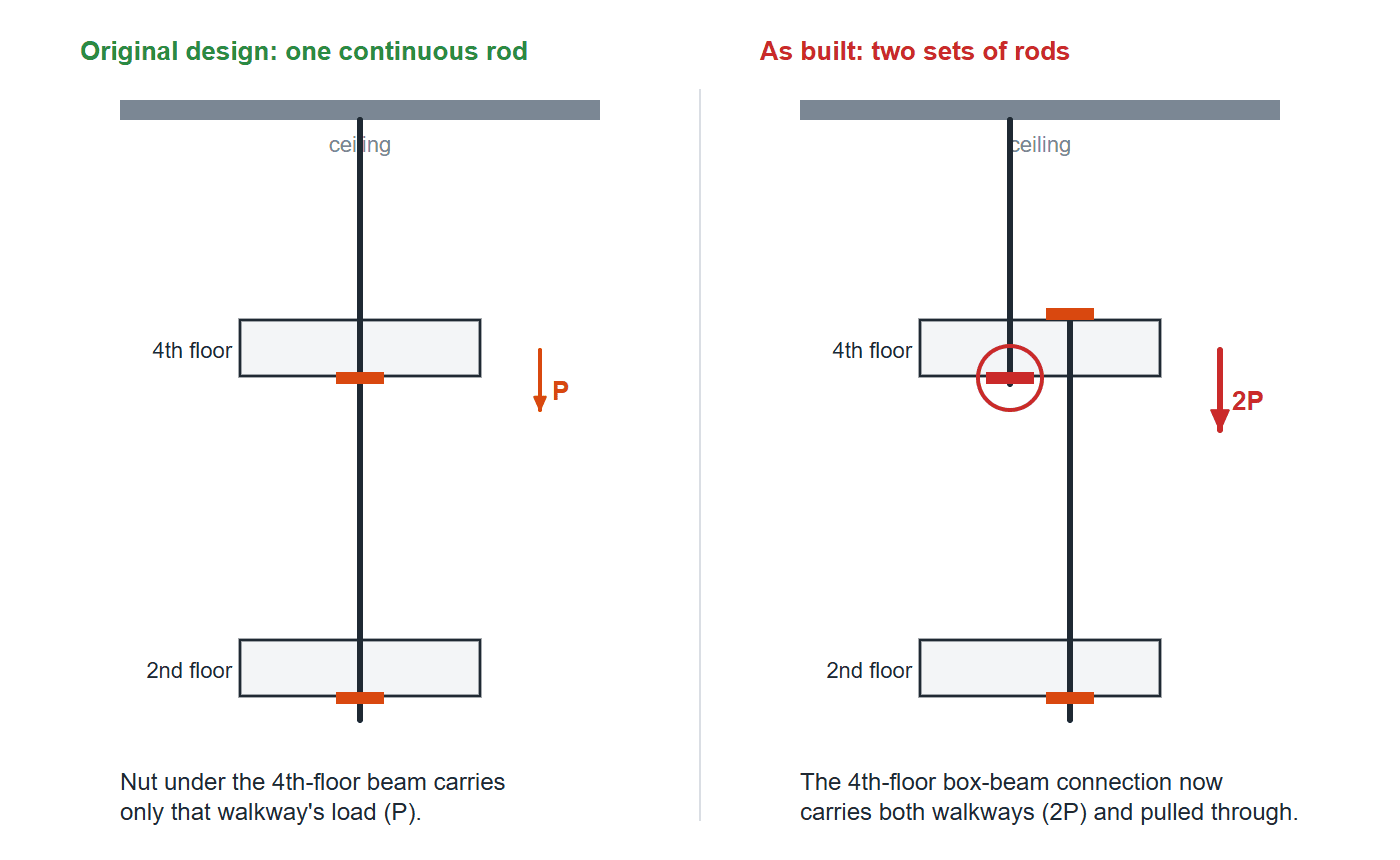
Hyatt Regency walkways, 1981: the original design hung both walkways from continuous rods, so each fourth-floor box-beam nut carried one walkway. The built change used two sets of rods, so the fourth-floor connection carried both walkways and pulled through. Diagram: Arch2O
6. Tacoma Narrows Bridge, Washington, USA

©Seattle Times
- Deaths: none (a dog left in a car died)
- Opened: 1 July 1940
- Collapsed: 7 November 1940
- Cause: aeroelastic (torsional) flutter of a slender, solid deck
When it opened, the bridge had the third-longest suspension span in the world. To save money, the designer Leon Moisseiff replaced the deep open stiffening truss of an earlier proposal with shallow solid plate girders. Wind could not pass through the deck, and in a moderate wind of about 65 km/h (40 mph) the deck began to twist in a self-reinforcing motion, aeroelastic flutter, until hangers snapped and the main span fell into the water, as Practical Engineering explains. It is not simple resonance, as it is often described. Wind-tunnel testing of long-span bridges and tall buildings stems from this failure.
7. Rana Plaza (Savar Building), Dhaka, Bangladesh

©CNN
- Deaths and injuries: 1,134 killed, about 2,500 injured
- Collapsed: 24 April 2013
- Cause: illegal upper floors, industrial loads in a building designed for shops and offices, and ignored warnings
The eight-storey Rana Plaza held clothing factories, a bank and shops. Upper floors had been added without permission, and heavy generators and machinery vibrated a frame designed for commercial use. Cracks appeared on 23 April; the bank and shops on the lower floors closed, but garment workers were ordered back the next morning and the building collapsed during the morning shift. It is the deadliest garment-factory disaster in history and led to the Bangladesh Accord on fire and building safety.
8. Ronan Point, London, England

©Research Gate
- Deaths and injuries: 4 killed, 17 injured
- Completed: March 1968
- Collapsed (partially): 16 May 1968
- Cause: gas explosion in a large-panel system building without robust joints
Two months after the 22-storey tower in Newham opened, Ivy Hodge struck a match on the 18th floor to make tea; a gas leak at her new cooker exploded and blew out a load-bearing flank wall panel. With nothing to tie it in, the panel structure above collapsed, and the falling debris carried away the corner of the building below. Hodge survived. As Designing Buildings records, the failure led to the UK rule that a building must not suffer collapse “disproportionate” to its cause, now Requirement A3 of the Building Regulations in England.
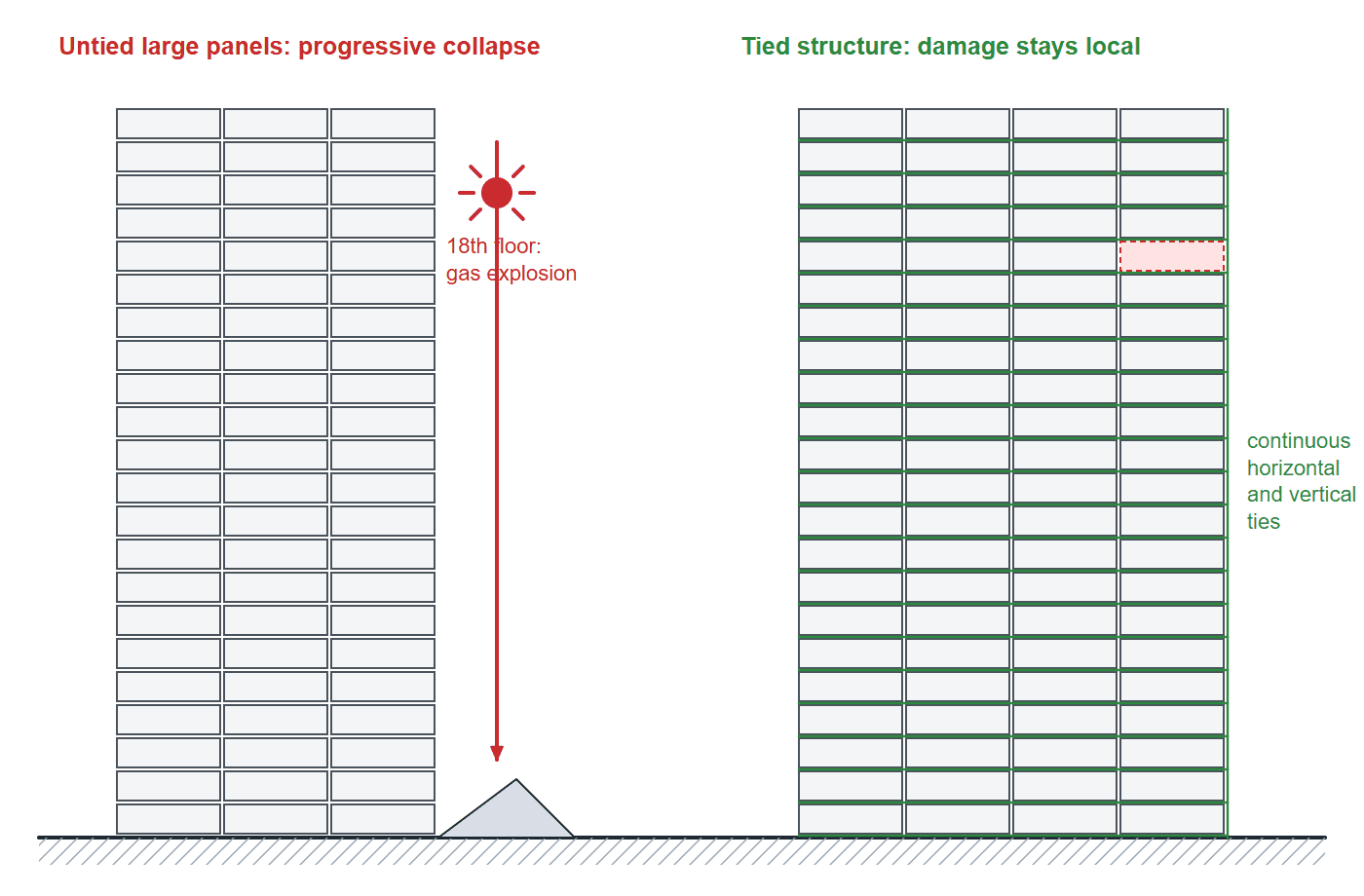
Ronan Point, 1968: a gas explosion on the 18th floor blew out a load-bearing flank wall panel; with no ties to hold it, the floors above collapsed and the debris carried away the corner below. Robust design ties floors and walls together so local damage stays local, the basis of the UK rule on disproportionate collapse. Diagram: Arch2O
9. Highland Towers, Selangor, Malaysia

©NST
- Deaths: 48
- Completed: 1978
- Collapsed: 11 December 1993
- Cause: slope failure after poor drainage and retaining-wall design
Block 1 of the three 12-storey Highland Towers blocks in Ulu Klang fell after ten days of continuous rain, the New Straits Times recalls. Inadequate drainage on the hillside above, and works on the slope, let groundwater build up until a landslide destroyed the retaining wall behind the car park and undermined the block’s foundations. Signs of damage were visible for days before the collapse. The “force of 200 jumbo jets” comparison on the earlier version of this page had no source and has been removed.
10. Royal Plaza Hotel, Nakhon Ratchasima, Thailand

Image via Bangkok Post
- Deaths and injuries: 137 killed, 227 injured
- Collapsed: 13 August 1993
- Cause: three storeys added to a three-storey frame without strengthening
The hotel was extended from three to six storeys without the columns and foundations being checked or strengthened. Over time the overloaded ground-floor columns deformed under sustained load (creep); when one failed, the rest followed and the building collapsed almost vertically within seconds, leaving only the separately built lift core. As the record of the case notes, the architect who oversaw the extension was later convicted of negligence, and his sentence was raised to life imprisonment on appeal.
Why buildings collapse: principles explained with diagrams
Across these building collapses, the same six principles recur. They are general design lessons, not a substitute for the structural codes that apply where you build.
- Robustness against progressive collapse. A local failure must not spread. In England this is Requirement A3 of the Building Regulations, with guidance in Approved Document A; in Europe, EN 1991-1-7 (accidental actions); in the US, ASCE 7 and the GSA and Department of Defense progressive-collapse guidelines. Tie forces, alternative load paths and key elements are the main methods (Ronan Point, Twin Towers).
- Every change to a connection is a structural change. Substitutions made during shop drawings or on site need the same calculation and sign-off as the original design (Hyatt Regency).
- Change of use and added storeys require reassessment. New loads, removed columns and extra floors must be checked against the existing frame and foundations by a qualified engineer and approved by the authority (Sampoong, Rana Plaza, Royal Plaza, Edifício Liberdade).
- Ground and water are part of the structure. Temporary works, spoil heaps, excavations, drainage and retaining walls can overturn a sound building (Lotus Riverside, Highland Towers).
- Light, slender structures need aerodynamic checks. Wind-tunnel testing or specialist analysis is standard for long spans and tall towers (Tacoma Narrows).
- Cracks are warnings. When distress appears, the building should be evacuated and assessed; in several cases above, people died because owners kept the building open (Sampoong, Rana Plaza, Highland Towers).
Physical evidence matters to these lessons. A fragment of the Tacoma Narrows Bridge’s steelwork is kept by the Washington State History Museum in Tacoma, a reminder that the study of building collapses and structural failures starts with what is left behind.
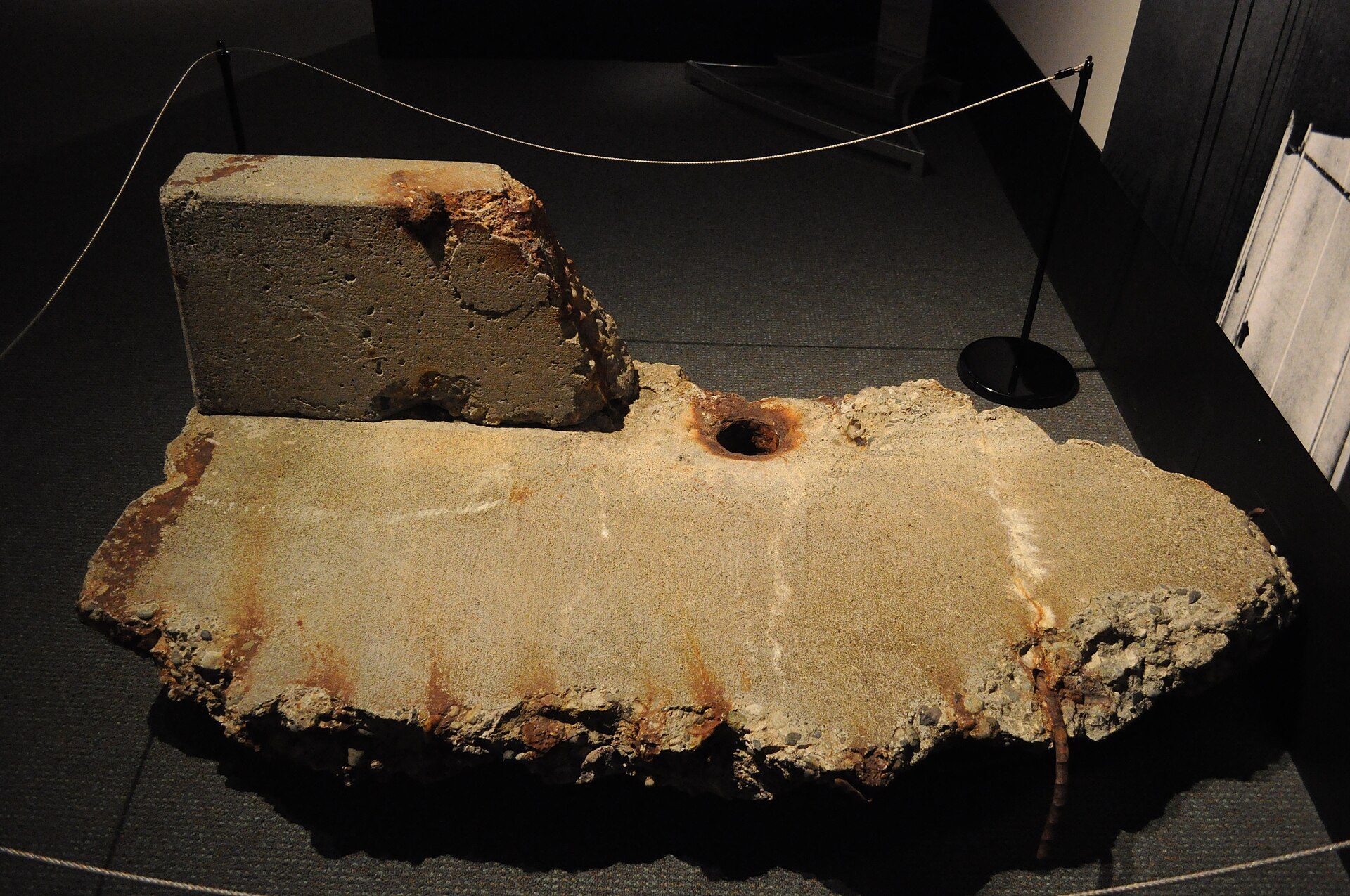
A fragment of the first Tacoma Narrows Bridge ('Galloping Gertie') at the Washington State History Museum, Tacoma. Photo: Joe Mabel, CC BY-SA 3.0, via Wikimedia Commons. Joe Mabel, source, CC BY-SA 3.0
Precedent analysis: what changed afterwards
Three of these building collapses changed practice well beyond their own countries. Ronan Point created the modern idea of disproportionate collapse and the requirement to tie large-panel and precast structures together; many UK system-built towers were later strengthened or demolished. The Hyatt Regency collapse made the responsibility of the engineer of record for connection design a standard case in professional-ethics teaching, as the US National Bureau of Standards investigation made the failure mechanism clear. And after the Twin Towers, NIST’s recommendations on fireproofing, structural robustness and evacuation fed into US model building codes. Each shows how a forensic investigation turns a disaster into a rule.

For a different view of where architecture is heading, from engineering ambitions to speculative designs, see our look at futuristic architecture.
Sources and further reading
- NIST, FAQs on the WTC towers investigation.
- National Bureau of Standards, Investigation of the Kansas City Hyatt Regency walkways collapse (NBSIR 82-2465).
- Designing Buildings: disproportionate collapse (UK Requirement A3).
- Online Ethics Center: Hyatt Regency case.

Toqa Mostafa is a dedicated editor at Arch2O, bringing a sharp editorial perspective to architectural storytelling. Based in Egypt, she curates and refines content that showcases innovative design and urban solutions. Her work at Arch2O highlights her ability to engage readers with compelling narratives, bridging architectural creativity and critical discourse. Toqa’s editorial expertise contributes significantly to Arch2O’s mission of exploring the intersection of design, technology, and sustainability.