

Australian wellness entrepreneur Tony de Leede has taken Gwinganna Lifestyle Retreat off the market and committed to invest up to AU$12 million (US$8.4 million) in a major transformation of the property. The Gwinganna wellness retreat expansion follows the retreat’s 20th anniversary on 11 March 2026, and de Leede calls it Phase Two, the next 20 years. It reverses his plan of June 2025 to sell the retreat for AU$70 million to AU$80 million so that he could step back from the business. “At the age of 73 I am going to do everything I can to celebrate the next 20 years,” he says.
De Leede explains that the original sale plan grew out of a deal he watched from the outside. The 2021 sale of competitor Gaia Retreat and Spa, co-founded by the late Olivia Newton-John, went to the Australian investment group Tattarang, controlled by billionaire Andrew Forrest and his then wife Nicola. “The reason was at the end of Covid, one of our biggest competitors Gaia was sold at a significant premium,” he says. He then tested the market himself, aiming for double the price Gaia achieved, because he believed Gwinganna should technically have been worth triple. He has now chosen to keep the business and build a programme aimed at growing consumer interest in recovery, preventative health and longevity.
The first phase of the work changes the spa itself, starting with a new contrast therapy area, meaning a sequence of hot and cold treatments. It will include hot bathing pools with mineral and magnesium treatments, two cold plunge pools and additional infrared barrel saunas. The existing spin studio will become a dedicated recovery area with breathing and meditation chairs, massage and recovery chairs, a Somadome, individual infrared saunas and compression therapy boots. De Leede is working with architect Pouné Parsanejad of Studio P, who designed several of Gwinganna’s original buildings, including its spa sanctuary.
Guest rooms are the second major change, and de Leede describes the result as Australia‘s first true wellness suites. “By this I mean 80 per cent of our rooms will have their own personal infrared saunas, massage chairs and LED light therapy panels so people can stand in private to get their light therapy,” he says. Most of the upgrades are expected to be finished by the end of 2026, while the wider investment programme is scheduled for completion by mid-2027. The next stage, the Gwinganna Longevity Project, arrives in 2027 and brings health testing and personalised supplementation, delivered with a partner company that de Leede believes can do it correctly.
The mix of services reflects who the retreat serves, because de Leede sees the Baby Boomer generation as underserved by the wellness industry. “People who are 55 and older control approximately 80 per cent of the wealth and they are increasingly willing to spend their wealth to protect their health,” he says. He adds that the team is assembling many ways to extend guests’ health span and life span, with the aim of living longer and better. He also believes wellness, recovery and longevity services are moving beyond health clubs and spas into apartments, hotels, residences and office buildings.
Read more:
- The First Cortina Hotel to Open with a 1,200sq m Revivo Spa in the Dolomites
- Vilnius SPA – Anykščiai | SP Architektu Grupe
- Active Therapy Center R3 | Gabriel Gomera Studio
Alongside the retreat upgrades, de Leede is planning Project Canopy, Domes of Gwinganna, a separate nature-based experience for day visitors. The proposed AU$6 million to AU$8 million development is progressing with support from Gold Coast City Council as part of its ambitions to grow nature-based tourism. De Leede anticipates that it could open by the end of 2027 or the first quarter of 2028, if development applications and approvals line up, and he believes the combination of experiences could be a world first. Together, the two projects represent a potential investment of AU$9 million to AU$12 million.
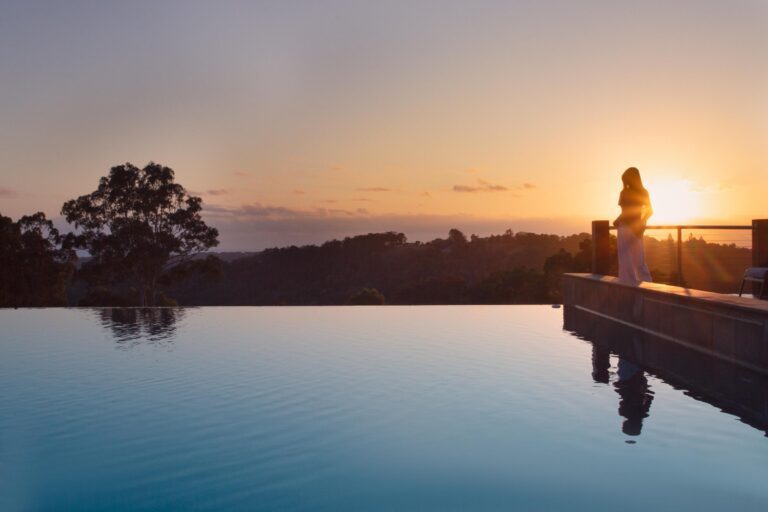
Exclusive: Tony de Leede takes Gwinganna off the market and unveils ambitious plans for its next 20 years
The project is built around two domes. The Geo Dome would run a 45-minute multi-sensory journey through an imagined Australian eucalyptus forest, then through cultural and musical storytelling, a sunset sequence and a final period of stillness. Its technology plans call for a 12 to 14-metre dome with multiple high-resolution laser projectors, 3D spatial audio, programmable scent, optional haptic feedback through lounge beds and a control system to synchronise everything, with capacity of roughly 28 to 62 beds depending on the layout. The Ancient Healing Dome takes the opposite approach, because it is an earthen, softly lit enclosure with two rings of beds around a central performance area.
- Geo Dome: 12 to 14 metres in diameter, with indicative capacity of 28 to 62 beds
- Ancient Healing Dome: 12 to 14 metres in diameter and about 7 to 8 metres high, with indicative capacity of 28 to 42 beds
- Potential suppliers or consultants: The Dome Company, IKONIX and Amber Technology, none yet confirmed as contractors
- Visitor journey: about four hours, including a 15 to 20-minute coach ride from an off-site arrival area
The Ancient Healing Dome would use no projection at all, relying on live gongs, crystal bowls, handpan and chimes, with the didgeridoo included through a partnership with Traditional Owners. The plans state that its design and capacity remain to be tested. Any First Nations language, stories or performances are intended to be developed with local Traditional Owners on their terms. Beyond the domes, the proposal includes guided and self-guided nature trails and a mountain bathing experience with hot and cold contrast therapy, infrared saunas, light therapy, and breathing, meditation and recovery massage pods, plus possible mountain dome accommodation whose timing is still unclear.
De Leede has no immediate plans to bring in outside investors. Existing shareholder Hugh Jackman has expressed interest in becoming more closely involved with the destination and is expected to visit the retreat shortly, although no investment arrangement has been confirmed. De Leede says the decision to keep Gwinganna has given him a renewed sense of purpose: “I have no interest in playing golf, I don’t like fishing very much and I don’t watch cricket or football on TV. This gives me joy and this new project is just about the most exciting thing I have ever done and it keeps me vibrant and happy.” Gwinganna occupies a 320-acre site in Queensland’s Tallebudgera Valley, in the Gold Coast hinterland, and de Leede also owns Komune Resort in Bali, where further developments are planned.
For more background, see our guide to minimalist bathroom design.

Jane Doe is an American architectural editor with a deep-rooted passion for design and the built environment. She holds a degree in Architecture from Columbia University, where she developed a strong foundation in both architectural theory and urban studies. With over a decade of editorial experience, Jane specializes in shaping content that bridges architecture, urbanism, and cultural discourse. Her work spans leading design publications, exhibition texts, and digital platforms, where she is known for her clear, engaging narratives and her ability to translate complex spatial ideas for a broad audience. Jane is particularly interested in issues of equity, sustainability, and the evolving role of cities in a changing world.