

There is no single official list of the best architecture schools in the US, but the most-cited international ranking, the QS World University Rankings by Subject 2026 (Architecture and Built Environment), places MIT highest among US universities (2nd worldwide), followed by Harvard, UC Berkeley, Columbia and Cornell. For anyone planning to practise in the US, the more important test is whether a programme is accredited by the National Architectural Accrediting Board (NAAB). This decision guide is for prospective students: it compares what the rankings measure, explains accreditation, admissions and real costs, and ends with a checklist.
Arch2O has covered top architecture schools worldwide and earlier lists of the best architecture schools in the USA; you can also browse our older coverage via site search. This page focuses on how to use rankings well rather than repeating a list.
What is the #1 architecture school in the US?
On the QS 2026 subject table, published on 25 March 2026, MIT is the top-ranked US institution and second in the world after University College London (The Bartlett). Rankings of this kind measure the reputation and research output of the whole university in the field, not the quality of one studio or the fit for one student, so treat “number one” as a starting point for research, not a verdict.

The Great Dome and Killian Court at MIT, Cambridge, Massachusetts; MIT is the highest-ranked US university in the QS 2026 architecture subject table. Photo: Peacearth, CC BY-SA 4.0, via Wikimedia Commons. Peacearth, source, CC BY-SA 4.0
1. MIT: architecture inside an institute of technology
MIT’s Department of Architecture sits in the School of Architecture and Planning and is organised into discipline groups, including Architecture and Urbanism, Building Technology, Computation, and History, Theory and Criticism, with the Art, Culture and Technology programme alongside. The structure is the useful fact for applicants: if you want to combine design studios with building performance or computation, MIT puts those groups in one department.
For a step-by-step view of applying, especially as an international candidate, see Your 5 Steps Guide to Join Architecture Schools in USA.

Core II Inge D
2. Harvard GSD: architecture alongside landscape and urbanism
Harvard’s Graduate School of Design (GSD) teaches architecture together with landscape architecture and urban planning and design, so students can take courses and studios across those departments. Its studio space is the stepped open “trays” of Gund Hall, designed by John Andrews and opened in 1972, where students of all programmes work in one large room.

Gund Hall (John Andrews, 1972), home of the Harvard Graduate School of Design, Cambridge, Massachusetts. Photo: Daderot, CC0, via Wikimedia Commons. Image: Daderot (Creative Commons Zero)
History still matters in these curricula; read our essay on whether history of architecture still has a place in today’s schools.

Critical Intervention
3. Princeton: a small school with a strong history and theory tradition
Princeton’s School of Architecture is much smaller than MIT or Harvard, offering a professional M.Arch and a doctoral programme alongside its undergraduate major. A smaller school usually means smaller studios and closer contact with faculty; it also means fewer electives, so compare the course lists, not just the name. Princeton sits lower on the QS subject table (39th in 2026) than its reputation among architects might suggest, which is a good reminder that one ranking does not capture everything.
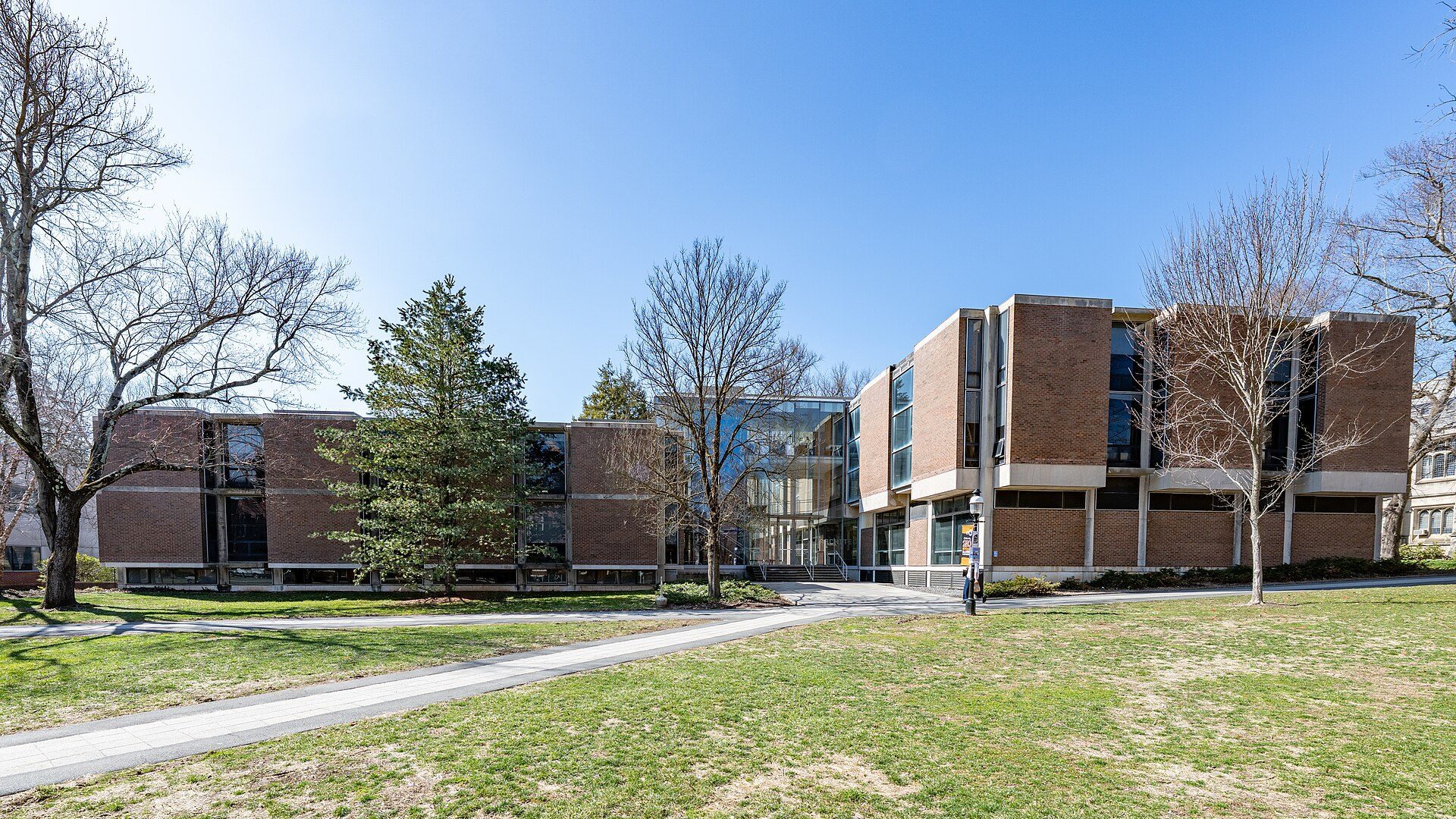
Princeton University School of Architecture, Princeton, New Jersey. Photo: ajay_suresh, CC BY 4.0, via Wikimedia Commons. ajay_suresh, source, CC BY 4.0
The physics complex shown below is on the same campus but is not the architecture school’s home; when you visit, ask to see the studios and workshops you would actually use.

Princeton University Center for Theoretical Physics
How architecture school rankings work
Different rankings measure different things, and the same school can sit in very different places depending on which you read. Earlier Arch2O pieces on architecture school rankings in the UK show the same pattern. The main sources are:
- QS World University Rankings by Subject (annual; 2026 edition published March 2026): based on academic reputation, employer reputation and research citation measures for the whole university in “Architecture and Built Environment”, which also covers planning and construction research.
- DesignIntelligence (US, periodic): surveys of hiring firms and academics about the programmes they most admire. We could not confirm the latest edition, so check the publisher before quoting a recent rank.
- NAAB accreditation: not a ranking, but a pass/fail check of whether a professional degree meets the standards that US licensing boards rely on.
The table below shows where US universities sit in the QS 2026 subject table. It is a reputation-and-research view of whole universities; use it to build a shortlist, then compare the programmes themselves.
| University | QS 2026 world rank | NAAB-accredited professional degree(s) |
|---|---|---|
| Massachusetts Institute of Technology | 2 | M.Arch |
| Harvard University | =7 | M.Arch |
| University of California, Berkeley | 10 | M.Arch |
| Columbia University | 16 | M.Arch |
| Cornell University | =19 | B.Arch, M.Arch |
| Georgia Institute of Technology | =28 | M.Arch |
| Stanford University | =28 | None (no accredited professional degree; check) |
| University of California, Los Angeles | 32 | M.Arch |
| University of Pennsylvania | =34 | M.Arch |
| Yale University | =36 | M.Arch |
| Princeton University | 39 | M.Arch |
| University of Michigan | 49 | M.Arch |
Source: QS World University Rankings by Subject 2026 (published 25 March 2026), via xuanxiao.org mirror cross-checked with UCL, Tsinghua and Tongji announcements; degree types from school/NAAB pages – verify each on the NAAB directory (as of 2026-11-01).
When you compare programmes, look past the rank at what you will actually do. Check the studio sequence, the technology and fabrication teaching, and the electives you can take. Many schools combine design tools with analysis software, from Rhino and Grasshopper to energy and daylight simulation; online architecture courses are a cheap way to test which kind of teaching suits you before you apply.
Which Ivy League school has the best architecture program?
On the QS 2026 table, Harvard ranks highest of the Ivy League universities (joint 7th worldwide), followed by Columbia (16th), Cornell (joint 19th), Penn (joint 34th), Yale (joint 36th) and Princeton (39th). Brown and Dartmouth do not offer NAAB-accredited professional degrees. Each school has a distinct character:
Yale: design-build from the first year
Yale School of Architecture is housed in Paul Rudolph’s Rudolph Hall (1963). Its best-known feature is the Jim Vlock First Year Building Project, founded in 1967 and compulsory for first-year M.Arch I students: the class designs a house for a local partner organisation and then helps build it. Since 1989 the project has focused on affordable housing in New Haven (Yale School of Architecture).

Rudolph Hall (Paul Rudolph, 1963), home of the Yale School of Architecture, New Haven, Connecticut. Photo: Ɱ, CC BY-SA 4.0, via Wikimedia Commons. Ɱ, source, CC BY-SA 4.0
Columbia: architecture in New York
Columbia’s Graduate School of Architecture, Planning and Preservation (GSAPP) is based in Avery Hall, which also houses the Avery Architectural and Fine Arts Library, one of the largest architecture libraries in the world. The school’s setting means many studios and research projects deal with New York and other large cities, and it offers preservation and real-estate development programmes alongside architecture.
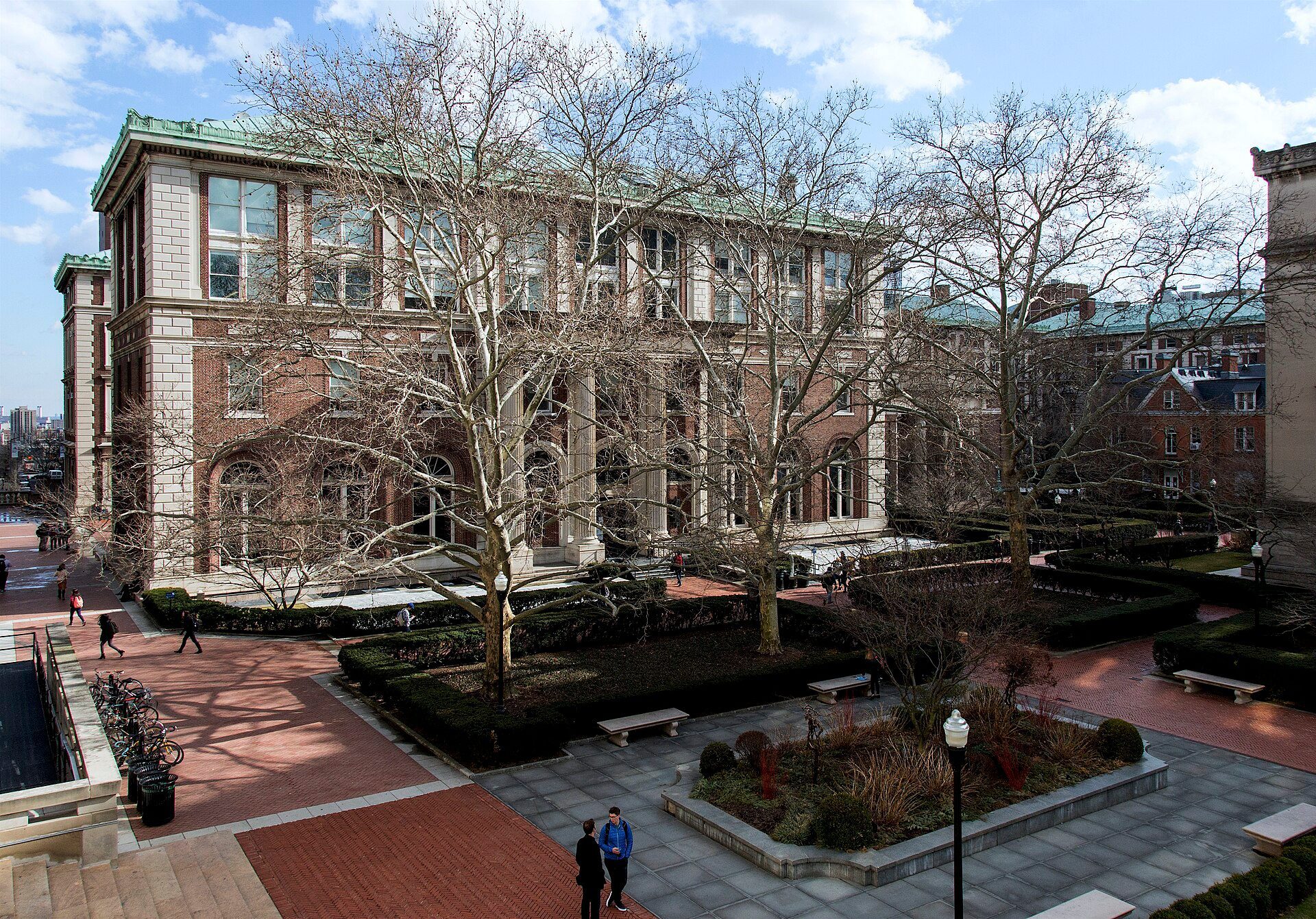
Avery Hall, Columbia University, New York, home of GSAPP and the Avery Architectural and Fine Arts Library. Photo: GSAPPstudent, CC BY-SA 4.0, via Wikimedia Commons. GSAPPstudent, source, CC BY-SA 4.0
Harvard, Princeton, Cornell and Penn
Harvard and Princeton are covered above. Cornell is unusual among the Ivies in offering a five-year professional B.Arch as well as an M.Arch, and Penn’s Weitzman School offers an M.Arch with several dual-degree options. Both appear in the comparison table rather than in separate profiles here.
Admission requirements and portfolio evaluation
Graduate programmes in architecture usually ask for a bachelor’s degree, transcripts, a portfolio, a statement of purpose and letters of recommendation; many top schools no longer require the GRE, and international applicants need an English-language test score. Check each school’s current requirements, because they change from year to year. Schools do not publish a minimum GPA that guarantees admission; the portfolio carries the most weight for most design programmes.
What the portfolio needs to show
Admissions reviewers want to see how you think, not just finished images. Our guide on how to build an architecture portfolio covers selection and layout. In short: show process (sketches, models, iterations), explain your role in group work, and include work outside architecture if it shows spatial thinking, such as art, photography or making.

Software and coding
Most programmes expect basic drawing and 3D modelling software skills on entry, and teach the rest. Coding (Python, Grasshopper) is not normally an admission requirement, but it is useful if you are interested in computation-led programmes such as MIT’s.
How much does architecture school cost?
Graduate architecture school in the US is expensive, and professional M.Arch degrees for students without an architecture background take about three years. Two official examples:
- Harvard GSD publishes a 2026-27 budget for master’s students of $104,802 per academic year: $64,000 tuition plus health insurance and fees, food and housing ($24,624), books and materials ($3,500) and personal costs (Harvard GSD tuition page).
- University of Pennsylvania estimated the total cost of its 3-year M.Arch for students starting in 2024-25 at $273,457 to $293,405, of which $205,858 was tuition and fees (Penn Weitzman estimated cost).
Public universities usually cost less, particularly for in-state students, but check each school’s own cost-of-attendance page; we have not quoted a general range because figures vary widely by state and residency. Ask every school about scholarships, teaching and research assistantships, and model-making and printing costs, which can add significantly to the budget.
Is architecture the hardest degree?
Architecture is known for long studio hours, and student surveys regularly place it among the most time-intensive subjects. “Hardest” depends on the student, but plan for a heavy workload, especially in the weeks before reviews.
Licensure and career outcomes
In the US, licensing boards set the rules, but most require a professional degree from a NAAB-accredited programme. NAAB accredits three professional degrees: the Bachelor of Architecture (B.Arch, usually five years), the Master of Architecture (M.Arch) and the Doctor of Architecture (D.Arch). Accreditation is granted for terms of up to eight years. After the degree, candidates complete the NCARB Architectural Experience Program and the Architect Registration Examination. Some states allow other routes, so check the board in the state where you want to practise. Arch2O lists schools that offer integrated paths to the architect licence.
Programmes are also adding teaching on AI and machine learning and on environmental performance, from life-cycle assessment to energy simulation. Climate-responsive design matters everywhere, including in schools that promote sustainability in developing countries. If you are open to studying abroad, compare our guides to top architecture schools in Europe and top architecture schools in Germany; check whether a foreign degree will be recognised where you want to work.
Checklist: choosing among the best architecture schools in the US
- Confirm accreditation. Look the exact degree up on the NAAB programme directory. A “pre-professional” bachelor’s is not an accredited degree.
- Read rankings by method. Use QS for global research reputation and firm surveys for employer views; neither measures teaching quality directly.
- Compare the curriculum. Studio sequence, technology courses, electives across departments, design-build or travel opportunities.
- Work out the full cost. Use each school’s official cost-of-attendance page, then subtract realistic funding offers.
- Talk to current students and recent graduates. Ask about studio culture, workload and where graduates work.
- Prepare the portfolio early. Allow several months to select, document and lay out your work.
Common mistakes to avoid
- Choosing by overall university fame rather than by the architecture programme.
- Applying to a non-accredited degree without realising it adds years to licensure.
- Comparing tuition only, ignoring living costs, materials and the length of the programme.
- Treating a ranking from several years ago as current.
Final thoughts
Choosing among the best architecture schools in the US is about fit, not only prestige. Use the rankings to build a shortlist, accreditation to remove programmes that will not lead to a licence, and the checklist above to compare cost, curriculum and culture. Then talk to the people who study and teach there.
Sources and further reading
- QS World University Rankings by Subject 2026: Architecture and Built Environment (TopUniversities; ranks cross-checked via a mirror and school announcements).
- NAAB programme directory and Cornell AAP’s NAAB statement.
- Harvard GSD tuition and budget; Penn Weitzman estimated cost.
- Yale Jim Vlock First Year Building Project.

Sophie Tremblay is a Montreal-based architectural editor and designer with a focus on sustainable urban development. A McGill University architecture graduate, she began her career in adaptive reuse, blending modern design with historical structures. As a Project Editor at Arch2O, she curates stories that connect traditional practice with forward-thinking design. Her writing highlights architecture's role in community engagement and social impact. Sophie has contributed to Canadian Architect and continues to collaborate with local studios on community-driven projects throughout Quebec, maintaining a hands-on approach that informs both her design sensibility and editorial perspective.