

The best architecture schools for a student depend on the degree route, teaching approach, cost and country in which they want to practise. A university’s reputation cannot answer all of those questions.
The international shortlist below is not a numbered ranking. It compares specific programmes through their published information and explains what to check before applying. Programme and accreditation information was reviewed in October 2026; verify the requirements for your intended intake.
Start with the qualification you need
An undergraduate architecture degree may be a professional qualification or preparation for further study. A master’s degree may be a first professional degree or a specialised degree for someone already qualified. Similar titles can lead to different routes.
For the United States, check the NAAB programme directory and the requirements of the relevant licensing jurisdiction. Accreditation applies to the named degree programme, not every course offered by a famous university. Our B.Arch and M.Arch comparison explains the distinction in more detail.
Architecture programmes to compare
| School | Programme to investigate | Question for your shortlist |
|---|---|---|
| MIT, United States | Master of Architecture | Does the professional route match your previous education? |
| Harvard GSD, United States | Master of Architecture I | How do its studio sequence and entry route fit your background? |
| Cornell AAP, United States | Bachelor of Architecture | Do you want a professional undergraduate architecture route? |
| UCL Bartlett, United Kingdom | Architecture MArch | How do its design units and qualification stage match your plans? |
| ETH Zurich, Switzerland | MSc ETH in Architecture | Do you meet the academic and language requirements? |
| TU Delft, Netherlands | MSc Architecture, Urbanism and Building Sciences | Which track fits your intended field and registration route? |
| NUS, Singapore | Master of Architecture | How does the programme fit your prior qualification and regional interests? |
MIT: distinguish the professional and research routes
MIT’s architecture department offers several graduate pathways. Compare the professional MArch with specialised or research degrees rather than treating them as interchangeable. Read the programme-specific admissions requirements alongside the curriculum.
For your application, identify the kind of studio and research work you want to pursue. Then select portfolio projects that demonstrate relevant thinking, development and communication, rather than relying on the school’s name as the reason for applying.
Harvard GSD: examine the MArch I sequence
The MArch I programme provides a professional route with its own entry and curriculum structure. Review the studio progression, required technical courses and the rules for any advanced placement.
Ask how much of the advertised range you can actually take within the required programme. Electives, travel, workshops and research opportunities are valuable when they fit the timetable and your budget.
Cornell: consider a professional undergraduate route
Cornell’s B.Arch is a NAAB-accredited professional programme. It is a different starting point from a non-professional bachelor’s degree followed by a professional master’s.
Compare the sequence and total commitment of the whole route, including how studio requirements interact with other study. Transfer applicants should examine the programme’s own standing and credit rules instead of assuming that completed years will transfer directly.
UCL Bartlett: look closely at the actual course
The Architecture MArch is distinct from other architecture-related master’s courses. Examine its design units, portfolio expectations and stated professional recognition for the intake you intend to join.
The UK’s education and registration framework is changing. Check the Architects Registration Board’s current guidance rather than assuming that an older Part 1, 2 and 3 summary applies unchanged to every future student. Our AA and Bartlett comparison supports a closer course-level review.
ETH Zurich: check language and entry requirements
ETH’s MSc in Architecture should be assessed through its current course and application requirements. Confirm the language evidence, prior degree and any practical-experience conditions for your route.
Look at actual studio briefs and student work. They are more useful for judging fit than broad descriptions such as technical, experimental or traditional applied to an entire school.
TU Delft: choose the track, not only the school
The Architecture, Urbanism and Building Sciences master’s includes different tracks. Architecture, landscape, urbanism and building technology should not be compared as if they lead to identical work or registration outcomes.
Map your intended track to its curriculum, graduation project and applicable professional route. If you plan to practise in another country, check recognition there separately.
NUS: connect the programme to your design interests
The NUS Master of Architecture offers another context for advanced architectural study. Compare its entry requirements, design work and research opportunities against your previous education and intended practice.
Climate, urban density and regional construction cultures can be meaningful reasons for choosing a school. Explain which questions you want to study and how the programme gives you a way to investigate them.
A shortlist worksheet
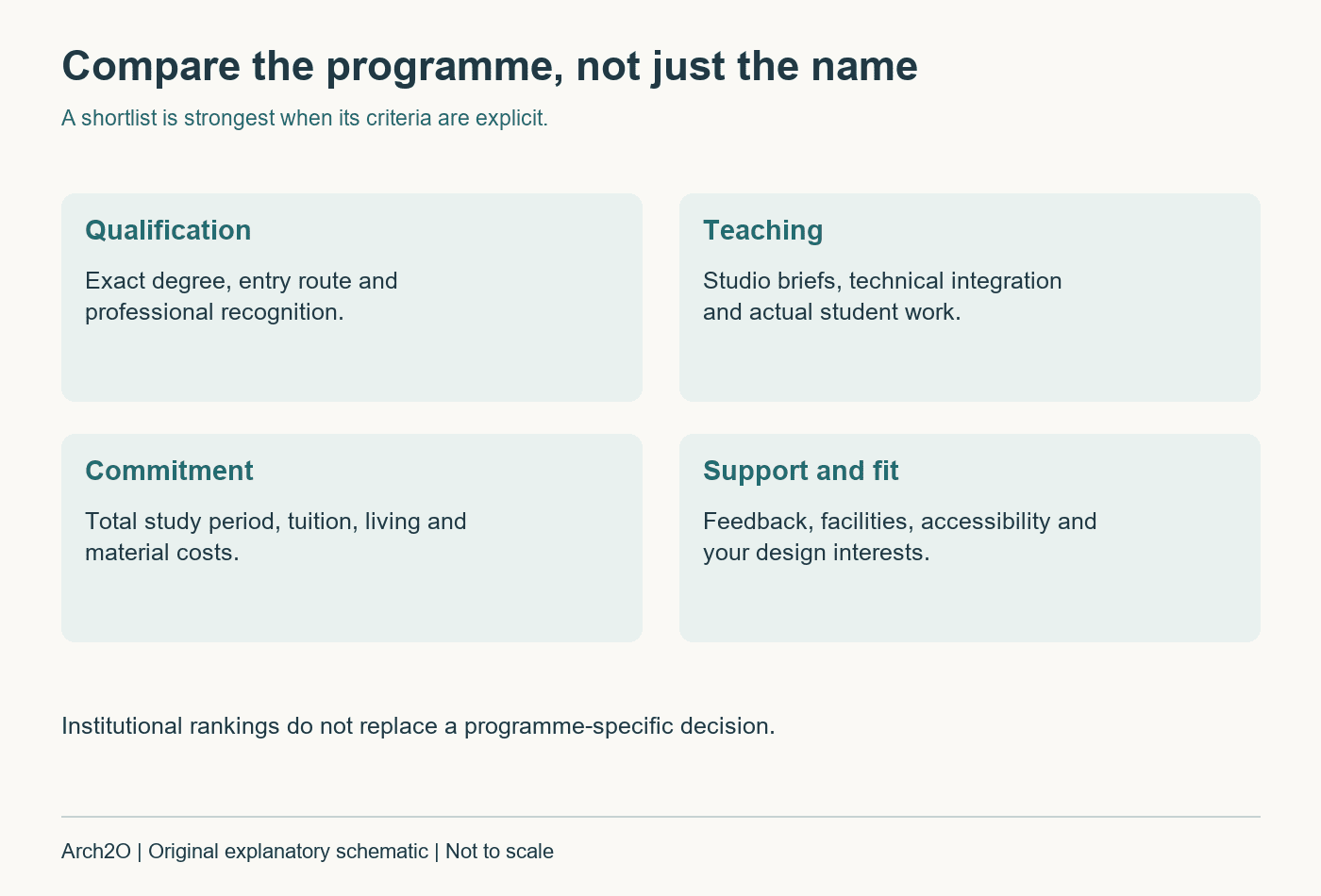
- Qualification: exact degree, accreditation and intended registration route.
- Teaching: studio briefs, technical integration, feedback and assessment.
- Cost: tuition, living costs, materials, travel and the complete study period.
- Support: workshops, accessibility, wellbeing and international-student advice.
- Application: portfolio, prerequisites, language evidence and deadlines.
- Outcomes: relevant graduate work and independently checked professional eligibility.
Use our architecture-school cost and debt guide and studio-culture guide to test the less visible parts of the decision. A strong programme is one whose route, working culture and total commitment you can explain before accepting an offer.
Should a ranking decide your choice?
Use rankings to discover options, then read what they measure. Institutional reputation, research and student experience are different things. Our architecture-school rankings guide explains how to compare those claims without turning one table into a universal recommendation.
The aim is a defensible shortlist: a small number of programmes where the qualification, curriculum, support and cost fit the education you actually need.

Ibrahim Abdelhady is an architect, academic, and media entrepreneur with over two decades of experience in architecture and digital publishing. He is the Founder and CEO of Arch2O.com, a leading platform in architectural media, renowned for showcasing innovative projects, student work, and critical discourse in design. Holding dual PhDs in Architecture, Dr. Abdelhady combines academic rigor with industry insight, shaping both future architects and architectural thought. He actively teaches, conducts research, and contributes to the global architecture community through his writing, lectures, and media ventures. His work bridges the gap between practice and academia, pushing the boundaries of how architecture is communicated in the digital age.