

The main alternatives to plexiglass in buildings are polycarbonate (when impact resistance matters most), toughened or laminated glass (when scratch resistance, fire behaviour and long life matter most) and, for small indoor items, PETG. Plexiglass itself (cast PMMA acrylic) is roughly half the weight of glass and lets through about 92% of visible light, but it scratches easily, burns, and moves about eight times more with temperature than glass. This guide sets out sourced properties, where each material suits, a worked expansion example for a glazing rebate, and the projects that show acrylic at architectural scale.
If you trained as an architect you probably know plexiglass from model-making: the clear sheet that was hard to cut cleanly and cracked if you forced it. In buildings the same material appears in skylights, signage, screens, furniture and pavilion roofs, and in 2020 it became the default material for protective counter screens.
Plexiglass, acrylic, Perspex: what it is
Plexiglass is polymethyl methacrylate (PMMA), a thermoplastic usually supplied as transparent sheet. “Plexiglas” (one s) is a trademark; Perspex and Lucite are other brand names for the same polymer, and most people simply say acrylic. Sheet is made either by casting between plates (cast acrylic, such as PLEXIGLAS GS) or by extrusion (such as PLEXIGLAS XT). Cast sheet machines and polishes better; extruded sheet is cheaper and more uniform in thickness.
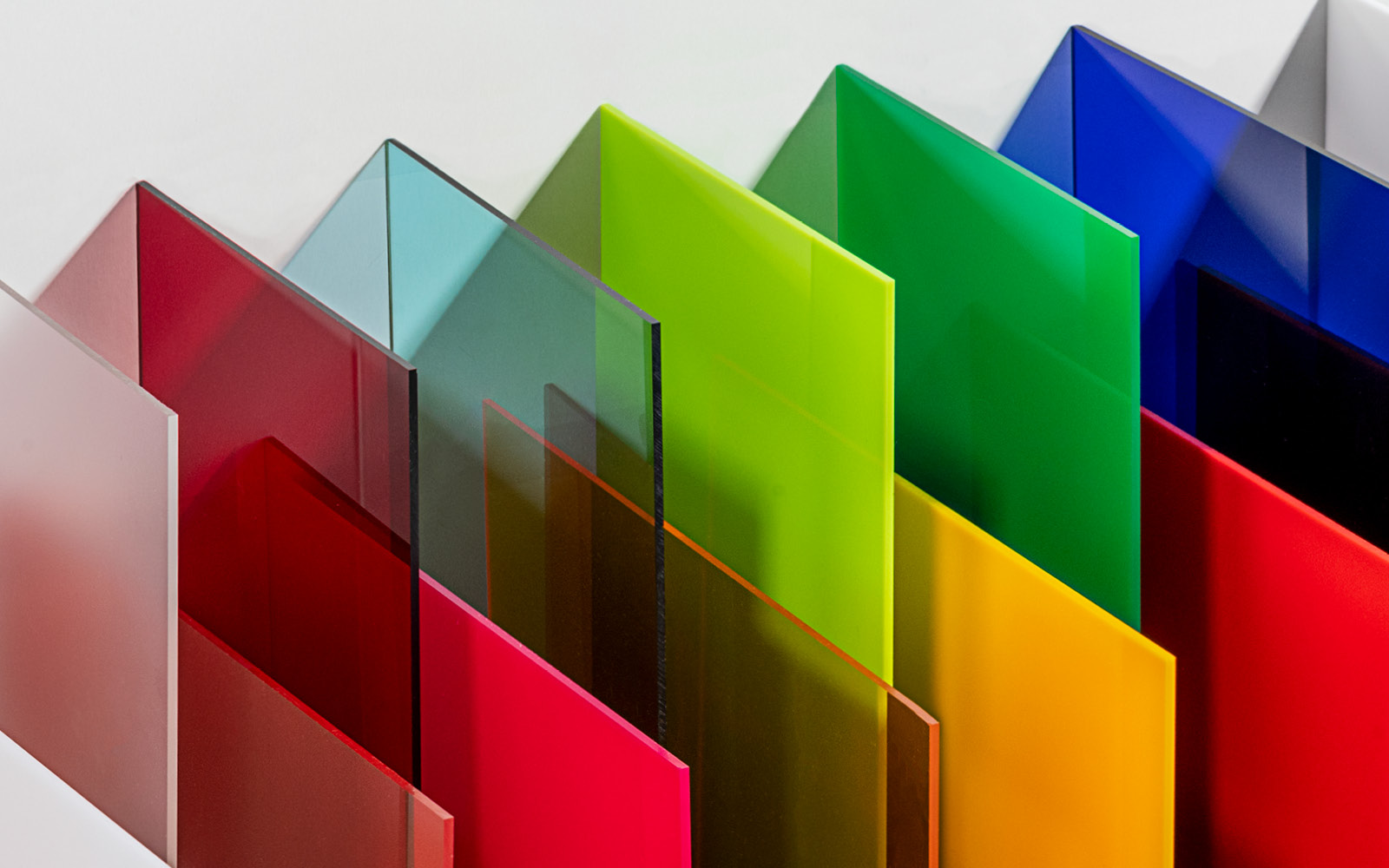
Courtesy of Plexiglas
Because it is a thermoplastic, acrylic can be heated and bent, drape-formed into domes, laser-cut and polished at the edges. That formability, more than its clarity, is why designers reach for it.
History of plexiglass
The German chemist Otto Röhm worked on acrylic polymers from the early 1900s. PMMA was developed in 1928 by several chemists, and Röhm & Haas in Darmstadt brought it to market in 1933 under the trademark Plexiglas. In Britain, Rowland Hill and John Crawford at ICI developed the same polymer in the early 1930s and it was sold as Perspex; DuPont sold it in the United States as Lucite. During the Second World War both sides used acrylic for aircraft windscreens, canopies and gun turrets and for submarine periscopes, and production rose sharply. After the war the material moved into windows, rooflights and illuminated signs.
Plexiglass or glass?
Comparing glass with the alternatives to plexiglass starts here. Acrylic is lighter and much less likely to break dangerously than ordinary annealed glass: it has a density of about 1.19 g/cm³ against about 2.5 g/cm³ for soda-lime glass, and when it does break it tends to form large, dull-edged pieces rather than sharp shards. Glass wins on surface hardness, fire behaviour and dimensional stability. Whether acrylic is cheaper over a building’s life depends on the application: it is easier to replace and to handle, but it scratches and may need polishing or replacement sooner in public areas. No reliable lifecycle cost comparison exists for general use, so compare quotations for your own project rather than relying on a rule of thumb.
Properties table: plexiglass and its alternatives
The table compares typical values from manufacturer data and reference sources. Grades and thicknesses differ, so specify from the current datasheet of the exact product.
| Property | Cast acrylic (PMMA, e.g. PLEXIGLAS GS) | Polycarbonate (e.g. Makrolon) | Soda-lime float glass |
|---|---|---|---|
| Density | 1.19 g/cm³ (ISO 1183) | 1.20 g/cm³ (ISO 1183-1) | about 2.5 g/cm³ |
| Visible light transmission (clear) | up to about 92% (3 mm) | about 86–88% (2–3 mm, grade-dependent) | about 89–90% (thin clear float; varies with thickness and iron content) |
| Linear thermal expansion | 7 × 10⁻⁵ /K (0.07 mm/m·K) | about 6.5–7 × 10⁻⁵ /K | about 9 × 10⁻⁶ /K |
| Thermal conductivity | about 0.19 W/m·K | about 0.2 W/m·K | about 1 W/m·K |
| Impact behaviour | better than annealed glass; breaks into large dull pieces | very high; used for security glazing | annealed glass shatters; toughened or laminated needed for safety |
| Surface hardness | scratches easily unless coated | scratches easily unless coated | hard; resists scratching |
| Fire | combustible; ignites about 460 °C | combustible; some grades flame-retardant | non-combustible |
Source: Röhm PLEXIGLAS GS/XT data sheet; Evonik PLEXIGLAS EPD; Covestro Makrolon sheet data; Wikipedia (PMMA, polycarbonate, soda-lime glass) (as of 1 Nov 2026).
Three numbers decide most choices between acrylic and the alternatives to plexiglass. Light transmission is similar for acrylic and float glass, so clarity rarely decides it. Impact resistance favours polycarbonate by a wide margin, which is why it is used for security glazing and machine guards. Thermal expansion is the number that catches people out: acrylic and polycarbonate both expand roughly seven to eight times as much as glass for the same temperature change.
Worked example: sizing the expansion gap for an acrylic pane
This is an illustrative calculation, not a design for a specific product. Take a 2,000 mm long PLEXIGLAS GS pane in an external frame. Röhm gives a linear expansion coefficient of 7 × 10⁻⁵ per kelvin (0.07 mm per metre per kelvin). Assume the sheet can swing between −10 °C on a winter night and 50 °C in summer sun, a range of 60 K.
- Acrylic: 2,000 mm × 0.00007 × 60 = 8.4 mm change in length.
- Soda-lime glass of the same length (9 × 10⁻⁶ per kelvin): 2,000 × 0.000009 × 60 = 1.1 mm.
So an acrylic pane needs a clearance of several millimetres at each end of the rebate, and the rebate must be deep enough that the sheet stays engaged when it contracts. In practice that means oversized holes or slots for any fixing through the sheet, no rigid clamping, and a glazing gasket or tape that lets the sheet slide. Fabricators also recommend that acrylic is never fixed with a hard sealant that bonds it rigidly to the frame. A typical detail therefore shows the sheet floating in a deep frame rebate with a compressible gasket on both faces and a clear gap at the sheet edge.
Where plexiglass works, and where an alternative is better

Courtesy of Pottery Barn
-
Windows and skylights
Acrylic domes and flat rooflights are common because the sheet can be thermoformed and is light to lift onto a roof. Acrylic has a far lower thermal conductivity than glass (about 0.19 W/m·K against about 1 W/m·K), but a single sheet is still a poor insulator; the window’s U-value depends on whether it is double-skinned and on the frame. Where hail or vandalism is the risk, polycarbonate is the safest of the alternatives to plexiglass.
-
Solar panels and greenhouse glazing
Solar panels need a cover that resists weather and passes light. Acrylic transmits up to about 92% of visible light, and UV-stable grades do not yellow quickly. Most commercial photovoltaic modules, however, use toughened glass covers rather than acrylic, because glass resists abrasion and long-term weathering better; acrylic is more often seen in solar collectors, greenhouses and lenses. The live page’s claim that plexiglass is “more durable than tempered glass” for solar panels has been removed because no source supports it.
-
Secure facilities and counter screens
Acrylic resists breakage better than annealed glass and is easy to cut and fix, so it is widely used for counter screens. For true security glazing (ATMs, detention facilities, bullet-resistant screens) polycarbonate or glass-clad polycarbonate laminates are normally specified to a tested rating, and an ordinary acrylic sheet is not a substitute.
-
Interior design and furniture
Shelves, side tables, stools, shower screens and display cases use acrylic because it can be bent and edge-polished. Clear acrylic furniture scratches with use; choose an abrasion-resistant coated sheet or tempered glass for table tops that see daily wear.
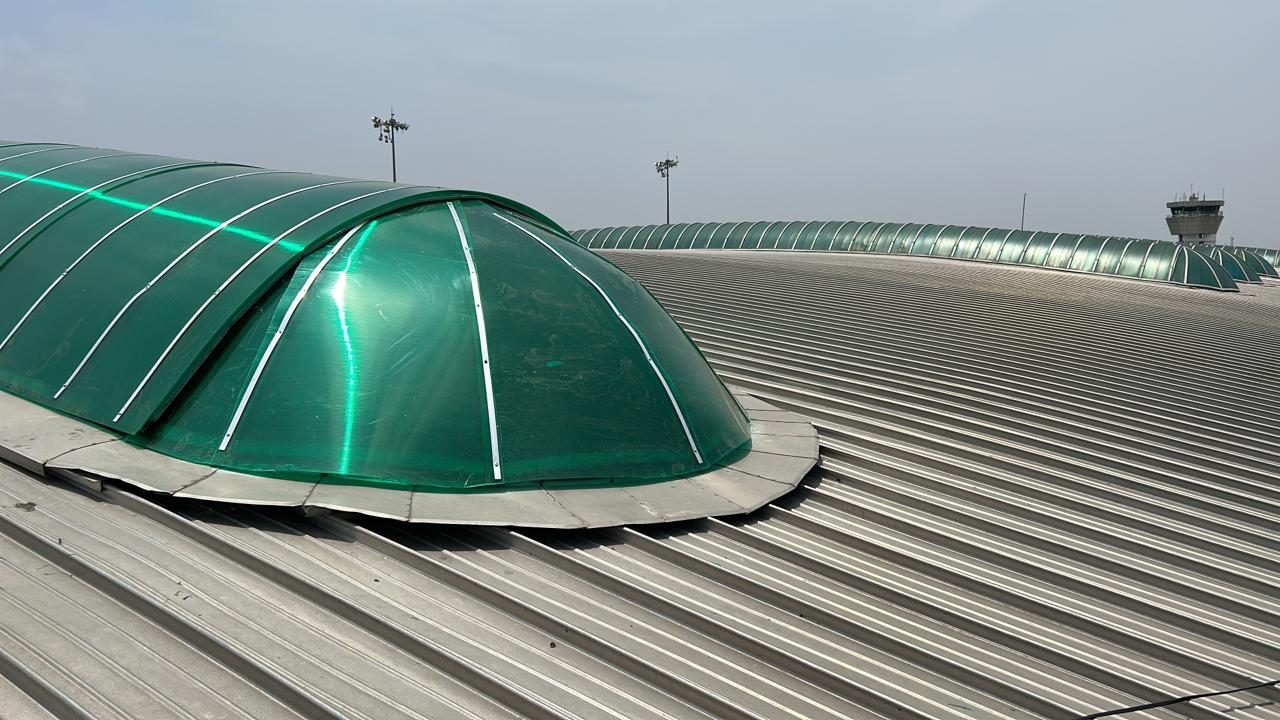
Multiwall polycarbonate barrel rooflight at Aurangabad Airport, India. Photo: Tilara Polyplast, CC BY-SA 4.0, via Wikimedia Commons. Tilara Polyplast, source, CC BY-SA 4.0
For rooflights and canopies that may be hit by hail or debris, multiwall polycarbonate sheet is the most common of the alternatives to plexiglass: it is light, insulates better than a single skin and is very hard to break, at the cost of lower clarity and a surface that also scratches.
Fire behaviour and building codes
All the plastics in the table are combustible. PMMA ignites at about 460 °C and burns with little smoke but with burning drips. Building regulations therefore limit where light-transmitting plastics may be used. In the United States the International Building Code (2024 edition) controls them in Chapter 26 (Plastic), which covers light-transmitting plastic wall panels, glazing, roof panels and skylights, with limits on area, separation and the material’s tested burning rate. In Europe the product’s reaction-to-fire class under EN 13501-1 is declared by the manufacturer; check the declared class of the exact product against your national regulations before specifying it for walls, ceilings or escape routes.
Is plexiglass sustainable?
In a period of environmental crisis it is fair to ask whether more plastic barriers are a good idea. Acrylic can be recycled mechanically (regrinding offcuts) or chemically: heating PMMA breaks it back down to its monomer, methyl methacrylate, which can be purified and polymerised again. The process is technically proven but costly, and the recovered monomer needs careful purification, so it is not yet routine for post-consumer sheet. Acrylic’s long life outdoors helps; its fossil-fuel origin and combustibility count against it. For a broader comparison of envelope options, see this guide to facade materials.
Plexiglass and the 2020 pandemic
During the COVID-19 pandemic, shops, pharmacies and restaurants installed acrylic screens at counters, and demand for sheet rose sharply. Public-health guidance in several countries listed physical barriers among measures for workplaces with close contact. Designers also explored more unusual forms, such as the dining hoods below.

Courtesy of Christophe Gernigon
5 examples of plexiglass in architecture and design
-
Plex’eat hoods | Christophe Gernigon

Courtesy of Christophe Gernigon
French designer Christophe Gernigon proposed suspended acrylic hoods for restaurants in 2020 as a shield for diners. Plex’eat hoods take the shape of large transparent lampshades hung above the table so that each person sits beneath one. They were designed for one person; the designer said larger versions for couples and families could follow. The design is a concept for protection between diners; no test of its effect on airborne infection has been published.


-
Gulliver airship | Martin Rajniš

Photography by Petr Kralik
This literary auditorium takes the shape of an airship and rests diagonally on the roof of the DOX Centre for Contemporary Art in Prague. The idea was to give the existing concrete building a new landmark and a place for readings and debates. The structure combines a timber skin on a steel frame with transparent sheets on the roof, so daylight filters between the wooden ribs into the space.


-
Maria Nila head office | ASKA

Photography by Mikael Lundblad
ASKA converted a four-storey townhouse in Stockholm, built in the National Romantic style, into the head office and salon of the haircare brand Maria Nila. At the entrance, an art installation of cut acrylic discs hangs from the ceiling, designed to look like shampoo dripping down, which draws visitors’ attention to the company’s product.

Photography by Mikael Lundblad
-
Art Shield statue conservation pavilion | Hello Wood

Photographs by Zsuzsa Darab
This roughly 10-metre-tall steel pavilion was built in Vörösmarty tér, Budapest, to protect the square’s monument while it was conserved. Hello Wood clad it in transparent plastic sheet so that the statue stayed visible: the screen keeps off driving rain and carries coloured light in the evening, turning a conservation enclosure into a temporary landmark.


-
Laureus Learning Pavilion | Architecture BRIO

Courtesy of Ariel Huber + Rob Thomas Photography + Architecture BRIO
The Learning pavilion, sponsored by the Laureus Foundation, is a gathering space and play area for children from low-income families near Mumbai. A long translucent roof, about 29 metres according to the original project description, covers a deck and a double-height workshop space, giving shade without cutting out daylight.


Choosing between plexiglass and its alternatives
When weighing alternatives to plexiglass, choose acrylic itself for clarity, edge polish and forming: displays, signage, furniture, domed rooflights and installations. Choose polycarbonate where impact or vandal resistance decides it. Choose toughened or laminated glass where scratch resistance, fire classification and dimensional stability matter, which covers most facade glazing. Whatever you choose, take the expansion figure from the product datasheet and detail the frame so the sheet can move.
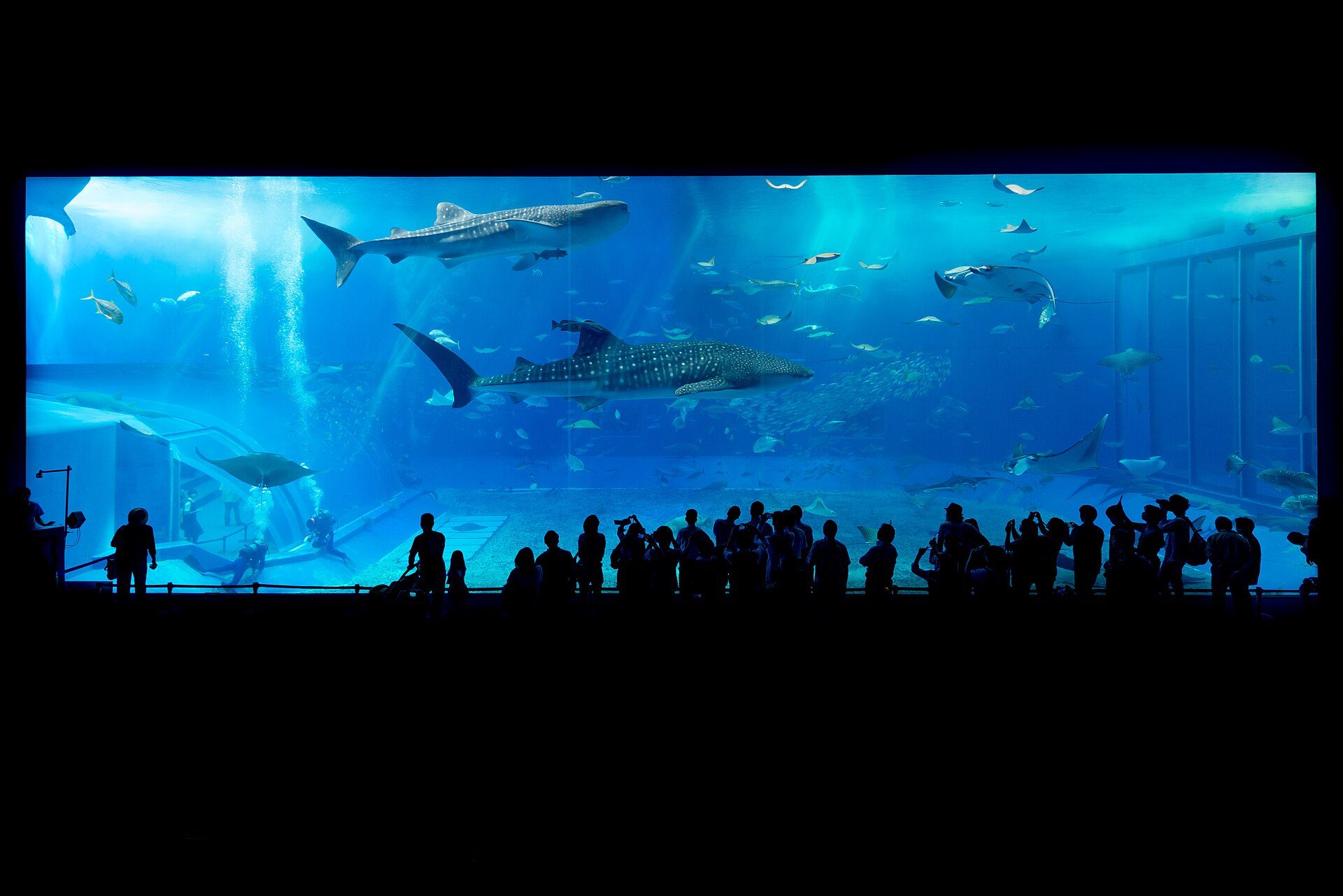
The Kuroshio Sea tank at Okinawa Churaumi Aquarium, Japan, seen through its large acrylic viewing panel. Photo: Jordy Meow, CC BY-SA 3.0, via Wikimedia Commons. Jordy Meow, source, CC BY-SA 3.0
Very thick cast acrylic is also used where glass would be impractically heavy or hard to join, such as large aquarium windows, which are bonded from several cast panels. That use shows acrylic’s strength in thick sections, while polycarbonate and glass remain the usual alternatives to plexiglass in thin building glazing.
Sources and further reading
- Röhm, PLEXIGLAS GS/XT technical data sheet (distributor copy)
- Evonik, PLEXIGLAS environmental product declaration (density 1.19 g/cm³)
- Poly(methyl methacrylate), Wikipedia (history, transmission, recycling, ignition)
- Soda-lime glass, Wikipedia (density, expansion)
- Covestro, Makrolon solid sheet technical data (distributor copy)
- International Code Council, IBC 2024 Chapter 26 Plastic

Daniel Mercer is a Coffee Break section editor at Arch2O, currently based in Berlin, Germany. With a background in architectural history and design journalism, Daniel holds a Master’s degree from the University of Edinburgh, where he focused on modern architecture and urban theory. His editorial work blends academic depth with a strong grasp of contemporary design culture. Daniel has contributed to several respected architecture publications and is known for his sharp critique and narrative-driven features. At Arch2O, he highlights innovative architectural projects from Europe and around the world, with particular interest in adaptive reuse, public infrastructure, and the evolving role of technology in the built environment.