

Inside Donald Trump’s house in Manhattan, the triplex penthouse at the top of Trump Tower, the rooms are known for gilded mouldings, marble, crystal chandeliers and painted ceilings in a Louis XIV-inspired style. Since January 2025 Trump has lived in the White House as president, and since 2019 his declared home has been Mar-a-Lago in Palm Beach. This article is for design-curious readers. It describes the penthouse and his best-known estates from published sources, labels every figure with its date and source, corrects several claims that circulated in an earlier version of this page, and leaves out addresses and private details.

Waring Abbott/Getty Images
Quick tour inside Donald Trump’s house and properties
Trump’s homes are best understood as part of his business: most of the properties below are owned through the Trump Organization, and several combine private rooms with clubs, golf courses or hotels. For comparison with other notable homes, see the world’s most expensive houses or Obama’s post-presidential house.
Where does Donald Trump live? An overview of the main residences
- Washington, DC: the White House, as president since 20 January 2025.
- Florida: Mar-a-Lago, Palm Beach, his declared permanent residence since 2019 and a private members’ club.
- New York: the penthouse at Trump Tower in Manhattan and the Seven Springs estate in Westchester County.
- New Jersey: a residence at his golf club in Bedminster, often used in summer.
An earlier version of this article listed a Beverly Hills mansion on Rodeo Drive. That house, a 1927 Tudor-style home near Rodeo Drive, was bought by the Trump Organization in 2007 for $7 million and sold in June 2019 for $13.5 million, as The Real Deal reported, so it is no longer part of the portfolio.
Donald Trump’s Manhattan penthouse: the gold-filled residence
Overview and location
The penthouse occupies the top floors of Trump Tower on Fifth Avenue, a 58-storey mixed-use tower designed by Der Scutt of Swanke Hayden Connell Architects and completed in 1983. Its saw-tooth glass facade gives many rooms two views, and its pink-marble atrium was one of the most talked-about interiors of 1980s New York.
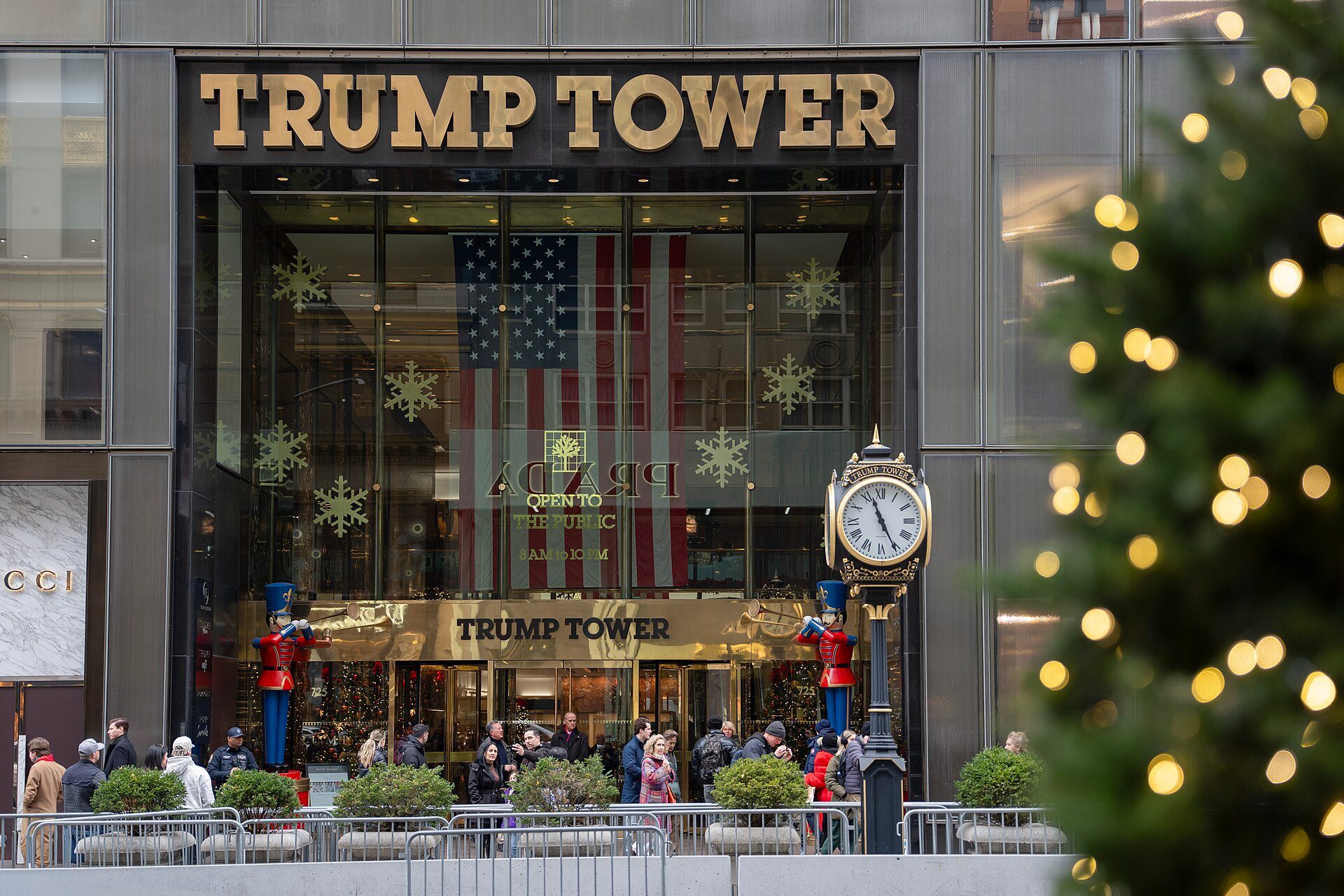
Trump Tower's Fifth Avenue entrance (1983, Der Scutt): the penthouse occupies the top floors. Photo: Quintin Soloviev, CC BY 4.0, via Wikimedia Commons. Quintin Soloviev, source, CC BY 4.0
The gold aesthetic
Photographs published by Town & Country and others show gilded cornices, columns and furniture, marble floors and walls, crystal chandeliers and a painted ceiling in the main living room. The style borrows from French palace interiors rather than from modern design. The quantity and karat of the gold used have never been documented, so claims such as “24-karat gold crown moulding throughout” in earlier versions of this page have been removed.

Waring Abbott/Getty Images
The family photographs and framed magazine covers on display show the other side of the apartment: a home that also works as a stage for the owner’s public image.

Waring Abbott/Getty Images
The gold toilet often linked to Trump never belonged to him. In 2017 the White House asked the Guggenheim Museum to borrow Van Gogh’s Landscape with Snow; the curator declined and offered instead a loan of Maurizio Cattelan’s solid-gold toilet sculpture America, as Hyperallergic reported in January 2018. The offer was widely read as a pointed joke, and there is no record that it was accepted. Arch2O covered the story in “Deal gone wrong: Trump gets a gold toilet instead of a Van Gogh”.
Classical art and Greek influence
Published photographs show classical references alongside the gilding: Greek-style vases, a bronze sculpture group of mythological lovers in the sitting area, painted ceilings with classical figures and cushions with a family crest. Together they suggest a collector’s version of a European palace rather than a historically accurate period interior.

Waring Abbott/Getty Images

Waring Abbott/Getty Images
The formal dining room continues the palace theme, with arched openings, gilded wall panels and a chandelier over a round table.
Seven Springs: the Bedford estate
Property scale and history
Seven Springs is a Georgian-style mansion on about 213 acres (86 ha) in Westchester County, north of New York City. It was built in 1919 for the financier Eugene Meyer, later owner of The Washington Post, to designs by the architect Charles A. Platt. Trump bought it in 1995 for $7.5 million, according to an Associated Press report (March 2021), which describes a house of roughly 2,600 m² (28,000 sq ft) with more than a dozen bedrooms, an indoor pool and a bowling alley. Earlier versions of this page gave 230 acres, 60 rooms and 15 bedrooms; those figures were not supported by the sources found and have been replaced.
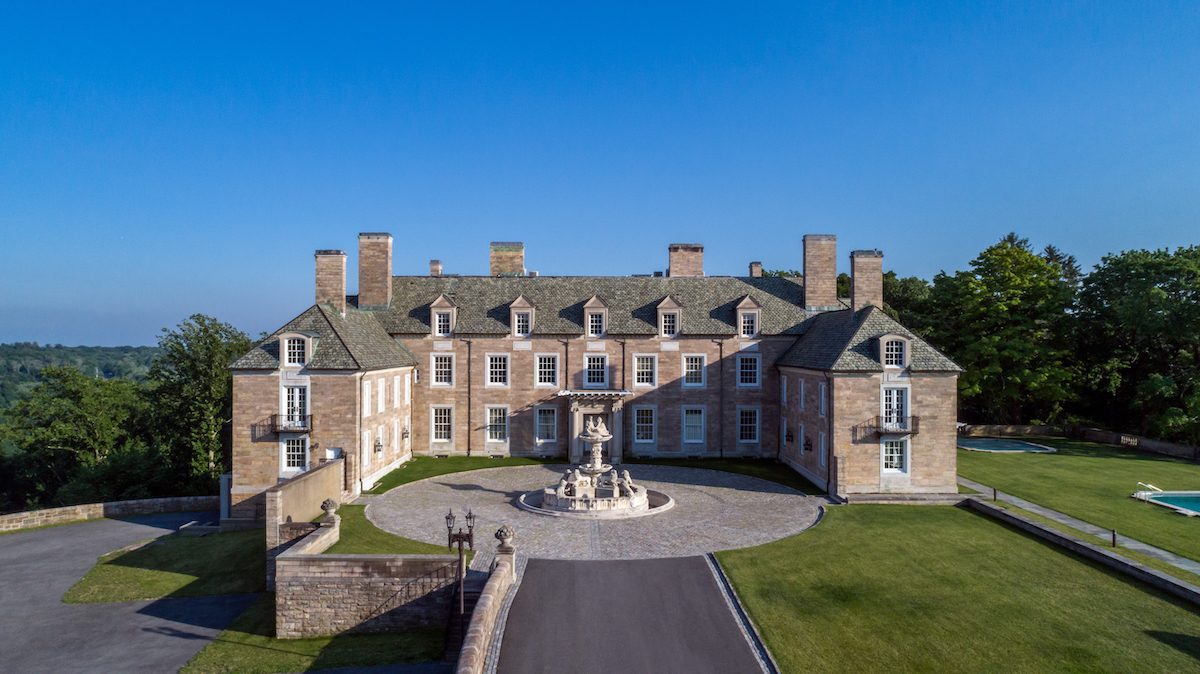
Seven Springs, Westchester County: the 1919 Georgian-style mansion by Charles A. Platt, seen from above its forecourt. Image: © The Trump Organization, used under licence
Architectural significance
Platt was one of the leading country-house architects of the American Renaissance, and Seven Springs is a typical example of his calm, symmetrical Georgian manner, in contrast to the gilded penthouse. The estate later became the subject of New York state investigations into the valuations used for a conservation easement, as the same AP report explains; Trump never moved in.
Mar-a-Lago: the Palm Beach estate
Mar-a-Lago was built between 1924 and 1927 for the cereal heiress Marjorie Merriweather Post. Marion Sims Wyeth designed the house and the theatre designer Joseph Urban the decoration, in a Mediterranean Revival style with Spanish, Venetian and Portuguese motifs and a tower overlooking both the ocean and Lake Worth Lagoon. It was designated a National Historic Landmark in 1980. Trump bought it in 1985 and turned it into a private members’ club in the 1990s, keeping private quarters for his family.
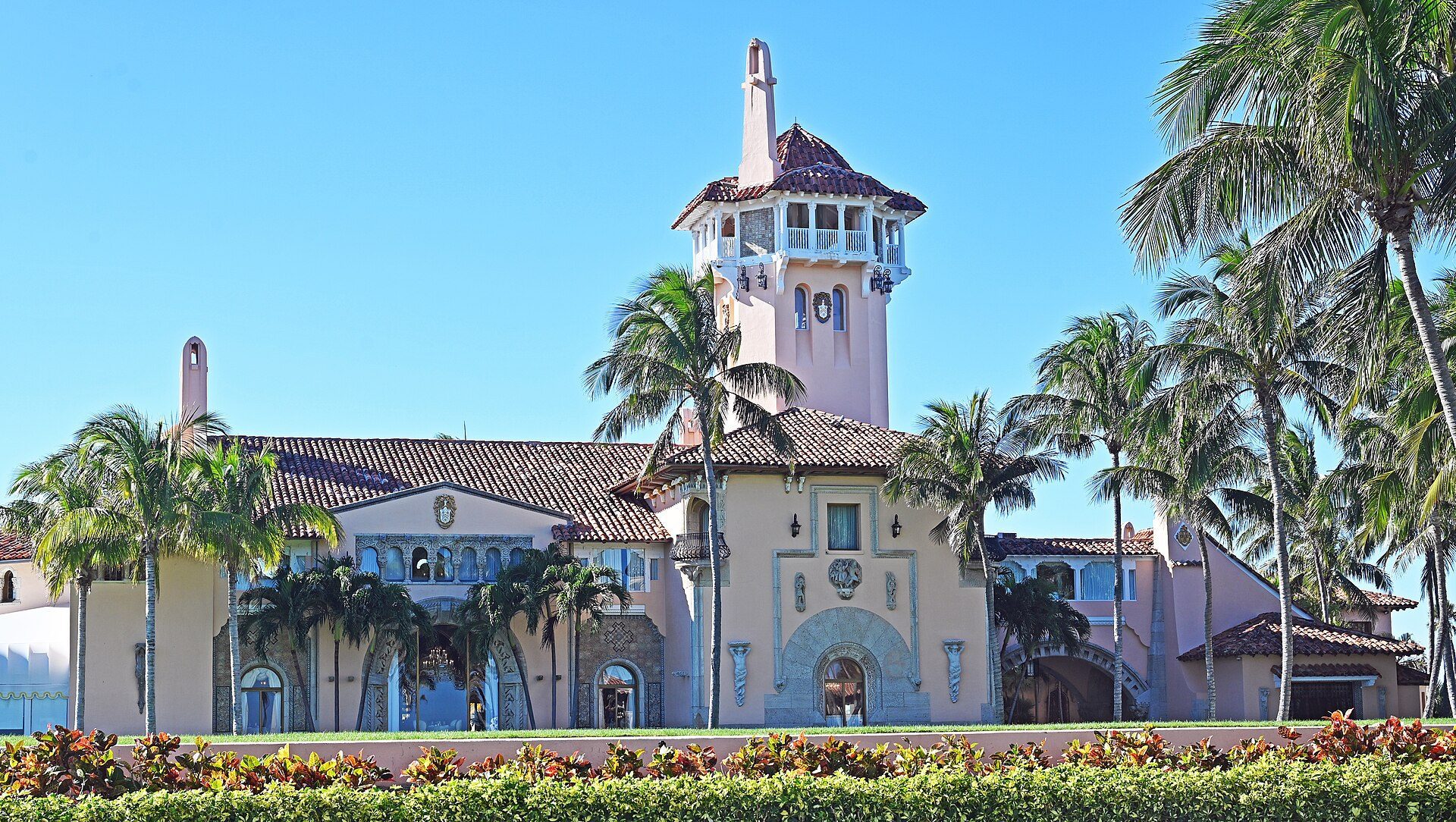
Mar-a-Lago, Palm Beach (1927), by Marion Sims Wyeth with decoration by Joseph Urban. Photo: Jud McCranie, CC BY-SA 4.0, via Wikimedia Commons. Jud McCranie, source, CC BY-SA 4.0
For architects, Mar-a-Lago is a key example of 1920s Palm Beach resort architecture: a stage-set house that uses imported tiles, carved stone and painted ceilings to create an invented Mediterranean past.
Virginia: Trump Winery
The Virginia property often mentioned is the Trump Winery near Charlottesville, bought in 2011 from the estate of Patricia Kluge. It is a commercial vineyard with a hotel and event spaces rather than a private family home.
Entries: value, date, source and design features
| Property | Status | Figure (type, date) | Architect / designer | Design features | Source |
|---|---|---|---|---|---|
| Trump Tower penthouse, Manhattan | Residence (tower completed 1983) | No sale; no verified value | Tower: Der Scutt / Swanke Hayden Connell | Gilded, marble, palace-style interiors | Wikipedia; Town & Country |
| Mar-a-Lago, Palm Beach | Declared residence since 2019; club | Bought 1985 (price not cited here) | Marion Sims Wyeth; Joseph Urban (1927) | Mediterranean Revival; National Historic Landmark 1980 | Wikipedia |
| Seven Springs, Westchester | Estate, not lived in | Bought 1995 for $7.5m (AP, 2021) | Charles A. Platt (1919) | Georgian mansion, ~213 acres | AP via ABC News 4 |
| Beverly Hills house | Sold June 2019 | Bought 2007 $7m; sold 2019 $13.5m | 1927 Tudor-style house | No longer owned | The Real Deal |
| Trump Winery, Virginia | Commercial vineyard | Bought 2011 (price not cited here) | — | Winery, hotel, events | Wikipedia |
Source: The Real Deal (2019); AP via ABC News 4 (2021); Wikipedia (Mar-a-Lago, Trump Tower, Trump Winery) (as of 29 October 2026).
Design philosophy and signature elements
Gold as a design statement
Across his properties, Trump favours visible luxury: gold leaf, marble, crystal and historic styles. The penthouse is the purest example; Mar-a-Lago and Seven Springs are historic houses that he bought rather than designed, so their architecture belongs to Wyeth, Urban and Platt.
Classical references and art collecting
The classical paintings, sculpture and vases in the penthouse place it in a long tradition of American owners recreating European palace interiors, from the Gilded Age mansions of Newport to Post’s own Mar-a-Lago.
Comparative context: Trump’s homes within the luxury market
Large as they are, these homes are not among the world’s most expensive. Antilia in Mumbai and the other homes in the list linked above are valued far higher, and Bill Gates’ house took a very different, technology-led approach. At the other extreme are small houses that feel bigger on the inside and tiny houses, which make the opposite case for how much space a home needs.
Design lessons from Trump’s residential aesthetic
- Interior design as personal branding. The gilded penthouse is instantly recognisable, which is its purpose.
- Historic styles as a backdrop. Classical and French palace references give a new tower apartment an invented history.
- Buying architecture rather than commissioning it. Seven Springs and Mar-a-Lago are significant because of their original architects.
- Hybrid uses. Mar-a-Lago combines a private residence with a members’ club, a model that has kept a large historic house in use.
Corrections to the earlier version
- The gold toilet was offered by the Guggenheim and is not owned by Trump; the “$50,000 18-carat gold toilet” claim has been removed.
- The Beverly Hills house was sold in 2019.
- Seven Springs is about 213 acres, built 1919 for Eugene Meyer; the room and bedroom counts were unsupported.
- References to a 2024-25 “transition” have been updated: Trump has been president since 20 January 2025.
- The claim of “properties across nine states” was undated and unsourced and has been removed.
Sources and further reading
- Mar-a-Lago and Trump Tower (summaries with references).
- The Real Deal: Beverly Hills sale (June 2019).
- Hyperallergic: the Van Gogh request and the gold toilet (January 2018).
Inside Donald Trump’s house, the story is less about gold than about how a public figure uses architecture: a branded penthouse in a tower he built, and historic estates whose original designers still define them.



Ibrahim Abdelhady is an architect, academic, and media entrepreneur with over two decades of experience in architecture and digital publishing. He is the Founder and CEO of Arch2O.com, a leading platform in architectural media, renowned for showcasing innovative projects, student work, and critical discourse in design. Holding dual PhDs in Architecture, Dr. Abdelhady combines academic rigor with industry insight, shaping both future architects and architectural thought. He actively teaches, conducts research, and contributes to the global architecture community through his writing, lectures, and media ventures. His work bridges the gap between practice and academia, pushing the boundaries of how architecture is communicated in the digital age.