

The Pritzker Architecture Prize is the profession’s highest international honor, established in 1979 by Jay and Cindy Pritzker through the Hyatt Foundation to recognize a living architect whose built work has made a consistent, significant contribution to humanity. Each laureate receives $100,000, a formal citation, and a bronze medallion inspired by the work of Louis Sullivan. In March 2026, the honor went to Chilean architect Smiljan Radić Clarke, the 55th laureate in the prize’s history — a selection that once again put the prize’s private, opaque internal machinery under public scrutiny.

The bronze Pritzker Architecture Prize medallion, designed after the work of Louis Sullivan and presented to each laureate alongside a $100,000 award and citation.
Most coverage of the Pritzker Prize treats it as a yearly headline: a name, a body of work, a handful of quotes. Far fewer readers understand what actually happens behind the scenes — who can be nominated, how a five-to-nine-person jury evaluates buildings scattered across six continents, and why the prize has, at several points in its 47-year history, found itself defending its own legitimacy. This piece works through the mechanics first, then the controversies, because understanding the process is what makes the criticism legible.
What Is the Pritzker Prize?
The Pritzker Prize is widely known as “the Nobel Prize of architecture” — an annual award, founded in 1979 by the Pritzker family and administered through the Hyatt Foundation, that honors a living architect for a lifetime body of built work rather than a single project. Jay Pritzker and his wife Cindy modeled the award directly on the Nobel Prizes, reasoning that architecture — unlike literature, science, or peace work — had no equivalent global recognition. The foundation funds the $100,000 cash prize, the citation, and since 1987 the bronze medallion, and it rotates the annual ceremony among architecturally significant cities rather than fixing it in one place.
Since Philip Johnson became the inaugural laureate in 1979, the prize has been presented to architects irrespective of nationality, and jurors have repeatedly said publicly that ideology and creed play no role in deliberations. What has changed over time is the profile of who wins: the prize’s early decades leaned heavily toward Western, corporate modernists, while the past twenty years have broadened to include architects working in social housing, informal urbanism, and non-Western material traditions.
Who Won the Pritzker Prize in 2026?
Chilean architect Smiljan Radić Clarke was named the 2026 Pritzker Architecture Prize Laureate, becoming the 55th recipient and only the second Chilean architect to win, after Alejandro Aravena in 2016. Radić, who founded his Santiago-based practice in 1995, is best known outside architecture circles for the 2014 Serpentine Pavilion in London — a boulder-supported, semi-translucent fiberglass enclosure that reads as neither fully open nor fully closed. That same tension between permanence and fragility runs through his broader portfolio, including the Restaurant Mestizo, the Pite House, and the extension of the Chilean Museum of Pre-Columbian Art.
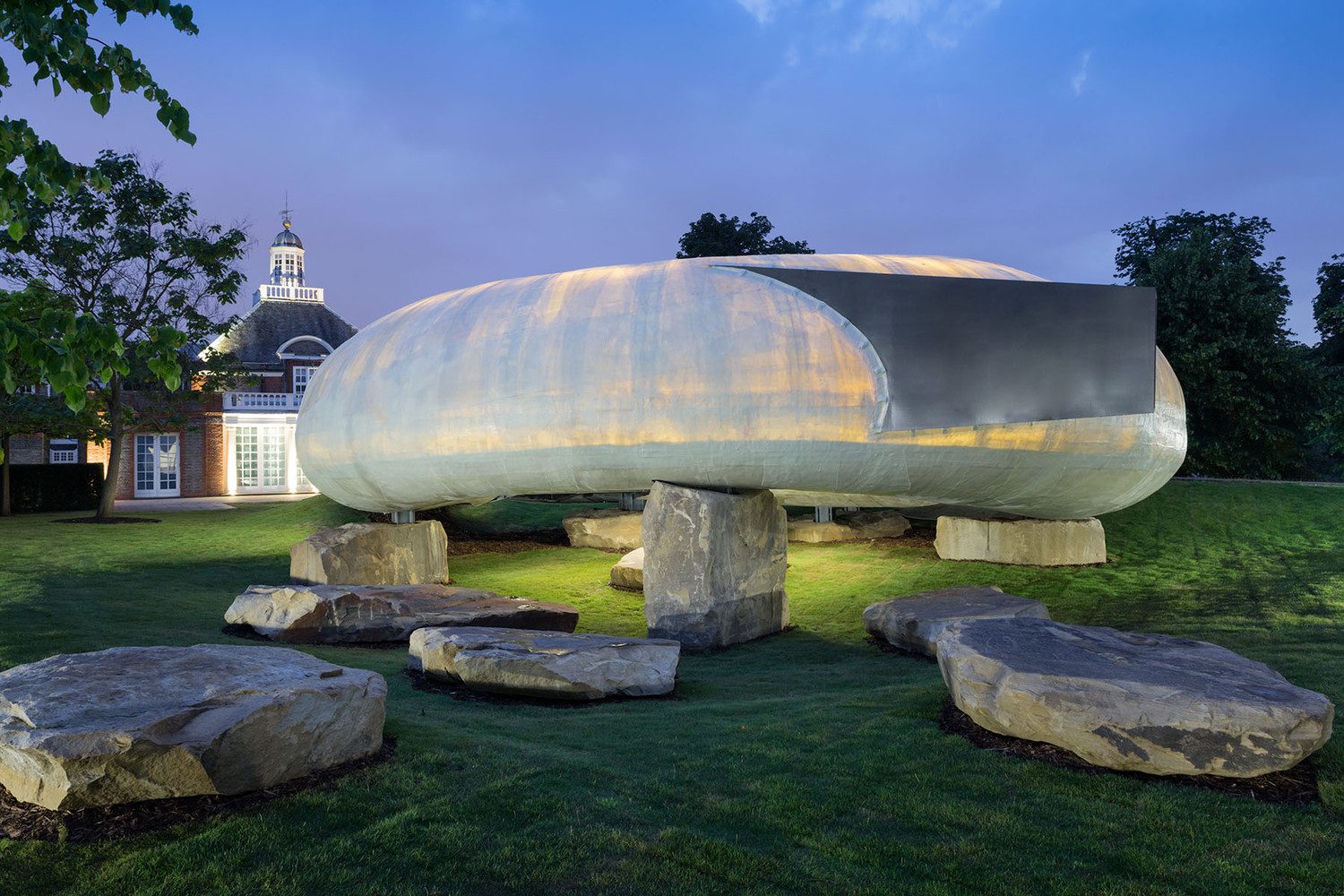
A project by Smiljan Radić Clarke, the 2026 Pritzker laureate, illustrating his material experimentation and the tension between permanence and fragility that defines his work. Photography by Iwan Baan
The jury’s official citation praised Radić for a body of work “positioned at the crossroads of uncertainty, material experimentation, and cultural memory”, noting that his structures often read as temporary or unfinished, yet still function as calm, quietly optimistic shelter that treats vulnerability as part of the human condition rather than something to be designed away. Jury chair Alejandro Aravena, himself the 2016 laureate, added that Radić works from “the edge of the world” with only a handful of collaborators, yet consistently reaches “the innermost core of the built environment and the human condition.” Rather than favoring a signature style, the citation frames Radić’s practice as a deliberate embrace of fragility — concrete, stone, timber, and glass handled with enough precision that apparent instability becomes an intentional emotional register rather than a structural flaw.
How Are Architects Nominated for the Pritzker Prize?
Nominations are actively solicited each year by the prize’s executive director from an international pool of critics, academics, past laureates, and other experts in the field, but any licensed architect may also submit a personal application before the November 1 deadline. This second pathway is rarely publicized and even more rarely used successfully — but it is not hypothetical. In 1988, Gordon Bunshaft, the Skidmore, Owings & Merrill designer behind Lever House and the Hirshhorn Museum, is widely reported to have nominated himself for the prize, and went on to share that year’s award with Oscar Niemeyer. The nominating process itself runs continuously year to year, with all jury deliberation, discussion, and voting conducted in strict secrecy, and no public shortlist is ever released before the winner is announced.
What Criteria Does the Pritzker Jury Use?
The jury weighs four core pillars: originality of spatial vision, technical mastery of construction materials, clarity and rigor of execution, and a demonstrated, consistent contribution to humanity and the built environment over time — not the merit of any single project. This last point is the one most frequently misunderstood by the public: the Pritzker is explicitly a career-spanning honor, closer in spirit to a body-of-work retrospective than a design competition, which is why laureates are rarely announced on the strength of one recent building alone.
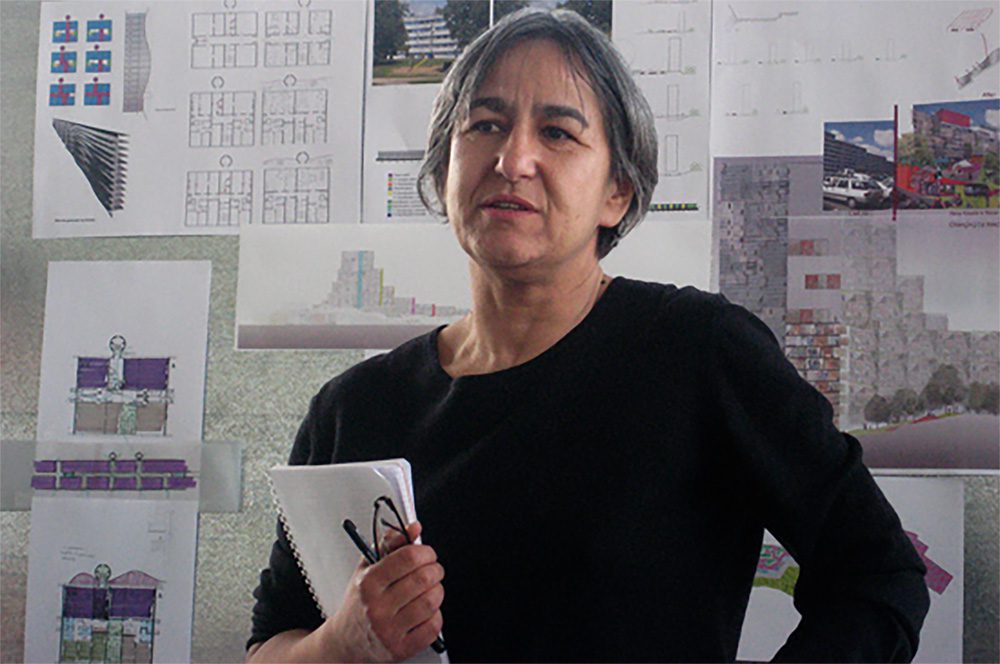
Anne Lacaton, who with Jean-Philippe Vassal received the 2021 Pritzker Prize for a body of transformation-focused, socially minded architecture.
Inside the Selection Process: The Global Site Visits
What separates the Pritzker jury from most design-award panels is that its members do not judge from portfolios, renderings, or photographs alone. The jury — typically five to nine members drawn from architecture, business, education, publishing, and culture, and including past laureates and figures well outside the profession — physically travels to inspect nominees’ built work in person, often visiting projects on multiple continents within a single deliberation cycle. These are not press tours: visits are frequently conducted quietly, without advance publicity, so jurors can experience a building’s spatial quality, material detailing, and relationship to its site the way an ordinary occupant would, rather than the way a building is staged for an awards submission.
This travel-intensive model is deliberate. Photographs flatten scale, light, acoustics, and the felt experience of moving through a space — precisely the qualities the jury’s criteria ask them to weigh. A juror who has stood inside Radić’s Serpentine Pavilion or walked the site lines of a Kéré school building is positioned to make a judgment that a jury working from drawings alone could not credibly make. The tradeoff is that the process is slow, expensive, and — because deliberations are never published — largely invisible to the public, which has periodically fueled suspicion that the prize functions as an insider’s club rather than a transparent meritocracy.
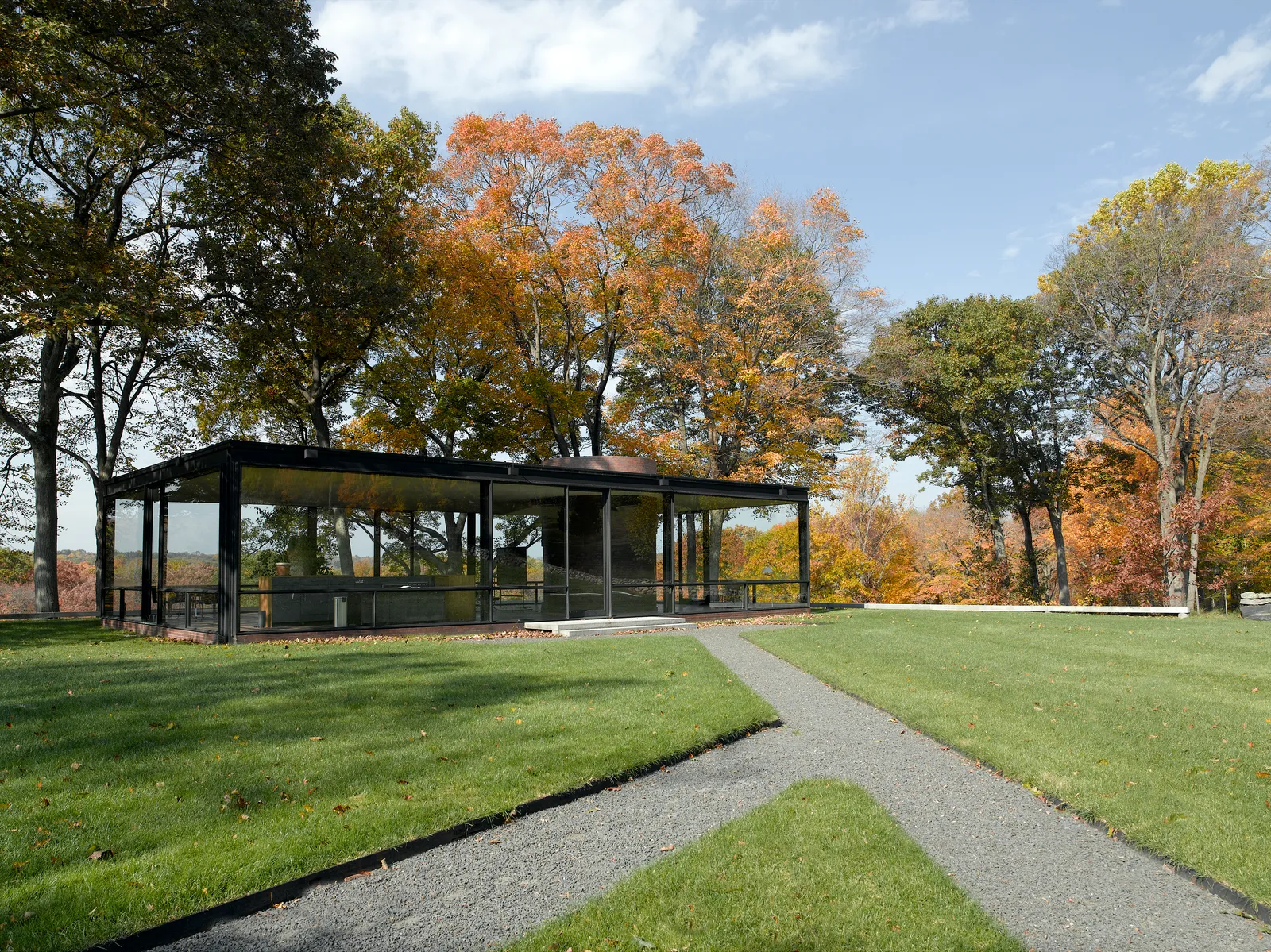
Autumn view of Philip Johnson’s Glass House in New Canaan, Connecticut, built by the first Pritzker laureate. Photo by Carol M. Highsmith / Buyenlarge / Getty Images
The Evolution and Criticism of the Medal
The prize’s roster of laureates tells its own history of shifting architectural values. Philip Johnson’s inaugural 1979 win reflected an era still oriented around singular, largely Western corporate icons — a pattern that continued through much of the 1980s. Zaha Hadid’s 2004 win marked a turning point on two fronts: she became the first woman to receive the prize in its 25-year history, and her selection signaled the jury’s growing willingness to recognize fluid, computationally driven digital form-making as a legitimate architectural language rather than a stylistic curiosity. Two decades later, laureates such as Diébédo Francis Kéré (2022) reoriented the prize again, toward architects whose primary contribution is social and humanitarian — community schools, low-cost material innovation, and climate-responsive building in the Global South — rather than formal spectacle.
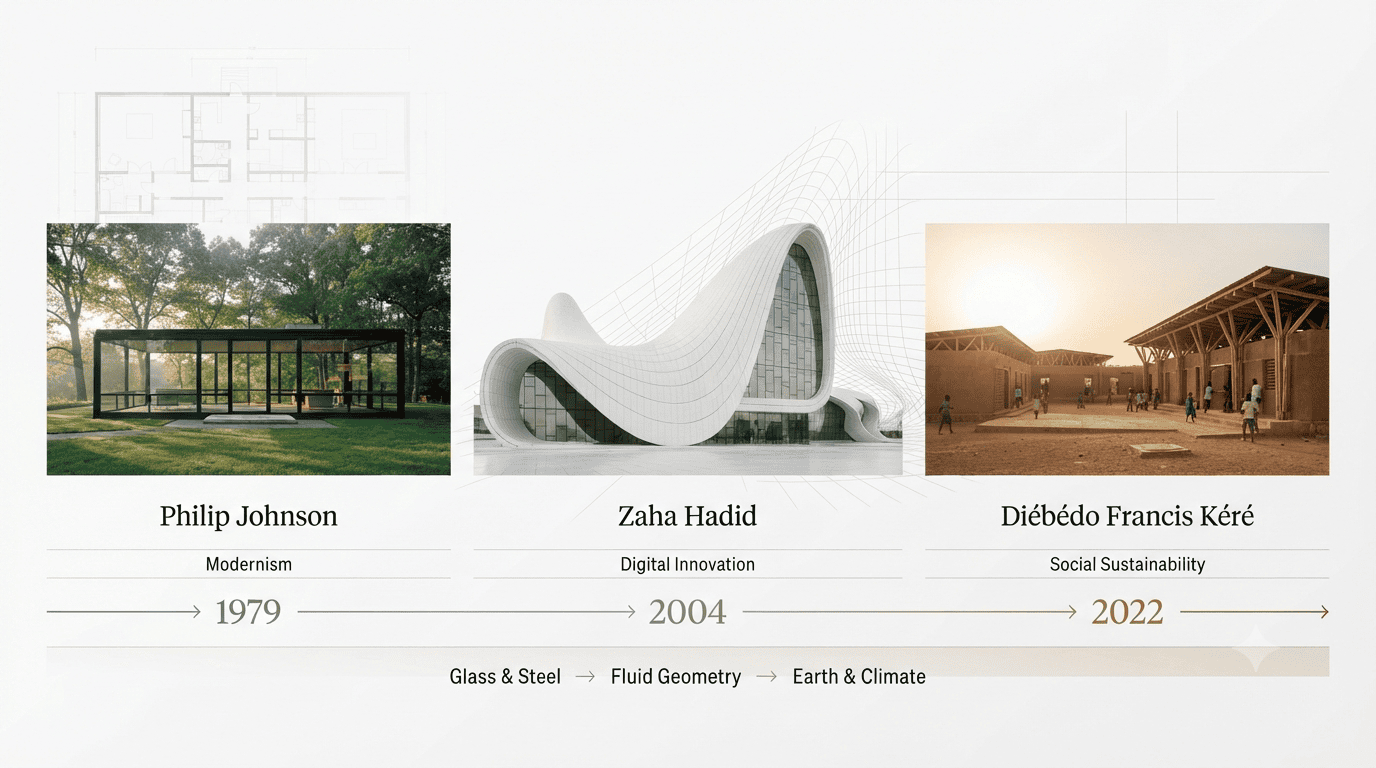
AI-generated illustration accompanying the history of Pritzker laureates and the prize’s evolving architectural values from Western modernism toward social and humanitarian work.
No episode has tested the prize’s legitimacy more directly than the Denise Scott Brown controversy. Robert Venturi won the Pritzker in 1991 for work produced in inseparable, decades-long partnership with Scott Brown, his wife and professional collaborator, who received no recognition from the jury at the time. In 2013, students in the “Women in Design” group at the Harvard Graduate School of Design launched a petition demanding the jury retroactively name Scott Brown a co-laureate. Scott Brown herself has said publicly that she felt excluded by architecture’s elite throughout her career, and critics have argued the episode exposed a structural bias in the prize’s framework: a selection process built to crown a single “genius” architect struggles to fairly evaluate joint or collaborative practices, a mode of working that is common in the profession but poorly suited to a Nobel-style, individual-laureate model. The Pritzker jury has never reversed the 1991 decision, and the foundation’s public position has remained that the prize does not revisit past verdicts — a stance that continues to draw criticism from those who see it as an unwillingness to correct a documented historical oversight. For a deeper look at how the profession’s obsession with singular authorship shapes which architects become famous and which remain anonymous, see our companion piece on architectural authorship and anonymity.
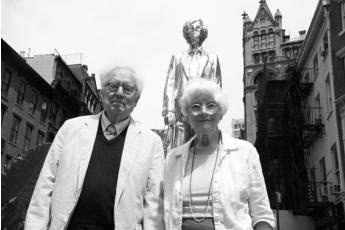
Robert Venturi and Denise Scott Brown, whose exclusion from Venturi’s 1991 Pritzker Prize sparked a lasting debate over how the award recognizes collaborative partnerships.

Luca Moretti is a content strategist with a foundation in urban design and architecture. Based in Milan, he focuses on writing that bridges aesthetics, material culture, and everyday spatial experiences.