

The best plants for shower areas and steamy bathrooms are tropical species that like humidity and tolerate low light: Boston and bird’s nest ferns, pothos, heartleaf philodendron, peace lily, spider plant, moth orchid, air plants and the ZZ plant, with a bundle of cut eucalyptus hung under the shower head for scent. This guide, for homeowners and designers, explains what plants can and cannot do in a bathroom, profiles 15 options with their light needs and pet safety, and gives practical placement dimensions and a ventilation checklist.
Starting the day under a cold shower or ending it with a warm one is a daily ritual, which is why bathrooms should never be under-designed. Plants are one of the quickest ways to make a bathroom feel calmer and closer to nature.

Courtesy of Katrina Lee
Is it a good idea to put plants in the shower?
Yes, if you choose the right plants and place them where they get light and are not blasted by water or soap. Many tropical houseplants enjoy the humidity of a bathroom. But some popular claims are wrong:
Plants do not dry out a bathroom
Plants take up water through their roots and release it through their leaves, so they add moisture to the air rather than removing it. A bathroom still needs an extractor fan or opening window to control condensation and mould; plants are not a substitute for a dehumidifier.
Plants do not noticeably purify indoor air
Early chamber experiments suggested houseplants remove pollutants, but a 2019 review by Bryan Cummings and Michael Waring in the Journal of Exposure Science and Environmental Epidemiology concluded that ordinary potted plants do not improve indoor air quality; matching the effect of normal ventilation would take somewhere between 10 and 1,000 plants per square metre, as Newswise reported. Nor do a few plants raise oxygen levels in a room in any measurable way.
They look good and can make a space feel calmer
The real benefit is visual and psychological: flowers and greenery make a room feel softer, more natural and more relaxing.
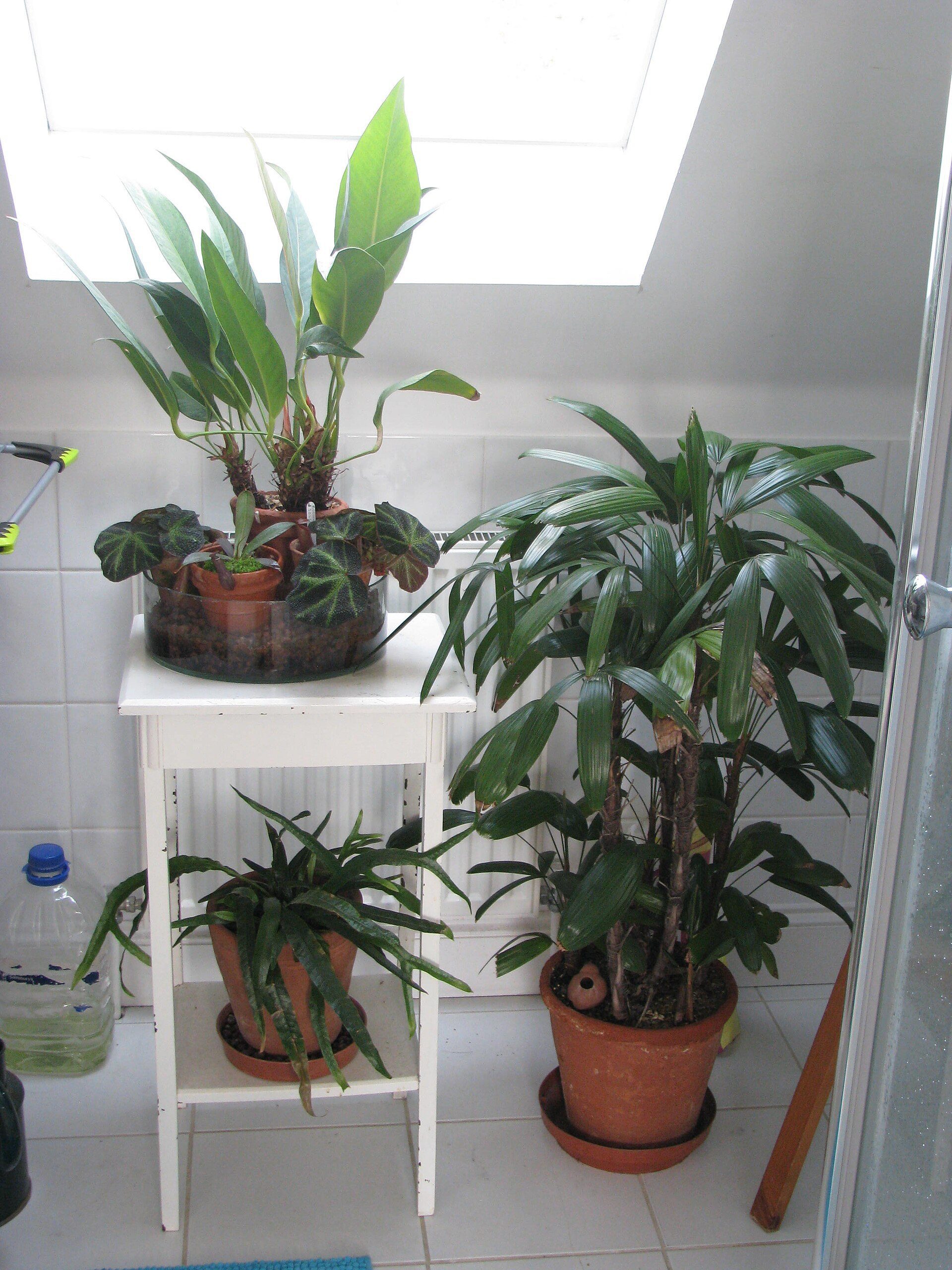
Tropical houseplants on a stand by a bathroom window, next to the shower. Photo: peganum, CC BY-SA 2.0, via Wikimedia Commons. peganum from Small Dole, England, source, CC BY-SA 2.0
15 calming plants for shower areas and bathrooms
A bathroom is humid, often warm, and frequently short of daylight, so choose plants that suit those conditions. The table summarises the 15 options; check each plant’s toxicity in the ASPCA plant database if you have cats or dogs.
| Plant | Light | Humidity | Pets |
|---|---|---|---|
| Golden pothos | Low to bright indirect | Likes | Toxic |
| Eucalyptus (cut stems) | – | Releases scent in steam | Toxic if eaten |
| Peace lily | Bright indirect | Likes | Toxic |
| Heartleaf philodendron | Low to medium | Likes | Toxic |
| Boston fern | Bright indirect | Loves | Generally non-toxic |
| Cyclamen | Bright, cool | Moderate; dislikes heat | Toxic |
| Dragon tree | Medium | Tolerates | Toxic |
| Lucky bamboo | Low to medium | Tolerates | Toxic |
| Bird's nest fern | Bright indirect | Loves | Check ASPCA |
| Snake plant | Low to bright | Tolerates; avoid wet soil | Toxic |
| Air plants (Tillandsia) | Bright indirect | Likes | Check ASPCA |
| Spider plant | Medium | Likes | Generally non-toxic |
| Moth orchid | Bright indirect | Likes | Check ASPCA |
| Begonia | Bright indirect | Likes | Toxic |
| ZZ plant | Low to medium | Tolerates | Toxic |
Source: Arch2O summary; toxicity to be confirmed in the ASPCA Toxic and Non-Toxic Plants database (as of 24 October 2026).
1. Golden pothos

Courtesy of Beards and Daisies
Golden pothos (Epipremnum aureum) is a fast-growing trailing or climbing plant with heart-shaped leaves that can hang from a shelf or be trained up a pole. It prefers bright, indirect light but copes with shade or artificial light. It is toxic to pets.
2. Eucalyptus (cut stems)

Courtesy of Angelica Baini / BuzzFeed
Eucalyptus in the shower is usually a bundle of cut stems, not a living plant. Tied to the shower head, out of the direct spray, the steam releases its fresh scent. Replace the bundle every few weeks as it dries. Eucalyptus is toxic to pets if eaten.
3. Peace lily

Courtesy of GavinD / Getty Images
The peace lily (Spathiphyllum) is a flowering evergreen that is easier to care for than its delicate look suggests. It likes bright, indirect light and humidity, and droops visibly when it needs water. It is toxic to pets.
4. Heartleaf philodendron

Courtesy of istockphoto.com
The heartleaf philodendron has glossy, heart-shaped leaves and trails beautifully from hanging pots or shelves. Trimming keeps it compact and bushy. It tolerates low light and enjoys humidity. It is toxic to pets.
5. Boston fern

Courtesy of We Are Found
Boston ferns love humidity and moist soil, which makes a bathroom with a window ideal. Display them in a hanging basket or on a stand in a pot that drains well. They are generally listed as non-toxic to pets.
6. Cyclamen

Courtesy of Planters Etc.
Cyclamen, with upswept flowers and patterned, heart-shaped leaves, adds winter colour. It prefers cool, bright conditions and dislikes heat and draughts, so it suits a cool bathroom with a window better than a hot, steamy one. It is toxic to pets.
7. Dragon tree

Courtesy of Grumpy Cow Studios / Getty Images
The dragon tree (Dracaena marginata) is a tough, slow-growing plant with narrow leaves on woody stems, one of the larger houseplants that will live comfortably in a bathroom. It tolerates humidity and some neglect. It is toxic to pets.
8. Lucky bamboo

Courtesy of Deavita.net
Lucky bamboo (Dracaena sanderiana) is not a true bamboo but an African species in the same plant family as asparagus. It grows in water without soil, and its stems can be trained into spirals; change the water regularly. It is toxic to pets.
9. Bird’s nest fern

Courtesy of Hort Zone
The tropical bird’s nest fern thrives in warmth and humidity and suits a bathroom with a window. Keep the soil lightly moist and give it bright, indirect light; avoid pouring water into the central rosette.
10. Snake plant

Image by Jeff Herr Photography
Snake plants are very tolerant of low light and irregular watering, though they rot if kept wet, so let the soil dry between waterings. Their stiff, upright leaves have pointed tips, so place them out of the way. They are toxic to pets.
11. Air plants

Courtesy Pistils Nursery
Air plants (Tillandsia) need no soil and take water and nutrients through their leaves, so a humid bathroom helps them, though they still need regular soaking or misting and good light. Some species are over-collected in the wild, so buy nursery-grown plants.
12. Spider plant

Courtesy of Balcony Garden Web
The spider plant tolerates a wide range of conditions, including humidity and moderate light, which makes it a good beginner’s bathroom plant. It produces small plantlets (“spiderettes”) that are easy to root. It is generally listed as non-toxic to pets.
13. Moth orchid

Courtesy of Waitrose and Partners
The moth orchid (Phalaenopsis) enjoys humidity and bright, indirect light, and is the easiest orchid to grow at home; it can flower for months. Keep it out of the shower spray.
14. Begonia

Courtesy of Planters Etc.
Begonia is a large genus of well over a thousand species, many from humid tropical regions, so several do well in a warm, bright bathroom. Water at the soil rather than the leaves to avoid mildew. Begonias are toxic to pets.
15. ZZ plant (eternity plant)

©Luxe.co.th
The ZZ plant (Zamioculcas zamiifolia), sometimes called the eternity plant, tolerates low to medium light and needs little water, storing it in its thick stems and rhizomes. It is a good choice for a bathroom with a small window. It is toxic to pets.
Placement and dimensions
Where you put plants for shower rooms matters as much as which ones you choose. These are practical rules of thumb, not regulations. The plan below shows them in a typical 2.0 x 1.7 m bathroom.
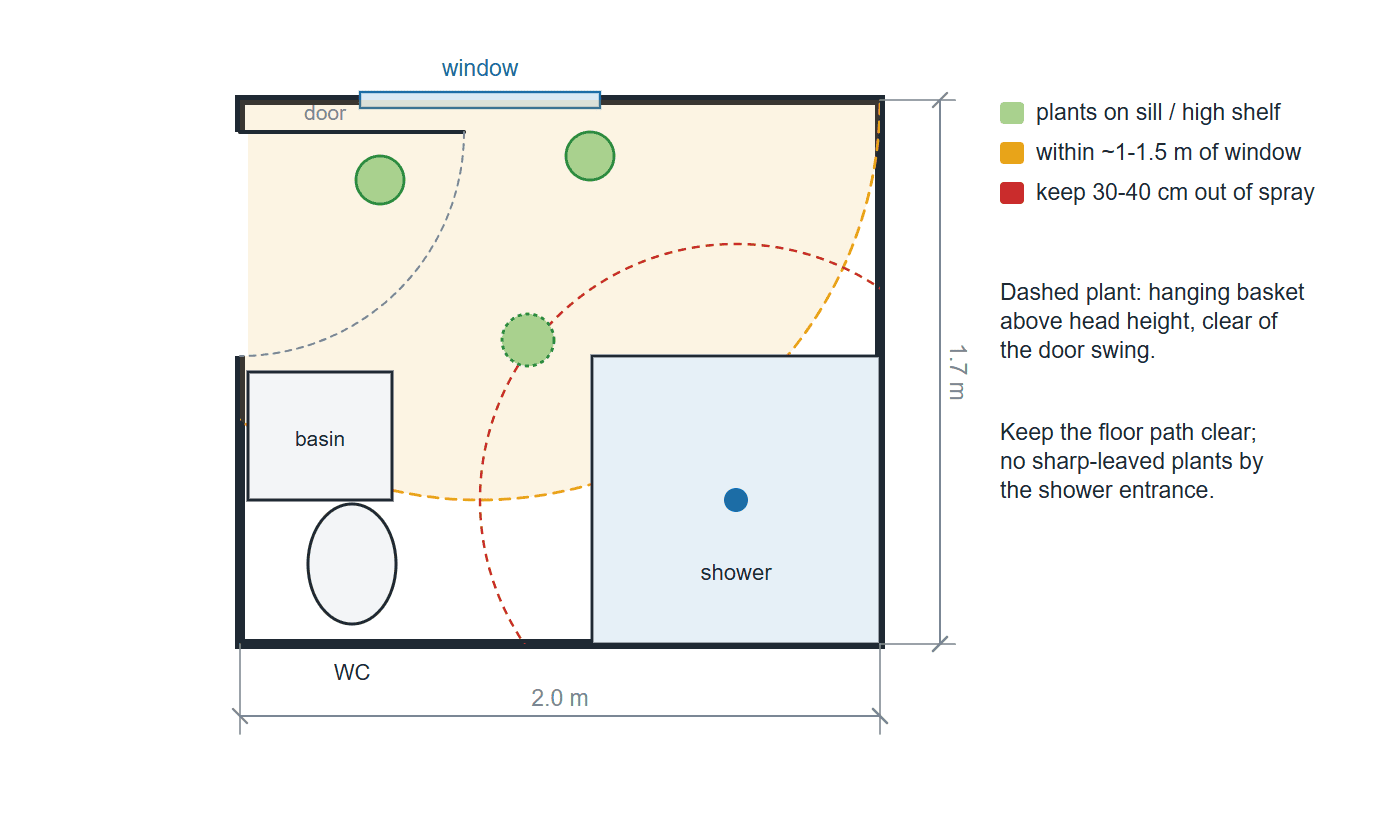
Plant placement in a typical 2.0 × 1.7 m bathroom: most plants within about 1-1.5 m of the window, at least 30-40 cm from the shower spray, hanging plants above head height away from the door, and a clear floor path. Rules of thumb, not regulations. Diagram: Arch2O
- Light first: place most plants within about 1–1.5 m of a window; in windowless bathrooms choose low-light plants (ZZ, snake plant, pothos) or add a grow light.
- Out of the spray: keep plants at least 30–40 cm from the shower head’s direct spray, on a high shelf, a ceiling hook or a niche, so soap and hot water do not damage leaves.
- Hanging plants: hang baskets above head height and away from doors, with a drip tray or a pot without drainage holes inside a decorative pot.
- Floor plants: keep a clear path; avoid sharp-leaved plants near the shower entrance.
Checklist for plants for shower rooms
- Ventilation: building rules set minimum bathroom extract rates; for example, the US International Residential Code requires 50 cfm intermittent or 20 cfm continuous when mechanical ventilation is used, and England’s Approved Document F has given 15 l/s intermittent or 8 l/s continuous. Check the rules where you live.
- Light: a window or a grow light rated for damp locations.
- Pots: drainage plus a tray, or a waterproof outer pot.
- Surfaces: non-slip, water-resistant shelves and hooks fixed into solid backing.
- Pets: check toxicity before buying.
- Care: wipe dust and soap film from leaves; watch for overwatering in humid rooms.
Sources and further reading
- Cummings, B. E. and Waring, M. S. (2019), “Potted plants do not improve indoor air quality”, Journal of Exposure Science and Environmental Epidemiology; summary on Newswise.
- ASPCA, Toxic and non-toxic plants.
- Building Science Advisor (PNNL), Bathroom exhaust fans (US requirements).

Toqa Mostafa is a dedicated editor at Arch2O, bringing a sharp editorial perspective to architectural storytelling. Based in Egypt, she curates and refines content that showcases innovative design and urban solutions. Her work at Arch2O highlights her ability to engage readers with compelling narratives, bridging architectural creativity and critical discourse. Toqa’s editorial expertise contributes significantly to Arch2O’s mission of exploring the intersection of design, technology, and sustainability.