


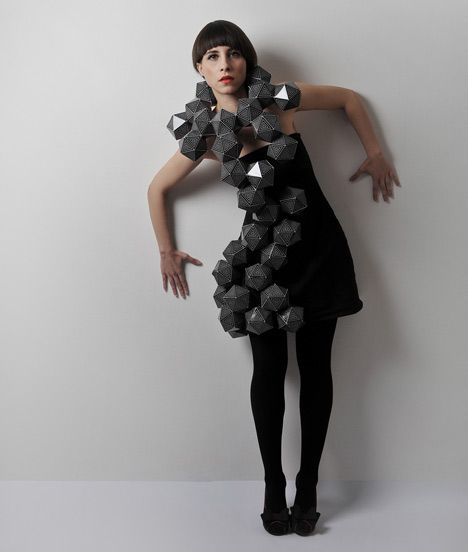
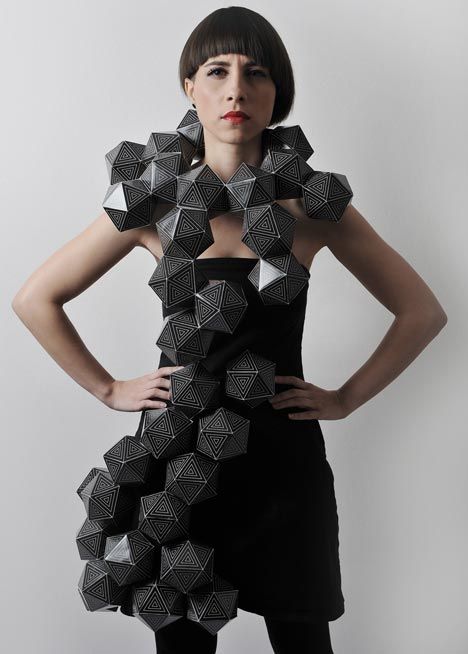
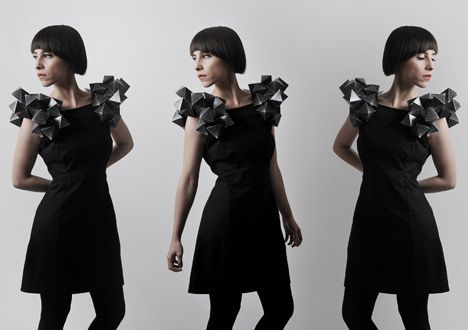
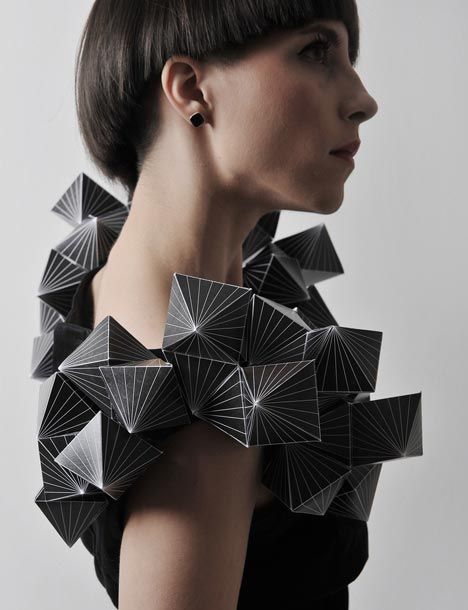
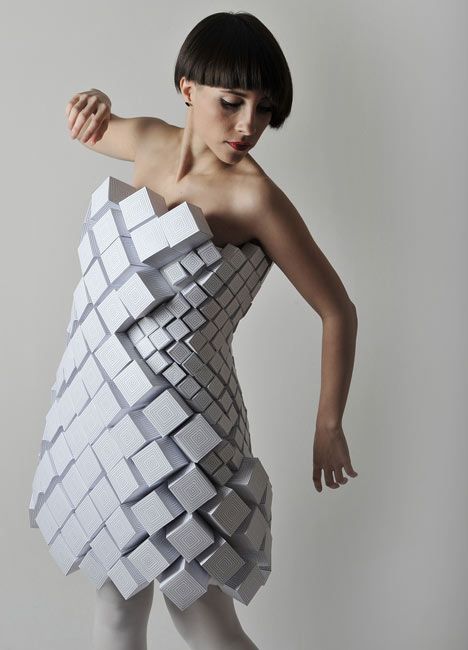
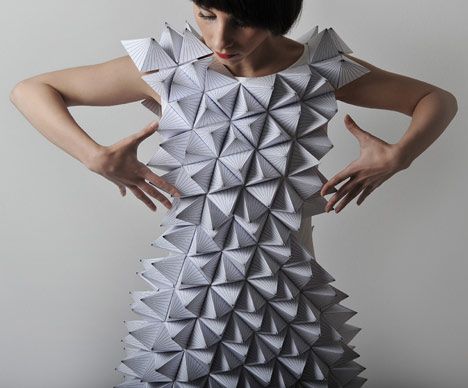
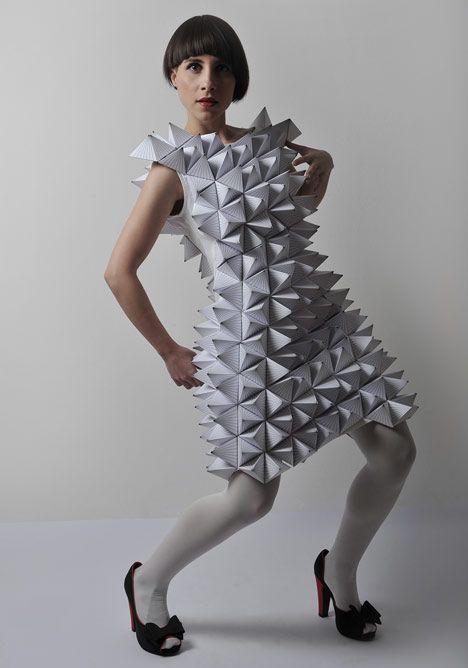
Amila Hrustic is an unusual fashion designer who recently presented one of her most interesting designs “Plato’s Collection”, which is inspired from the great Greek philosopher, Plato, who studied what we now call “Platonic solids” . The collection consists of five unique dresses handcrafted from a combination of textiles and paper and comes into five Platonic solids: tetrahedron, cube, octahedron, dodecahedron and icosahedron. The collection doesn’t seem to fit into the category of everyday/everybody fashion, but like much of catwalk fashion, fits right in at stage performances, haute couture and/or worn by the very brave + stylish.
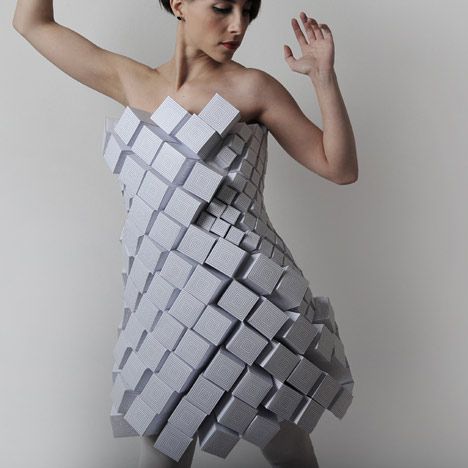
designed by Amila Hrustic
One thing I really like about this project is what Amila mentions in her description,
“This project examines the concept of geometrically arranged and structured space in relation to the human body. It is the most appropriate to call it a study of perception and contrast, and study of relation between artificial and organic, amorphous and geometric. Each of the five Platonic solids is a basic building element for making dresses. Simplicity of form and use of black and white print patterns on rigid paper emphasize the sculptural collection, its attitude toward the body and overall expression”

designed by Amila Hrustic
Credits:
Milan Senic (Dresses construction)
Irfan Redzovic (Photography)
Lana Pasic (Model)


Ibrahim Abdelhady is an architect, academic, and media entrepreneur with over two decades of experience in architecture and digital publishing. He is the Founder and CEO of Arch2O.com, a leading platform in architectural media, renowned for showcasing innovative projects, student work, and critical discourse in design. Holding dual PhDs in Architecture, Dr. Abdelhady combines academic rigor with industry insight, shaping both future architects and architectural thought. He actively teaches, conducts research, and contributes to the global architecture community through his writing, lectures, and media ventures. His work bridges the gap between practice and academia, pushing the boundaries of how architecture is communicated in the digital age.