

Legal Risks of AI in Architecture Practice: What Firms Need to Know
As of mid-2026, raw AI-generated architectural output cannot be copyrighted in the United States, and using AI does not shield a design professional from liability — it typically compounds it. Firms that treat AI as a routine production tool without contract-level and workflow-level safeguards are absorbing legal exposure across copyright, confidentiality, professional negligence, and litigation discovery.
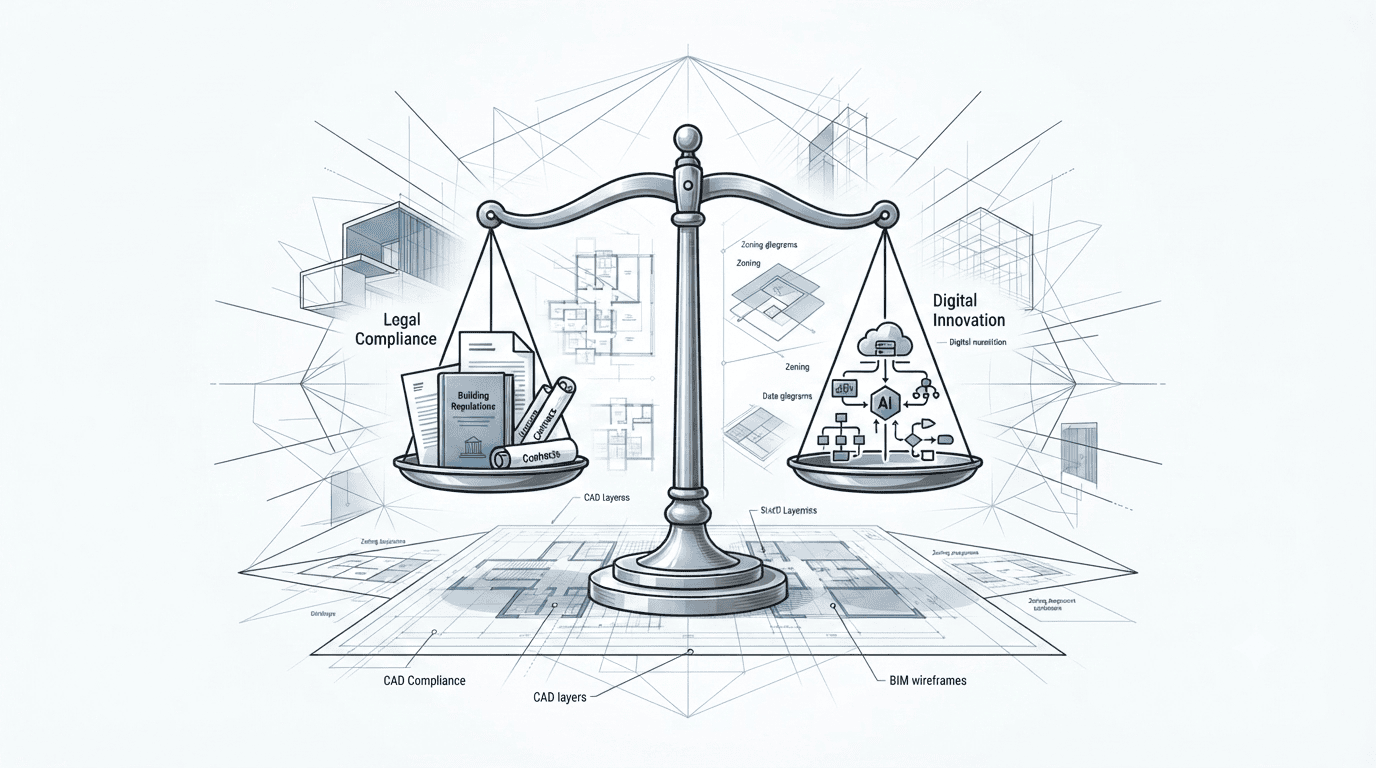
AI-generated illustration introducing the legal risks architecture firms face when using AI tools, spanning copyright, confidentiality, professional liability, and litigation discovery.
Can AI-generated architectural designs be copyrighted?
In the United States, raw machine output cannot be copyrighted due to human authorship requirements confirmed by the Supreme Court’s denial of certiorari in Thaler v. Perlmutter on March 2, 2026. True legal protection requires substantial human modification, orchestration, and programmatic development.
The Supreme Court’s refusal to hear Thaler v. Perlmutter left standing the D.C. Circuit’s 2025 ruling that the Copyright Act of 1976 requires works to be authored, in the first instance, by a human being. The case originated with computer scientist Stephen Thaler’s attempt to register “A Recent Entrance to Paradise,” an image he acknowledged was produced entirely by his self-built AI system, listing the machine itself as sole author. Both the Copyright Office and every reviewing court rejected that framing, and the Supreme Court’s denial closes off further appeal, at least for now.
For architecture practices, the takeaway is structural, not academic. A design produced by prompting a generative tool and accepting the output wholesale — a rendered facade study, a generative massing option, a construction detail drafted end-to-end by a model — carries no US copyright protection on its own. Protection attaches only where a human architect exercises genuine creative control: selecting, substantially revising, combining outputs with independently authored work, or directing an iterative design process where the human’s judgment, not the model’s, determines the final expressive result. Firms should document that human contribution contemporaneously, because the dividing line between “AI-assisted” and “AI-authored” is exactly where copyright protection is won or lost.
Is it legally risky to upload project files to public AI tools?
Yes. Public processing routinely breaks client non-disclosure boundaries, leaks proprietary firm data, and breaches modern commercial contract conditions that explicitly ban machine model processing.
Architecture and engineering contracts increasingly carry express prohibitions on feeding project drawings, BIM models, client data, or site documentation into third-party AI systems without prior written consent. These clauses have grown more common precisely because clients — developers, institutional owners, government agencies — recognize that once a file enters a public or consumer-grade AI tool, the firm loses meaningful control over where that data resides, how long it is retained, and whether it could be used to improve a vendor’s underlying model.
For firms, the exposure is threefold: breach of the client services agreement’s confidentiality clause (a contract claim independent of any copyright question), potential trade secret dilution where proprietary firm methodologies or unbuilt design concepts are exposed, and, in regulated sectors, breach of statutory data protection obligations if the uploaded files contain personal data. The safest practice is treating any consumer-facing AI tool as a public disclosure channel unless a firm has a specific enterprise agreement with contractual data-handling guarantees in place.
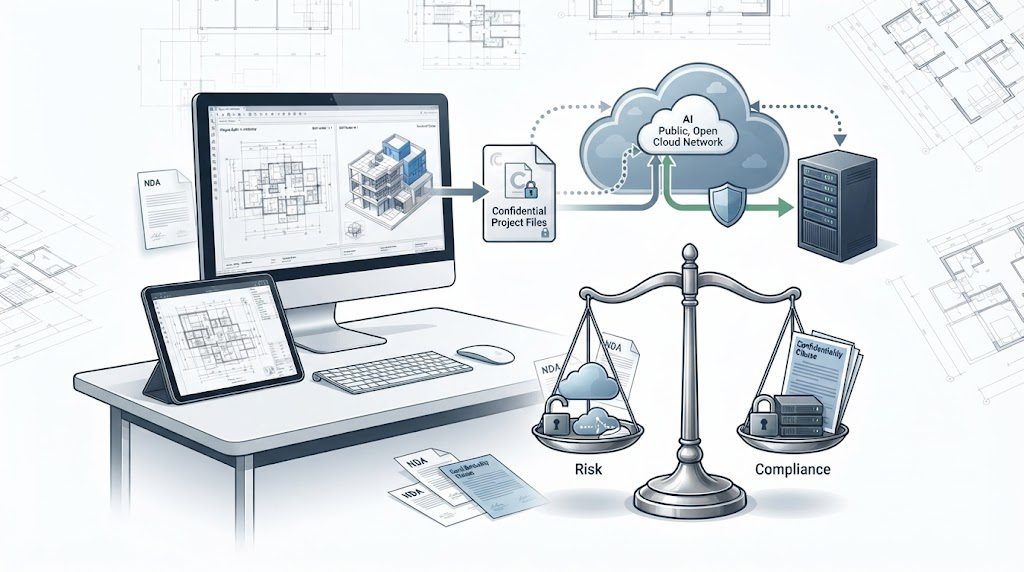
AI-generated illustration of the confidentiality risks of uploading project drawings, BIM models, or client data into public AI tools without contractual data-handling safeguards.
Does using AI protect an architect from liability, or increase it?
It completely retains or compounds structural liability. Under laws like California’s AB 316, professionals remain fully responsible for code compliance, meaning automated structural errors are treated as standard human negligence.
California’s AB 316, which took effect January 1, 2026, added Section 1714.46 to the state’s Civil Code. The provision bars any defendant who “developed, modified, or used” an AI system from asserting, as a defense in a civil action, that the AI autonomously caused the harm. It doesn’t create strict liability on its own — a plaintiff still has to establish causation and foreseeability — but it permanently removes the argument that a firm can point to the model and walk away. The obligation architects already owed under professional standards of care, building codes, and licensing board rules is unchanged by the presence of AI in the workflow; if anything, courts are likely to treat undocumented reliance on unverified AI output as evidence of a failure to exercise ordinary professional skill.
Practically, this means AI-assisted structural calculations, code-compliance checks, or specification drafting need the same licensed-professional review and sign-off that manually produced work has always required. Firms that can show a documented QA process — a human engineer verifying AI-suggested load calculations, for instance — are in a materially stronger position than firms that cannot.
Are conversations with AI tools protected by attorney-client privilege?
No. Under the February 2026 federal ruling in USA v. Heppner, data shared with generic commercial machine platforms is stripped of attorney-client privilege and the work-product doctrine, making prompt histories discoverable during litigation.
In Heppner, a federal court in the Southern District of New York ordered production of documents a defendant had generated using a commercial AI assistant, even though the defendant had incorporated information received from counsel into the prompts and later shared the AI’s output with his attorneys. The ruling treated the AI-generated material as outside the privilege boundary because the tool itself is a third-party commercial service, not an extension of the attorney-client relationship.
For architecture firms facing or anticipating a professional liability claim, this matters directly: prompt histories, draft correspondence, and AI-assisted analysis prepared in anticipation of litigation may be discoverable even when routed through counsel, unless the firm has structured that work through a properly walled, counsel-directed process from the outset. Firms should assume that anything typed into a general-purpose AI tool during or ahead of a dispute could surface in discovery.
The Global Copyright Map
Firms operating across borders, or licensing design work internationally, face materially different copyright regimes for AI-assisted output. The table below summarizes the current 2026 landscape across the three jurisdictions most relevant to international practice.
| Jurisdiction | Governing Rule | Status of Raw AI Output |
|---|---|---|
| United States | Copyright Act of 1976; Thaler v. Perlmutter (cert denied March 2, 2026) | No copyright protection without substantial human authorship |
| United Kingdom | Copyright, Designs and Patents Act 1988, Section 9(3) | Protected for 50 years; the person who made arrangements for the work’s creation is deemed author |
| European Union | EU Product Liability Directive (2024/2853); national copyright law (author-centric, human-only) | Copyright generally unavailable; AI-embedded software/configurations reclassified as “products” under strict liability, with member-state transposition due by December 2026 |
The UK’s Section 9(3) is the notable outlier: unlike the US and most EU member states, it extends a defined 50-year copyright term to computer-generated works that have no human author, attributing authorship instead to whoever made the “arrangements necessary” for the work’s creation. This creates an unusual asymmetry — a design produced by an AI tool with minimal human input may be protectable in the UK while the identical output is unprotectable in the US. Firms licensing or publishing design work across jurisdictions should treat copyright status as jurisdiction-specific, not universal.
The EU’s Product Liability Directive takes a different angle entirely: rather than addressing authorship, it reclassifies software, including AI models and configurations, as “products” subject to strict liability rules traditionally reserved for physical goods. As transposition into national law proceeds toward the December 2026 deadline, firms deploying AI-driven design tools in EU markets should expect expanding exposure for defective AI-generated outputs, independent of any copyright analysis.
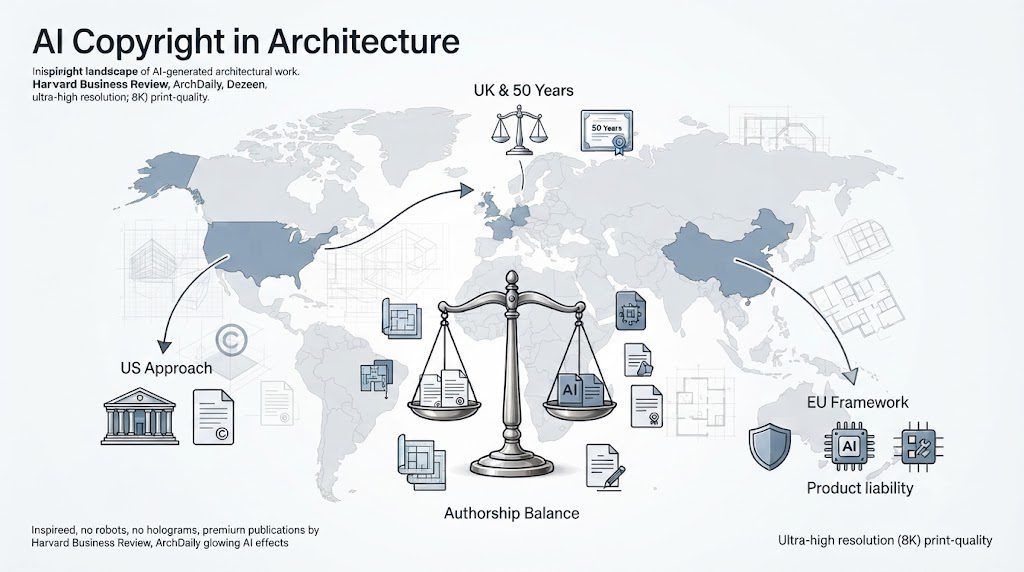
AI-generated illustration representing the differing international copyright regimes for AI-assisted architectural output across the United States, United Kingdom, and European Union.
Corporate Shield Blueprint: Contract Clauses for 2026
Firms can meaningfully reduce upstream liability with a handful of concrete contract and governance measures:
1. AI disclosure and consent clauses. Client agreements should specify which categories of AI tools the firm may use on a project, require written consent before uploading project data to any tool outside that pre-approved list, and define what counts as “project data” broadly enough to cover renderings, models, and site photography.
2. Human-authorship documentation protocol. Given the US human-authorship requirement, firms should maintain a design log recording where AI tools were used and what human modification, selection, or direction followed, creating a contemporaneous record that supports a copyright claim if the final work is challenged.
3. Vendor indemnification and liability allocation. Software and AI vendor agreements often limit the vendor’s liability for tool errors. Firms should negotiate indemnification provisions that don’t leave the firm holding 100% of the exposure when a vendor’s AI tool produces a flawed output that the firm relied on.
4. Mandatory professional review sign-off. No AI-generated structural, code-compliance, or life-safety content should reach a client or permitting authority without a named licensed professional’s documented review, given that AB 316-style statutes foreclose any “the AI did it” defense.
5. Privileged-channel routing for litigation-adjacent work. Once a dispute is reasonably anticipated, AI-assisted analysis should be routed through counsel using a structured, documented process rather than ad hoc use of consumer AI tools, given the discoverability risk illustrated by Heppner.
6. Data residency and retention clause for AI tools. Where firms use enterprise AI platforms, contracts with those vendors should specify data retention limits, a prohibition on using firm or client data for model training, and encryption standards consistent with the firm’s existing confidentiality obligations to clients.
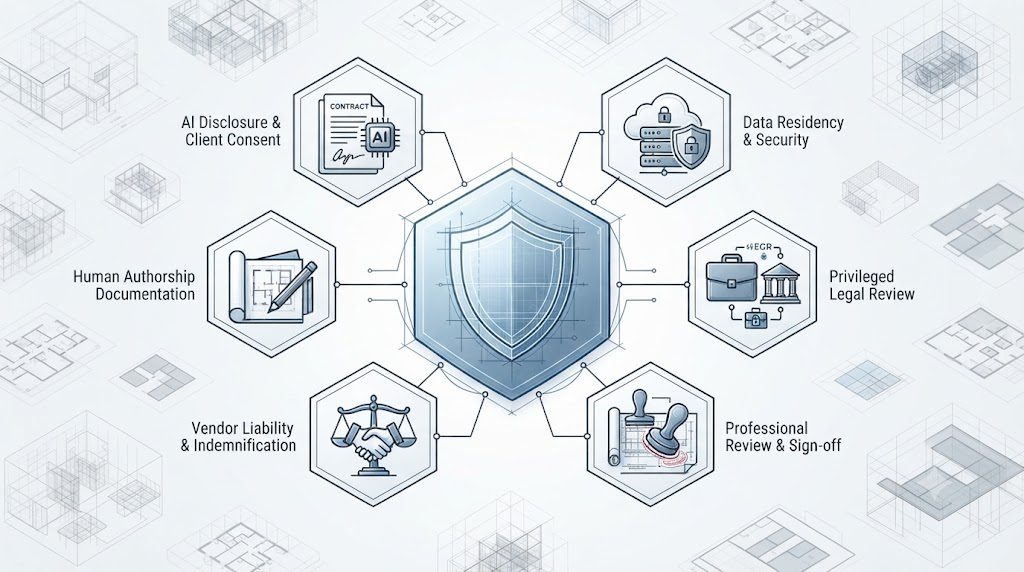
AI-generated illustration of the contract and governance safeguards firms can use to reduce AI-related legal exposure, from disclosure and consent clauses to mandatory licensed-professional review sign-off.
For related guidance, see Pillar 3: Design Tools, Software & AI, and the companion briefs on career readiness for AI-era practice and software budgeting for small firms.

Luca Moretti is a content strategist with a foundation in urban design and architecture. Based in Milan, he focuses on writing that bridges aesthetics, material culture, and everyday spatial experiences.