

“Don’t fight forces, use them.” -Buckminster Fuller
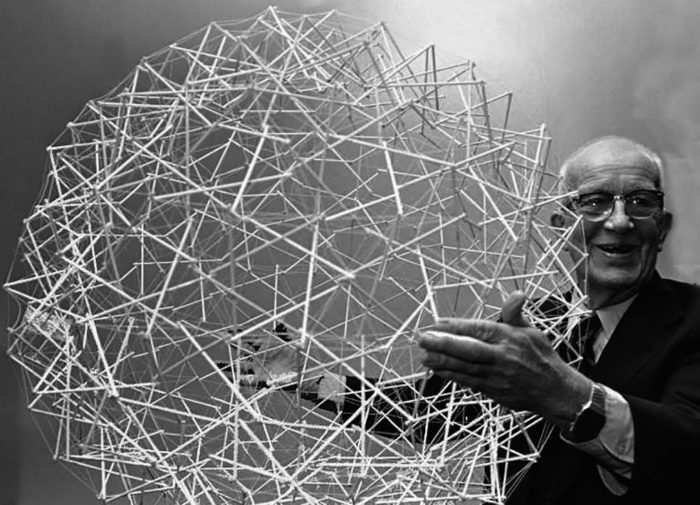
Tensegrity Structures are one of the construction world’s fascinating innovations. Architects always look out for the challenging and the unconventional, and the famous Buckminster Fuller is no exception. He created a “fuller world” on his way, experimenting with different architectural and structural visions, one of which turned out to be one of the intelligent innovations in the construction field: Tensegrity.
According to Fuller himself, tensegrity structures are “self-tensioning structures composed of rigid structures and cables, with forces of traction and compression, which form an integrated whole.” But what does this actually mean in practice?
Buckminster Fuller ©POET ARCHITECTURE via Flickr Licence Public Domain Mark 1.0
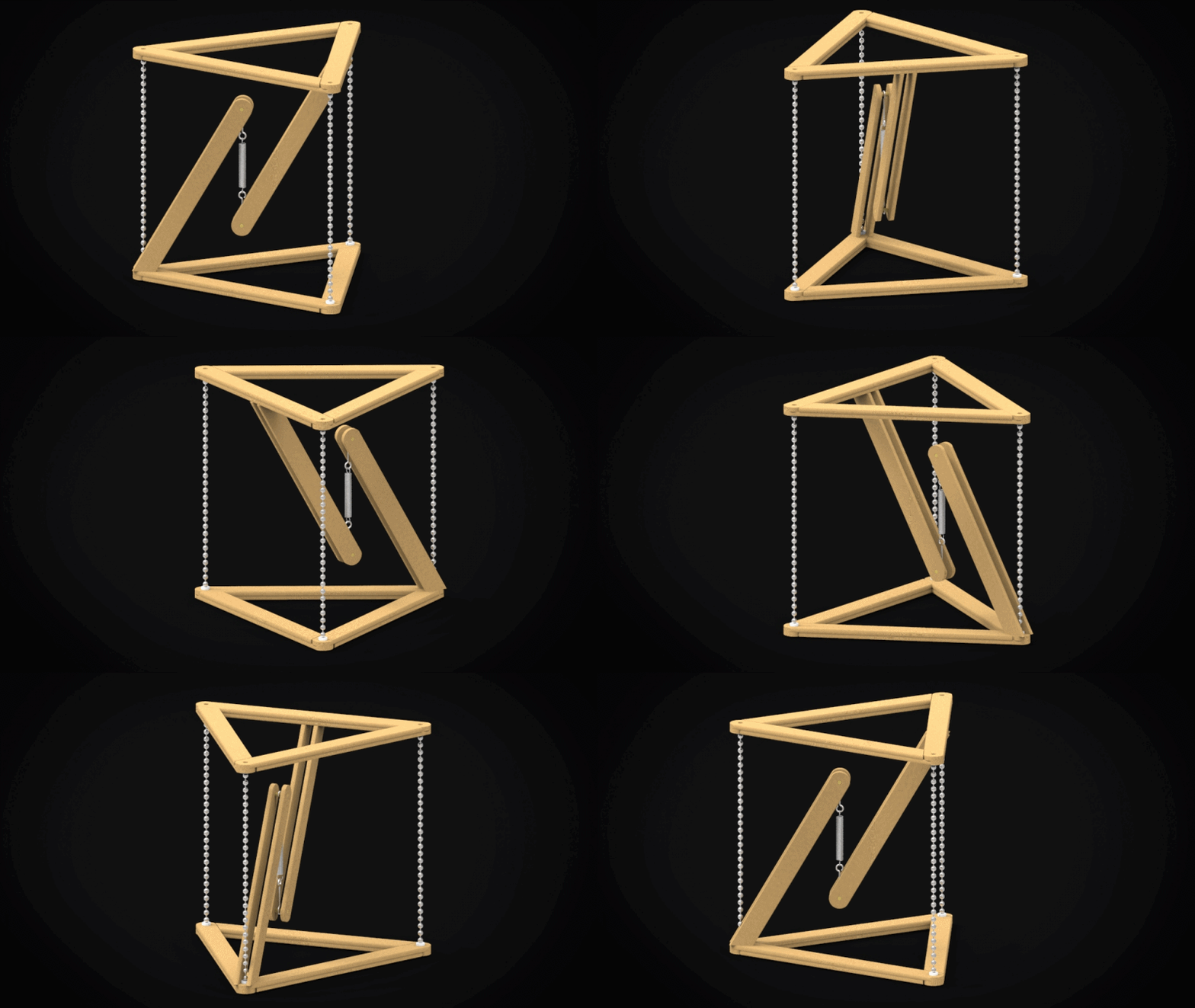
The most intimate example of tensegrity lies within our own bodies—our spine is a natural tensegrity structure! To understand this better, consider how most buildings work: they rely on compression force, where weight presses downward through solid columns and beams. Tensegrity flips this convention entirely. Instead of fighting gravity with massive supports, it uses tension force—a pulling force transmitted through cables, strings, or chains—to create structures that appear to float in space.
What are Tensegrity Structures?
At its core, a tensegrity structure is a system where continuous tension cables hold discontinuous compression bars in perfect balance. The rigid elements never touch each other directly; instead, they float within a network of tensioned cables that pull everything together into a stable, integrated whole.
©Roland Schneider
This principle mirrors nature’s efficiency. Just as vernacular architecture creates spaces that breathe with natural forces, tensegrity works with physics rather than against it, achieving remarkable strength through elegant material economy.
The History of Tensegrity: Vision Meets Sculpture
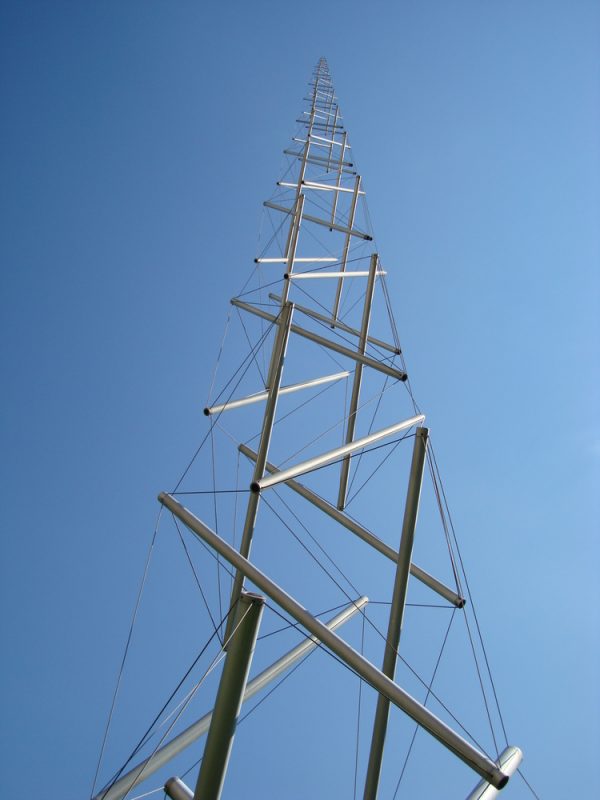
Buckminster Fuller began developing his tensegrity vision in the 1920s, but the first physical realization came in 1949 through his student, sculptor Kenneth Snelson. Working on a model for his Needle Tower sculpture, Snelson suspended two X-shaped wooden bars with a single nylon cable, accidentally discovering the fundamental principles that would define tensegrity architecture.
Also Read: Get the Most out of 3D Printed Architecture Overview and Our Top Picks for Its Structures
Needle Tower_Keneth Snelson ©Neil R via Flickr Licence CC BY-NC 2.0
Seven Defining Features of Tensegrity Structures
Snelson and Fuller identified seven characteristics that make these structures revolutionary:
1- Pervasive tension and separation of rigid elements.
In Snelson’s iconic Needle Tower, compression-resistant struts never touch. Instead, a continuous network of tensed cables lifts, embraces, and interconnects each element individually—what they called “continuous tension, discontinuous compression.”
2. Remarkable Stability
Despite their ethereal appearance—those wooden Xs seem to float magically—tensegrity sculptures achieve extraordinary stability through mechanical equilibrium. Every component balances every other component simultaneously.
3. Prestressed Components
This equilibrium emerges from components amplifying each other’s nature: cables pull inward on strut ends while struts push outward, stretching the cables. Every element enters the system already stressed—compression members pre-compressed, tensile members pre-tensed—in a condition known as “self-stress” or “prestress.”
4. Inherent Resilience
While prestressing stabilizes them, tensegrity structures respond exquisitely to outside forces. When deformed, their components immediately and reversibly reorient without breaking, making them incredibly resilient against environmental stresses.
5. Globally Integrated
Because every component connects intimately to every other, the entire structure feels what any single part experiences—a truly holistic system where local changes affect the whole.
6. Modular Expandability
Individual tensegrity units function as complete systems, yet they can combine into larger assemblies. In these expanded systems, disrupting one unit won’t compromise overall integrity, offering remarkable redundancy.
7. Hierarchical Organization
Smaller tensegrity structures can serve as compressive or tensile elements within larger tensegrity systems, creating nested hierarchies of structural efficiency.
How Tensegrity Structures Work: The Science Behind the Magic
Understanding the mechanics reveals why these structures fascinate engineers and architects alike. Traditional buildings channel loads through continuous compression paths—walls, columns, foundations—requiring massive material to resist buckling. Tensegrity distributes forces differently.
When a load presses down on a tensegrity structure, the compression struts push outward against the tension network. The cables immediately redistribute this force throughout the entire system, converting potential failure into balanced tension. This is why a properly designed tensegrity can support surprising weight with minimal material—every component works in harmony rather than isolation.
The prestress condition is crucial. By pre-tensioning cables during assembly, engineers ensure the structure finds equilibrium immediately. This preloading means the system responds to external forces by adjusting tension distribution rather than collapsing. It’s similar to how a spider’s web remains taut and functional whether bearing a gentle breeze or trapped prey.
10 Stunning Examples of Tensegrity in Architecture
These principles have inspired remarkable built works that span art, infrastructure, and even space exploration:
1. Needle Tower by Kenneth Snelson
©HildaWeges Photography/Shutterstock
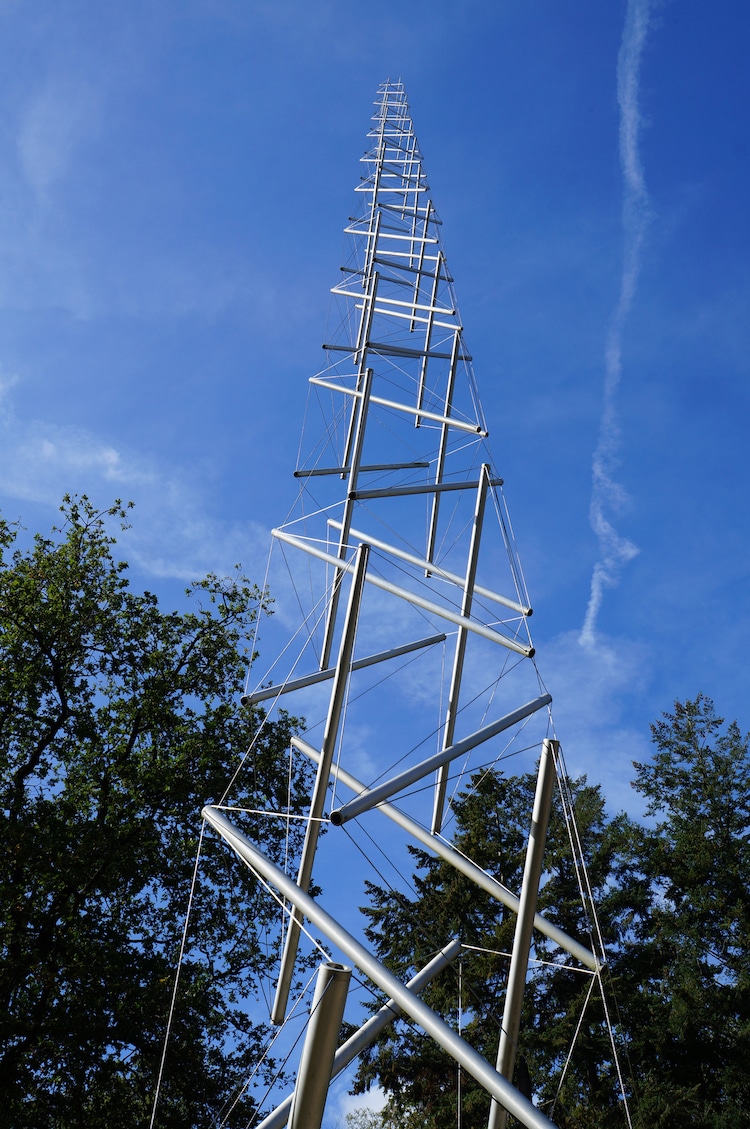
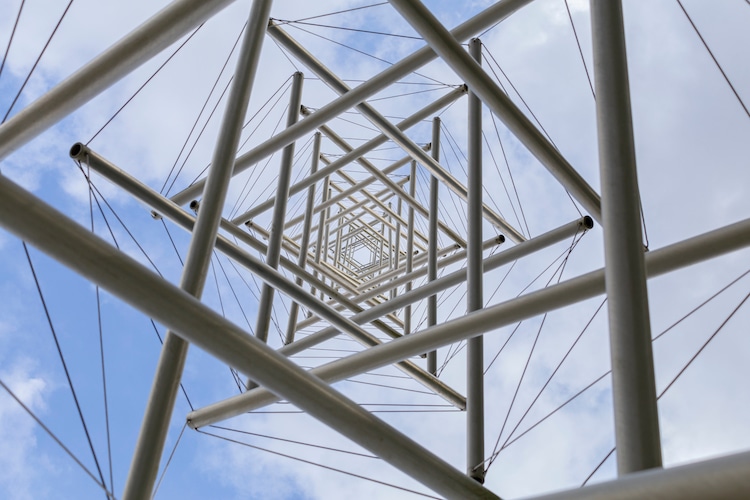
Standing at the Hirshhorn Museum and Sculpture Garden in Washington, D.C., Snelson’s Needle Tower remains the quintessential tensegrity sculpture. Aluminum tubes appear to float, held by nearly invisible steel cables that create tension. Step inside, and the cables reveal a six-pointed Star of David pattern—a hidden geometry that emerges only from within.
©HildaWeges Photography/Shutterstock
Also Read: How Steel Structures Have Changed the Face of Architecture Forever
2. Munich Olympic Stadium by Frei Otto
©Meunierd/Shutterstock
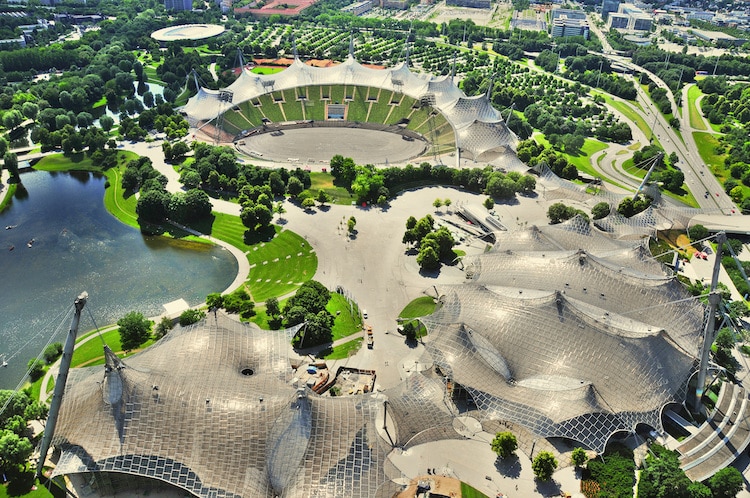
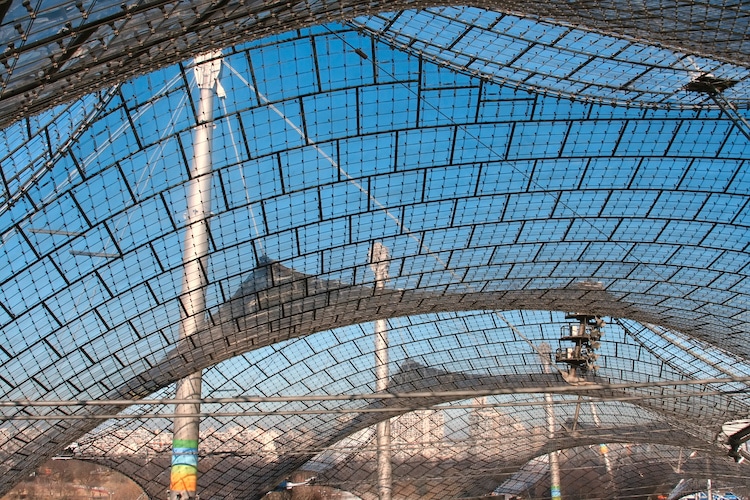
Frei Otto, inspired by his wartime tent-building experience, specialized in lightweight tensile architecture. The Munich Olympic Stadium demonstrates how tensegrity principles create vast, column-free spaces with minimal material. The result is both economically efficient and breathtakingly beautiful.
©Sahara Prince/Shutterstock
3. The Biosphere by Buckminster Fuller
©Meunierd/Shutterstock
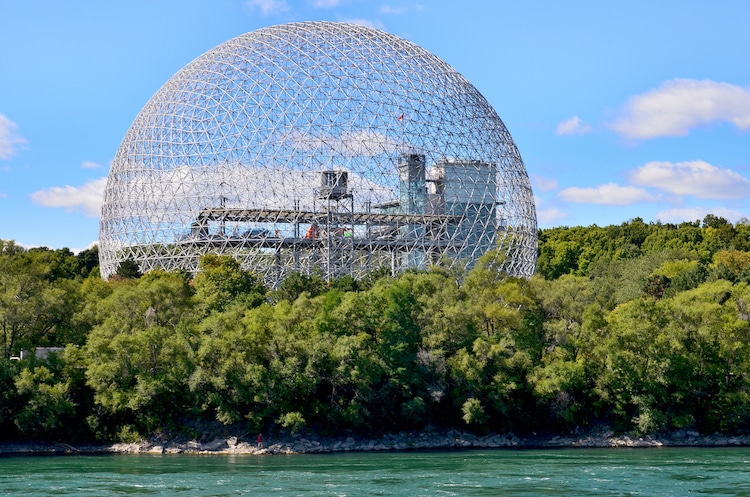
Fuller’s Montreal Biosphere showcases tensegrity’s aesthetic potential. This environmental museum’s sublime dome integrates structural logic with visual poetry, demonstrating how engineering principles can create iconic architecture.
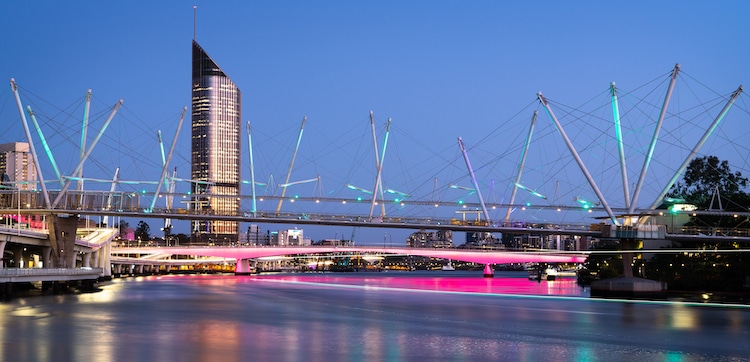
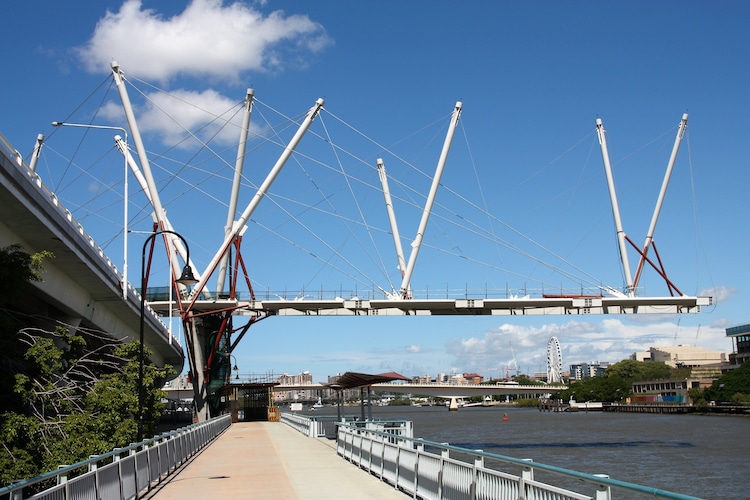
4. Kurilpa Bridge by Cox Rayner Architects and Arup Engineers
©Shane Spoor/Shutterstock
The world’s largest hybrid tensegrity bridge spans 1,500 feet in Brisbane, Australia. Large aluminum masts and light steel cables achieve perfect balance, creating a pedestrian bridge that feels both delicate and indestructible.
Also Read: 19 of the Most Beautiful Bridges Worldwide You’ll Ever See
©Tupungato/Shutterstock
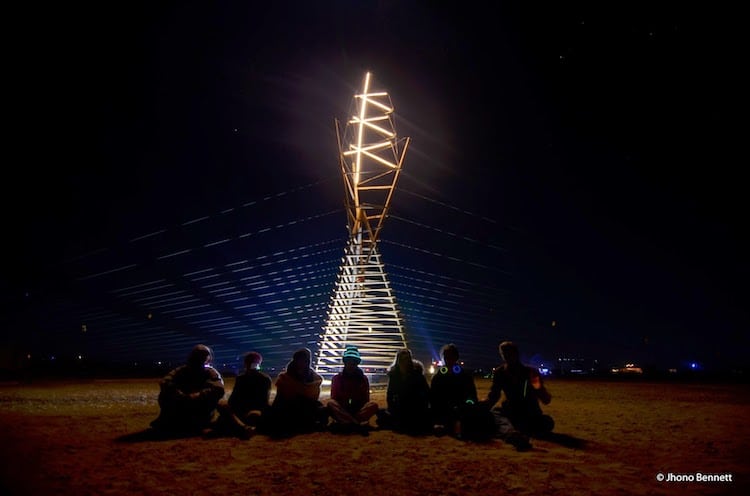
5. Dissipate at Afrikaburn by Thomas Van Deventer
©Jhono Bennett
Completed in 2015 for South Africa’s Burning Man counterpart, this sculpture evolves from traditional form to tensegrity as it rises. Crowdfunded and community-built, it demonstrates how these principles can engage public imagination.
6. Denver International Airport by Fentress Architects

©Arina P Habich/Shutterstock
Denver’s iconic terminal uses tensegrity principles across a 300-by-1,000-foot roofscape. Countless steel cables support a Teflon-coated fiberglass membrane that evokes the Rocky Mountains, proving tensegrity works at monumental scale.

©Arina P Habich/Shutterstock
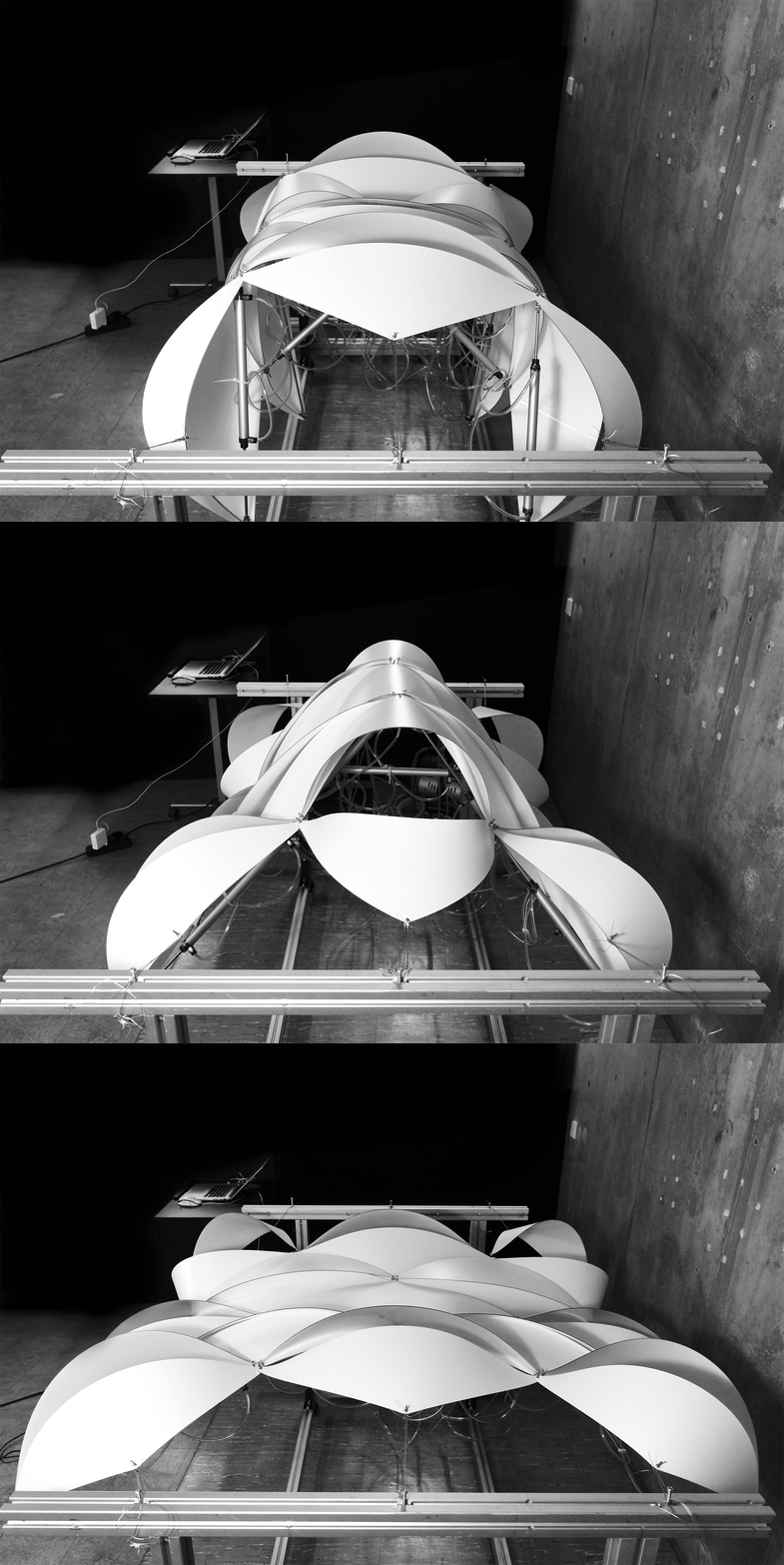
7. Reconfigurable Systems by Kuan-Ting Lai
©Kuan-Ting Lai
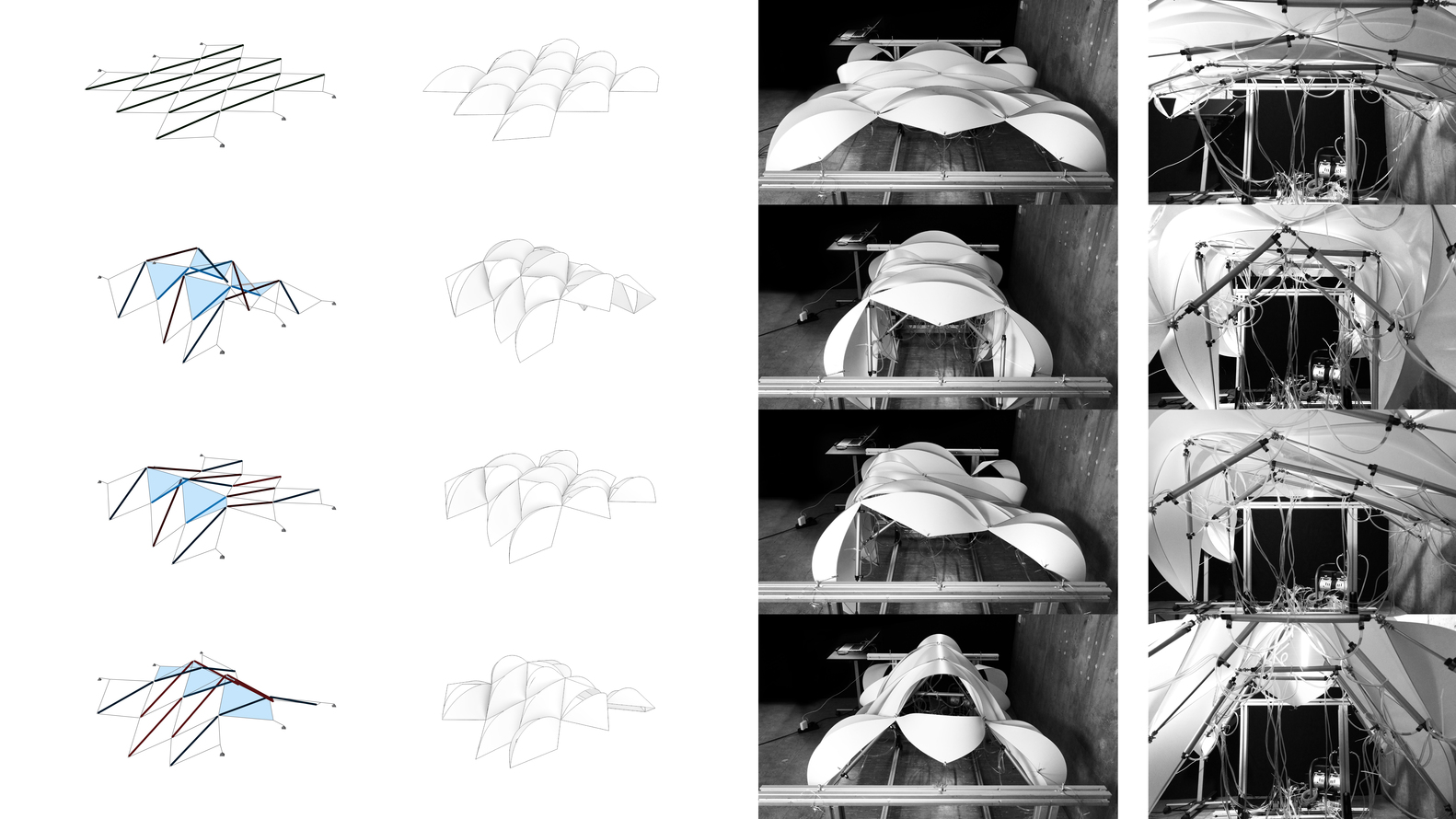
This research project explores tensegrity’s adaptive potential. By understanding basic rules and reconfiguration methods, Lai built prototypes that can transform their shape—opening possibilities for responsive architecture that adapts to changing needs.
©Kuan-Ting Lai
8- Parametric Tensegrity Structure for Local Art Fair by students of Ball State University in Muncie, Indiana
©Gernot Riether
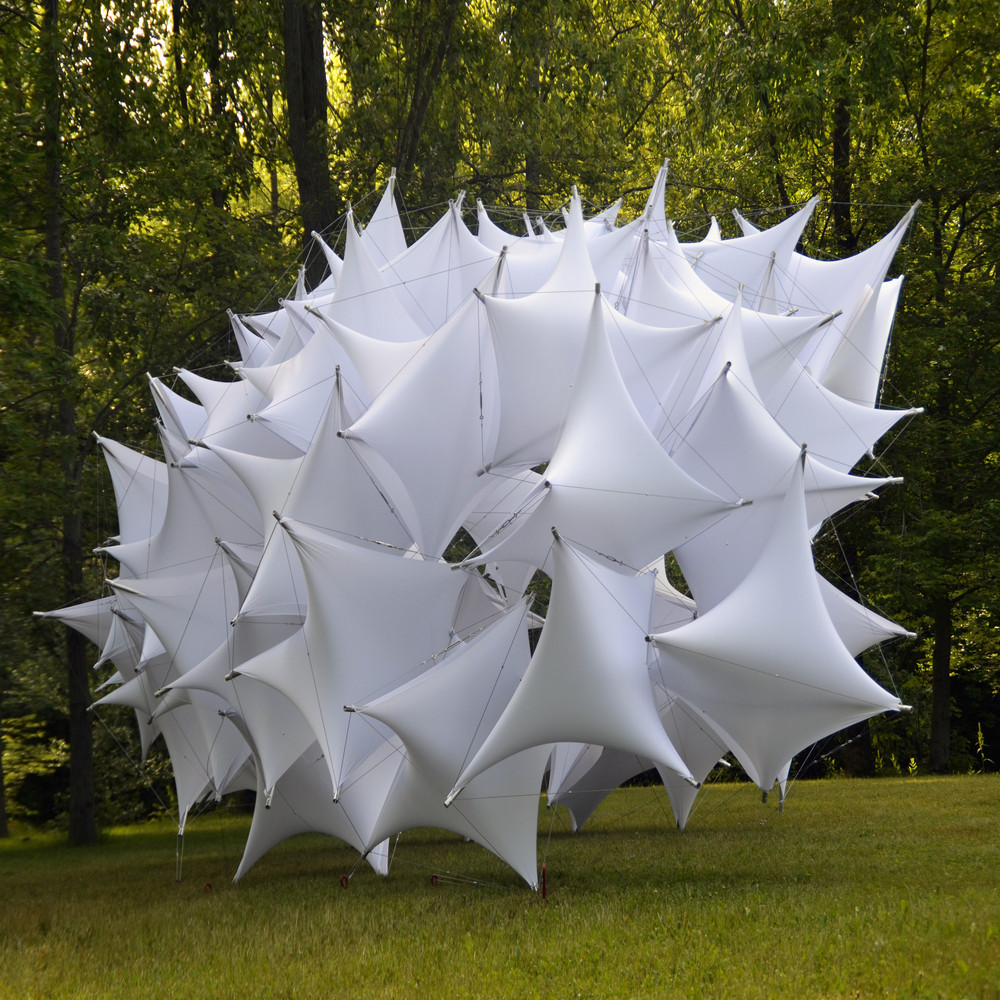
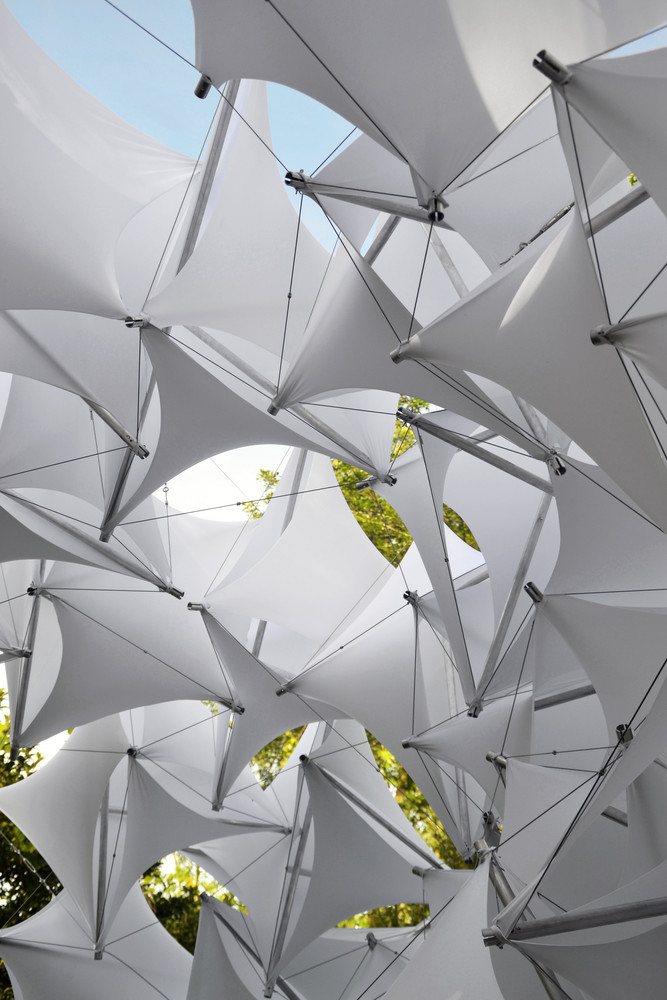
This example is a research project developed by students of Ball State University in Muncie, Indiana, under professors Gernot Riether and Andrew Wit, who are working towards formalizing parametric structures from 56 light and auto-shaded modules using elastane tissue to create a pavilion that offers protection from the sun. Structurally it was made from modular variations in measures and rotation from parametric software – Rhino and Kangaroo, essential for the conformation of the formal process.
©Gernot Riether
9. Nasa Super Ball Bot
©makezine.com
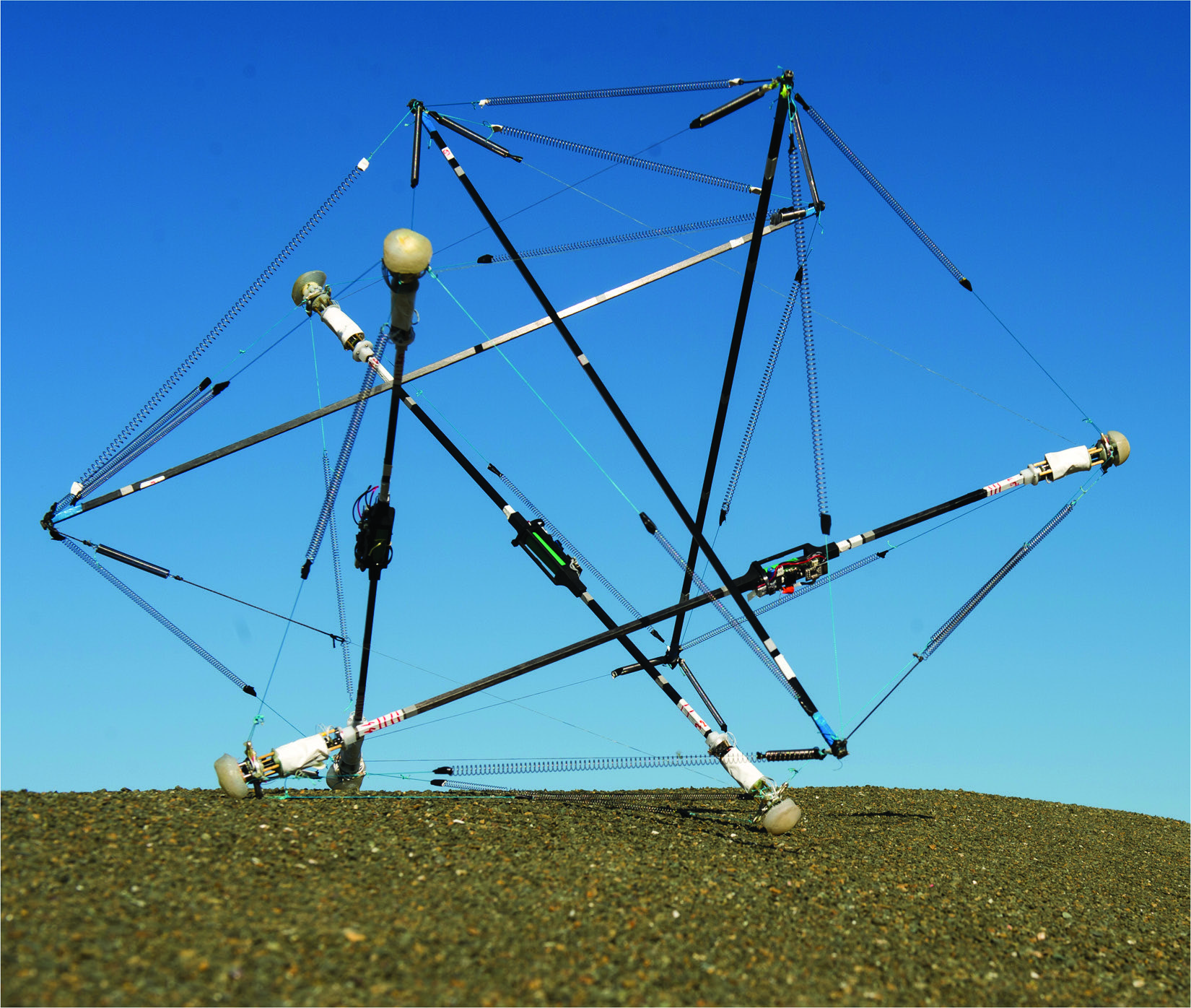
Super Ball Bot is a tensegrity-based, fully-featured landing and mobility platform that facilitates less expensive, more dependable planetary missions.
These robots designed to investigate the surface of planets are more robust and can tolerate more force. With its sphere-shaped wire and joint matrix, the Super Ball Bot is tough enough to survive being thrown from a spaceship thousands of feet above a planet’s surface and still bounce to safety.
The robot could be rolled over the planet’s surface in any direction once it landed and equipped with a data-gathering gadget in its very center. Due to the Super Ball Bot’s reduced mass and increased mobility, a prospective exploratory trip to Saturn’s moon Titan is now feasible.
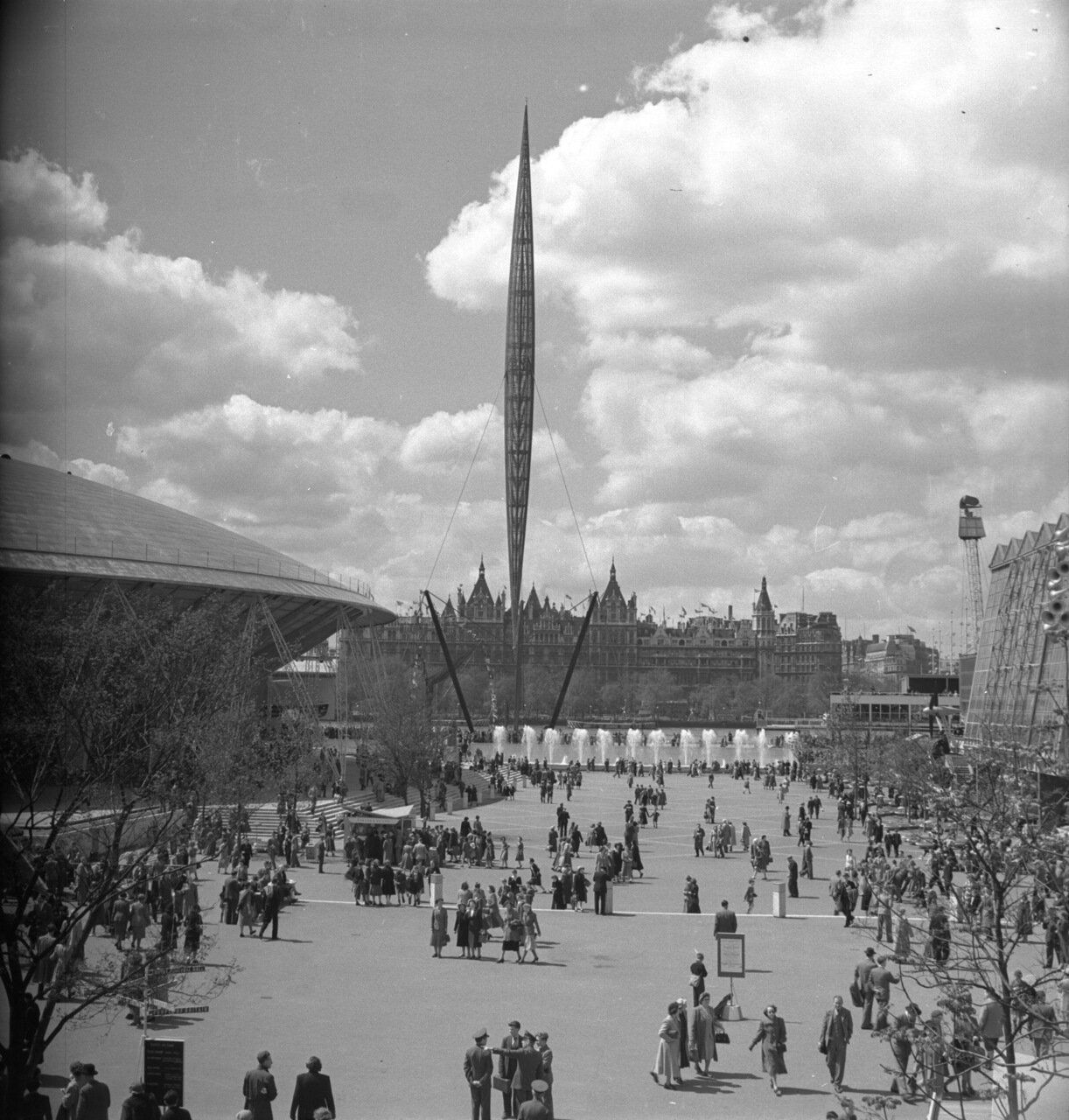
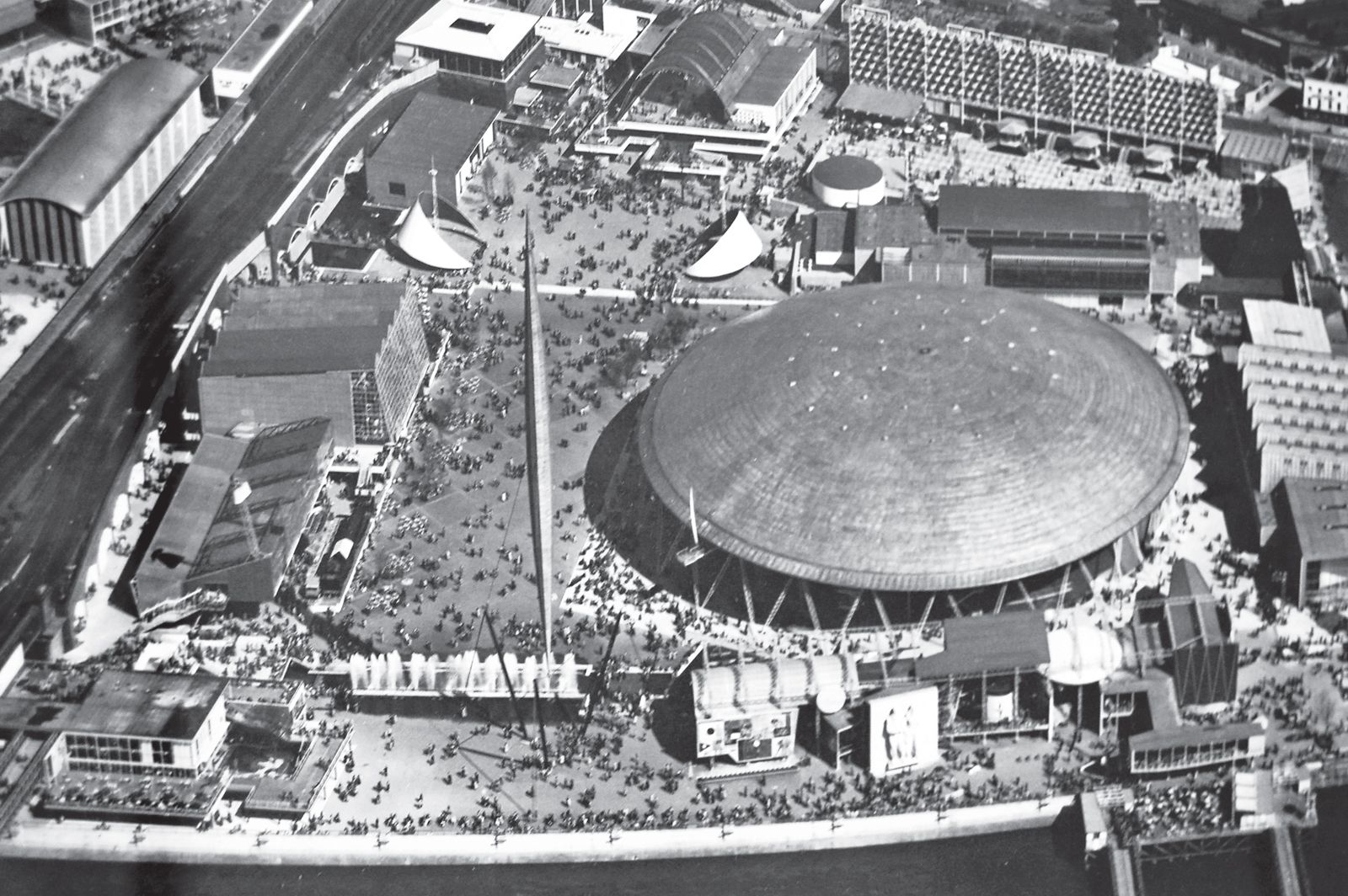
10. Skylon (Festival of Britain)
©humus.livejournal.com
In 1951, during the Festival of Britain, London’s thin, vertical, cigar-shaped steel tensegrity structure Skylon was constructed, giving the impression that it was ‘floating’ above the earth.
The Skylon was built of a steel latticework frame pointed at both ends and held together by cables strung between three steel beams. A vertical rig was set up for the half-built Skylon, which continued to rise in height while it stood alone. [2] Engineer Felix Samuely ensured the architects’ plan would hold together under load.
©mavink.com
Roughly 15 meters (50 feet) from the ground was the foundation for the Skylon that towered nearly 90 meters (300 feet) into the air. Aluminum slats illuminated from the inside covered the framework at night. There were concerns voiced in Parliament about the risk of lightning strikes to Skylon tourists, and Skylon was reportedly roped off at one time due to impending stormy weather—early lessons in construction safety guidelines for unconventional structures.
What makes tensegrity structures so strong?
Tensegrity structures derive their strength from continuous tension and discontinuous compression working in mechanical equilibrium. Every component is prestressed, meaning the system immediately redistributes any external load throughout the entire structure rather than concentrating stress in one area. This holistic force distribution makes them remarkably resilient and efficient.
Are tensegrity structures expensive to build?
Surprisingly, they can be more economical than traditional structures. By using minimal materials and maximizing tensile strength, projects like Frei Otto’s Munich Olympic Stadium proved that tensegrity reduces both material costs and structural weight. The key is careful engineering and precision in cable tensioning during assembly.
Can tensegrity be used in residential architecture?
While most examples are large-scale, the principles are scalable. Researchers like Kuan-Ting Lai are exploring reconfigurable tensegrity systems that could adapt to residential needs. The modular nature of tensegrity means it could theoretically create adaptive homes that respond to environmental conditions or family needs.
How do you maintain a tensegrity structure?
Maintenance focuses on cable tension monitoring and corrosion prevention. Because all elements are prestressed, regular inspection of connection points and cable integrity is essential. However, the redundancy built into these systems means that localized damage doesn’t typically compromise overall structural integrity.
Why aren’t tensegrity structures more common?
The primary barriers are engineering complexity and public unfamiliarity. Designing these systems requires sophisticated modeling software and specialized expertise. Additionally, building codes and construction safety guidelines have been slower to adapt to these unconventional approaches, though this is changing as more successful projects demonstrate their reliability.
The Future of Tensegrity: Beyond Earth
From the spine in our bodies to bridges spanning rivers, from art installations to robots exploring other planets, tensegrity principles continue to inspire innovation. The technology represents a fundamental shift in how we think about structure—not as a battle against gravity, but as a harmonious dance with physical forces.
As we face challenges of sustainability, material efficiency, and adaptive architecture, tensegrity offers compelling solutions. Its ability to create strong, lightweight, and resilient structures with minimal material waste aligns perfectly with contemporary environmental concerns. The research continues, from parametric design tools that make complex forms accessible to reconfigurable systems that could revolutionize how we inhabit space.
Buckminster Fuller’s vision of a “fuller world”—one that works with natural forces rather than against them—finds its purest expression in these floating, tensioned forms. They remind us that the most intelligent innovations often come not from fighting constraints, but from understanding and harnessing them.

Toqa Mostafa is a dedicated editor at Arch2O, bringing a sharp editorial perspective to architectural storytelling. Based in Egypt, she curates and refines content that showcases innovative design and urban solutions. Her work at Arch2O highlights her ability to engage readers with compelling narratives, bridging architectural creativity and critical discourse. Toqa’s editorial expertise contributes significantly to Arch2O’s mission of exploring the intersection of design, technology, and sustainability.