

The “Korean grasshopper” cafe is Grasshopper’s Dream (여치의 꿈), a café beside Gujeol-ri station near Jeongseon in Gangwon Province, South Korea, made from two old railway carriages raised on giant green steel legs and antennae so that each looks like a grasshopper. It stands at the start of the Jeongseon Rail Bike, a 7.2 km ride on a disused railway line. This short guide, for travellers and designers interested in playful adaptive reuse, explains what the building is, how it works as an attraction, and what to know before visiting.
What is Grasshopper’s Dream?
The café occupies two old train carriages that have been remodelled and mounted on huge steel legs, with antennae at the front, so that the pair reads as two green grasshoppers. According to Atlas Obscura, the lower level serves food and the upper level is a coffee shop, and at night the insects are lit from below.

It is a piece of “programmatic” or novelty architecture: a building shaped like an object to attract attention, here reusing redundant rolling stock from a closed railway. Nearby, along the same route, are other oversized sculptures, including a pair of giant fish and another, more cartoon-like pair of grasshoppers.
The Korean grasshopper cafe and the Jeongseon Rail Bike
The café sits at Gujeol-ri station, the start of the Jeongseon Rail Bike, which runs for 7.2 km along a former railway line through the valley to Auraji, mostly downhill, with a train back for riders, as described by This Is Korea Tours. The rail bikes are pedal-powered carts for two or four people; a small open sightseeing train carries riders back.
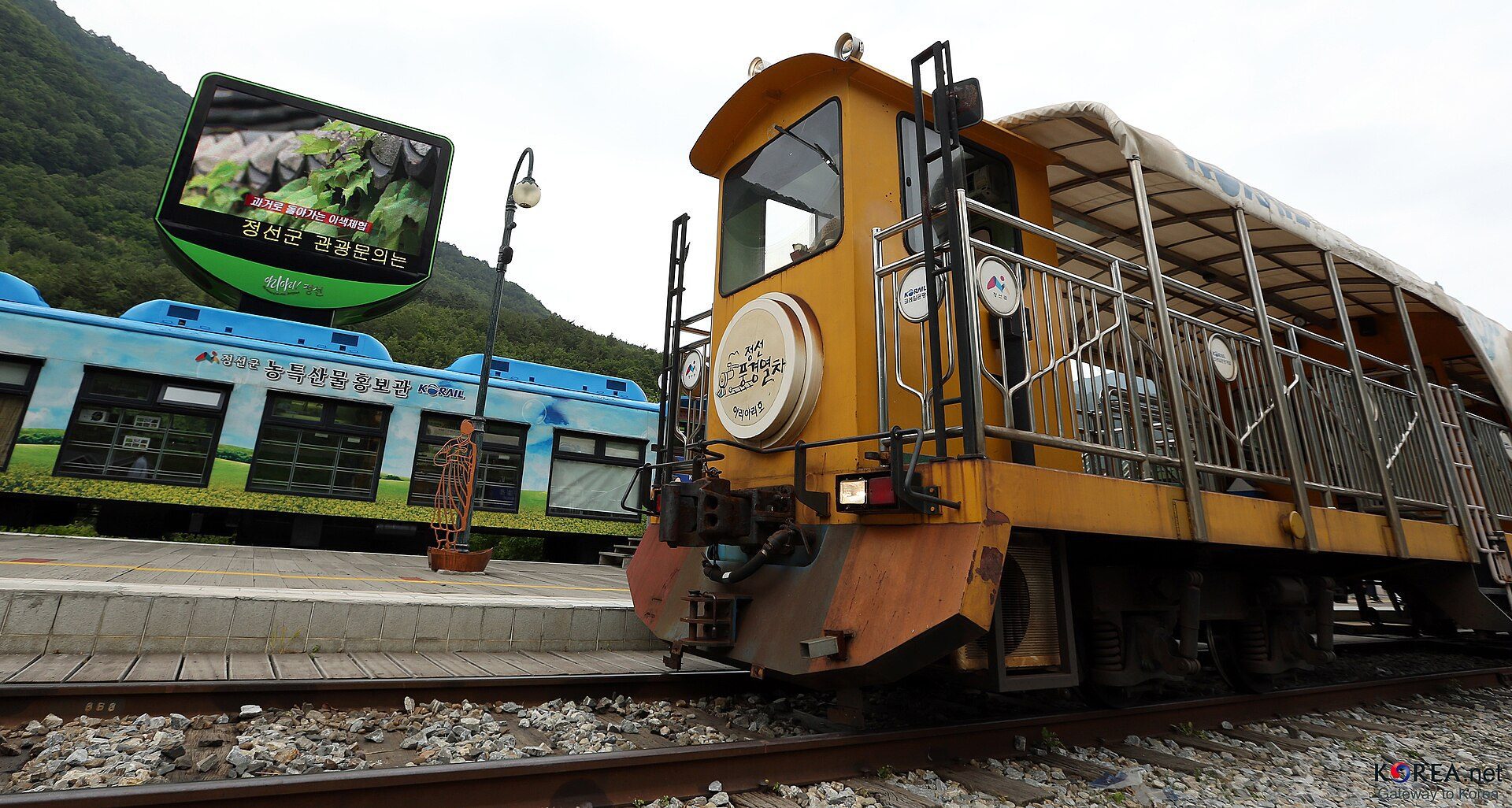
The open sightseeing train that runs alongside the Jeongseon Rail Bike route, photographed in 2014. Photo: Korea.net / Korean Culture and Information Service, CC BY-SA 2.0, via Wikimedia Commons. Korea.net / Korean Culture and Information Service (Jeon Han), source, CC BY-SA 2.0
Prices, departure times and seasonal timetables are set by the operator and change; a travel listing on Trazy gives current fares and times, but confirm with the operator before you travel.
Why it matters for designers
The Korean grasshopper cafe shows three ideas that recur in adaptive reuse and tourism architecture:
- Reuse redundant infrastructure. The rail bike turns a closed line into a leisure route, and the café gives old carriages a second life.
- Make a landmark. A memorable silhouette, visible by day and lit at night, turns a small café into a destination.
- Tie the building to the route. The café works because it sits at the start of the ride, where people gather.
For other South Korean architecture, see these Christian churches in South Korea and the opening of the Lotte World Tower in Seoul.


Sources and further reading
- Atlas Obscura, Grasshopper’s Dream Cafe, Jeongseon.
- This Is Korea Tours, Jeongseon Rail Bike.
- Trazy, Jeongseon Rail Bike listing.
Ibrahim Abdelhady is an architect, academic, and media entrepreneur with over two decades of experience in architecture and digital publishing. He is the Founder and CEO of Arch2O.com, a leading platform in architectural media, renowned for showcasing innovative projects, student work, and critical discourse in design. Holding dual PhDs in Architecture, Dr. Abdelhady combines academic rigor with industry insight, shaping both future architects and architectural thought. He actively teaches, conducts research, and contributes to the global architecture community through his writing, lectures, and media ventures. His work bridges the gap between practice and academia, pushing the boundaries of how architecture is communicated in the digital age.