

Sustainable interior materials are finishes, fabrics and furniture with a lower environmental impact over their life and lower emissions into the air people breathe indoors. The difficulty is not finding products that claim to be green, but checking which claims are true. Three kinds of evidence do most of the work: an Environmental Product Declaration (EPD) for the product’s life-cycle impacts, emissions certifications for volatile organic compounds (VOCs), and source certifications such as FSC for timber. This guide explains each, then goes through flooring, wall finishes, textiles and furniture, and ends with a verification checklist you can use on any project.
It is written for interior designers, architects and clients specifying sustainable interior materials, and for students learning how to read the paperwork behind a green claim.
How to judge claims about sustainable interior materials
Environmental Product Declarations (EPDs)
An EPD is a standardised, independently verified report of a product’s environmental impacts over its life cycle, calculated by life-cycle assessment. For construction products in Europe, EPDs follow ISO 14025 and EN 15804, which quantifies a product’s impacts over its whole life cycle using standard rules. The headline figure for most specifiers is global warming potential (GWP), the embodied carbon, expressed in kilograms of CO₂ equivalent per declared unit.
When you read an EPD, check four things: that it is third-party verified by a recognised programme operator, that the declared unit and life-cycle stages match the product you are comparing, that it is current (most are valid for five years), and that comparisons are only made between EPDs built on the same rules. An EPD does not mean a product is low-impact; it means its impacts are disclosed, so you can compare.
VOC emissions certifications
Many interior products release VOCs, such as formaldehyde and solvents, especially when new. Indoor concentrations of many VOCs are higher than outdoors, which is why low-emitting products matter in schools, offices and homes. The best-known certifications test finished products in chambers against strict limits: UL GREENGUARD Gold, for example, limits emissions of hundreds of individual VOCs and total chemical emissions and requires compliance with the California Department of Public Health Standard Method (CDPH v1.2), and the US Environmental Protection Agency maintains a list of emission criteria for indoor building products used in its programmes. Europe has equivalent schemes such as Eurofins Indoor Air Comfort and national emission classes.
Source and content certifications
- FSC or PEFC for timber and wood-based products, showing chain of custody from certified forests.
- Recycled content declarations, ideally independently verified, stating pre- and post-consumer content.
- Material health labels such as Declare or Cradle to Cradle Certified, which disclose ingredients and assess chemical hazards.
- Textile labels such as OEKO-TEX (tested for harmful substances) and GOTS (organic fibres with social criteria).
| Evidence | What it shows | Typical use | How to verify |
|---|---|---|---|
| EPD (ISO 14025 / EN 15804) | Life-cycle impacts incl. embodied carbon (GWP) | Comparing products' environmental impact | Programme operator's registry; check validity and rules |
| GREENGUARD Gold / CDPH v1.2 | Low chemical emissions into indoor air | Paints, adhesives, furniture, boards, flooring | UL certification database |
| FSC / PEFC | Timber from certified forests, chain of custody | Wood floors, panels, furniture | FSC / PEFC certificate databases |
| Declare / Cradle to Cradle | Ingredients and material health | Finishes and furniture | Certifier's product database |
| OEKO-TEX / GOTS | Textiles tested for harmful substances / organic fibres | Upholstery, curtains, rugs | Label check online |
Source: Arch2O summary of scheme descriptions (EN 15804 EPDs, UL GREENGUARD, FSC, OEKO-TEX, GOTS) (as of 21 October 2026).
Flooring
Flooring covers large areas and is replaced often, so it has a big influence on a project’s impact.
- Solid and engineered wood: renewable and long-lasting if refinishable; specify FSC or PEFC certification and low-VOC finishes and adhesives.
- Cork: harvested from the bark of cork oaks without felling the tree; warm, quiet and resilient underfoot.
- Linoleum: made from linseed oil, wood flour, cork and jute on a natural backing; durable and repairable.
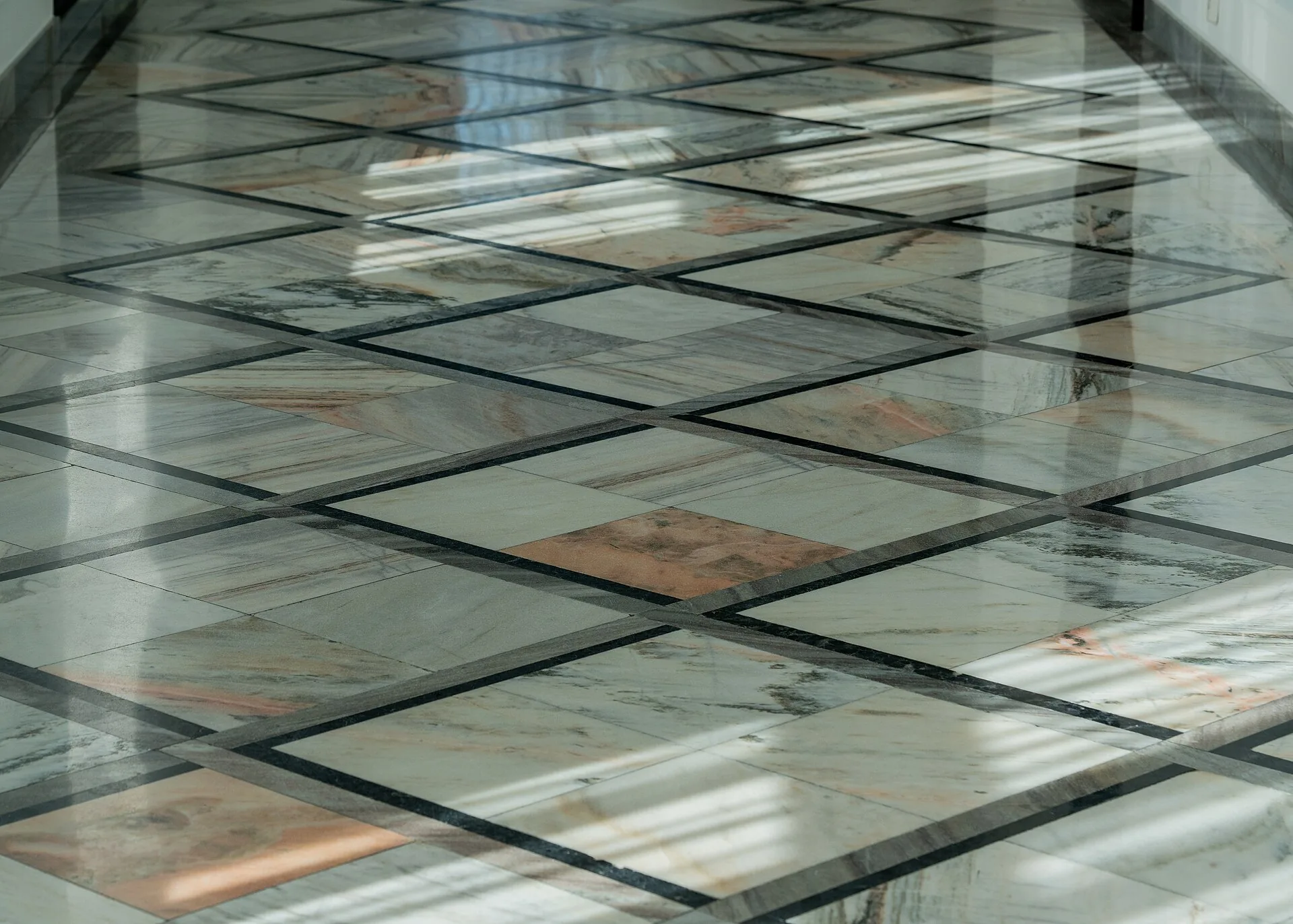
- Stone and ceramic tile: high embodied energy but very long-lasting and VOC-free; compare EPDs and choose local sources where possible.
- Carpet: choose high recycled content, take-back schemes and low-emission certification; carpet tiles allow worn areas to be replaced individually.
Wall finishes
- Clay and lime plasters: low-carbon, breathable finishes that help buffer indoor humidity; clay plaster can be repaired and even reused.
- Low-VOC and mineral paints: check emissions certification rather than “eco” labels; silicate and lime paints are naturally low in organic content.
- Timber panelling and acoustic panels: certified timber or recycled-fibre panels can improve acoustics while storing carbon.
- Wallcoverings: avoid PVC where alternatives exist; look for paper or textile wallcoverings with emissions certification.

Textiles
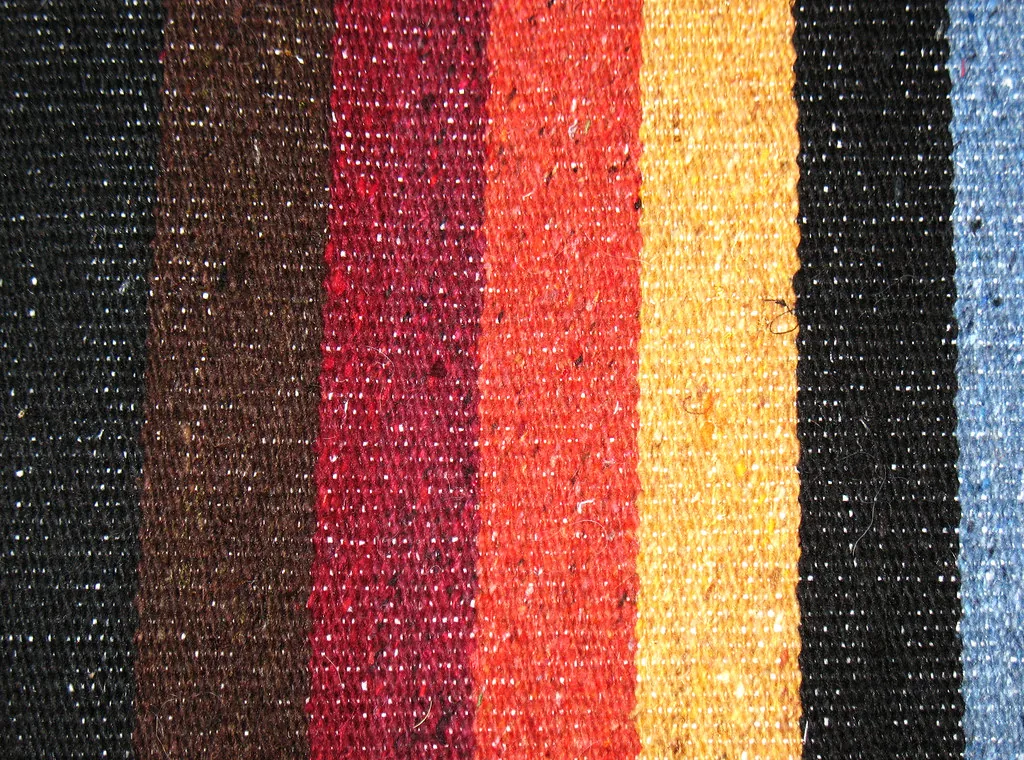
Upholstery, curtains and rugs touch occupants directly. Prefer natural or recycled fibres such as wool, linen and hemp, or recycled polyester, with OEKO-TEX or GOTS certification; check what flame retardants are used to meet fire regulations, as some chemical treatments are of concern; and choose durable, cleanable fabrics so they last.
Furniture
The most sustainable furniture is often furniture that already exists: reuse, refurbish and reupholster before buying new. For new pieces, look for certified timber, low-emission boards and finishes, modular designs that can be repaired, and manufacturer take-back schemes. Our feature on recycled design shows how reclaimed materials can become high-quality interiors.
A verification checklist for sustainable interior materials
- Ask for evidence, not adjectives. “Natural”, “eco” and “green” mean nothing without data.
- Request a third-party verified EPD and check its validity date, declared unit and programme operator.
- Check emissions certification for every product that is installed or applied wet indoors: adhesives, sealants, paints, floor finishes and composite boards.
- Verify certificates on the certifier’s own database, not just the supplier’s brochure.
- Check source certification for timber (FSC or PEFC chain of custody).
- Consider durability and end of life: can it be repaired, refinished, taken back or recycled?
- Prefer reuse of existing materials and furniture wherever quality allows.
- Record everything in the specification so the evidence stays with the project.
A specification workflow for sustainable interior materials
Choosing sustainable interior materials is easier with a simple workflow. First, set targets in the brief: low indoor emissions, documented embodied carbon, responsibly sourced timber and products that can be repaired or reused. Second, shortlist products with third-party evidence, such as environmental product declarations, emissions certifications and chain-of-custody certificates, and check that certificates are current and cover the exact product. Third, compare options per square metre over the same service life, including maintenance and replacement. Fourth, record the evidence in the specification and ask contractors to submit it for approval before ordering.
- Prefer durable, repairable finishes over short-lived decorative ones.
- Reuse what exists: existing floors, doors and furniture often have the lowest footprint of all.
- Avoid unnecessary layers: exposed structure or simple finishes reduce material use.
This approach turns sustainable interior materials from a marketing label into a verifiable part of the project.
Common mistakes when specifying sustainable interior materials
The most common mistake is to rely on marketing words such as “eco”, “natural” or “green” instead of documents. Ask for a product-specific Environmental Product Declaration rather than an industry average, check that it was verified by a third party, and compare products only when their declarations use the same functional unit and scope. A second mistake is to focus on one property and ignore others: a recycled-content carpet with a high-emission adhesive, or a low-carbon board finished with a solvent-based lacquer, can undo the benefit. Third, designers often forget installation and maintenance: some floor finishes need frequent re-coating with products that emit volatile organic compounds, and some “natural” materials need replacement sooner. Finally, sustainable interior materials only work if they last, so durability, repairability and the ability to take products back at the end of their life matter as much as the numbers on a certificate.
Make a materials comparison that survives specification
Use the same functional requirement, service life and assessment boundary for each option. Separate a product declaration from an ecolabel, and distinguish indoor-emission testing from a statement about recycled content. Request the relevant current documents for the exact product and manufacturing site. Record the assumptions about replacement, adhesives, transport and end-of-life treatment. If two datasets cannot be compared on the same basis, state that limitation rather than choosing whichever number looks smaller. Retaining a serviceable finish may deserve comparison with replacing it.
For the wider specification process, our guide to selecting architectural building materials explains how to compare requirements before choosing a product.
Summary
Choosing sustainable interior materials is about evidence: EPDs for life-cycle impacts, emissions certifications for indoor air, and source certifications for timber and textiles, checked on the certifiers’ own databases. Combine that evidence with durability and reuse, and the result is an interior that is healthier for its occupants and lighter on the planet. For the wider context, see our introduction to what sustainable architecture means in practice and our look at sustainable interior design trends.

Luca Moretti is a content strategist with a foundation in urban design and architecture. Based in Milan, he focuses on writing that bridges aesthetics, material culture, and everyday spatial experiences.