

Bjarke Ingels and BIG: How Sustainable Design Became Visually Radical
Bjarke Ingels is a Danish architect and founder of Bjarke Ingels Group (BIG), best known for coining the term “hedonistic sustainability” in a 2011 TEDx talk — the idea that environmentally responsible design should make life more enjoyable rather than more restrictive. The concept’s most famous built expression is CopenHill (Amager Bakke), a waste-to-energy power plant in Copenhagen topped with an artificial ski slope, hiking trails, and a climbing wall. Ingels’ work sits at the intersection of pragmatism and spectacle, and it has made him one of the most publicly visible architects of his generation.
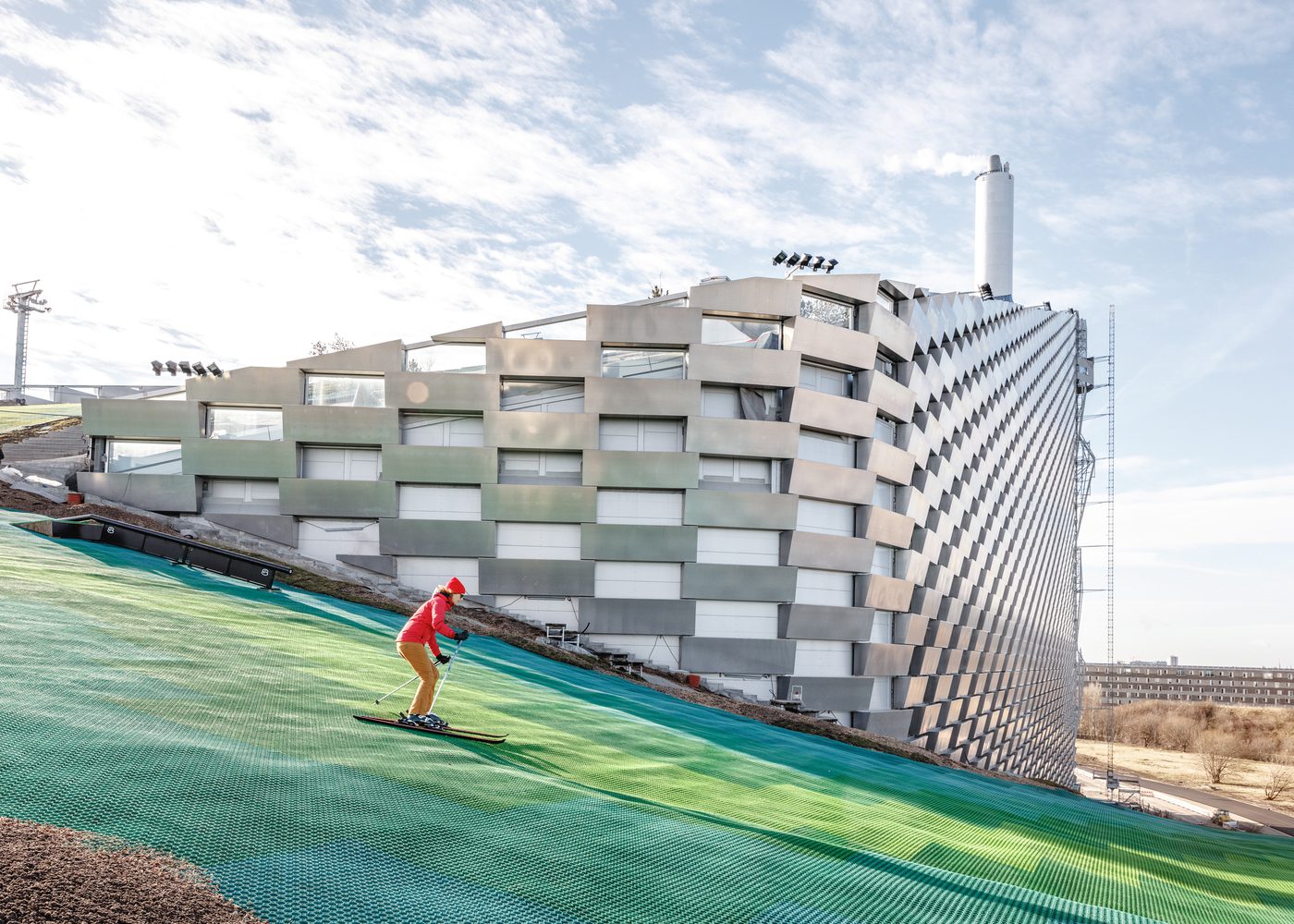
CopenHill (Amager Bakke) in Copenhagen by BIG, a waste-to-energy power plant topped with an artificial ski slope, hiking trails, and a climbing wall — the built expression of hedonistic sustainability. Photography by Rasmus Hjortshoj
What is Bjarke Ingels known for?
Bjarke Ingels is known for “hedonistic sustainability,” a design philosophy he introduced at a 2011 TEDx talk, and for CopenHill, the Copenhagen power plant that put that philosophy on the skyline. Ingels built his reputation on the argument that sustainable buildings had spent decades asking people to sacrifice comfort for the planet’s sake, and that this framing was a strategic failure. His response was to design projects that fuse an infrastructural or environmental function with something people actively want to use — a ski slope on top of a waste incinerator, a courtyard garden on top of a parking structure, a public park doubling as flood protection. The approach turned Ingels from a promising Danish architect into a globally recognized brand, and it turned BIG into one of the busiest firms in contemporary practice, with a client list that has included Google and WeWork alongside cultural and civic commissions across four continents.
What does “hedonistic sustainability” mean?
Hedonistic sustainability is Ingels’ argument that sustainability initiatives fail when they rely on guilt or self-denial, and succeed when they are simply more enjoyable to use than the alternative. Ingels has summarized the idea by saying, in essence, that sustainable design won’t win if it isn’t also better designed and more pleasurable to inhabit. Rather than treating environmental performance and human delight as competing goals that must be balanced against each other, Ingels’ studio treats them as the same problem: find the single form that solves both at once.
The mechanism behind this is what BIG calls hybrid typology — taking two building programs that are normally kept apart (a power plant and a recreation ground; a parking garage and an apartment block; a housing complex and a public plaza) and physically fusing them into one form. CopenHill is the clearest example: the building processes roughly 400,000 tons of waste annually into energy for the city, while its sloped, turfed roof functions as a year-round recreation destination with dry ski and snowboard runs. The 8 House in Copenhagen’s Ørestad district applies the same logic at a housing scale, arranging apartments, townhouses, and commercial space around a figure-eight footprint so that a continuous sloped path lets residents cycle from the ground floor to the tenth-floor rooftop without ever using an elevator, folding social infrastructure directly into the building’s section.
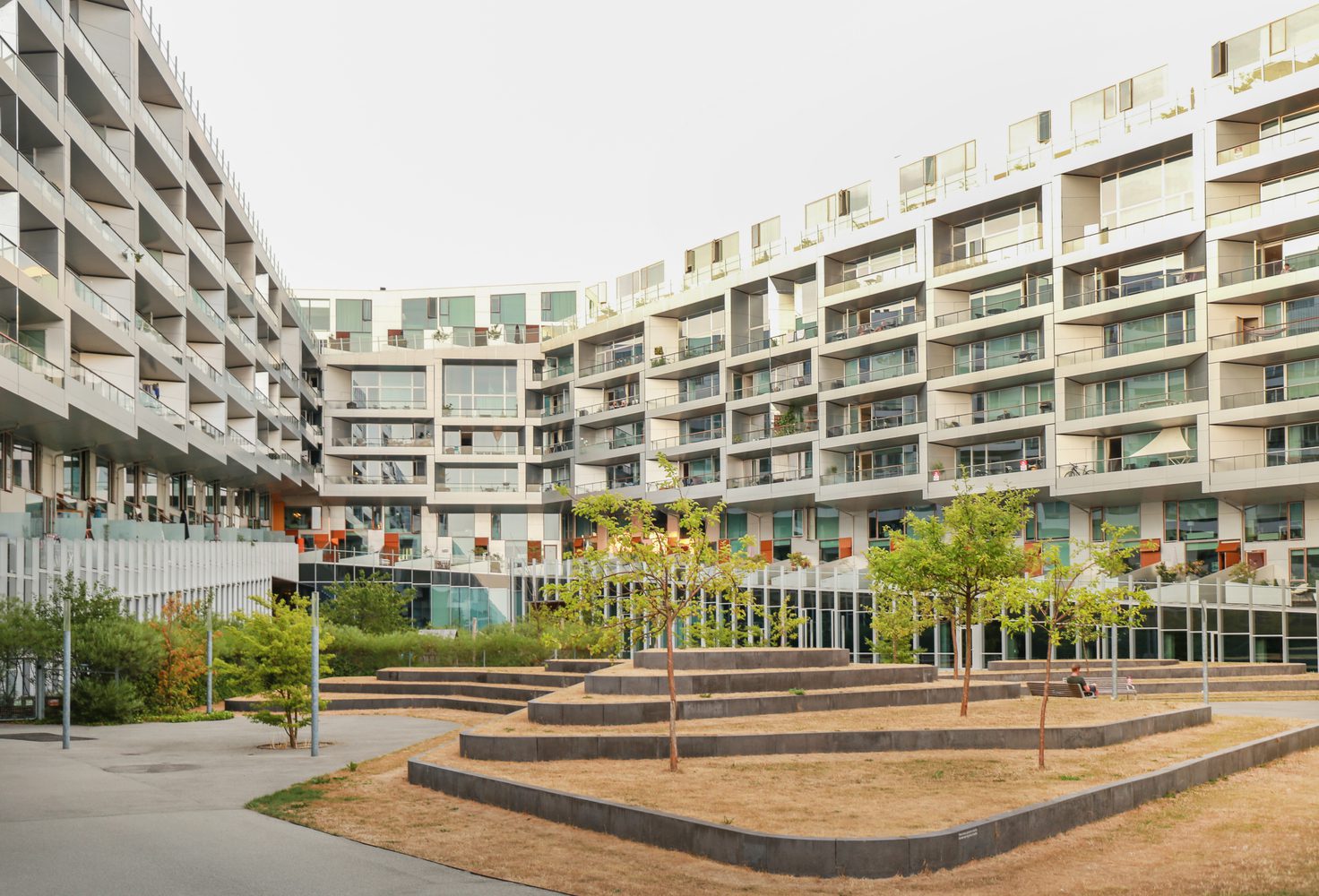
A BIG project illustrating hedonistic sustainability and hybrid typology, fusing an environmental or infrastructural function with public recreation in a single form. Photography by Maria Gonzalez
What is Bjarke Ingels’ most famous building?
CopenHill (Amager Bakke), completed in 2019, is Bjarke Ingels’ most famous building and the fullest built realization of hedonistic sustainability. It converted a purely industrial program — a combined heat-and-power waste incinerator serving greater Copenhagen — into a public amenity that draws skiers, hikers, and climbers, alongside a rooftop bar and running track. Its 85-meter smokestack was designed to periodically emit a giant smoke ring for every ton of carbon dioxide released, a feature intended as a piece of environmental communication rather than pure infrastructure, though the ring-emitting mechanism was ultimately never activated after opening.
Where did Bjarke Ingels train before starting BIG?
Bjarke Ingels trained at Rem Koolhaas’s Office for Metropolitan Architecture (OMA) before founding BIG in Copenhagen in 2006. Ingels studied architecture at the Royal Danish Academy of Fine Arts and briefly at the Escola Tècnica Superior d’Arquitectura de Barcelona, then worked at OMA in Rotterdam, where Koolhaas’s own brand of theory-driven, deliberately provocative modernism left a clear mark on Ingels’ later work. In 2001, Ingels co-founded PLOT with fellow OMA alumnus Julien De Smedt; that partnership dissolved in 2006, at which point Ingels established BIG as an independent practice.
The Philosophy in Depth
Ingels first laid out hedonistic sustainability publicly at a 2011 TEDx talk in Copenhagen, delivered in the shadow of the city’s failed 2009 UN Climate Change Conference. His diagnosis was that the summit, like much of the sustainability movement around it, had a communication problem as much as a policy problem: environmentalism was being sold as sacrifice, and people don’t rally around sacrifice. His proposed fix was not a new material or structural system but a reframing — sustainability should be marketed and designed as an upgrade to daily life, not a tax on it.
This reframing is closely tied to what Ingels calls “pragmatic utopia,” a phrase that appears throughout BIG’s own project descriptions and lectures. The idea is that utopian ambition and pragmatic constraint are not opposites to be traded off but ingredients to be combined in the same design move — a rejection of both the purely visionary, unbuildable manifesto and the purely functionalist, joyless solution. In practice, this shows up as Ingels’ signature hybrid typology: stacking, folding, or wrapping two conflicting programs into a single form so that neither has to be diminished for the other to work. Beyond CopenHill and 8 House, this logic runs through projects like VIA 57 West in Manhattan, a “courtscraper” that bends a conventional tower into a pyramidal form to open a private courtyard onto the Hudson River, and Via Alcatraz, applied variously to museum, residential, and civic commissions across BIG’s growing portfolio.
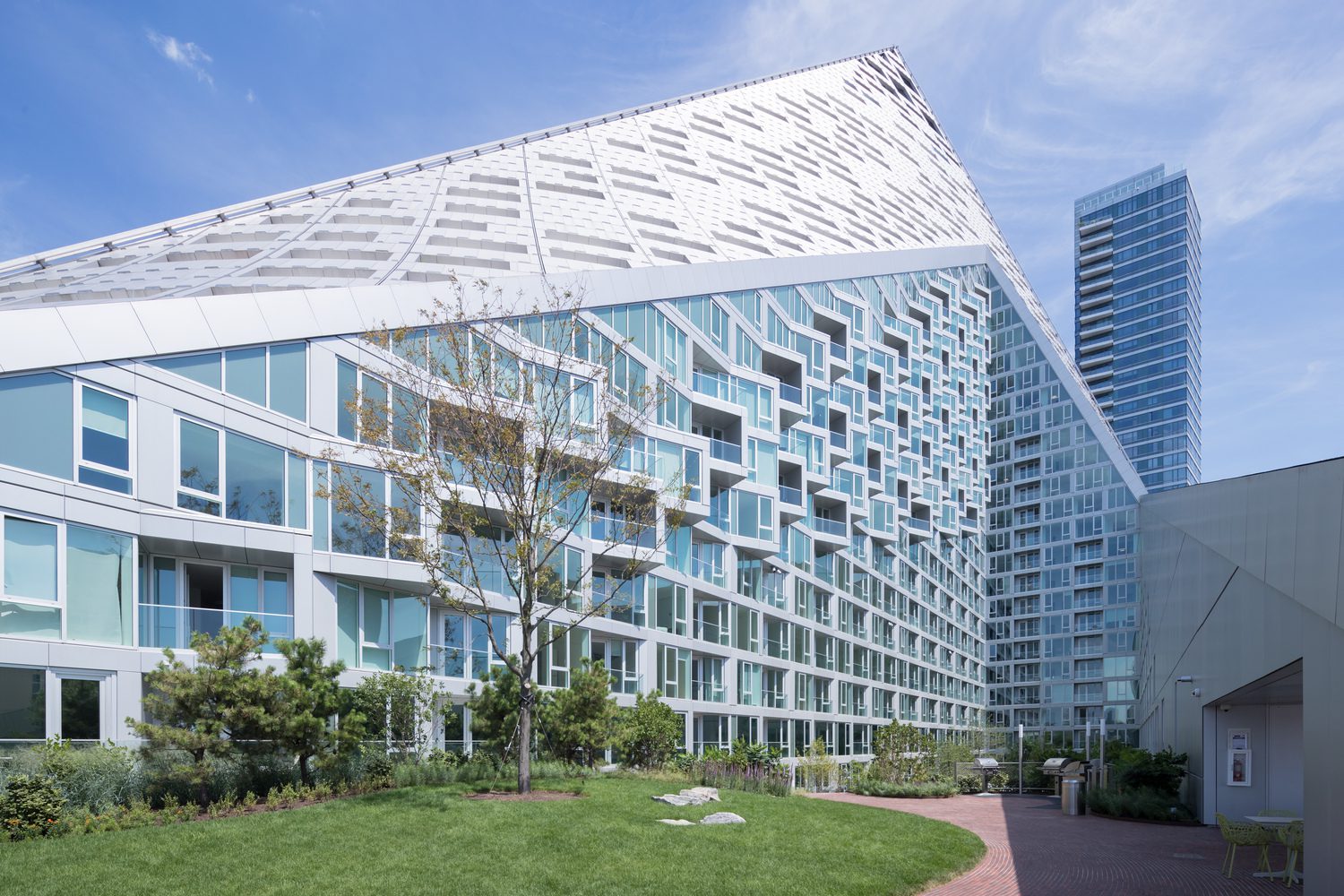
VIA 57 West in Manhattan by BIG, a ‘courtscraper’ that bends a conventional tower into a pyramidal form to open a private courtyard toward the Hudson River. Photography by Iwan Baan
Career Trajectory
Ingels’ path runs from OMA under Rem Koolhaas, to the short-lived PLOT partnership with Julien De Smedt, to the founding of BIG in Copenhagen in 2006. Early BIG projects like the Mountain Dwellings and 8 House established the hybrid-typology signature at a housing scale within Denmark, while later commissions — the Google headquarters projects in Mountain View and London, the World Trade Center’s Two World Trade Center design, and a growing string of museum, residential, and civic buildings — pushed the firm onto an international stage. BIG has grown from a small Copenhagen studio into a firm with offices across Copenhagen, New York, London, and Barcelona, employing several hundred architects, designers, and researchers, and running dozens of projects concurrently across Europe, North America, Asia, and the Middle East.
The Honest Critique
Ingels’ most ambitious extension of hedonistic sustainability is Masterplanet, a BIG-authored planning framework that applies the logic of an architectural master plan — problem definition, proposed solutions, phased implementation — to the entire planet, covering sectors from energy and transport to biodiversity and health. The initiative asks a legitimate question: can existing technologies, coordinated at a global scale, actually decarbonize human civilization? But it has also drawn serious pushback from within the planning and design academy, precisely because of who is asking that question and on whose authority.
Billy Fleming, director of the McHarg Center at the University of Pennsylvania’s Stuart Weitzman School of Design, has been one of the most direct critics of this framing. Fleming’s objection is not to the individual technical proposals inside Masterplanet but to the underlying premise: that a private design firm, answerable to its paying clients rather than to any electorate, is a legitimate body to be proposing planetary-scale plans for how ten billion people should live. Ingels himself has partly anticipated this line of criticism, publicly stressing that BIG “has no authority whatsoever over the planet” and framing Masterplanet as a provocation meant to “get the ball rolling” rather than a governing document. Other critics have pushed the same concern from different angles — Elizabeth Yeampierre of the climate justice group UPROSE has argued that the plan sidesteps the historical role of Euro-American extraction in causing the crisis it proposes to solve, while some architecture critics have questioned whether Masterplanet constitutes genuine design work at all, rather than a persuasive graphic-design exercise standing in for one.
This tension is worth sitting with rather than resolving too quickly. Ingels’ defenders point out that architects have long used speculative, provocative master plans — from Buckminster Fuller’s geodesic dome proposals onward — as a way of shifting public imagination even when the specific proposal is never built. His critics point out that climate policy made at planetary scale carries real distributive consequences, and that those consequences are usually decided through democratic institutions rather than design studios, however well-intentioned. Both things can be true at once, which is part of why Masterplanet remains one of the more contested chapters in Ingels’ career rather than a settled triumph.
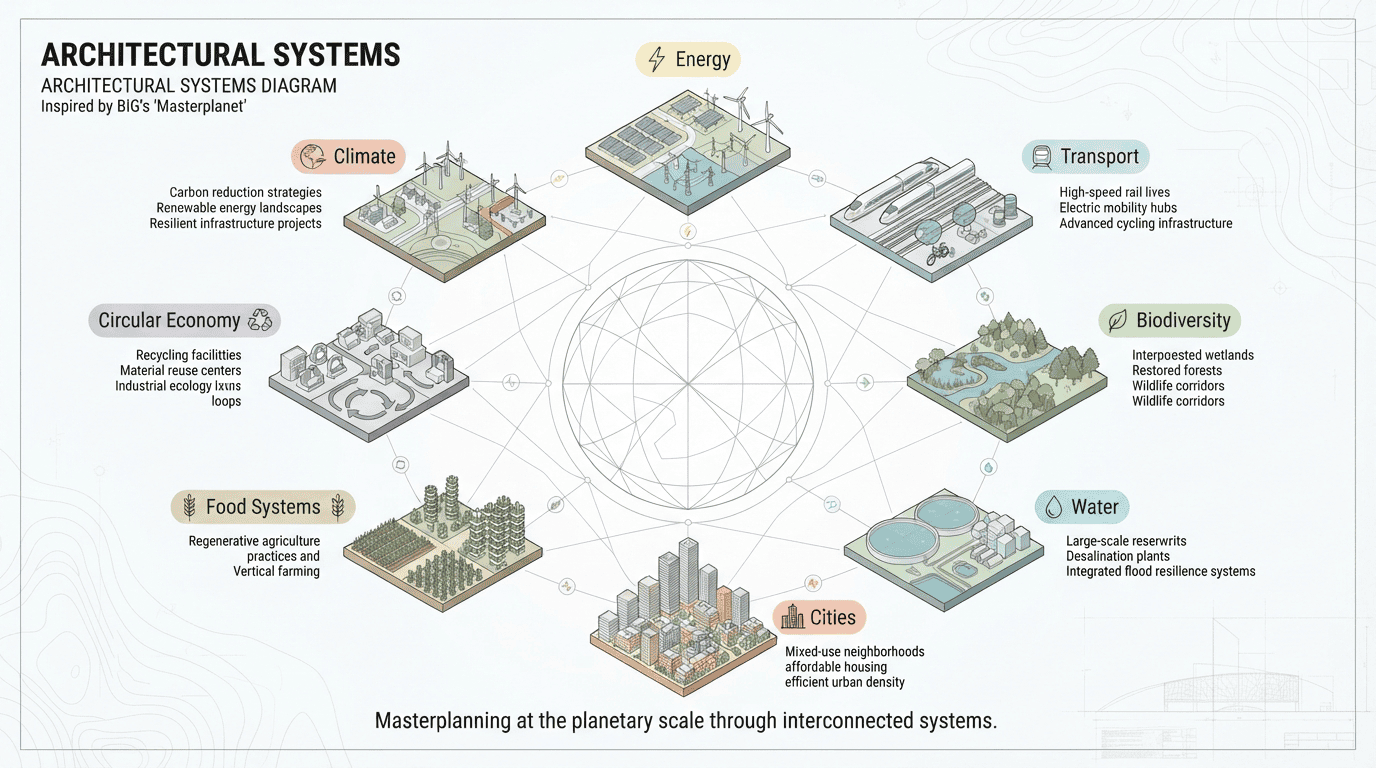
AI-generated illustration accompanying the discussion of Masterplanet, BIG’s planetary-scale planning framework, and the debate over its democratic accountability.
For more on how Ingels fits within the broader canon of contemporary practice, see our pillar guide to Famous Architects. For the wider debate his work sits inside, see our companion pillar on Sustainable Architecture.

Luca Moretti is a content strategist with a foundation in urban design and architecture. Based in Milan, he focuses on writing that bridges aesthetics, material culture, and everyday spatial experiences.