

House Snik, This challenging small extension transforms an existing family house into a more flexible home, without losing the connection with the architecture of its uniform neighbourhood.
© Johnny Umans
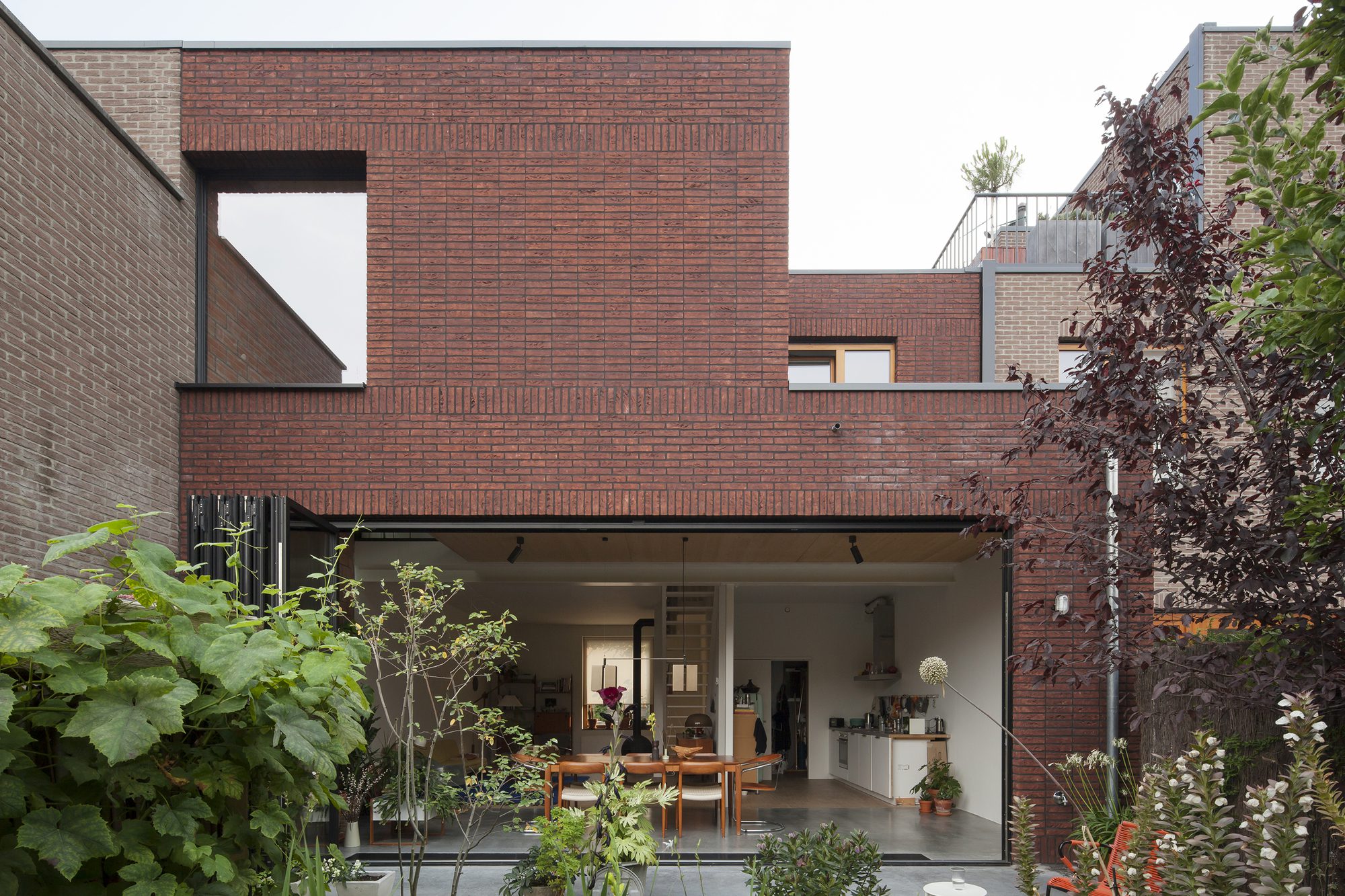
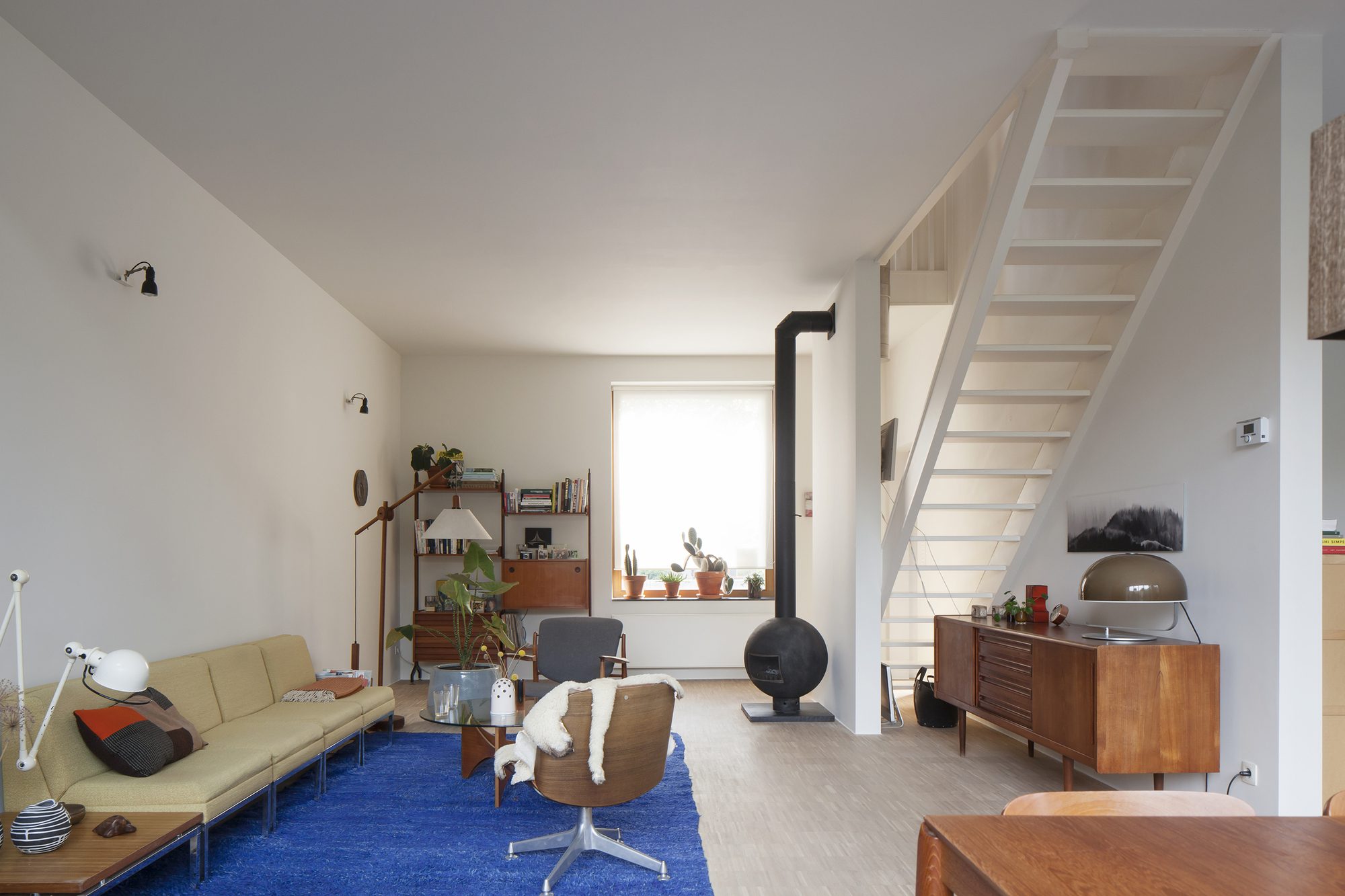
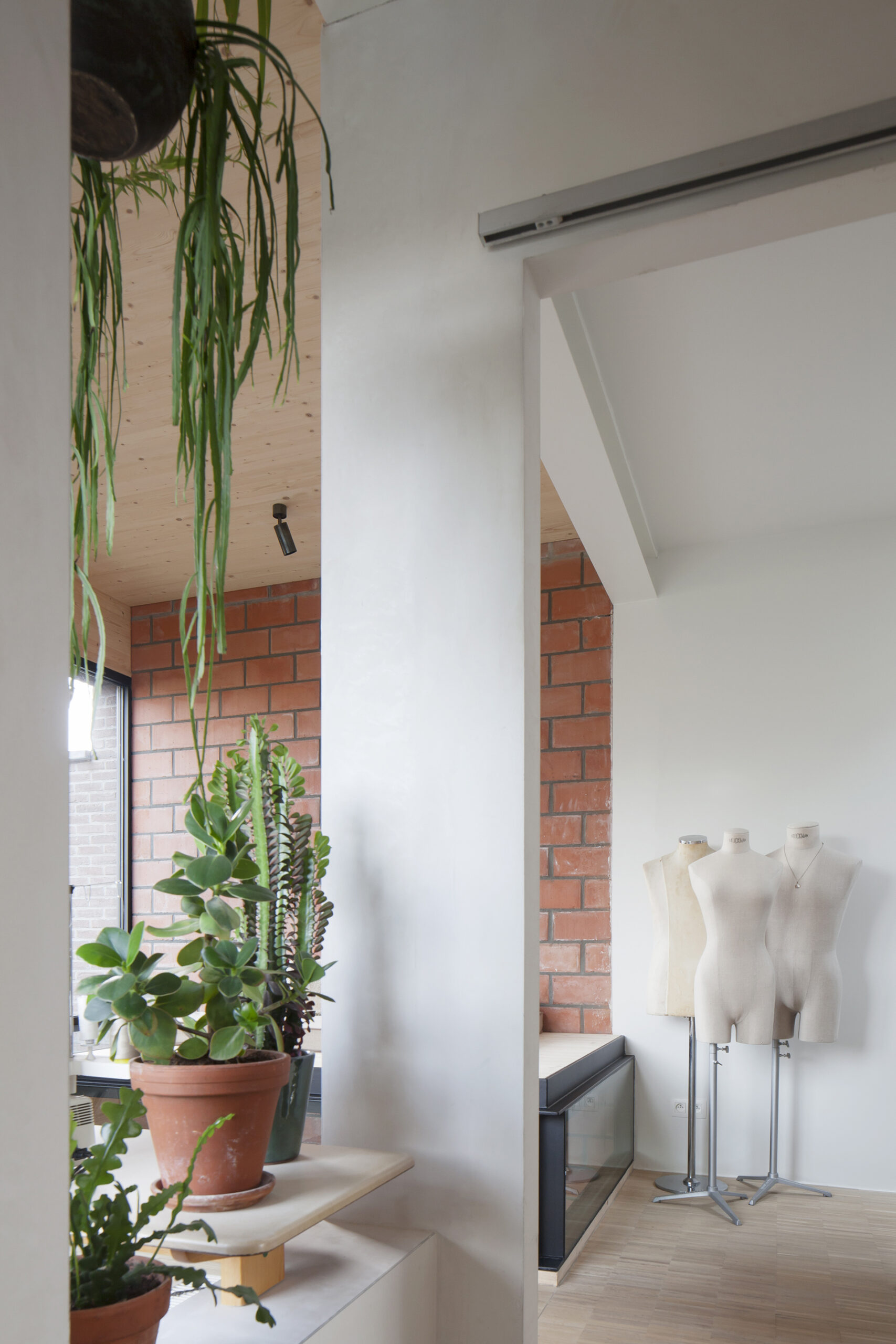
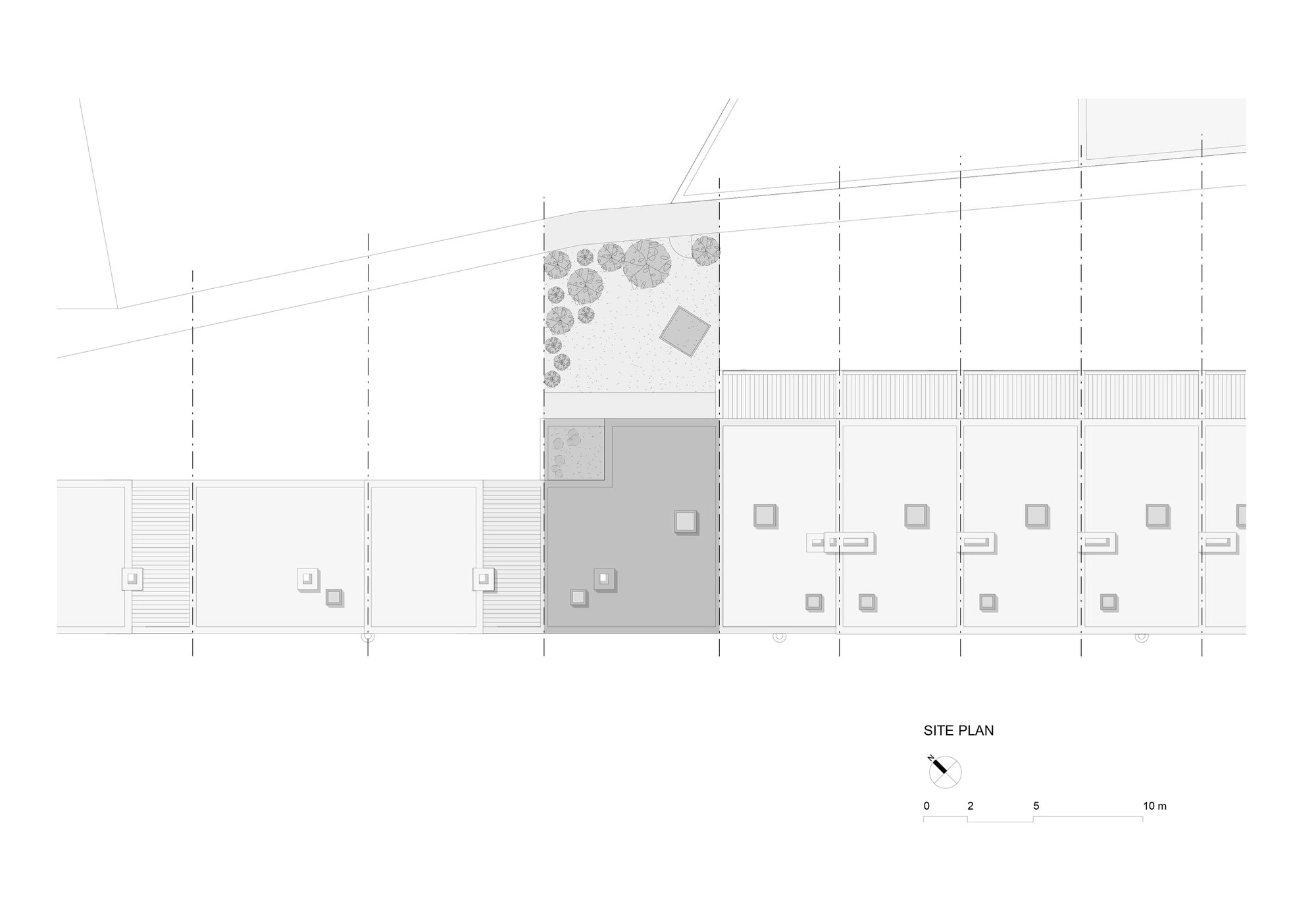
The existing building is part of a recently build neighbourhood in the southern part of the Antwerp city centre. The house is situated at the edge of two different typologies: wide but shallow buildings and narrow but deeper buildings. It is a two-story building, part of the first type (wide but shallow). The inhabitants wanted more space to be able to invite their (newly composed) family: they wished for a larger living room as well as an extra space on the first floor with a flexible use, as workshop (for theatre costume design) and a guestroom.
© Johnny Umans
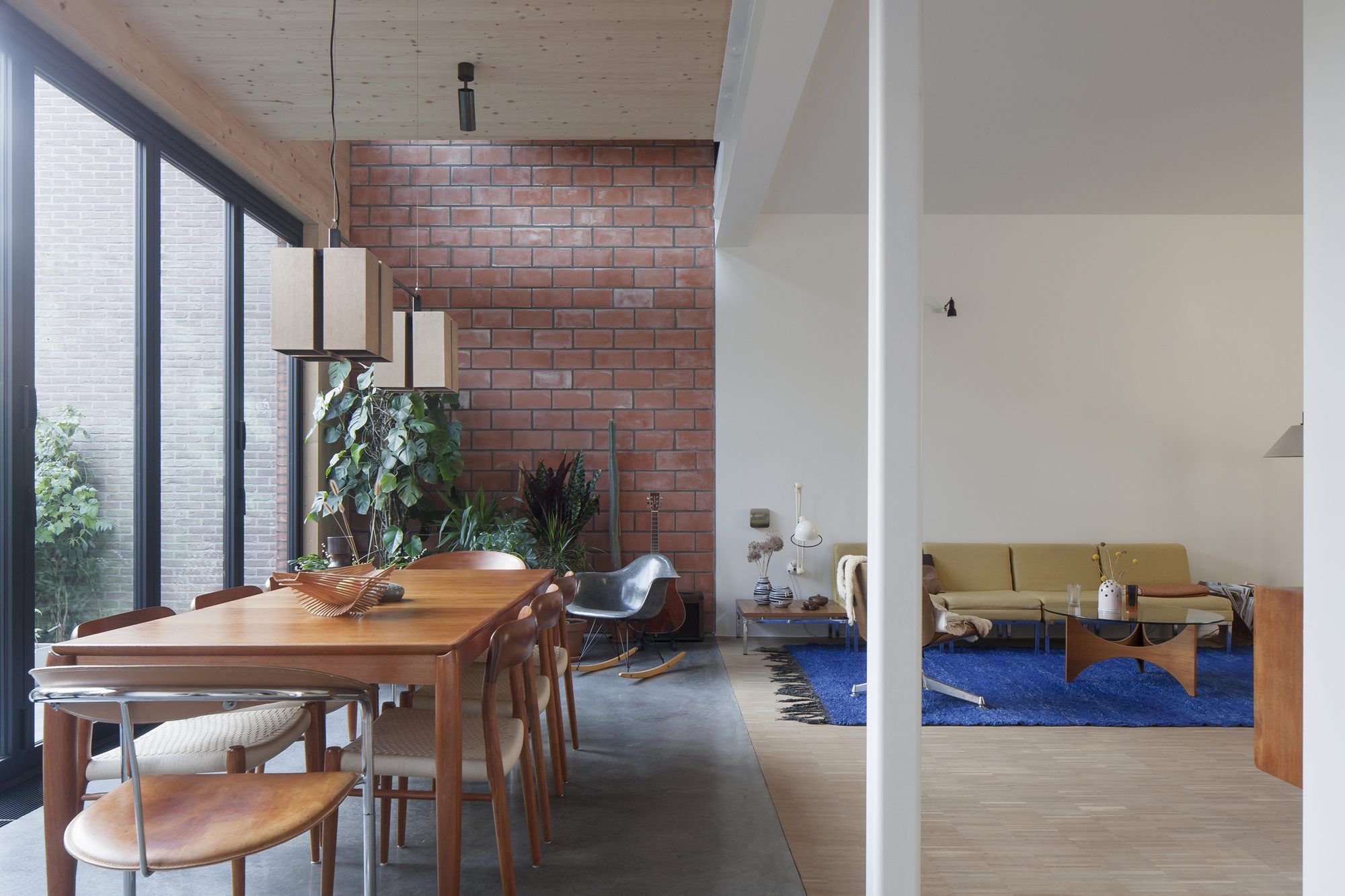
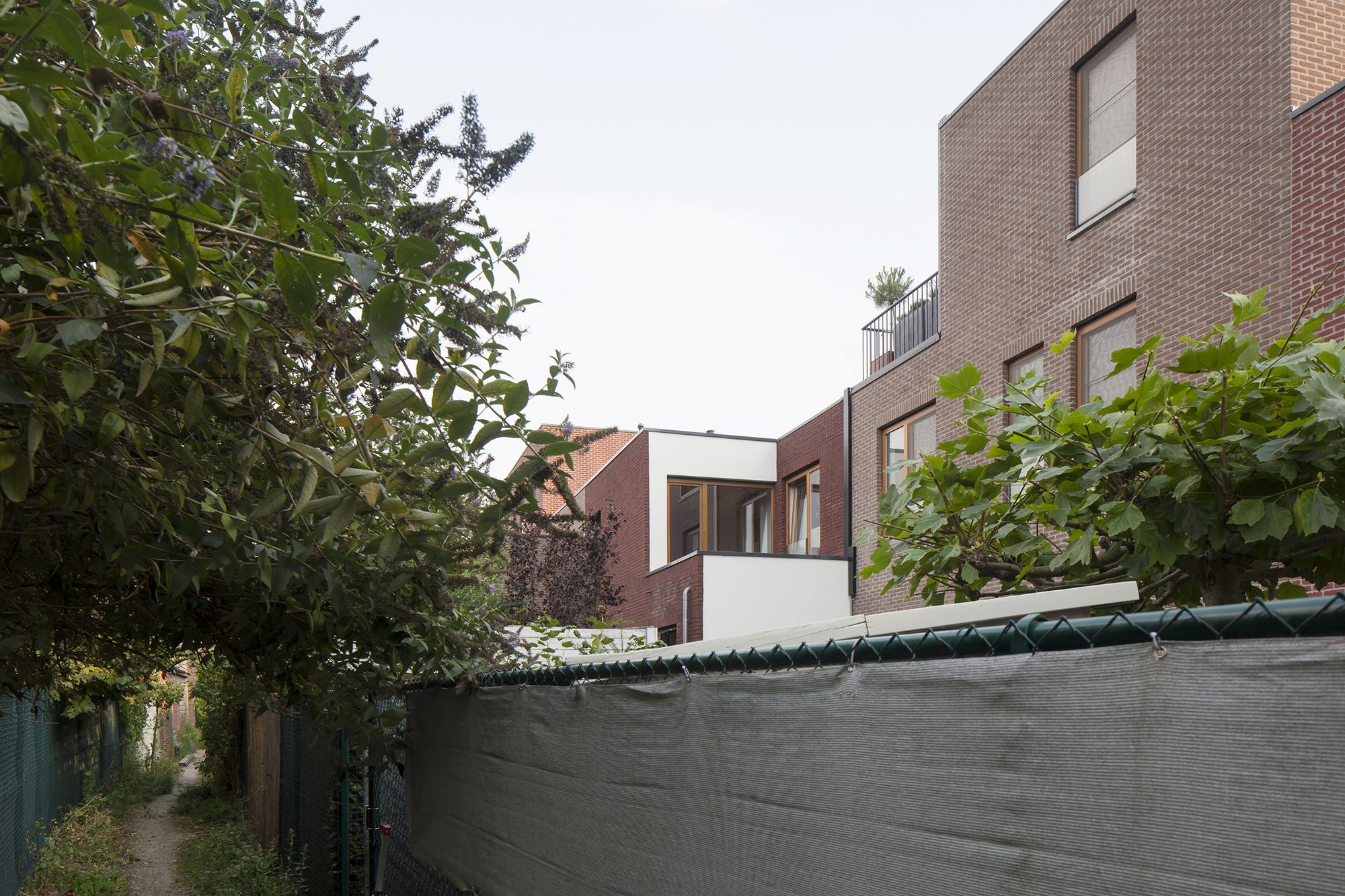
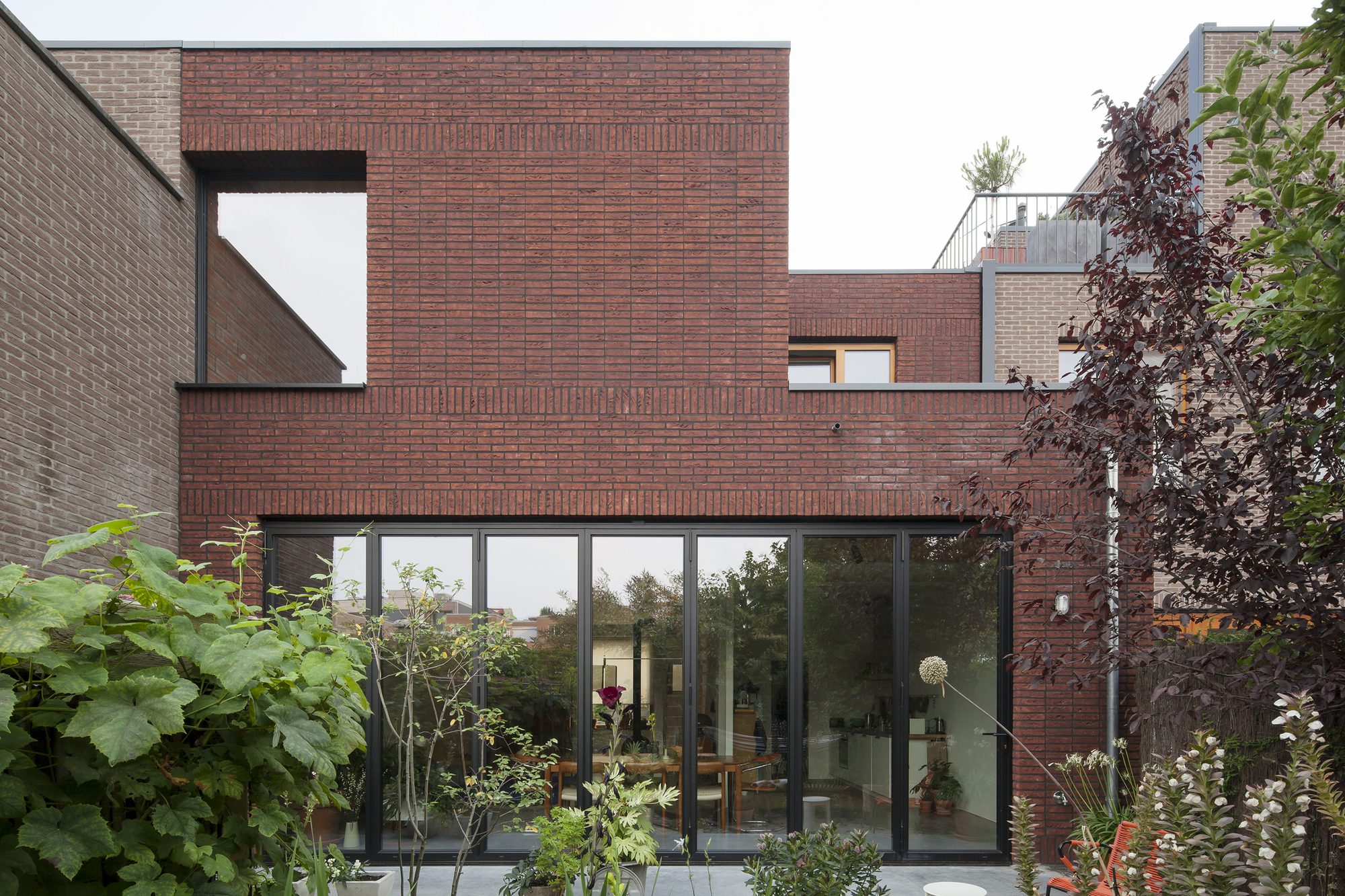
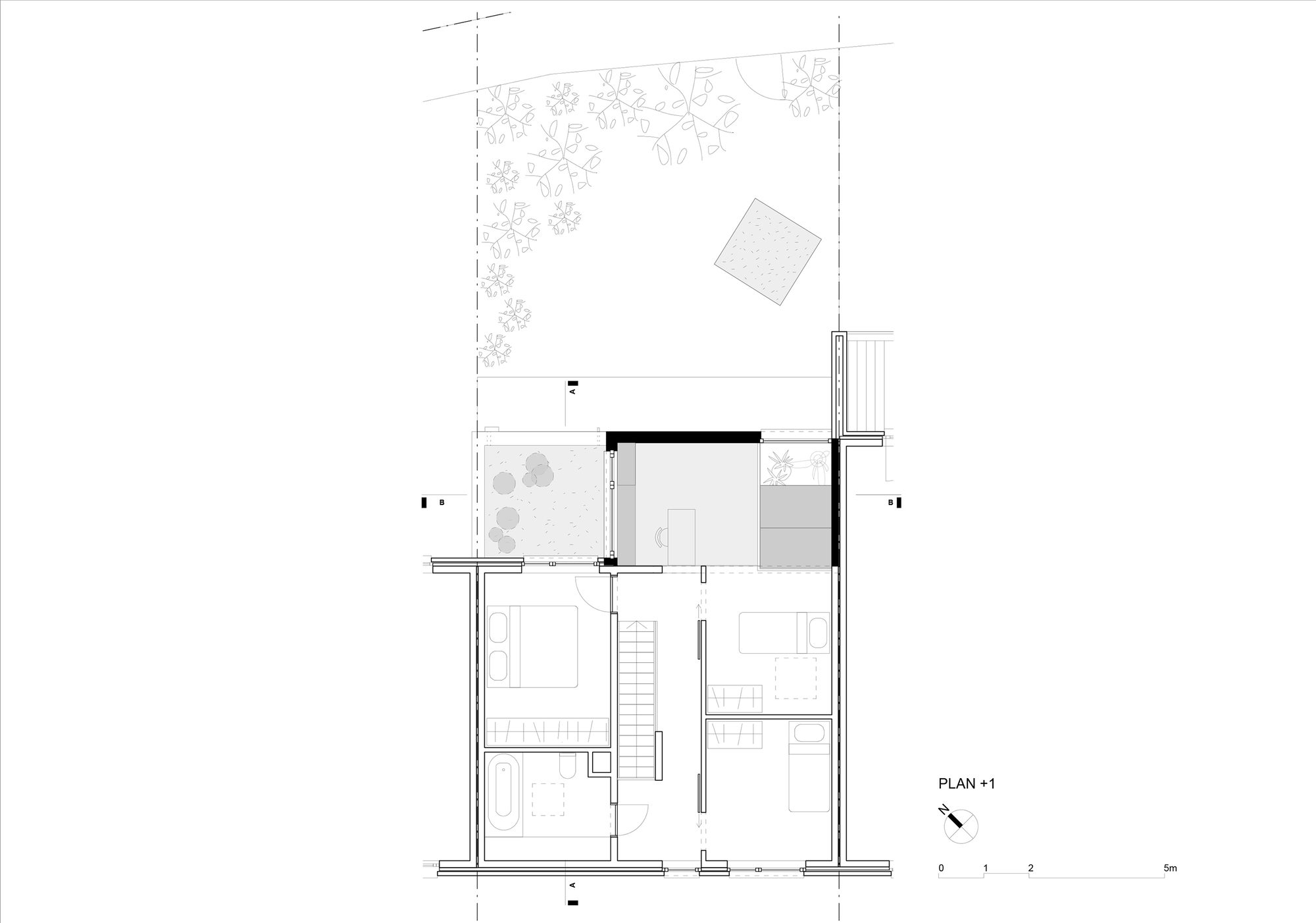
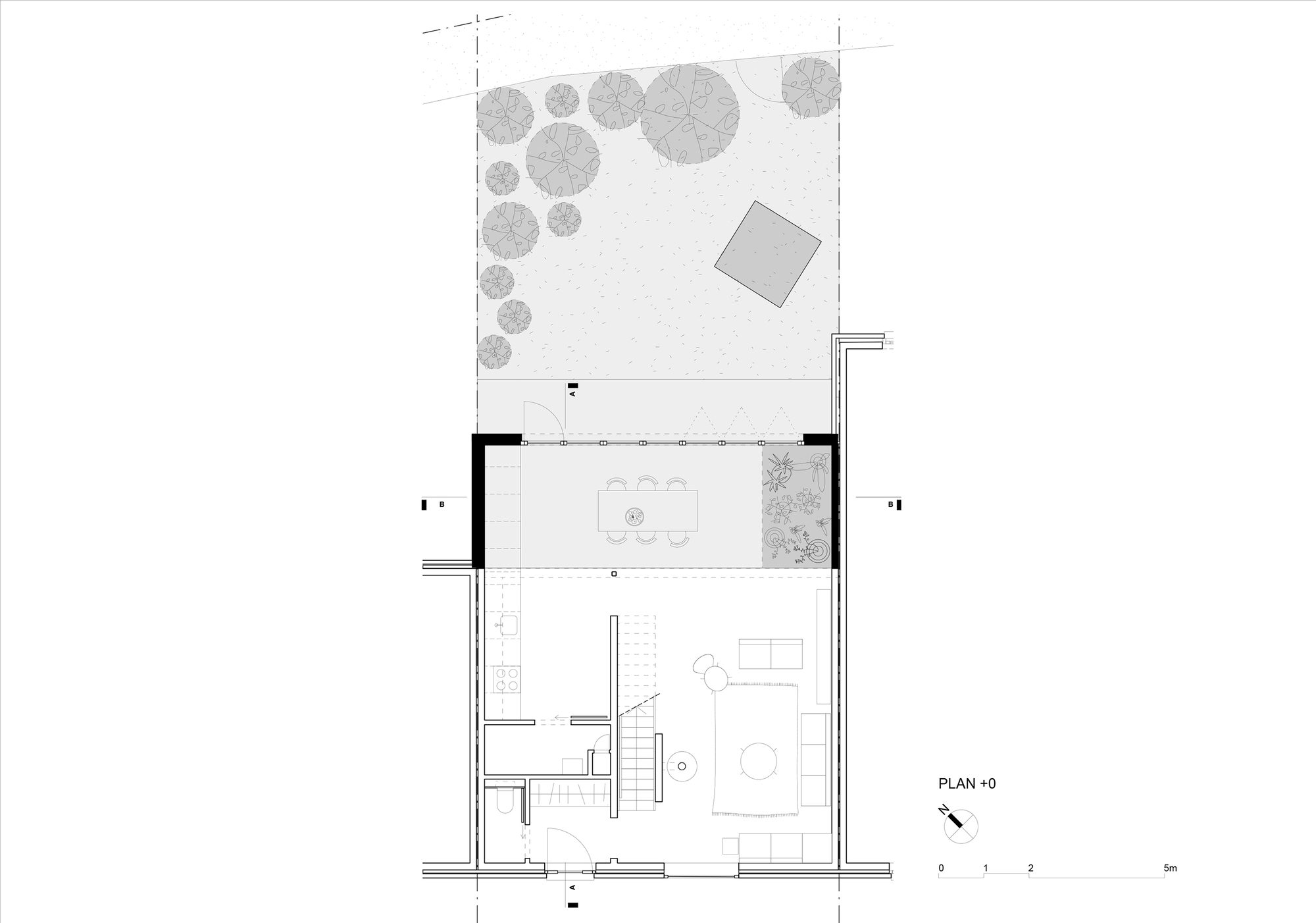
Aligning the garden elevation with the adjacent building on the right instead of the one to the left made it possible to enlarge the building with 2.80 m, also the maximal expansion allowed by the urban planning department. The transformation is made visible by literally extracting the rear façade in red brick. The new sides that appear are finished in white plasterwork.
© Johnny Umans
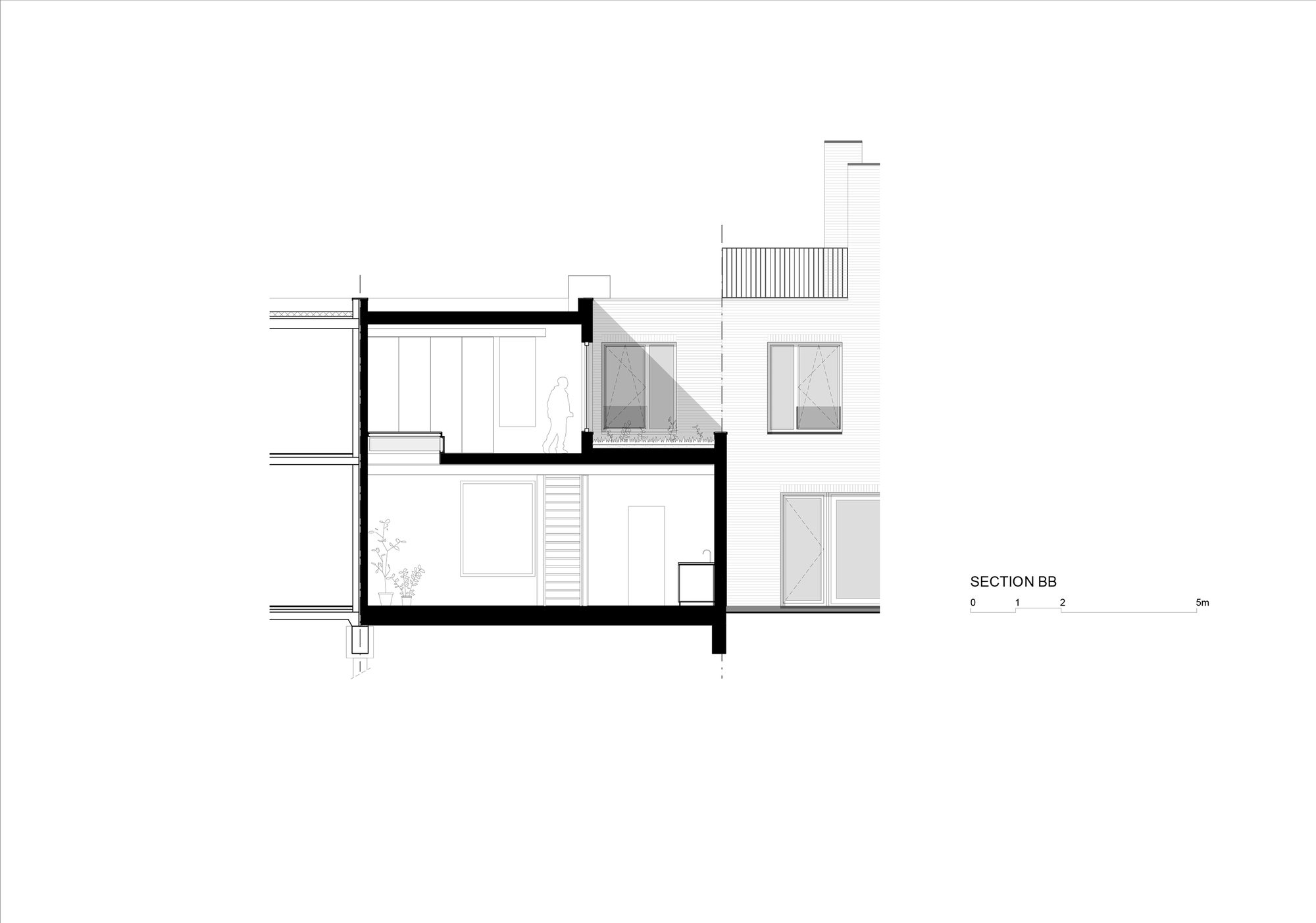
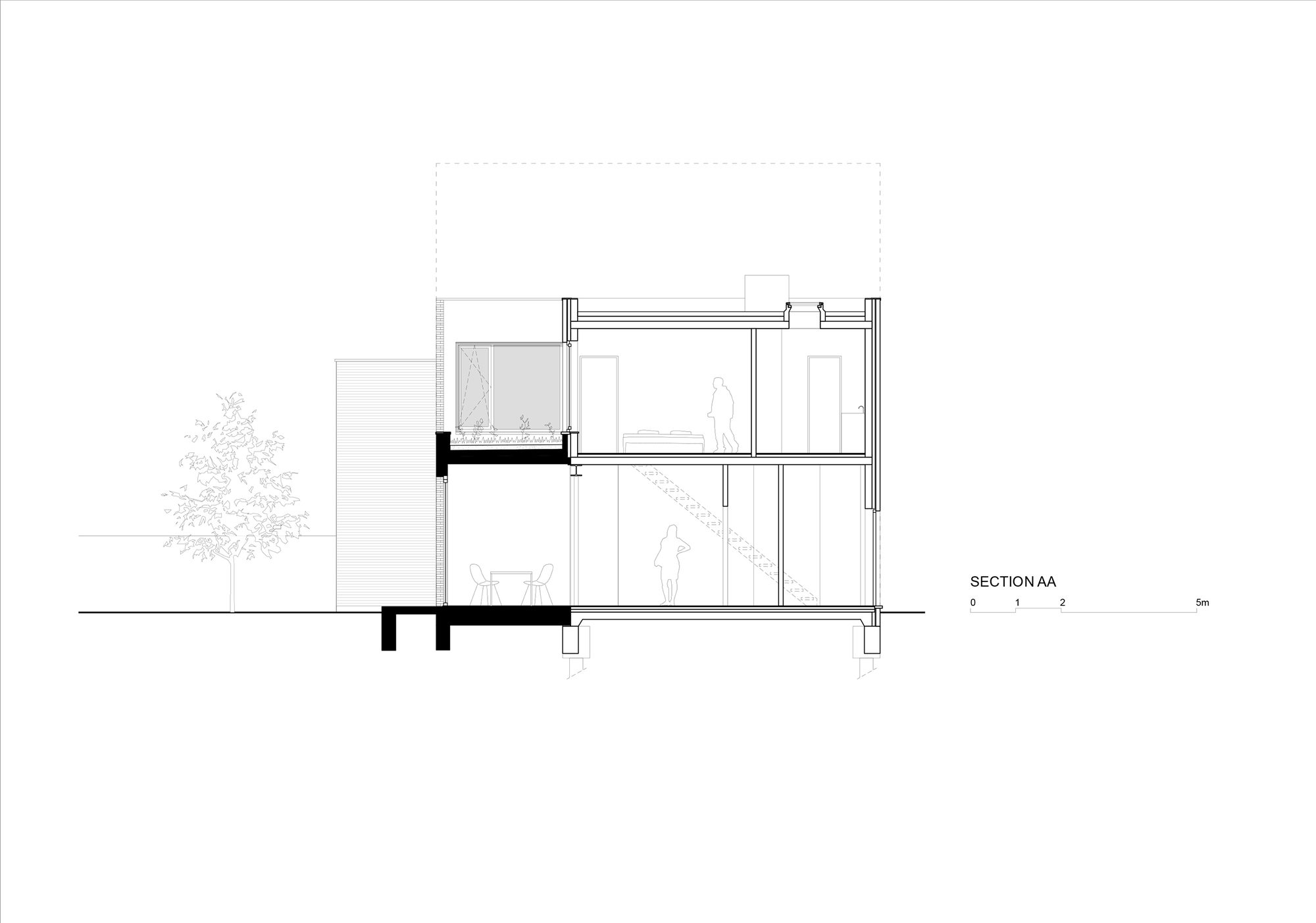
At ground level, the new extension now occupies the full width of the building plot, the first-floor volume is situated at the right side, where a common wall existed. The upper floor volume keeps the same distance of 2.80 m from the border on the left side. By this gesture the rowhouse transforms and obtains a new orientation to the northwest and is enriched with a green roof.
© Johnny Umans
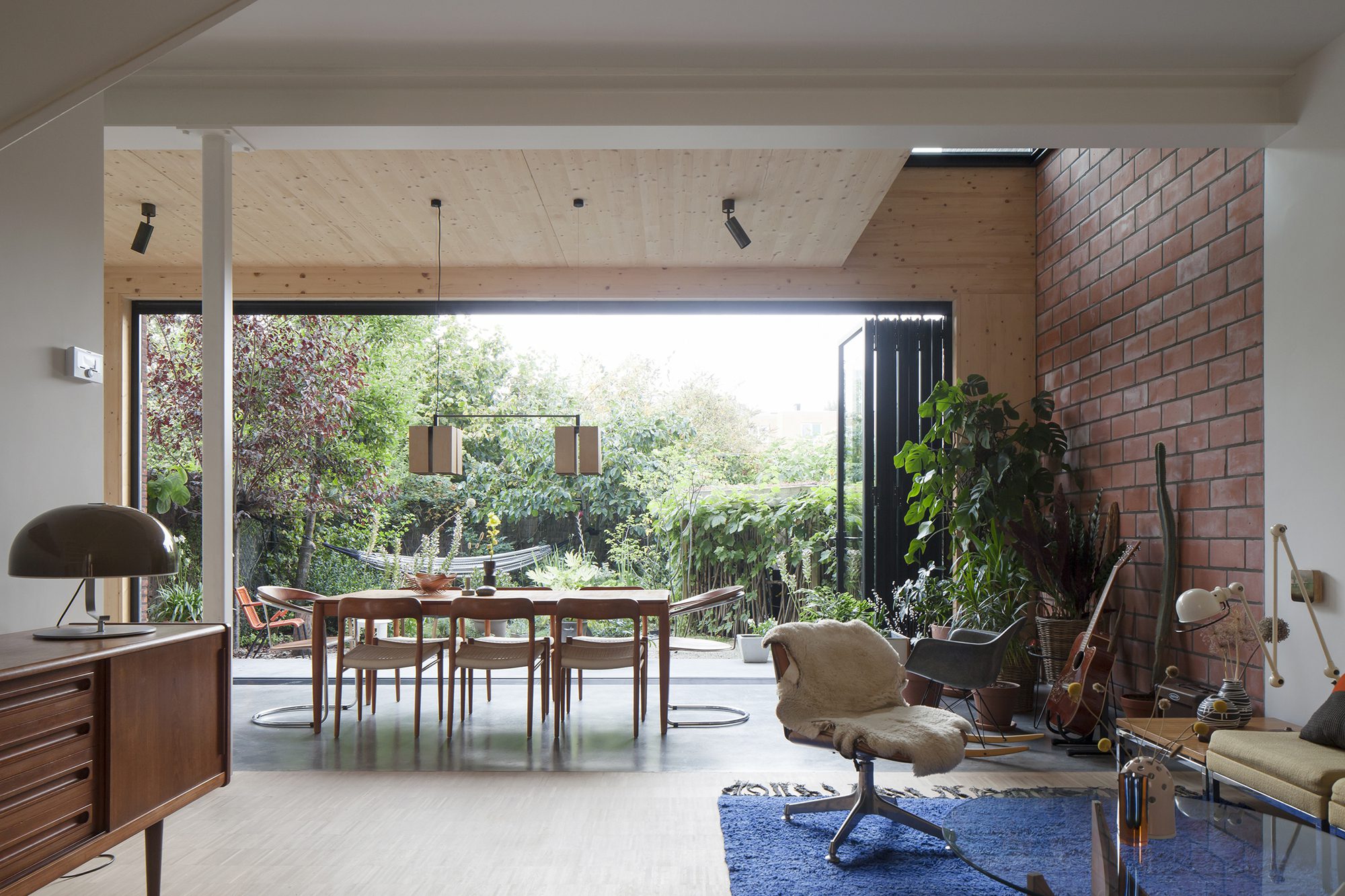
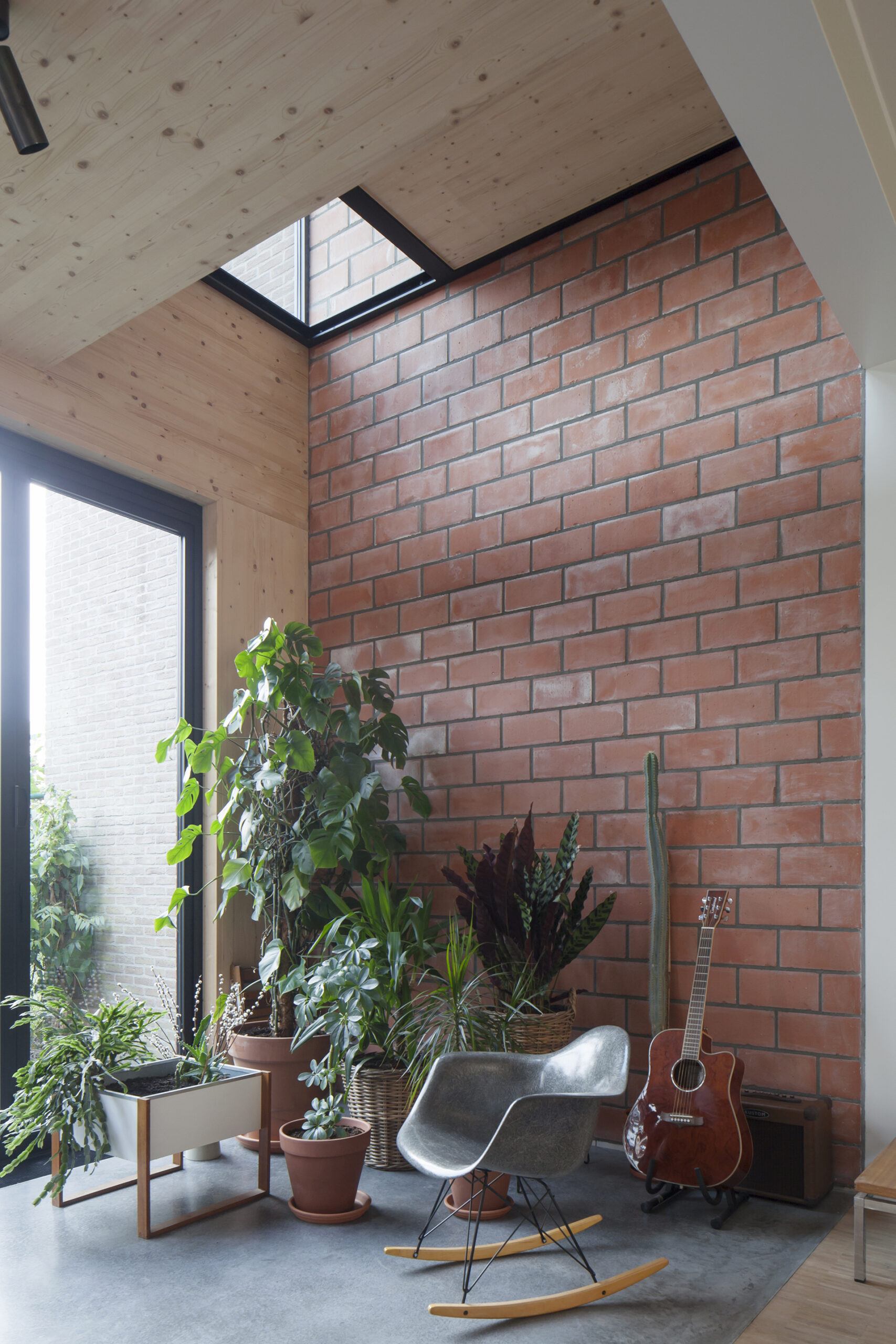
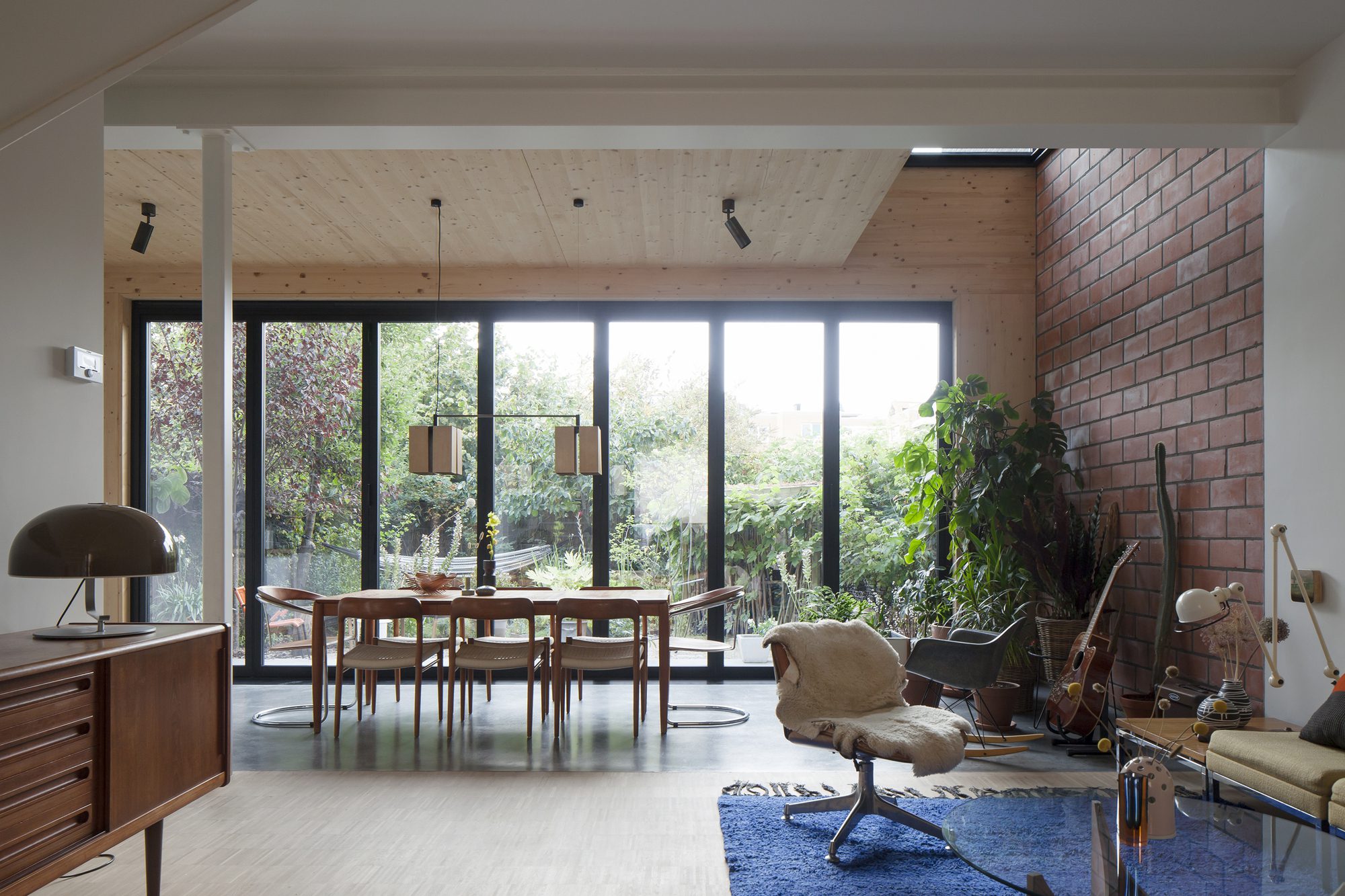
Between the living area and the garden, a large folding window integrates the lush city garden completely in the home. The use of the same polished concrete creates a seamless transition between inside and outside.
© Johnny Umans
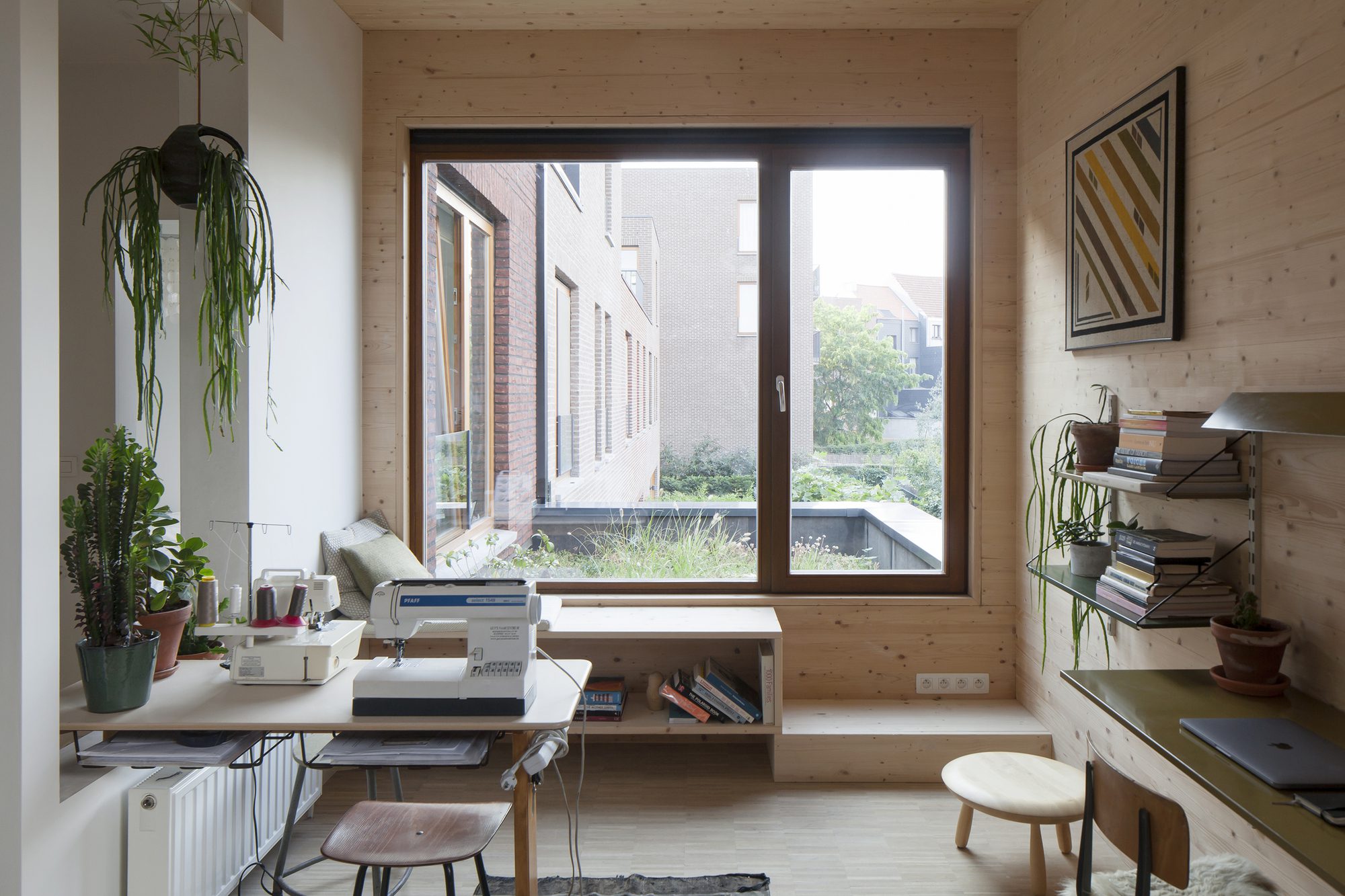
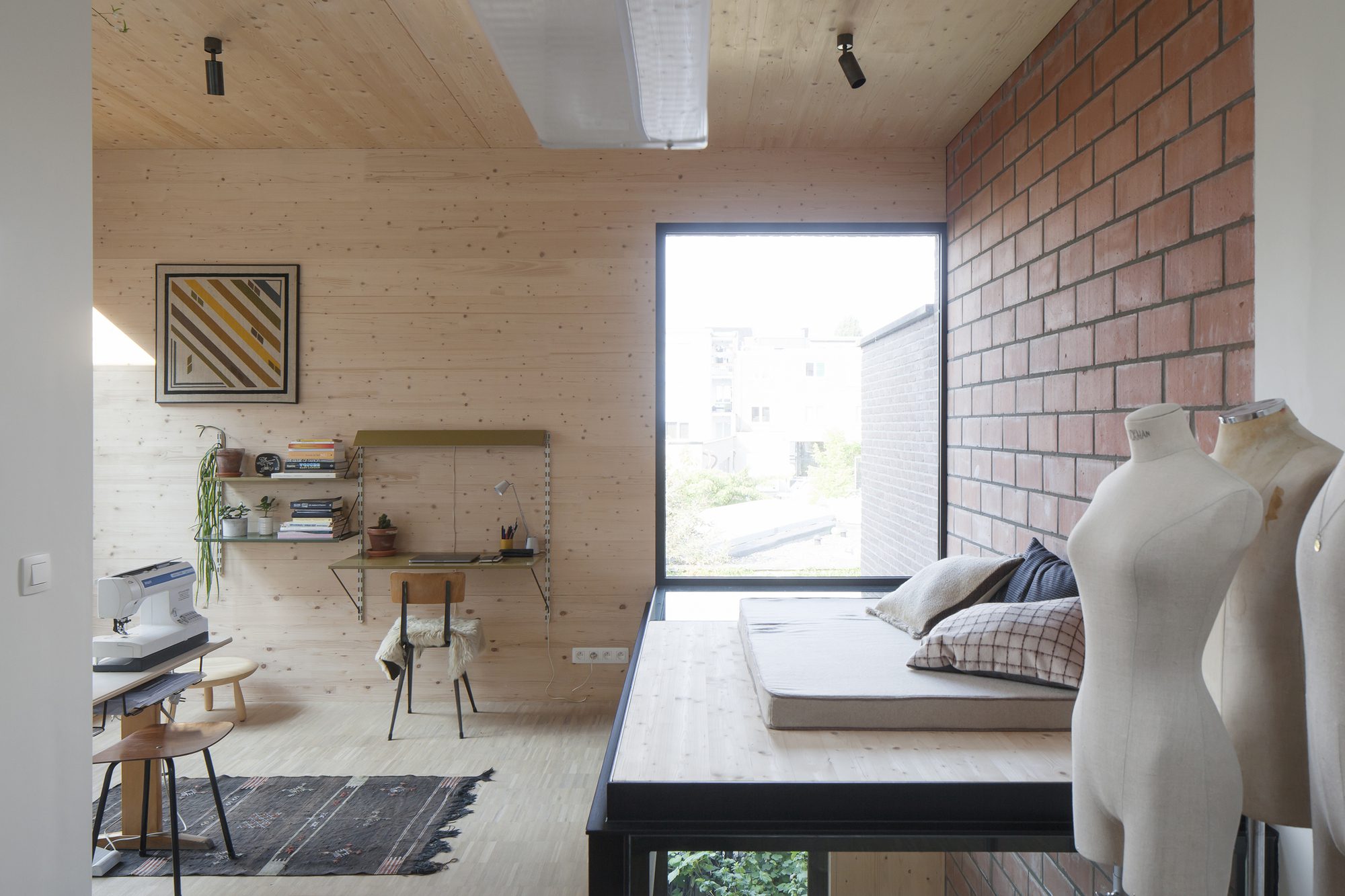
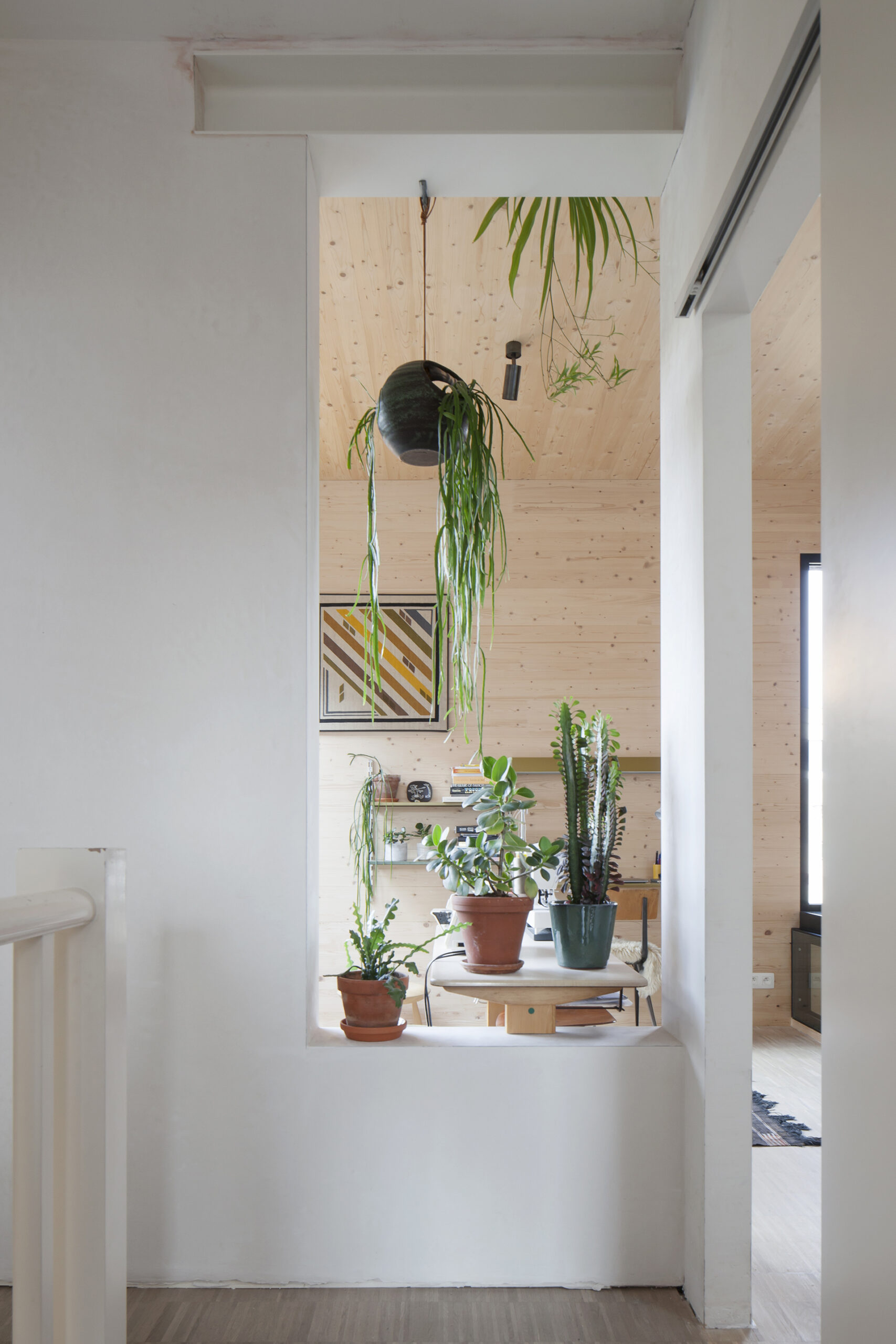
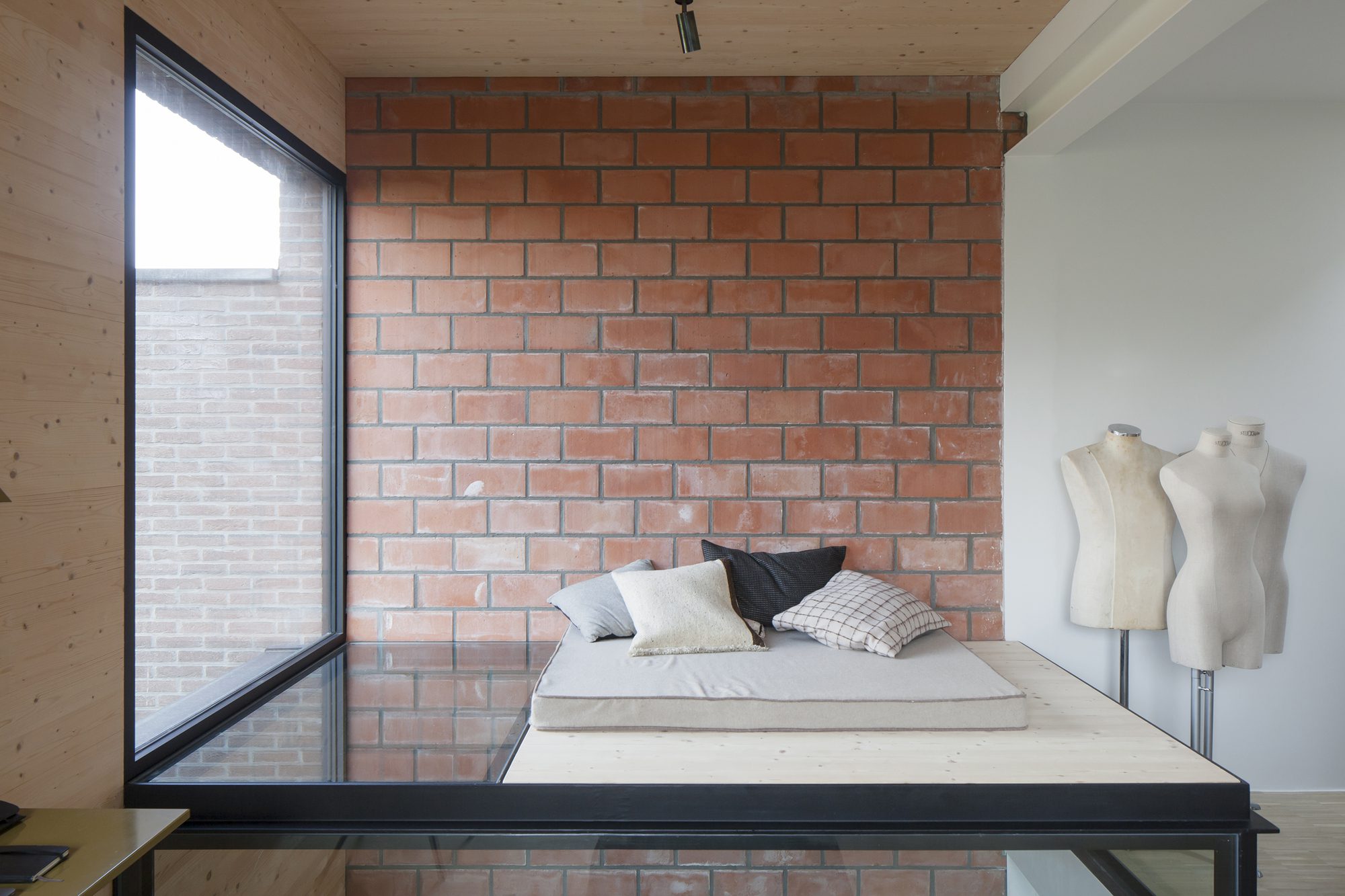
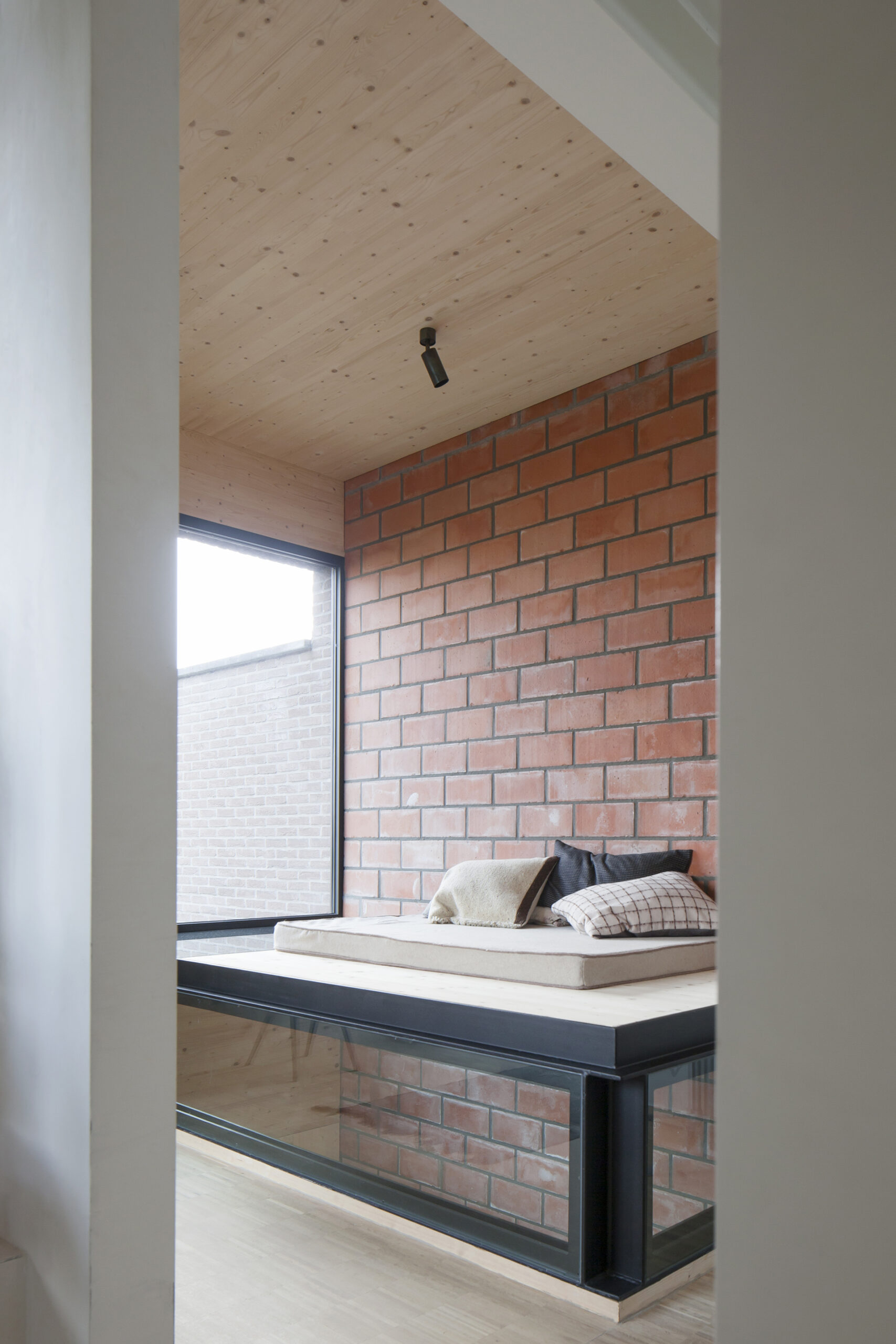
The designer’s workshop is situated on the first floor and can be split in two rooms. By lifting a part of the floor, a podium is created. Through the glass sides of the podium the two adjacent rooms are connected in a subtle manner with the living room below and natural light reaches to the central part of the ground floor.
© Johnny Umans
The existing housing development was entirely constructed on foundation piles.
© Johnny Umans
Using the same type of foundation wasn’t possible for the new extension (for technical as well as financial reasons). A lightweight structure was required, directing us to a wood construction in CLT – cross laminated timber. The important benefits of a CLT structure, apart from the weight, are the extreme reduction of the constructing time and the thin structural walls (only 8 cm). As the dimensions to expand where very limited, the compact façade system was a major asset.
© Johnny Umans
Though the rear façade is copying the colour of the original brickwork of the building, the classic and simple brickwork pattern is replaced by a more layered and frivolous pattern, inspired by examples of the School of Amsterdam.
Project Info
Architects: MADE architects
Country: Belgium, Antwerp
Area: 150 m²
Year: 2019
Photographs: Johnny Umans
Manufacturers Reynaers Aluminium, ARWO BOUW, Jaga, VANDERSANDEN: Reynaers Aluminium
Design Team: Gill Matthyssen, Liesbeth Storkebaum, Fiona Deziron, James Scott

Anastasia Andreieva is an accomplished Architectural Projects Editor at Arch2O, bringing a unique blend of linguistic expertise and design enthusiasm to the team. Born and raised in Ukraine, she holds a Master’s degree in Languages from Taras Shevchenko National University of Kyiv. Her deep passion for architecture and visual storytelling led her to transition from translation and editorial roles into the world of design media. With a keen eye for conceptual clarity and narrative structure, Anastasia curates and presents global architectural projects with precision and flair. She is particularly drawn to parametric and digital design, cultural context, and emerging voices in architecture. When I’m not analyzing the latest architectural trends, you’ll probably find me searching for hidden gems in cityscapes or appreciating the beauty of well-crafted spaces. After all, great design—like great connections—can be found in the most unexpected places. Speaking of connections, because architecture isn’t the only thing that brings people together.