
Antoni Gaudí architecture combines math and spirit in ways that changed Barcelona sacred architecture forever. The Catalan master didn’t just build churches—he created stone symphonies where every curve follows divine mathematical logic. His approach to Gaudí Modernist architecture turns engineering into spiritual experience.
Walk into the Sagrada Família and you’ll feel it immediately. This isn’t your typical sacred space. The columns branch like trees, following precise mathematical ratios that create a living canopy. Yet every element follows strict structural rules. This balance between spiritual vision and technical precision defines what makes Gaudí’s work so revolutionary.
His Barcelona sacred architecture broke every rule in the book. While other architects copied Gothic styles, Gaudí studied nature’s own blueprint. He found that catenary curves and hyperbolic surfaces could do more than hold up buildings—they could lift the human spirit toward the divine.
The Mathematical Foundation of Sacred Space
Gaudí’s approach to architectural mathematics came from watching nature work. He spent hours studying how trees branch, how shells curve, how the human spine bends. These weren’t just pretty shapes—they were perfect engineering solutions that had evolved over millions of years.
His notebooks show page after page of calculations. He obsessed over catenary curves—the shape a chain makes when it hangs freely. Flip that curve upside down, and you get the perfect compression arch. No buttresses needed. No fighting against gravity. Just pure structural elegance.
Catenary Curves in Practice
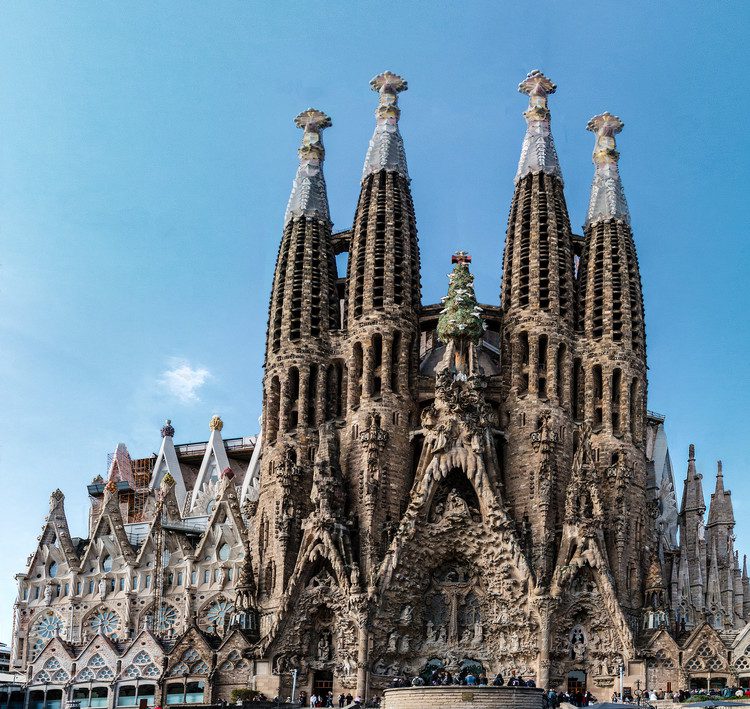
The Sagrada Família’s nave showcases catenary curves at their finest. These double-curved surfaces spread loads through pure compression, achieving spans that make modern engineers jealous. Every arch works with gravity, not against it. The result? A structure that meets today’s earthquake standards using 19th-century materials.
© Flickr User: haschelsax, bajo CC BY-ND 2.0
Gaudí calculated every angle with surgical precision. Column tilts follow mathematical formulas that spread loads while creating the visual effect of walking through an enchanted forest. The branching points occur at heights determined by golden ratio proportions. Your eye naturally flows upward, drawn by architectural mathematics toward heaven.
Light and Shadow Through Geometry
The hyperboloid surfaces intersect at calculated angles that flood the space with natural light while keeping structural stress to a minimum. Every window opening, every surface curve serves double duty—structural and spiritual. The Barcelona architecture becomes a prayer rendered in stone and light.
What Makes Antoni Gaudí’s Architecture Unique?
Most Art Nouveau architects treated natural forms as decoration. Gaudí saw deeper. He understood that nature’s shapes are fundamentally structural, not just pretty. This insight separated his work from every other architect of his era.
© Enfo, Wikipedia
Ruled Surfaces Revolution
Gaudí mastered ruled surfaces—complex geometric forms made by moving straight lines through space. The hyperboloid columns in the Sagrada Família prove this genius. Each column starts as a straight line rotating around a helical path. The result looks impossibly complex, but builders can construct it using straight elements.
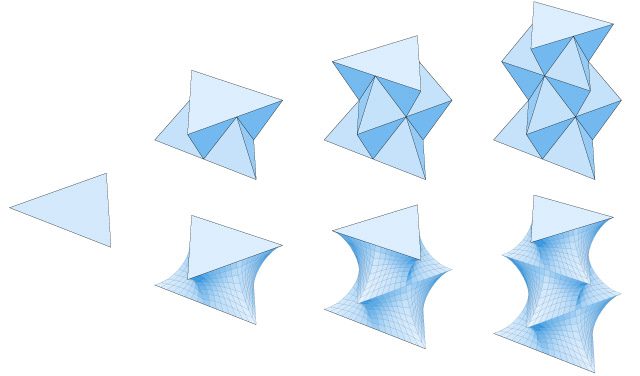
His engineering education gave him the tools to solve three-dimensional problems that stumped other architects. Those famous hanging chain models weren’t just art—they were analog computers that revealed optimal structural forms through pure physics. He was doing parametric design a century before computers existed.
Color and Light Integration
Gaudí’s understanding of light physics guided his use of colored glass and ceramic. The mosaic techniques filter specific wavelengths, creating interior lighting that changes throughout the day. This isn’t random decoration—it’s calculated design that aligns architectural experience with natural rhythms.
The chromatic integration serves both visual comfort and spiritual contemplation. Colors shift with the sun’s path, turning the building into a living calendar that connects human experience to cosmic cycles. Every tile placement follows mathematical principles that create optical effects impossible to achieve through random arrangement.
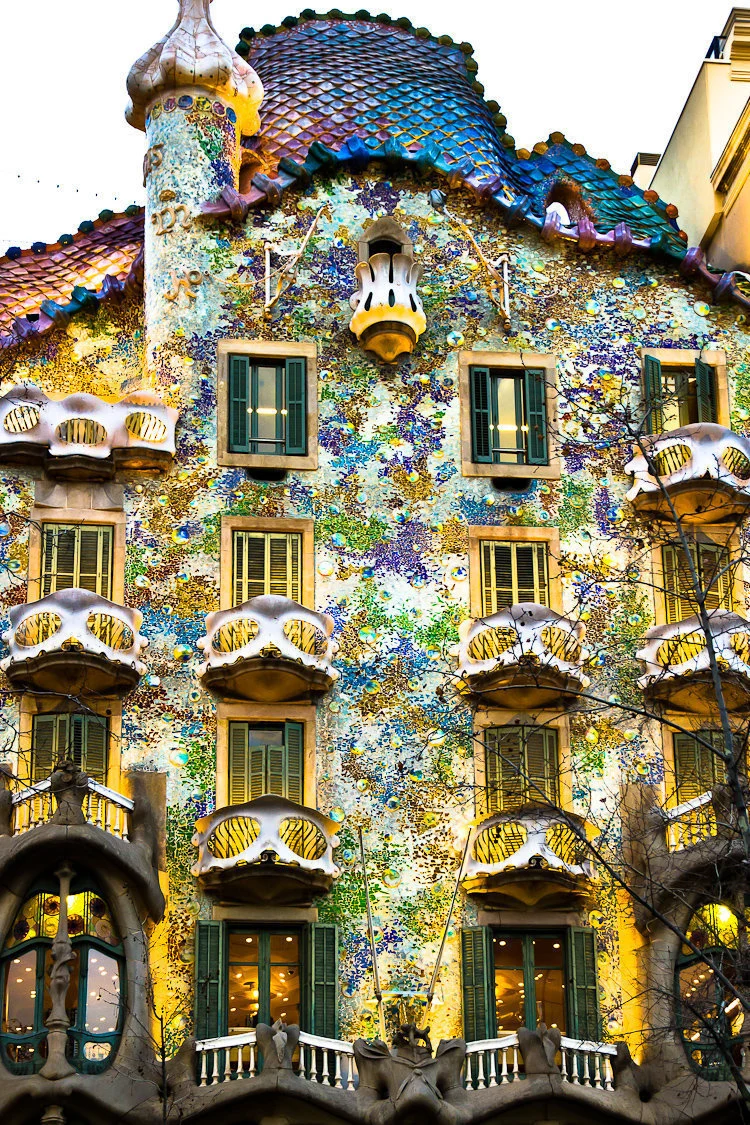
Casa Batlló Designed by Antoni Gaudí
The Sacred Geometry of Load Distribution
Gaudí’s structural innovations go far beyond making buildings look pretty. His mathematical approach to load distribution represents one of the most sophisticated examples of optimization theory in architectural history. The Sagrada Família eliminates traditional tension elements completely, relying purely on compression geometries.
Tree-Inspired Column Systems
The branching columns follow principles stolen from trees. Each column diameter changes according to load requirements, with cross-sections increasing toward the base in mathematical progressions that mirror natural growth. The branching points occur at calculated heights where loads benefit from geometric subdivision.
This creates multiple load paths that make the structure incredibly resilient. If one element fails, others can pick up the slack. It’s redundancy through mathematics—a safety system that nature perfected over millions of years.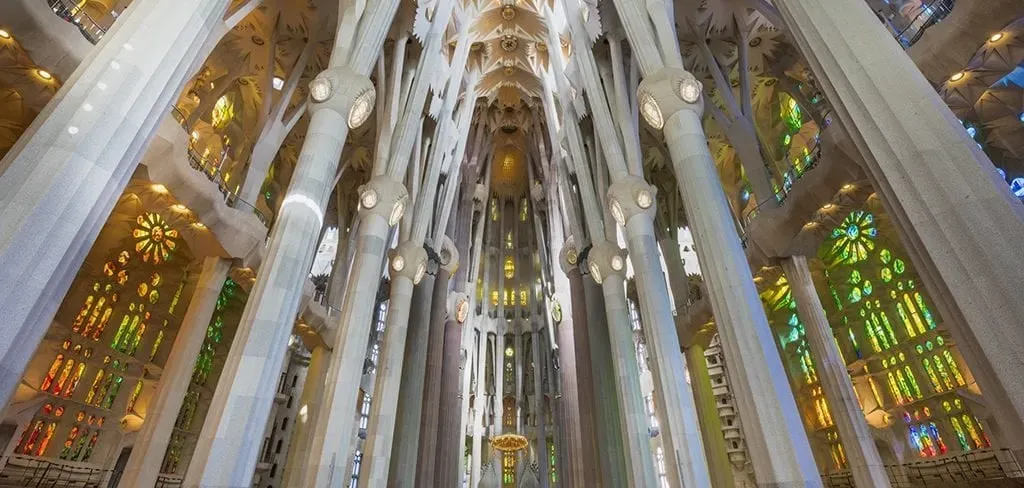
Vault Innovation
The vault system represents Gaudí’s most brilliant mathematical achievement. Intersecting hyperboloid surfaces create a three-dimensional grid that distributes loads through pure compression. This eliminates the stress concentrations that plague traditional groin vaults.
Modern computer analysis confirms what Gaudí achieved through intuition and analog experimentation. His stress distributions approach theoretical perfection. Contemporary architects need powerful software to match results he achieved with chains and weights.
Why Are There 18 Towers in Gaudí’s Design?
The eighteen towers of the Sagrada Família aren’t random. They represent a masterwork of symbolic mathematics that combines Christian iconography with structural engineering and acoustic performance. Every tower has multiple jobs to do.
The Height Hierarchy
The central Jesus tower reaches 172.5 meters—exactly one meter shorter than Barcelona’s Montjuïc hill. Gaudí believed human creation shouldn’t exceed divine creation. The four Evangelist towers rise to 120 meters, creating proportional relationships based on sacred ratios that appear throughout Christian architectural tradition.
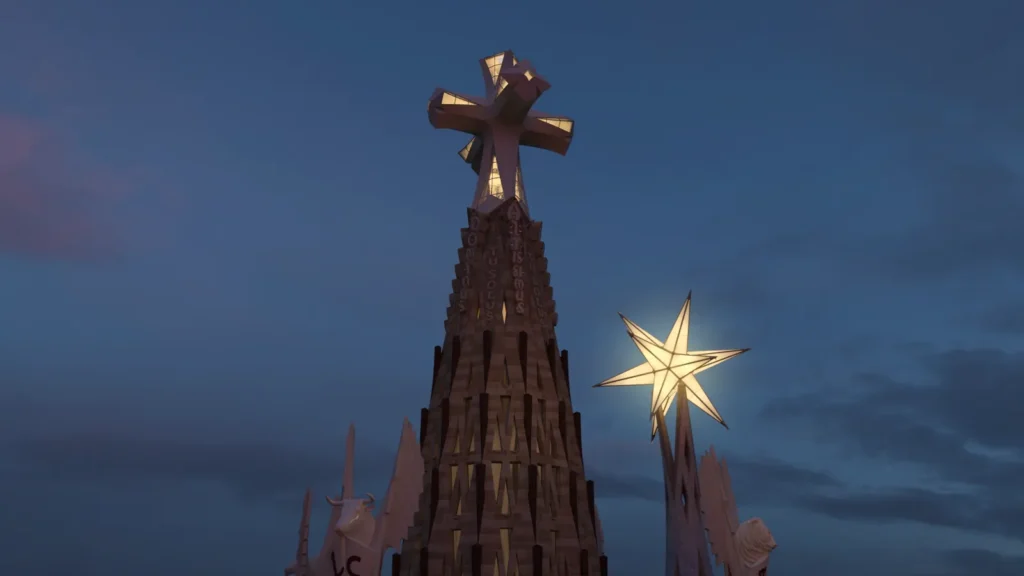
Nighttime illumination of the Jesus Tower and the Mary Tower
The twelve apostle towers, arranged in three groups of four, demonstrate sophisticated acoustic engineering. Their heights and positions create precise reverberation times optimized for polyphonic choral music. The mathematical spacing enables harmonic resonance patterns that turn the entire building into a musical instrument.
Acoustic Engineering Through Geometry
Each tower’s internal geometry follows helical principles derived from natural growth patterns. The spiral staircases ascend at calculated angles that minimize climbing effort while maximizing structural strength. The perforation patterns in tower walls create acoustic chambers tuned to specific frequency ranges.
The tower caps incorporate parabolic surfaces that focus and direct sound while serving as lightning protection. These elements integrate structural, acoustic, and symbolic functions through pure geometric manipulation. It’s multi-criteria optimization achieved through analog design methods that wouldn’t be matched until the computer age.
Organic Structural Systems in Sacred Architecture
Gaudí looked at Gothic cathedrals and saw buildings fighting nature. All those flying buttresses and external supports were symptoms of working against natural forces instead of with them. His solution? Learn from nature’s own engineering.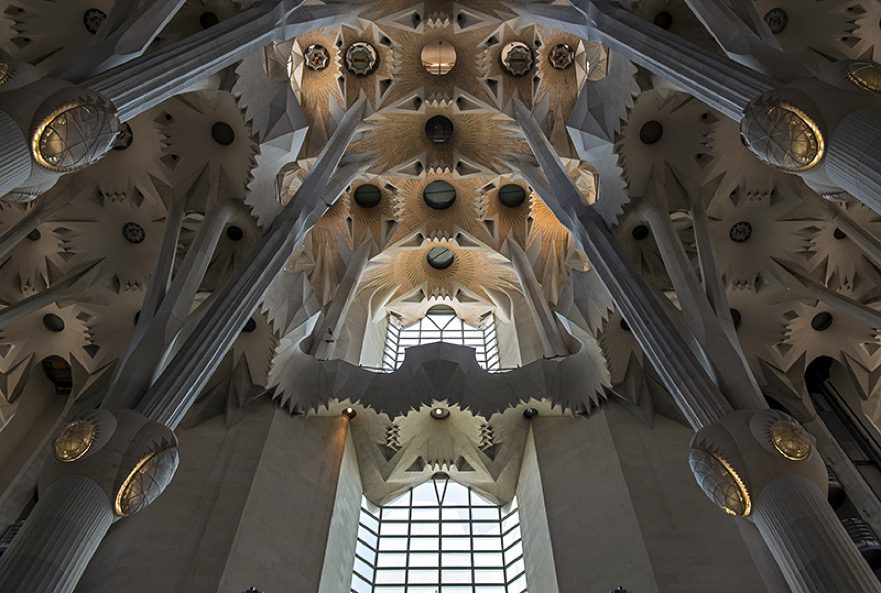
Botanical Inspiration
The column designs throughout his Barcelona sacred architecture follow principles derived from plant studies. Helical twisting patterns distribute eccentric loads while creating visual rhythms that guide the eye upward. The varying cross-sections optimize material distribution, creating forms that appear organic while following rigorous mathematical principles.
This isn’t mere imitation—it’s understanding. Gaudí studied why trees grow the way they do, how they distribute loads, how they respond to wind and weather. Then he applied these lessons to stone and iron.
Surface Geometry Mastery
The vault intersections demonstrate advanced understanding of surface geometry. Traditional Gothic construction required complex stone cutting to achieve groin vault intersections. Gaudí’s hyperbolic paraboloid surfaces meet along straight lines, simplifying construction while creating more elegant spatial experiences.
These ruled surfaces can be built using straight formwork, reducing construction complexity while achieving greater geometric sophistication. It’s the difference between fighting the material and working with it.
Natural Light Integration
Window placement follows mathematical principles derived from solar geometry studies. Openings are positioned and sized according to calculations that optimize daylight penetration while minimizing heat gain. The result enhances both visual comfort and spiritual atmosphere, proving how technical precision can serve transcendent goals.
Advanced Construction Techniques and Material Innovation
Realizing Gaudí’s mathematical visions required pushing construction technology toward what we now call parametric fabrication. His development of ruled surface construction techniques enabled complex three-dimensional forms to be built using traditional craft methods guided by mathematical precision.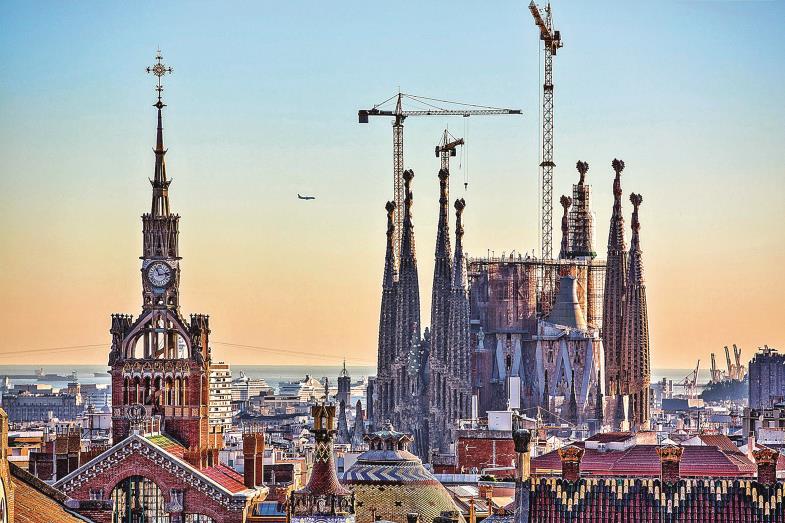
Trencadís: More Than Decoration
The famous trencadís mosaic technique represents more than decorative application. The irregular tessellation patterns follow mathematical rules that optimize surface coverage while accommodating thermal expansion stresses. The color progressions create optical effects that enhance spatial perception, using principles that anticipate contemporary understanding of environmental psychology.
Every broken tile placement serves multiple purposes—structural, thermal, and visual. This integrated approach shows how Gaudí thought about materials as active participants in architectural performance, not just passive coverings.
Precision Stone Cutting
Stone cutting for the Sagrada Família required unprecedented precision. Template systems based on mathematical projections enabled stonemasons to fabricate complex curved elements that fit together with tolerance levels approaching modern machine precision. These analog manufacturing techniques demonstrate how mathematical understanding can enhance rather than replace traditional craft knowledge.
The integration of iron reinforcement follows calculated patterns that add tensile strength where compression geometries prove insufficient. The reinforcement layouts, designed before modern rebar standards, demonstrate intuitive understanding of stress flow patterns that contemporary structural analysis confirms as optimal.
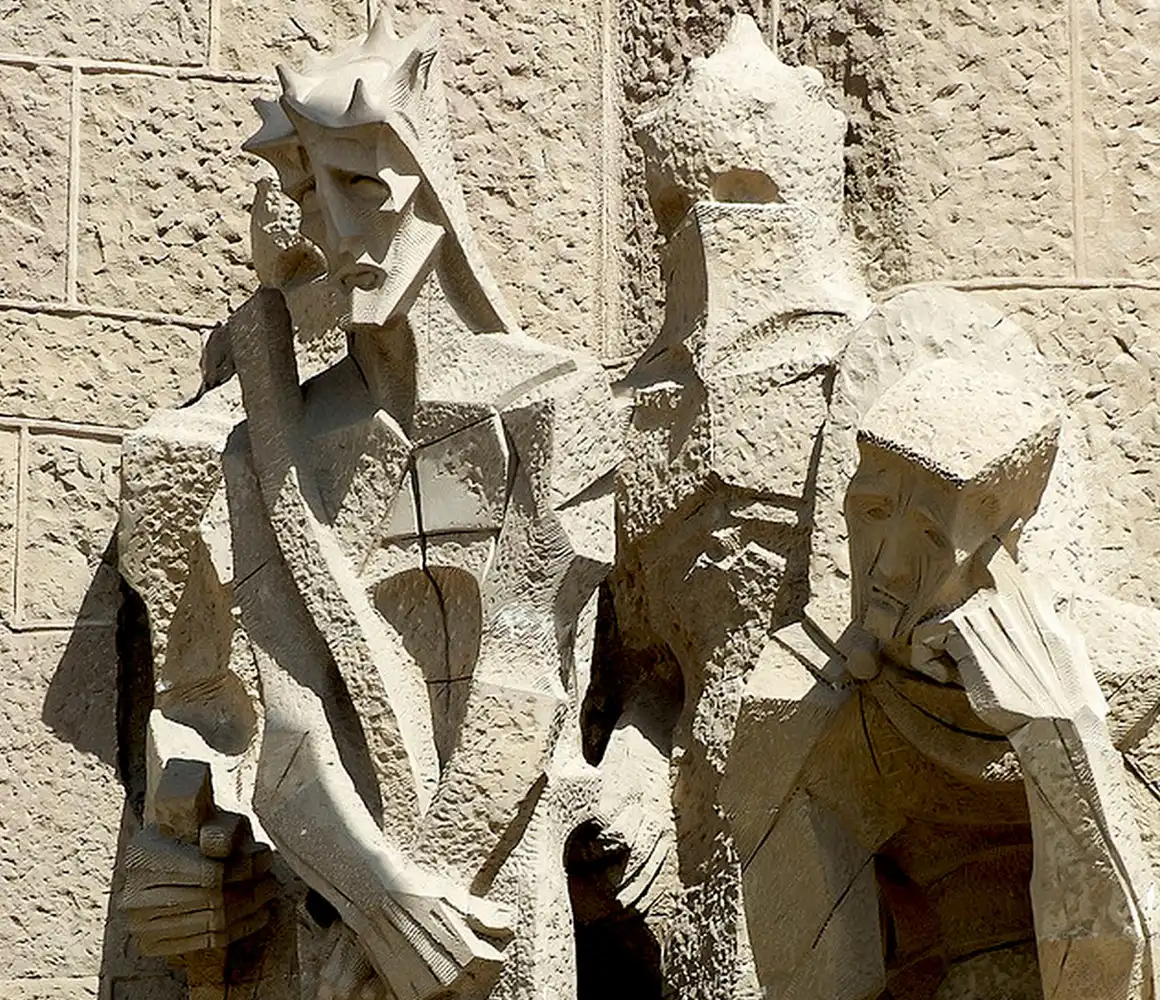
The Passion Facade © Expiatory Temple of the Sagrada Família
What Other Sacred Buildings Did Gaudí Design in Barcelona?
While the Sagrada Família represents Gaudí’s most mathematically complex sacred work, his other religious architectural projects in Barcelona show how his geometric principles evolved across different scales and requirements.
Palma Cathedral Restoration
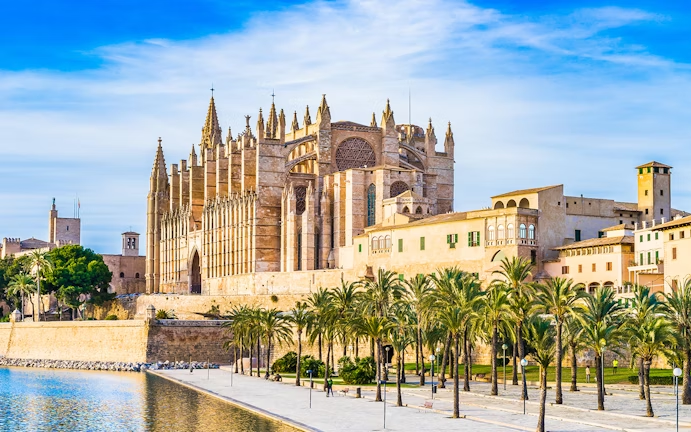
The restoration of Palma Cathedral showcases Gaudí’s ability to integrate mathematical precision with historical preservation. His interventions, including repositioning the choir and installing the baldachin, follow geometric principles that enhance both liturgical function and acoustic performance. The wrought iron elements incorporate parabolic curves that distribute loads while creating symbolic references to natural forms.
This project proved that Gaudí’s mathematical approach could respect historical contexts while improving functional performance. He didn’t impose his vision—he discovered the mathematical principles already present in the medieval structure and amplified them.
Chapel Designs
The chapel designs for various Barcelona institutions demonstrate how Gaudí’s mathematical principles could be adapted to smaller scales. Even in modest spaces, his use of catenary curves and hyperbolic surfaces creates spatial experiences that transcend physical limitations. The proportional systems maintain mathematical relationships that ensure visual harmony regardless of scale.
His theoretical projects for sacred architecture, documented in surviving sketches and models, reveal even more ambitious applications. Designs for a spiritual retreat center incorporate landscape geometry that would integrate built and natural forms through calculated relationships. These unrealized projects show how Gaudí’s mathematical approach could extend beyond individual buildings to entire sacred landscapes.
The Legacy of Mathematical Sacred Architecture
The mathematical principles developed in Gaudí’s sacred architecture continue to influence contemporary design through digital parametric methods that can now realize his geometric visions with unprecedented precision. Modern architects studying his work discover structural innovations that anticipate current sustainable design strategies.
Contemporary Relevance
Computer modeling of Gaudí’s catenary structures reveals optimization principles that inform contemporary shell design. His intuitive understanding of force flow patterns, developed through physical experimentation, established geometric rules that digital form-finding algorithms now confirm as theoretically optimal.
The acoustic engineering principles embedded in the Sagrada Família’s geometric systems provide precedents for contemporary performance space design. The mathematical relationships between tower heights, spacing, and internal geometries create reverberation characteristics that enhance liturgical music while maintaining speech intelligibility.
Modern Fabrication Possibilities
Contemporary fabrication technologies finally enable the realization of Gaudí’s most complex geometric visions. 3D printing and CNC fabrication can now produce the ruled surfaces and complex intersections that required extraordinary craft skill in Gaudí’s era. Yet the mathematical principles underlying these forms remain as relevant today as they were over a century ago.
The spiritual geometry of Gaudí’s sacred architecture demonstrates that mathematical precision and transcendent experience complement rather than compete with each other. His integration of structural rationalism with organic expressionism created architectural spaces where technical innovation serves spiritual aspiration.
Through his synthesis of mathematics, spirituality, and structural innovation, Antoni Gaudí transformed Barcelona’s sacred architecture into a testament to divine geometry. His buildings stand as prayers rendered in stone, mathematics made manifest in service of the transcendent. In an age of digital design tools, his analog approach reminds us that architectural beauty serves purposes no algorithm can fully comprehend.
The Catalan master’s work proves that Gaudí Modernist architecture and Barcelona religious architecture can achieve structural efficiency, spiritual transcendence, and mathematical beauty simultaneously. His legacy shows that architectural mathematics isn’t just about solving engineering problems—it’s about creating spaces that lift the human spirit toward the divine.

Luca Moretti is a content strategist with a foundation in urban design and architecture. Based in Milan, he focuses on writing that bridges aesthetics, material culture, and everyday spatial experiences.