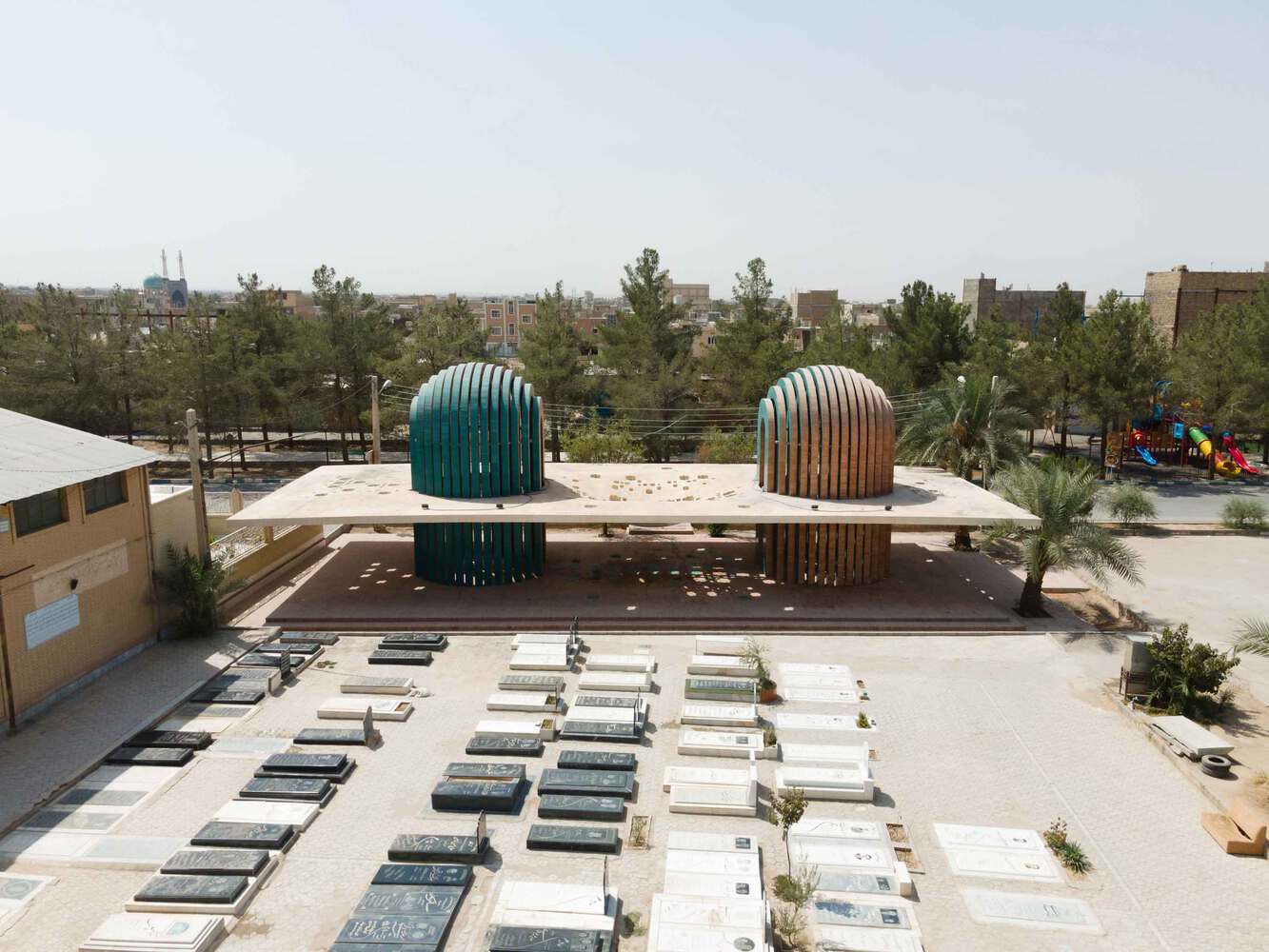


“Shafagh Tomb” Respect for the dead has always held a special place in Iranian culture. This respect has manifested itself in the construction of tombs, mausoleums, and crypts in such a way that there is almost no region, city, or village where such structures have not been built. This attention to the deceased has preserved the tradition of building tombs with a history of nearly 1,000 years. This tradition has undergone various formal and stylistic transformations over its centuries-long history.

© Arash Akhtaran
From the early examples of towers and domed buildings in the 4th century AH to pavilion-like tombs in the 11th century AH, from enclosed volumes to those interacting with the external environment, from commemorative to pilgrimage tombs, from individual graves to collective burial sites, and from simple structures to grand and detailed buildings—these are all part of this tradition.

© Arash Akhtaran
The Shafaq Tomb continues this historical tradition but does not merely repeat the past. Instead, it seeks a contemporary expression of Iran’s history, culture, and beliefs. It pursues this goal by defamiliarizing the symbols and concepts of Iranian mausoleum-pilgrimage architecture. For example, it removes the dome from its traditional, inaccessible position and places it at a human scale, symbolically democratizing it and aligning it with modern societal concepts. Similarly, the traditional inscription, typically located beneath the dome, is liberated from its confined space and redesigned as a modern calligraphic painting, transforming it into a canvas that celebrates freedom.

© Arash Akhtaran
The Shafaq Tomb takes the same approach in its relationship with its surroundings. By turning a private mausoleum into a gateway for entering the cemetery, it transfers the space into the public domain, blurring the line between a commemorative structure and a functional one. Additionally, inspired by the covered passageways of traditional regional architecture, known as Sabats, it creates a covered space that not only reduces the desert heat in the city of Ardakan for pilgrims and passersby but also provides a suitable environment for religious gatherings. In this way, it lies in the intermediate space between a private monument and a public arena.

© Arash Akhtaran
In conclusion, the Shafaq Tomb seeks maximum inclusiveness. It values both the individual and the collective, respects the sacred while recognizing the significance of the ordinary and everyday, and embraces the past while striving for modernity. Thus, in addition to preserving the symbolic and functional aspects of mausoleum-pilgrimage structures, it transforms into a space for the city and its people.
Project Info:
-
Architects: 35-51 ARCHITECTURE Office
- Country: Iran
- Area: 448 m²
- Year: 2023
-
Photographs: Arash Akhtaran
-
Lead Architects: Hamid Abbasloo,Abbas Yaghooti,Neda Adiban Rad
-
Design Team: Mohammad Reza Aghaie
-
Calligraphy Artist: Mohammad Reza Amouzad
-
Phase 2&Construction Consultant: Javad Hadavandi
-
Glaze Artist: Shirin Soroudi, Mehdi Rahimi
-
Structure: Majid Koolivand
-
Mechanical: Hadi Salehi
-
Construction Manager: Naser Akbarzadeh
-
Construction Supervisor: Mostafa Jafari
-
Construction Collaborators: Mohammad Reza Khani, Hashem Rezaie, Mohammad Hafiz, Mehdi Masumi, Jalil Mohamadi, Reza Arabi
-
Program / Use / Building Function: Religious Building