

A bike bridge is a bridge or elevated path built mainly for cyclists, often shared with pedestrians, that lets people on bikes cross water, roads or railways without mixing with motor traffic. The best examples combine a gentle gradient, enough width for two-way riding, safe parapets and good lighting with a strong architectural idea. This guide is for designers, students and cycling enthusiasts: it sets out the main design principles with jurisdiction-specific guidance, and then looks at ten bike bridges and cycle paths from Denmark, the Netherlands, Canada, Norway, New Zealand and Spain.
Countries such as Denmark and the Netherlands have led the way in treating cycling as part of the city’s infrastructure, borrowing ideas from impressive and thrilling bridges to create crossings designed around the bicycle rather than the car.
Design principles for a bike bridge
- Gentle gradients: ramps must be climbable without dismounting; long, shallow ramps or spirals (as at Cykelslangen and the Hovenring) are better than steep approaches or stairs.
- Width for two-way traffic: in England, the Department for Transport’s Local Transport Note 1/20 (2020) sets cycle-track widths of roughly 2-4 m depending on cycle flows and whether the track is one- or two-way, and covers bridges, including widths and parapet heights, in section 10.8 (Active Travel England, bridges). Dutch and Danish guidance set their own values.
- Separation from pedestrians: a marked cycle lane with footways each side, as on Calgary’s Peace Bridge, reduces conflict on busy crossings.
- Parapet height: cyclists sit higher than pedestrians, so parapets on cycle bridges are usually taller than on footbridges; earlier UK guidance from Sustrans recommended about 1.4 m (Sustrans, parapet heights on cycle routes, 2012). Check the current national standard.
- Smooth, grippy surface and drainage: no steps, joints or slippery decking in wet weather.
- Lighting and visibility: continuous, glare-free lighting for night use, and clear sight lines at bends and landings.
- Clearance for boats or vehicles: either enough height below the deck or an opening mechanism, which affects ramp length.
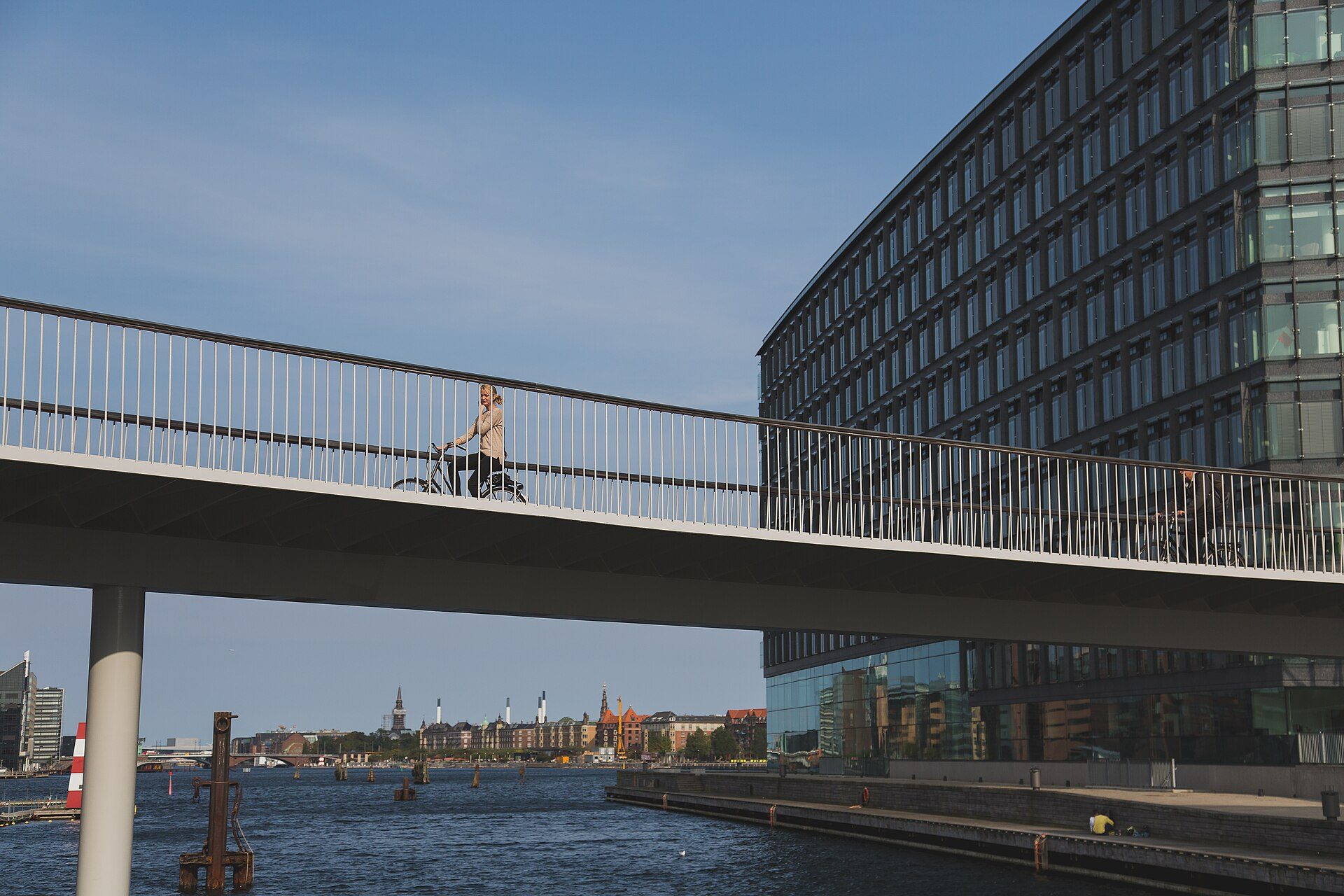
Cykelslangen, Copenhagen: a slender elevated deck with a tall railing and a gentle gradient for riders. Photo: Tony Webster, CC BY 2.0, via Wikimedia Commons. Tony Webster from Portland, Oregon, United States, source, CC BY 2.0
Diagram to draw (editor task): a long section through a bike bridge showing the deck, ramp gradients, clearance below, parapet height above deck, and a cross-section with cycle lane and footways.
Ten bike bridges and passageways
1. Bryggebroen, Copenhagen, Denmark

Courtesy of Dissing and Weitling
The 190 m Bryggebroen, designed by Dissing+Weitling and opened in 2006, was the first new harbour crossing for cyclists and pedestrians in central Copenhagen, linking Havneholmen to Islands Brygge (Wikipedia, Bryggebroen). Its success led to the Cykelslangen extension below.
2. Hovenring, Eindhoven, Netherlands

photography by © Helibeeld
This floating roundabout for cyclists, designed by ipv Delft and opened in 2012, is a 72 m diameter steel ring hung from a single central pylon by 24 cables. It lifts cyclists completely above a busy road junction, with ramps from each direction.
3. Melkwegbridge, Purmerend, Netherlands

Courtesy of Next Architects
Designed by NEXT architects across the Noordhollandsch Kanaal, the Melkweg (Milky Way) bridge splits users: pedestrians take a steep 12 m high arch, giving boats clearance, while cyclists use a low zigzag ramp that spreads the climb over a longer distance.
4. Peace Bridge, Calgary, Canada

Courtesy of Calatrava
The 126 m Peace Bridge over the Bow River, designed by Santiago Calatrava and opened in 2012, has a helical red steel tube with a glazed roof. A central cycle lane runs between two footways, and integrated lighting allows use at night.
5. Cykelslangen, Copenhagen, Denmark

Courtesy of Dissing + Weitling
Cykelslangen (the Bicycle Snake), also by Dissing+Weitling and opened in 2014, is an orange-surfaced elevated cycle track about 220 m long that links Copenhagen‘s Vesterbro side directly to Bryggebroen, so cyclists no longer have to carry bikes up stairs (Wikipedia, Cykelslangen). Its curving route keeps the gradient gentle.
6. Tjensvollkrysset, Stavanger, Norway

Photography: Pål Christensen
Like the Hovenring, this is a ring-shaped cycle and pedestrian bridge above a road junction, but built as a conventional concrete structure. The inside of its parapet is clad in coloured tiles, adding interest for people crossing.
7. LightPath (Te Ara I Whiti), Auckland, New Zealand

Photography: Russ Flatt
Monk Mackenzie Architects and LandLAB turned a disused motorway off-ramp, about 600 m long, into a walking and cycling path, surfaced in bright pink resin with interactive lighting along its edge. It opened in 2015 and shows how redundant road infrastructure can become a bike route.
8. Lex van Delden Bridge, Amsterdam, Netherlands

Photography by © Thijs Wolzak
Designed by Dok Architecten, this bridge for cyclists and pedestrians crosses a canal near Amsterdam’s Zuidas business district, linking the Boelelaan and Gershwinplein areas. Its form invites people to pause on the crossing as well as pass over it.
9. Twisted Valley, Elche, Spain

Photography by © Jesus Granada
Grupo Aranea’s Twisted Valley is a network of folding and bending paths and small bridges in a steep river valley in Elche, in the province of Alicante. It opened up the slopes for walking and cycling, with native trees planted for shade.
10. Van Gogh-Roosegaarde Bicycle Path, Nuenen, Netherlands

Courtesy of Studio Roosegaarde
Created by the Dutch designer Daan Roosegaarde and opened on 13 November 2014, this path of about 1 km near Nuenen, where Vincent van Gogh lived in 1883-1885, is inlaid with thousands of glow-in-the-dark stones in a swirling pattern inspired by The Starry Night, supported by LEDs and solar power (Smithsonian Magazine). It opened the Van Gogh 2015 year marking 125 years since the artist’s death.
Summary
A good bike bridge is designed around the rider: gentle gradients, enough width, separated or clearly shared space, tall parapets, a smooth surface and good lighting. The examples above show how these practical rules can produce memorable architecture, from Copenhagen’s harbour crossings to the floating rings of Eindhoven and Stavanger.

Daniel Mercer is a Coffee Break section editor at Arch2O, currently based in Berlin, Germany. With a background in architectural history and design journalism, Daniel holds a Master’s degree from the University of Edinburgh, where he focused on modern architecture and urban theory. His editorial work blends academic depth with a strong grasp of contemporary design culture. Daniel has contributed to several respected architecture publications and is known for his sharp critique and narrative-driven features. At Arch2O, he highlights innovative architectural projects from Europe and around the world, with particular interest in adaptive reuse, public infrastructure, and the evolving role of technology in the built environment.