

Controversial buildings are not always bad buildings. The ten famous buildings below, from the Eiffel Tower and Sydney Opera House to the Louvre Pyramid and London’s “Walkie Talkie”, were attacked for their looks, cost, function or effect on their surroundings, and several are now national symbols. This article is for students and designers. It gives the verified story of each controversy, sorts the causes into recurring patterns in a table, explains one technical failure with a diagram, and draws lessons for anyone proposing a bold design.
Bold moves in architecture are not always received warmly. Some buildings grow on people; others never do. One of the buildings here, the Empire State Building, was later named among the Seven Wonders of the Modern World by the American Society of Civil Engineers.
Here are some of the world’s most debated famous buildings:
The controversial buildings are listed roughly as the original article ordered them; dates and status are as reported by the sources linked.
1. The Portland Building, Oregon, United States

Portland Building by Michael Graves, 1982. Portland, Oregon.
The Portland Municipal Services Building by Michael Graves won a 1980 design competition, partly because it promised the most office space within the city’s budget. When it opened in 1982 it became the best-known early postmodern building in America, and one of the most criticised: its small windows, dark offices and applied classical motifs were attacked by architects and staff alike. Water leaks and structural problems followed, and the city weighed demolition. Instead it chose a major renovation, re-cladding the building at a cost that rose to about US$195 million and later more, and the National Park Service warned that the new skin would cost the building its 2011 National Register listing, as reported by Bloomberg CityLab.
2. Guggenheim Museum, New York, USA

Solomon R. Guggenheim Museum – Photography: Flickr user Aglez the city guy
Frank Lloyd Wright’s Solomon R. Guggenheim Museum opened in 1959 after more than 15 years of design and delay. Its continuous spiral ramp was criticised before it opened: in 1956 a group of artists signed a letter objecting that the sloping, curved walls were unsuitable for showing paintings. Critics said Frank Lloyd Wright had designed a monument to architecture rather than a gallery. Today the rotunda is one of the most recognisable interiors in the world, and it has starred in films, including the shoot-out in The International (2009).
3. Sagrada Familia, Barcelona, Spain

Sagrada Familia – Courtesy of Sal34 / Wikimedia
Construction of the basilica began in 1882, and Antoni Gaudí directed it from 1883 until his death in 1926. Work continued from his surviving drawings and plaster models, many of which were damaged in 1936, and it is paid for by donations and visitor tickets. Whether to continue at all was fiercely debated: in January 1965 an open letter in La Vanguardia, signed by architects and critics (accounts include Le Corbusier among the supporters, though the published signature lists vary), argued that the church should be left as Gaudí left it, as translated by Urbanophile. Construction went on. In February 2026 the cross was placed on the central Tower of Jesus Christ, bringing it to 172.5 m and making the basilica the tallest church in the world, according to Domus; interior work and parts of the main facade are still to be finished.
4. 20 Fenchurch Street “Walkie Talkie”, London, United Kingdom

20 Fenchurch Street in 2015, viewed from the roof balcony of City Hall
Rafael Viñoly’s tower widens as it rises, and its south face is concave. In late summer 2013, before the building was complete, the curved glass focused sunlight onto Eastcheap below, damaging parked cars, including melting parts of a Jaguar, and scorching shop fronts; temperatures above 45°C were reported in the street, and the press named it the “Walkie Scorchie”. The developers paid for the damage, suspended nearby parking and installed a permanent brise-soleil of horizontal aluminium fins on the south face. The building, designed by Rafael Viñoly Architects, was also criticised for its bulk on the City skyline. The diagram below shows why a concave facade focuses light.
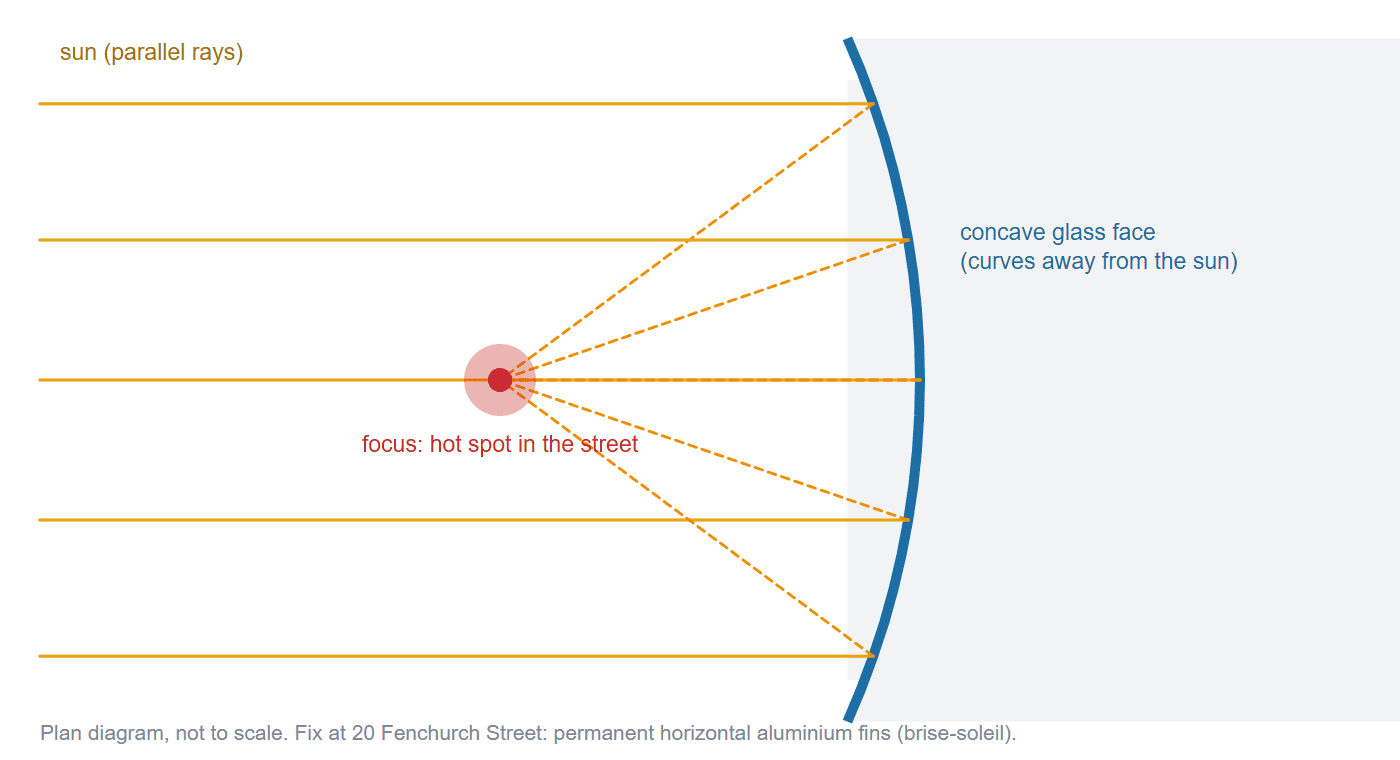
Why a concave facade focuses sunlight: parallel sun rays reflecting off a curved glass face converge on a zone in front of it, as at 20 Fenchurch Street in 2013, where the concave south face concentrated sunlight onto Eastcheap. A brise-soleil of horizontal fins later broke up the reflection. Diagram: Arch2O
5. The Louvre Pyramid, Paris, France

© Flickr
The Louvre was a royal palace before it became a museum. In the 1980s President Mitterrand’s Grand Louvre project commissioned the Chinese-American architect I. M. Pei to create a new main entrance, and his glass and steel pyramid in the Cour Napoléon, opened in 1989, caused an outcry: critics called a modern pyramid an insult to the historic palace. The pyramid solved a real problem by bringing visitors into a large underground hall serving all wings, and it is now one of the most photographed structures in Paris.
6. The Empire State Building, New York, USA

Empire State Building – Courtesy of British Architectural Library Trust
New Yorkers called it the “Empty State Building”
Designed by William F. Lamb of Shreve, Lamb & Harmon in Art Deco style, the Empire State Building opened on 1 May 1931, at the start of the Great Depression. Much of its office space stayed empty for years, earning the nickname. The controversy here was commercial, not aesthetic. Revenue from the observation decks helped keep it going, and the building is generally reported to have become profitable only around 1950. It remains one of New York‘s defining landmarks.
7. Al Janoub Stadium (Al Wakrah Stadium), Qatar

Al-Wakrah Stadium – Courtesy of Zaha Hadid Architects
Zaha Hadid Architects designed the stadium in Al Wakrah, south of Doha, with AECOM; it was the first new stadium completed for the 2022 FIFA World Cup, opening on 16 May 2019, after Zaha Hadid’s death in 2016. The practice describes the roof as an abstraction of the hulls of dhows, the region’s traditional boats, turned upside down. When the design was unveiled in 2013, tabloid media mocked its shape for an anatomical resemblance, overshadowing the reference the architects intended, and the wider debate about workers’ conditions on Qatar’s World Cup projects also touched the stadium and Zaha Hadid herself.
8. Sydney Opera House, Sydney, Australia

Sydney Opera House – Photography: Flickr user Dave Gorman
The Opera House was won in competition in 1957 by the Danish architect Jørn Utzon. Solving the geometry of the shell roofs took years, and costs rose. In 1966, after the New South Wales Minister for Public Works stopped paying him, Utzon resigned and returned to Denmark. Australian architects led by Peter Hall completed the building, changing the interiors substantially. It opened in October 1973, ten years late, at about A$102 million against an original budget of A$7 million. Utzon never returned to see it finished, but in 1999 he was appointed as a consultant to guide future work, and in 2007 the building was inscribed as a UNESCO World Heritage Site.
9. Eiffel Tower, Paris, France

Eiffel Tower – Image Courtesy of James Whitesmith
The tower is named after Gustave Eiffel, whose company designed and built it; the original concept came from his engineers Maurice Koechlin and Émile Nouguier, with the architect Stephen Sauvestre. Before it was finished, in February 1887, a group of artists and writers published a protest in Le Temps against this “useless and monstrous” tower. It was built for the 1889 World’s Fair with a permit for 20 years and was saved partly by its value as a radio antenna. It is now one of the most visited paid monuments in the world.
10. Tower Bridge, London, UK

Tower Bridge – Courtesy of Kashif.h/Wikimedia
This emblem of London was built between 1886 and 1894. It was not designed by Sir Joseph Bazalgette, as earlier versions of this article said: Bazalgette entered a high-level design that was rejected, partly because it would not give ships enough headroom without long approach ramps. The bridge as built is by the City Architect Sir Horace Jones with the engineer Sir John Wolfe Barry, using a bascule (lifting) span so that tall ships could pass. Parliament required a design in keeping with the Tower of London nearby, and after Jones died in 1887 Barry gave it a more ornate Victorian Gothic stone cladding over its steel frame. Critics at the time attacked that cladding as a sham that hid the engineering; today it is one of the city’s best-loved sights.
Why famous buildings become controversial: six patterns
The ten controversial buildings fall into a few recurring causes. The table sets them out with each building’s current status.
| Building | Architect / designer | Opened | Main cause of controversy | Status today |
|---|---|---|---|---|
| Eiffel Tower, Paris | Gustave Eiffel's company (Koechlin, Nouguier, Sauvestre) | 1889 | Context and aesthetics | Symbol of Paris |
| Tower Bridge, London | Horace Jones, John Wolfe Barry | 1894 | Gothic cladding seen as a sham | Landmark |
| Empire State Building, New York | Shreve, Lamb & Harmon | 1931 | Empty offices in the Depression | Landmark; profitable from c. 1950 |
| Guggenheim Museum, New York | Frank Lloyd Wright | 1959 | Function: walls unsuited to paintings | Icon |
| Sydney Opera House | Jørn Utzon; completed by Peter Hall and team | 1973 | Cost and time overrun; architect resigned | UNESCO World Heritage (2007) |
| Portland Building | Michael Graves | 1982 | Function and aesthetics; leaks | Re-clad (renovation cost about US$195m+) |
| Louvre Pyramid, Paris | I. M. Pei | 1989 | Modern form in historic context | Icon |
| 20 Fenchurch Street, London | Rafael Viñoly Architects | 2014 | Solar glare damaged street; bulk | Brise-soleil fitted |
| Al Janoub Stadium, Qatar | Zaha Hadid Architects with AECOM | 2019 | Symbolism (media reading of its form); labour debate | In use |
| Sagrada Familia, Barcelona | Antoni Gaudí; successors | Under construction since 1882 | Whether to continue; time | Central tower completed 2026 |
Source: Sources linked in the article (accessed 29 Oct 2026) (as of 29 October 2026).
Controversial buildings principles explained with diagrams
Six lessons for designers follow from these controversial buildings:
- Context: a new form next to a historic one (Louvre, Tower Bridge, Eiffel Tower) is judged against what is already there. Explaining the problem it solves, as Pei did with the entrance, helps.
- Function: if the form makes the building harder to use (Guggenheim, Portland Building), criticism lasts longer than any aesthetic debate.
- Cost and time: overruns (Sydney Opera House, Sagrada Familia, the Portland renovation) become the story, whatever the design quality.
- Environmental effects: reflective curved glass can focus sunlight, and tall buildings change wind and light at street level; solar-glare and microclimate studies at design stage, such as those now asked for by the City of London, avoid problems like the Walkie Talkie’s.
- Symbolism: forms are read in ways the designer did not intend (Al Janoub); test how a design will be described, not just how it will be drawn.
- Timing: economic cycles can make a good building look like a failure for decades (Empire State Building).
The Walkie Talkie is the clearest case of a design fault that could have been modelled: its glare fell on Eastcheap, the street shown below, and the fix was retrofitted after the damage.
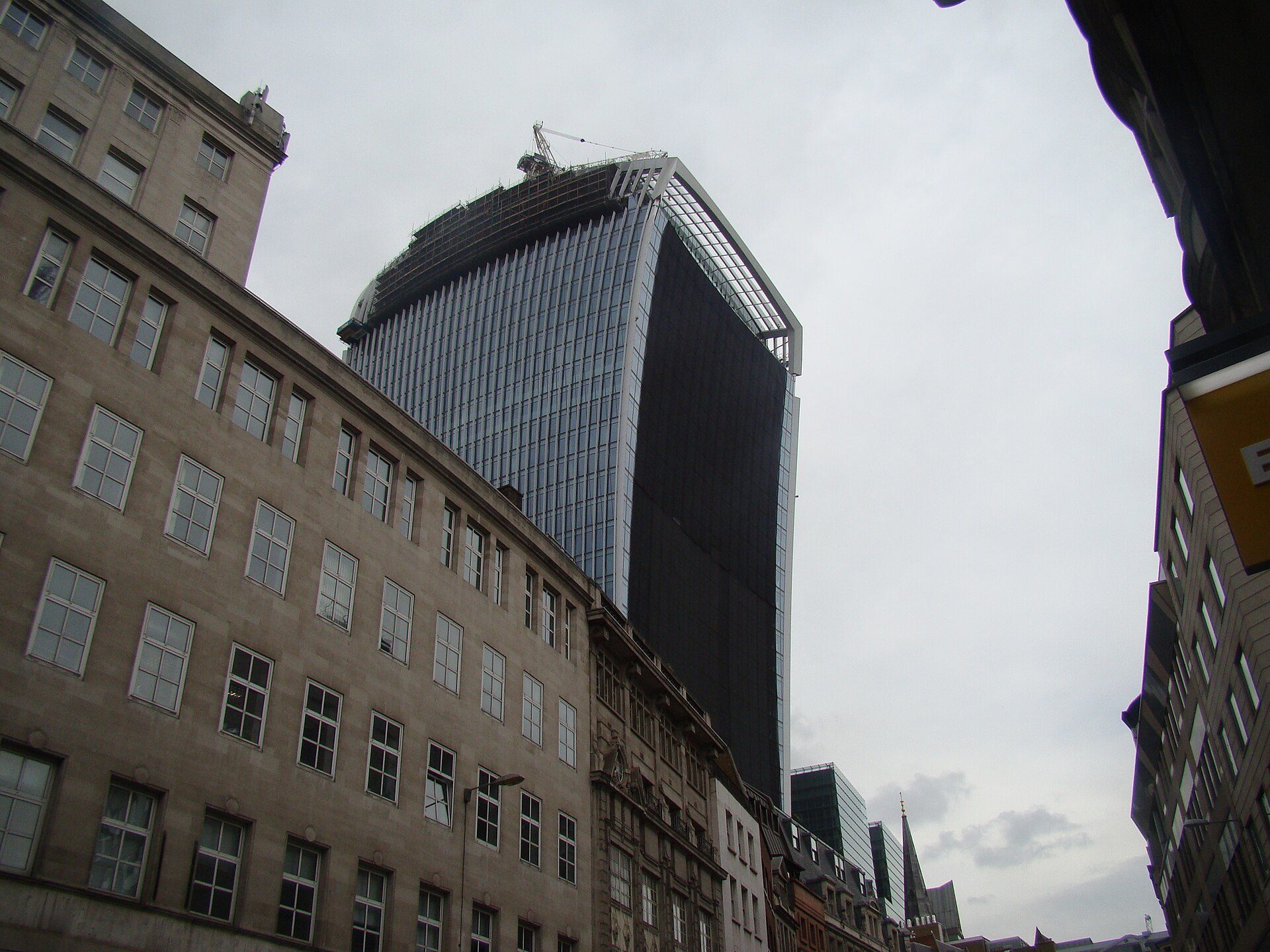
20 Fenchurch Street seen from Eastcheap, the street where reflected sunlight from the curved facade caused damage in 2013. Photo: Robert Lamb, CC BY-SA 2.0, via Wikimedia Commons (geograph). Robert Lamb, source, CC BY-SA 2.0
Precedent analysis: from outrage to icon
Three of these controversial buildings show the path from outrage to acceptance. The Eiffel Tower went from a temporary “monstrous” tower to a permanent symbol of Paris in a few decades. The Sydney Opera House went from political scandal to World Heritage Site within 34 years of opening. The Louvre Pyramid went from outcry to one of the most photographed structures in Paris in a generation. In each case the building did something no other building did, and it kept doing it well. Among controversial buildings, the Walkie Talkie and the Portland Building show the opposite: when a design creates a measurable problem for neighbours or users, the controversy does not fade, it gets fixed or rebuilt.
Sources and further reading
- Bloomberg CityLab: Is the renovated Portland Building still historic? (2019)
- Urbanophile: the 1965 manifesto against completing the Sagrada Familia
- Domus: Sagrada Familia becomes the world’s tallest church (2026)
- Tower Bridge (history and references)
- Al Janoub Stadium

Daniel Mercer is a Coffee Break section editor at Arch2O, currently based in Berlin, Germany. With a background in architectural history and design journalism, Daniel holds a Master’s degree from the University of Edinburgh, where he focused on modern architecture and urban theory. His editorial work blends academic depth with a strong grasp of contemporary design culture. Daniel has contributed to several respected architecture publications and is known for his sharp critique and narrative-driven features. At Arch2O, he highlights innovative architectural projects from Europe and around the world, with particular interest in adaptive reuse, public infrastructure, and the evolving role of technology in the built environment.