


Ideas must be communicated visually in architecture, and sketching is the fastest method and probably the best for idea expression. Yet many new architectural students who are just starting lack the natural ability to master architectural sketching. They will need to rely on mentors to explain the basics of sketching, which will take time if such mentors are found.
It is easy to get disheartened when you produce a couple of rubbish sketches that are out of proportion and look a bit weird. Don’t worry, you must keep at it, and know that it does take a bit of time to find your groove, but when you do, it is great to have that confidence in your ability for your course and career. If you experiment with digital architectural sketching, check these tips to improve your SketchUp skills easily.
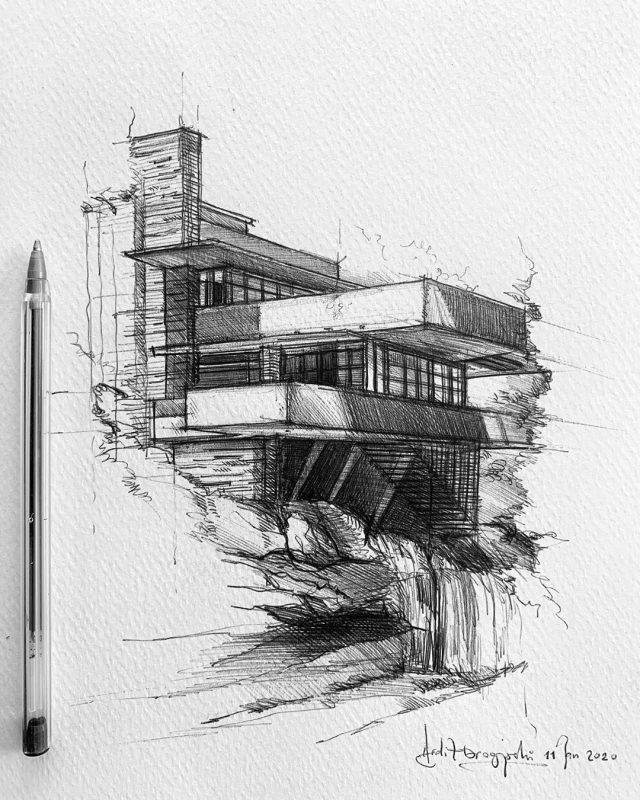
Falling water sketch by arditarts
Architectural Sketching Tips:
Like most architects, if you are still hooked to the pencil and paper technique, the following drawing tips will help any beginner overcome many challenges in architecture sketches.
1. Don’t move your pencil by bending your wrist or elbow
According to Bob Borson, the essential thing once you start sketching is not to move your pen/pencil by bending your wrist or elbow. Borson mentioned, “Lock your wrist and elbow into a comfortable angle and only move your entire arm when sketching.” As you get more skilled, this tip can be relaxed, and you can first bend your elbow and, ultimately, your wrist. Initially, you’ll end up with straighter lines by limiting your movement to the entire arm.”
2. Take control
Position your hand at the end of the pencil to gain more control and precision. This also produces darker markings. On the other hand, positioning your hand further up the pencil makes you less in control, creating lighter markings.
3. Diversify your lines
To make an attractive, lively sketch, try using various lines by shifting from thick to thin lines and light to dark shades. This can be challenging initially, but you can master it by practicing using different pencil grades (from 3H to 6B) and withholding the pencil at different angles. Remember that you must use line weight to help convey depth to your sketch. If you want to produce dynamic and unique drawings, go for irregular lines. They can turn dull, flat, and smooth illustrations into interesting ones.
Also read: 20 Mind-Blowing Ink Architectural Sketches
4. Add some texture
5. Avoid being too symmetrical
Drawing a balanced artwork is essential, but perfecting a precise symmetrical sketch might look dull. So add some simple changes, but keep the general lines symmetrical to give your drawing an exciting look.
6. Stay clear of smudging
Do not let smudges ruin your designs. Put an extra sheet of paper under your hand when shading to avoid un-required smudges. Also, begin shading from left to right if you are right-handed and shade from right to left if you are left-handed. On the other hand, if you want to add intentional smudges to smooth out shading, you can use a piece of tissue paper.
7. Drawing a sky
8. Silhouettes
9. Look at your drawings from a reverse angle
FAQS:

Ibrahim Abdelhady is an architect, academic, and media entrepreneur with over two decades of experience in architecture and digital publishing. He is the Founder and CEO of Arch2O.com, a leading platform in architectural media, renowned for showcasing innovative projects, student work, and critical discourse in design. Holding dual PhDs in Architecture, Dr. Abdelhady combines academic rigor with industry insight, shaping both future architects and architectural thought. He actively teaches, conducts research, and contributes to the global architecture community through his writing, lectures, and media ventures. His work bridges the gap between practice and academia, pushing the boundaries of how architecture is communicated in the digital age.