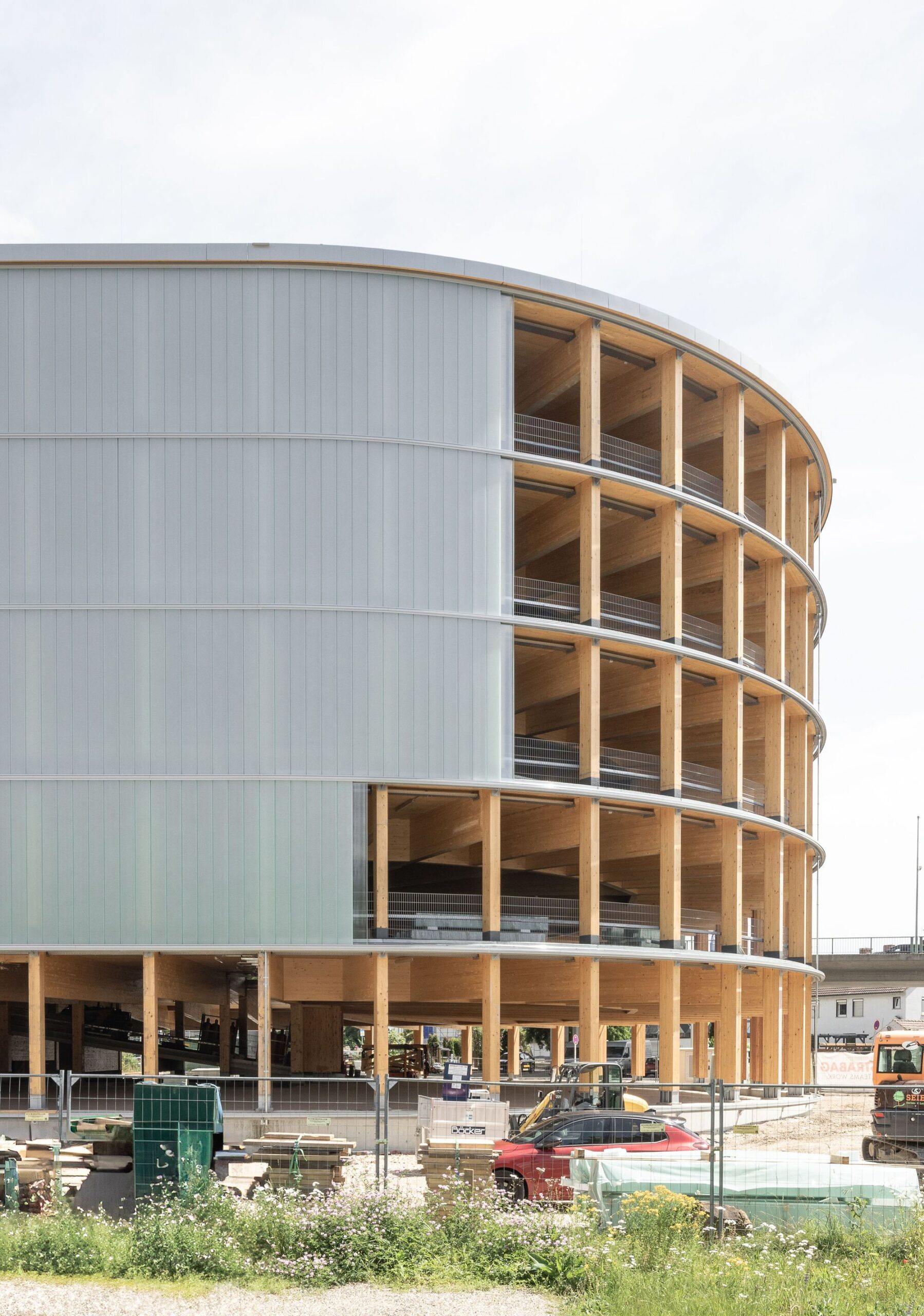


”Wooden Parking Garage Wendlingen” Designed by the Stuttgart-based firm herrmann+bosch architekten, this parking garage sets new standards in multiple aspects, combining high standards for design, user-friendliness, and sustainability. The parking garage is located on an important pedestrian axis between the planned OTTO quarter, which is being created from the industrial monument of the former Heinrich Otto & Söhne weaving mill, and the Wendlingen train station. With 349 parking spaces on 5 levels, it replaces the existing parking spaces on the “Behr-Areal”. It also promotes environmentally friendly mobility thanks to its convenient location near the train station, numerous e-charging stations for cars and e-bikes and secure parking facilities for 200 bicycles. Thanks to its Park+Ride function, the multi-storey parking lot also helps to relieve traffic congestion for the entire Stuttgart region.

© Roland Halbe
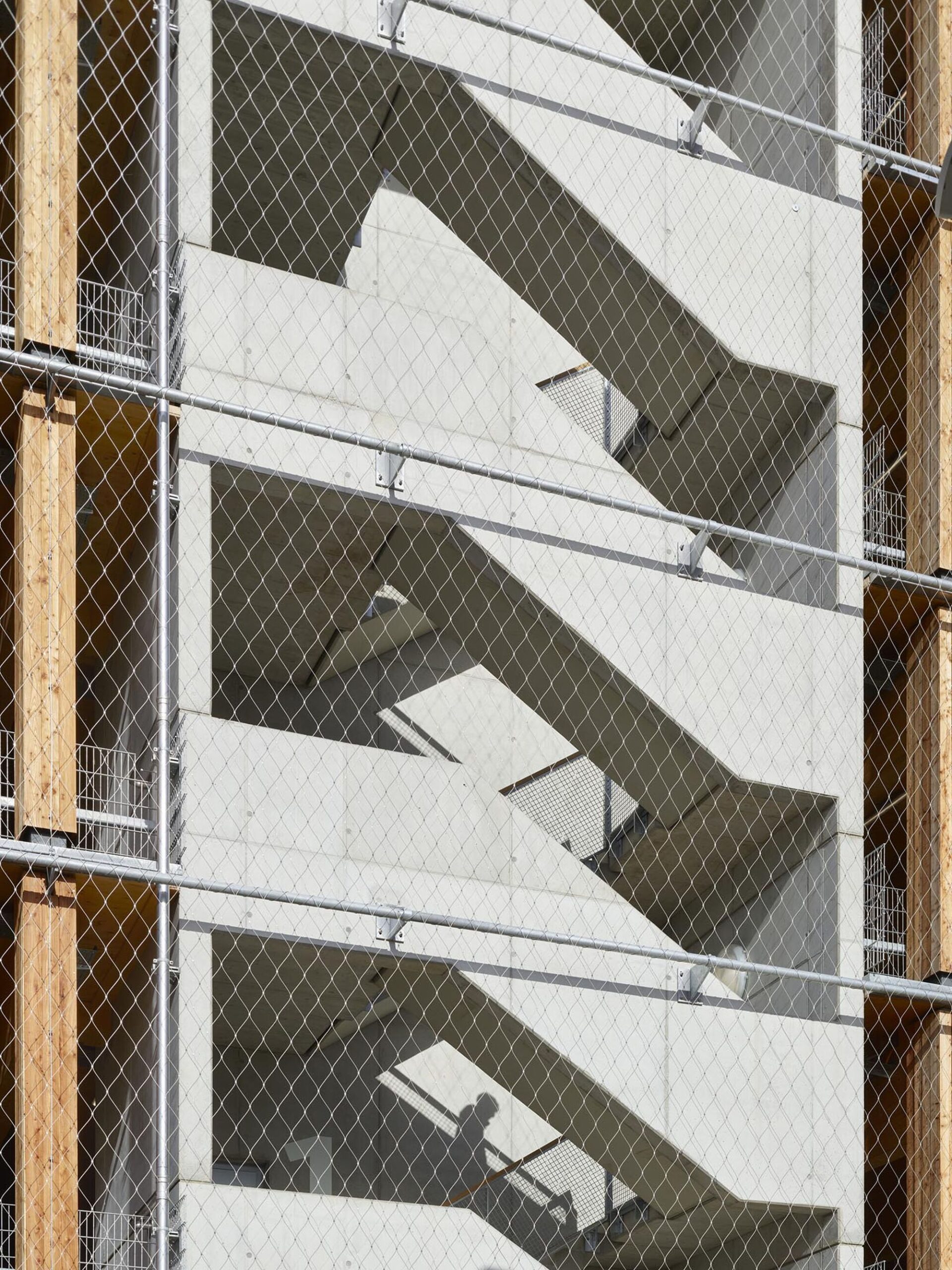
The unusual oval shape of the multi-storey parking lot is the result of the limited space available and allows maximum space efficiency. The sustainable timber construction also catches the eye. Instead of the usual steel or concrete construction, the parking garage consists mainly of cross-laminated timber ceilings and glulam columns. Only the two stairwells are made of concrete for static and fire protection reasons. The ceilings are covered with durable mastic asphalt. The column-free parking spaces are particularly user-friendly and can be adjusted in width at any time. All timber construction elements were brought to the construction site prefabricated and were assembled there using simple plug-in systems. This guaranteed a short construction time and a high level of cost-effectiveness.

Structure Diagram | © knippershelbig
The lightweight construction method and the minimal use of CO 2 -intensive materials such as steel and concrete meant that large amounts of CO 2 could be saved. In order to ensure the recyclability of the building, no composite materials were used and almost all connections were plugged and screwed together. This guarantees easy dismantling, separation by type and thus the reusability of the materials. The convertibility of the building is also guaranteed, as the storey heights are planned with a clear height of 2.35 m and between the beams with a height of 3.40 m and not with a height of 2.10 m like a conventional parking garage. The height and the absence of columns thus allow the parking garage to be converted into a residential or working environment with a beautiful, naturally lit inner courtyard in place of the centrally located ramp.

Structure Detail | © knippershelbig
The north side of the building has a soundproof façade made of translucent profiled glass across all levels. This effectively shields the planned residential development of the new Otto-Quartier from the noise of the parking garage, the adjacent railroad line and the road bridge. On the south side, the façade is open and contributes to the attractiveness of the building and its surroundings through the visibility of the timber construction and the greenery on the façade. The roof is also greened and a photovoltaic system is installed there, which provides renewable electricity. The electricity requirements of the e-charging stations are to be covered entirely by the photovoltaic system. The natural ventilation, which eliminates the need for failure-prone, high-maintenance ventilation technology and fire protection systems, increases the building’s cost-effectiveness.

Courtesy of Herrmann + Bosch Architekten
The green roofs and façades are also part of a sophisticated rainwater concept that takes into account the changes caused by the climate crisis. The rainwater concept planned for the project, which is resilient to heavy rainfall and climate-friendly, contrasts with conventional approaches that aim to quickly drain rainwater into sewer networks. The specially developed concept aims to ensure a water balance that is as natural as possible. This means that groundwater recharge and evaporation should be promoted and only the excess water should be throttled and discharged into the sewer system. To this end, the complex concept is made up of various runoff-avoiding measures (green roof, façade greening, infiltration troughs, cisterns, tree infiltration trenches, unsealed surfaces, etc.). It has a positive effect on the existing vegetation, offers improved flood protection and has a positive influence on the local microclimate. The concept follows the forward-looking model of the “sponge city”, which forms the basis of the planning for the entire “OTTO-Quartier” urban development project.

© Roland Halbe
Project Info:
-
Architects: herrmann+bosch architekten
- Country: Germany
- Area: 10880 m²
- Year: 2024
-
Photographs: Roland Halbe, Achim Birnbaum
-
Manufacturers: Lamberts, Carl Stahl ARC, IBC Solar, Schmitt + Sohn Aufzüge, Sherpa, Zinco
-
Structural Engineering: knippershelbig
-
HVAC Planning: H+H Planung
-
Landscape Architecture: Planstatt Senner
-
Wood Construction: Pletschacher
-
Shell Construction: Brodbeck
-
Steel Construction: Schmid
- Project Partner: Gerhard Bosch
- Project Leader: Katja Detering
- Project Architect: Felix Köstinger, Leonie Kahnert
- Execution: Pletschacher Holzbau
- Assembly: dieholzbox
- Fire Protection: brandschutz plus
- Glass Facade: Metz