
The concept the project :
The University of Technology in Mearag City, by Sherif Mohamed Abd El Halim, explores a fractal-inspired architectural concept where mathematical patterns influence spatial organization and form.
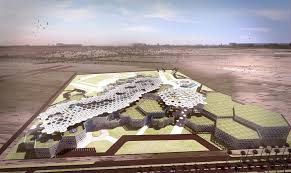
© Sherif Mohamed Abd El Halim
self-similar patterns, where self-similar means they are “the same from near as from far” .Fractals may be exactly the same at every scale,hey may be nearly the same at different scales. The definition of fractal goes beyond self-similarity per se to exclude trivial self-similarity and include the idea of a detailed pattern repeating itself. “fractal” was first used by mathematician Benoît Mandelbrot in 1975. Mandelbrot based it on the Latin fracturs meaning “broken” or “fractured”, and used it to extend the concept of theoretical fractional dimensions to geometric patterns in nature.
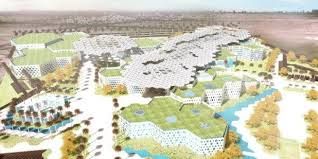
© Sherif Mohamed Abd El Halim
The hexagonal shape concept :
the reason behind the selection of the hexagon shape is because of
the nature of the land ‘sandy soil’ the particles of the sand is crystals
and it is regular geometrical form the crystals
© Sherif Mohamed Abd El Halim
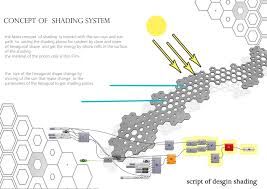
The Concept of shading system:
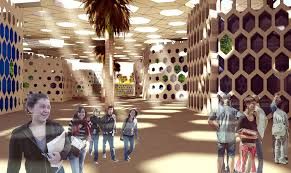
The main concept of shading is interact with sun rays and sun path to saving the shading places for student by close and open of hexagonal shape and get energy by photo cells in the surface of the surface . The material of the photo cells is thin film . the size of hexagonal shape change by moving the sun that make change of parameter of hexagonal shape to get shading .
© Sherif Mohamed Abd El Halim
Project info:
Designer : Sherif Mohamed Abd El Halim
School : Shoruk Academy in Egypt