

A rock garden is a planted landscape in which stone sets the structure and very free-draining soil lets plants from mountains, screes and dry places thrive. In the Western tradition it is mainly a home for alpine plants; in Japan, the dry rock garden (karesansui) uses stone and raked gravel with little or no planting. This guide is for homeowners, garden designers and architecture students. It explains the main types, how to build one that drains properly, how to choose and set stone, what to plant in which climate, and how to maintain it, with a section diagram of the build-up and examples from Kew, Wisley, Kyoto and Chandigarh.
What a rock garden is
Three things define a rock garden. First, stone is used as structure: it holds soil on a slope, shades plant roots and stores warmth. Second, the growing medium drains fast, because most rock plants die from wet roots in winter rather than from cold. Third, the plants are chosen for those conditions: low, compact, often slow-growing species from high altitude or dry regions. The Royal Horticultural Society (RHS) notes that alpines come from regions above the tree line with good drainage, usually cold and dry winters, and high light levels. A good rock garden recreates those conditions, not just their appearance.
The style has a long history in public gardens. The rock garden at the Royal Botanic Gardens, Kew, in London was begun in 1882 and later enlarged with Sussex sandstone, according to a 2011 history published by the Scottish Rock Garden Club. Like many landscapes of its time, it imitates a mountain valley, with a path running between rock outcrops.
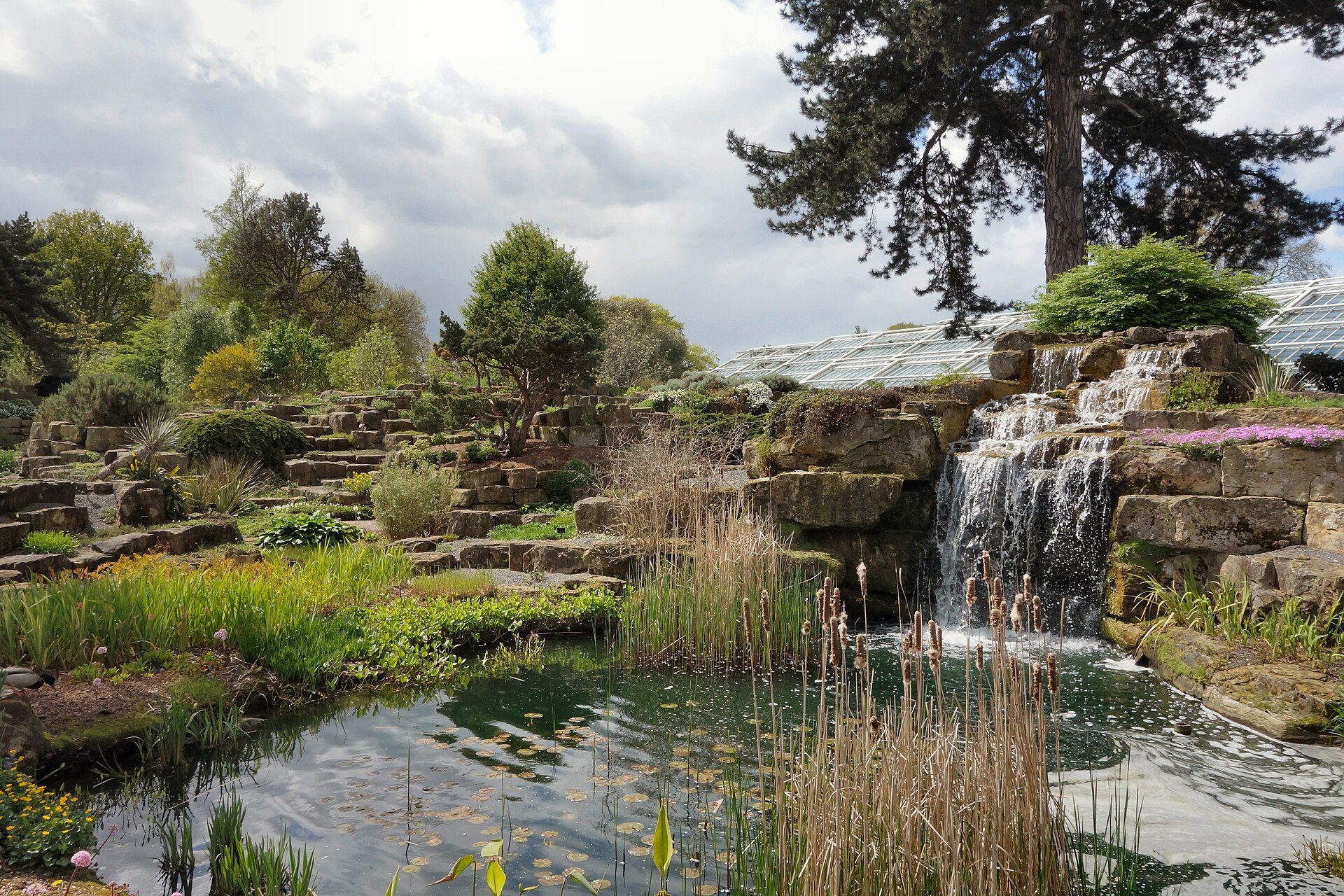
Kew's rock garden, begun in 1882: layered sandstone outcrops imitate a mountain valley, with a waterfall and pool. Photo: Peter Jeffery, CC BY-SA 2.0, via Geograph/Wikimedia Commons. Peter Jeffery, source, CC BY-SA 2.0
Types of rock garden: alpine, dry and Japanese karesansui
Alpine rock garden
The alpine rock garden is the classic British and European type: stone outcrops on a sunny slope, packed with gritty soil and small mountain plants. The RHS rock garden at Wisley, Surrey, was built in 1911 by the firm James Pulham and Son in natural stone, a few years after the RHS took over the Wisley site. It remains one of the best places to see how large stones are set into a slope to form ledges, pockets and screes for different plants.
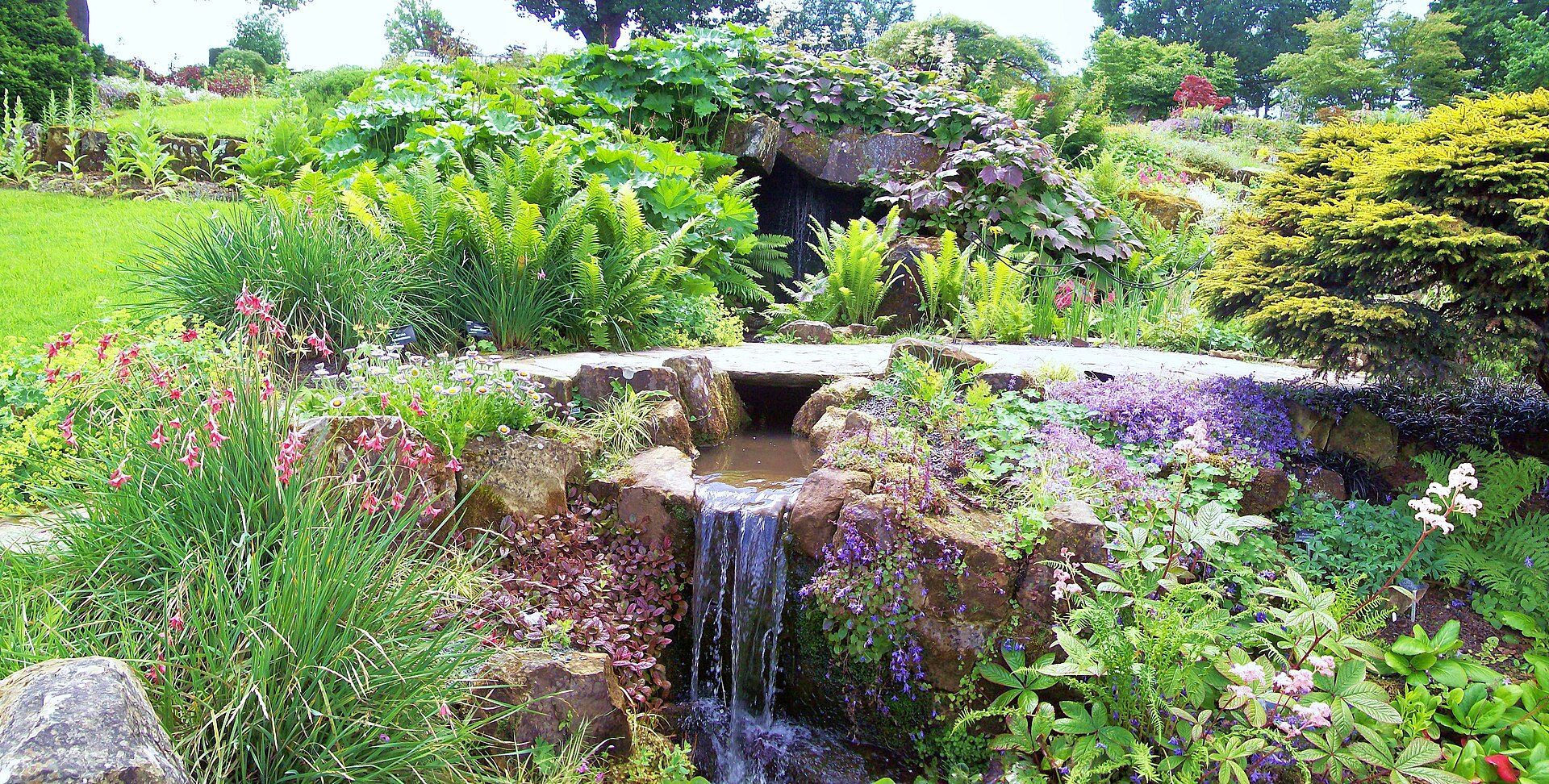
The RHS rock garden at Wisley (1911): natural stone set into the slope as ledges and pockets for plants. Photo: Len Williams, CC BY-SA 2.0, via Geograph/Wikimedia Commons. Len Williams, source, CC BY-SA 2.0
Dry or gravel garden
A dry garden uses gravel and stone with drought-tolerant plants, and in dry climates it is the most realistic kind of rock garden. The best-known British example is Beth Chatto’s Gravel Garden in Essex, made on a former car park in the early 1990s. The Beth Chatto Gardens state that it is never watered, although it lies in one of the driest parts of England. Its lesson is plant choice: species chosen for local rainfall do not need irrigation once established.
Japanese dry rock garden (karesansui)
The Japanese karesansui, or dry landscape garden, is a different idea. Stones and raked gravel represent mountains, islands and water, and the garden is designed to be viewed, not walked through. The most famous is at Ryōan-ji in Kyoto, part of the Historic Monuments of Ancient Kyoto World Heritage Site. Its fifteen stones are set in five groups in white gravel; the date is debated, and sources place it between the mid-15th and late 15th century. From any single point on the viewing veranda, one stone is always hidden.
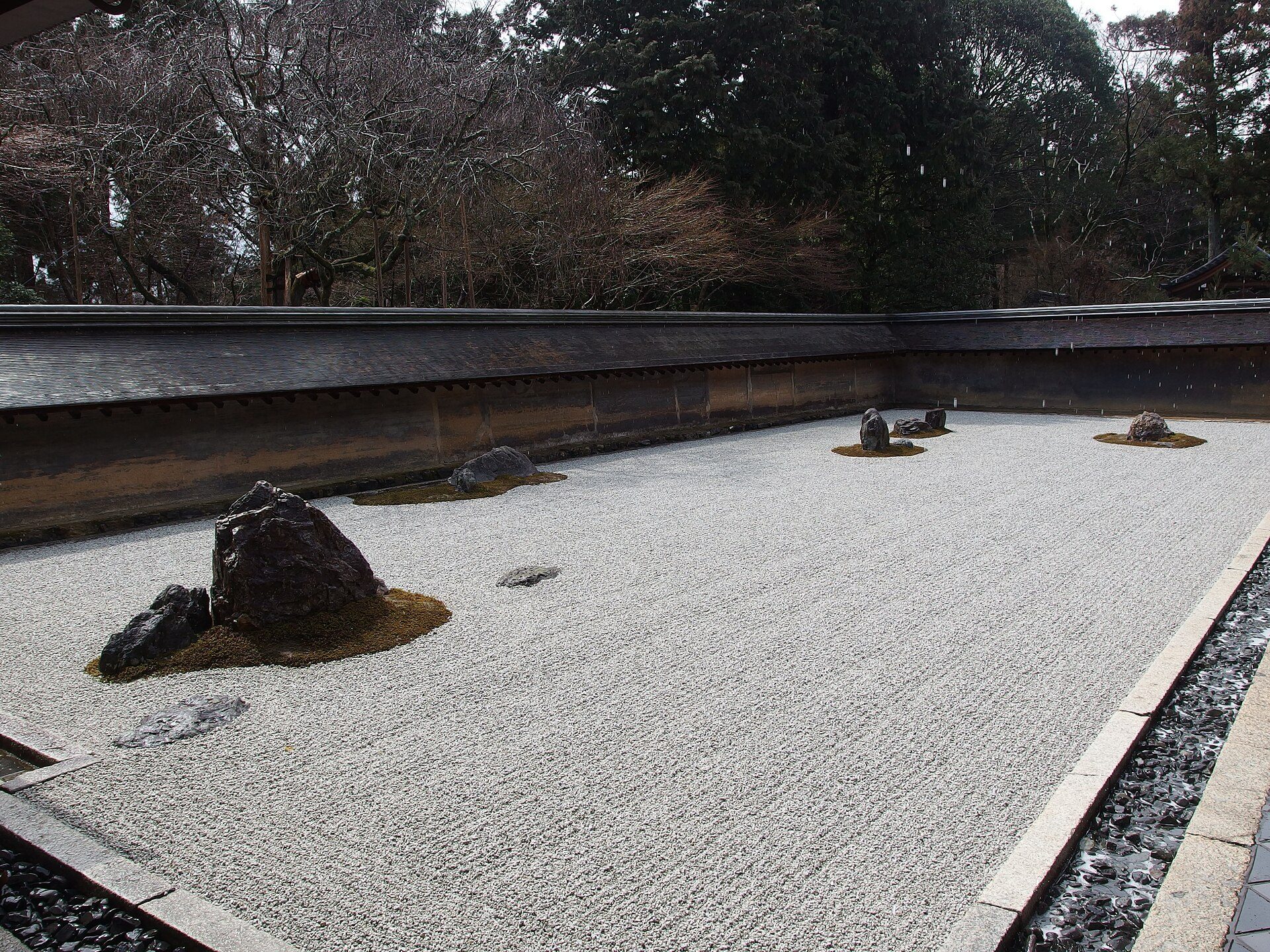
The karesansui at Ryoan-ji, Kyoto: stone groups in raked white gravel, enclosed by an earthen wall and viewed from the veranda. Photo: Guilhem Vellut, CC BY 2.0, via Wikimedia Commons. Guilhem Vellut from Annecy, France, source, CC BY 2.0
A fourth, unusual type is the sculptural “rock garden”. The Rock Garden of Chandigarh in India was built secretly from 1957 by the road inspector Nek Chand, using stone and waste from demolition sites, such as broken ceramics, tiles and bottles. It was discovered by the authorities in 1975 and opened to the public in 1976, according to the Better India’s profile of Nek Chand. It is more an outdoor art environment than a planted garden, but it shows how stone and reclaimed material can shape a whole landscape.

Figures clad in discarded glass bangles in Nek Chand's Rock Garden, Chandigarh. Photo: Rod Waddington, CC BY-SA 2.0, via Wikimedia Commons. Rod Waddington from Kergunyah, Australia, source, CC BY-SA 2.0
Site, drainage and soil
Choose the most open, sunny position you have, away from overhanging trees and their roots, as the RHS advises. Tree drip and leaf fall keep small plants wet and shaded. A gentle slope that faces the sun is ideal: it drains naturally and makes it easy to set stones as ledges. On a flat site, build a raised bed or mound.
Drainage is the most important part of the build. On heavy clay, lay a base of rubble, broken brick or stone about 15 cm (6 in) deep, then a layer of fabric or punctured sheet to stop the soil above washing into it, as Garden Health’s alpine rockery guide describes. On naturally sandy or stony ground you may not need this. Remove all perennial weeds before building, because they are very hard to remove once roots grow between stones.
For the growing medium, the RHS basic mix is one part loam, one part horticultural grit and one part leaf mould or coir by volume, adjusted for particular plants: more grit for plants from screes, more leaf mould for woodland alpines. Avoid builder’s sand, which packs down and holds water.
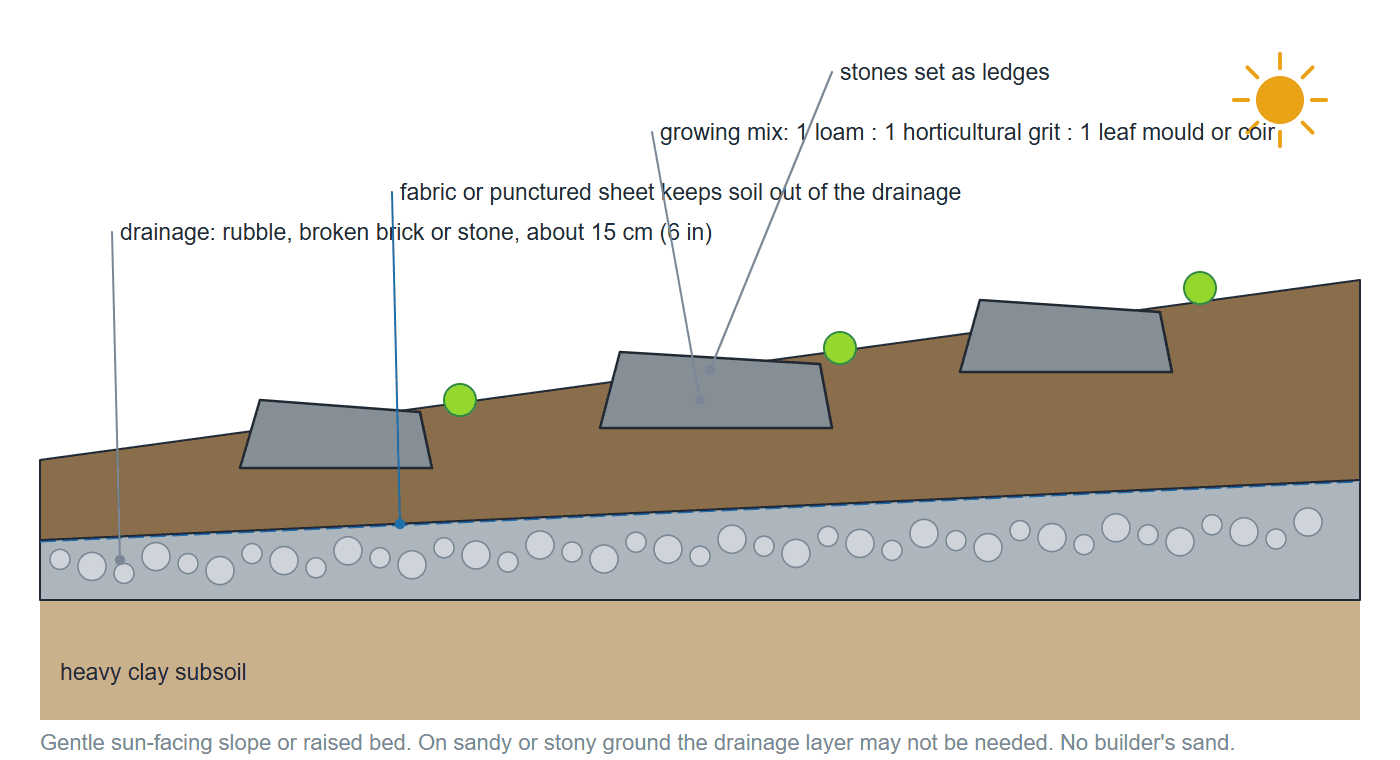
Rock garden build-up on heavy clay: a drainage base of rubble, broken brick or stone about 15 cm deep, a fabric or punctured sheet to stop soil washing in, then the RHS basic mix (one part each loam, grit and leaf mould or coir) with stones set as ledges on a gentle sunny slope. Diagram: Arch2O
Choosing and placing stone in a rock garden
Use one kind of stone throughout, ideally a local one: it looks more natural, usually costs less to transport and matches the surrounding landscape. Sandstone and limestone weather well and have visible bedding planes. Limestone also makes the soil alkaline, which suits many alpines but not lime-hating plants. Ask suppliers where their stone comes from. Some limestone pavement, a protected landform in the UK, has been quarried for gardens in the past, so buy only from known, legal sources.
Place the largest stones, the keystones, first, to set out the design. Bury each stone by about a third of its depth and tilt it slightly backwards into the slope, so rain runs towards the plant roots and the stone looks like an outcrop rather than something dropped on the surface, as Garden Health and the RHS describe. Keep the bedding lines (the layers in sedimentary stone) running in the same direction across the garden, as they would in a natural cliff. Large stones are heavy: move them with bars, rollers and a sack truck, lift with your legs, and hire help or machinery for big pieces.
Planting a rock garden
Choose plants for your climate first and for the look second. In cool, wet temperate climates, such as the UK, true alpines need the sharpest drainage and often a top layer of grit to keep their necks dry. In hot, dry climates, plants from Mediterranean scrub, dry grassland and deserts suit a gravel or rock garden better than high-mountain alpines, which dislike hot summer nights.
| Climate | Plant groups that suit | Example genera | Key need |
|---|---|---|---|
| Cool, wet temperate (e.g. UK, Pacific Northwest) | True alpines, cushion plants | Saxifraga, Gentiana, Dianthus, Sempervivum | Sharp drainage, grit collar, winter wet protection |
| Cold continental | Alpines and steppe plants | Pulsatilla, Androsace, Penstemon | Snow cover or dry winter; full sun |
| Mediterranean / dry summer | Mediterranean scrub and grassland plants | Thymus, Lavandula, Euphorbia, Cistus | Sun, poor soil, little summer water |
| Hot, arid | Succulents and desert perennials | Agave, Aloe, Echeveria (frost-tender) | Free drainage, shade for young plants |
Source: RHS Rock gardening advice (alpine conditions, soil mix); genera as standard horticultural examples (as of 25 October 2026).
The RHS recommends building in autumn or winter and planting in spring, when the widest range of plants is available. Plant into the pockets between stones, firm in well, and top-dress around each plant with grit or gravel. This keeps the crown dry, holds moisture in the soil below and helps suppress weeds.
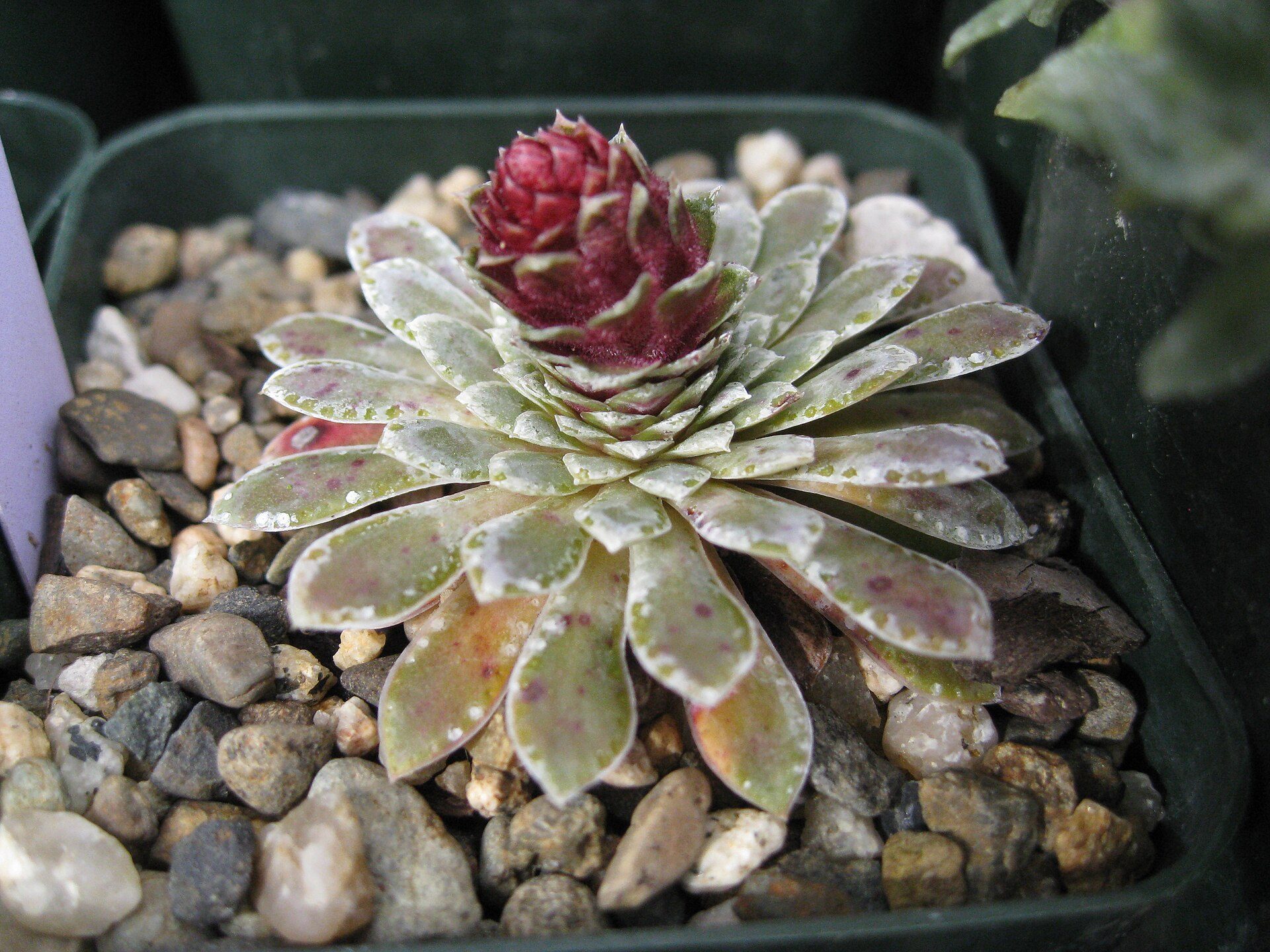
A saxifrage (Saxifraga grisebachii) with a gravel top-dressing around its neck, which keeps the crown dry. Photo: brewbooks, CC BY-SA 2.0, via Wikimedia Commons. brewbooks from near Seattle, USA, source, CC BY-SA 2.0
Maintenance
A well-built rock garden needs less work than a border, but it is not maintenance-free. Weed regularly and early, before roots get under stones. Refresh the grit top-dressing every year or two. Trim spreading plants after flowering so they do not smother smaller neighbours. In wet climates, remove fallen leaves in autumn, because they trap damp around the plants. Water new plantings until established; afterwards, a garden planted for your local rainfall should need little or no extra watering, as the Gravel Garden shows.
For gardens in small spaces, the RHS also covers sink and trough gardening, which uses the same mix and plants at a scale that fits a terrace or balcony.
Is a rock garden right for your site?
Build a rock garden if you have a sunny, open spot, ideally a slope, and you are willing to prepare the drainage properly. Choose an alpine garden in cool, wet climates if you enjoy small, detailed plants; a gravel garden in dry climates for low water use; and a karesansui-style garden where you want a calm, mostly unplanted space to view from a room or terrace. Rock and gravel gardens are often described as sustainable; that holds only when plants suit local rainfall and the stone is sourced responsibly. For more on that wider question, see our guide to what sustainable architecture means, and for bringing stone and plants indoors, our selection of biophilic interior design projects.

Emily Reyes is a Brooklyn-based architecture writer and Article Curator at Arch2O, known for her sharp eye for experimental design and critical theory. A graduate of the Southern California Institute of Architecture (SCI-Arc), Emily’s early work explored speculative urbanism and the boundaries between digital form and physical space. After a few years in Los Angeles working with boutique studios on concept-driven installations, she pivoted toward editorial work, drawn by the need to contextualize and critique the fast-evolving architectural discourse. At Arch2O, she curates articles that dissect emerging technologies, post-anthropocentric design, and contemporary spatial politics. Emily also lectures occasionally and contributes essays to independent design journals across North America.