


Oshinowo Studio‘s memorial design for Sierra Leone’s forgotten WWI carrier corps is one of those rare projects that hits you right in the gut – powerful, restrained, and loaded with meaning. The Lagos-based firm recently revealed their winning proposal commemorating the over 17,000 Sierra Leoneans who transported supplies, ammunition, and wounded soldiers during the war, yet remain largely invisible in historical accounts.
Reclaiming Erased Histories Through Form
You know how most war memorials feel heavy and stone-bound? This one flips that completely. Picture a massive glass prism shooting up nine meters above Lutyens’ 1930 memorial – it’s this incredible contemporary twist that somehow makes perfect sense.
What really gets me excited is that Tosin Oshinowo designed this. She’s breaking serious ground here – first woman, first West African architect to create a memorial for the Commonwealth War Graves Commission. That’s huge.
The design itself is stunning. Four structural glass blades, each one etched with names of the 946 fallen Carrier Corps members. It’s not just about the visual impact, though that’s undeniable. There’s something profound about using glass – transparent, reflective, catching light differently throughout the day.
Freetown wanted this memorial to anchor their commemorations, not just for Remembrance Day in November, but for their own significant dates and festivals too. Smart thinking. The integrated beacon system means it can light up for different occasions, making it a living part of the city rather than just a static monument.
“Honouring the past, shaping the future, our design for the Freetown memorial stands not only as a tribute to the fallen, those who lost their lives during the First World War, but as a symbol of Sierra Leoneans’ collective commemoration, representing cost of war and a people’s resilience, as well as the global commitment to peace for generations to come.” Architect Tosin Oshinowo
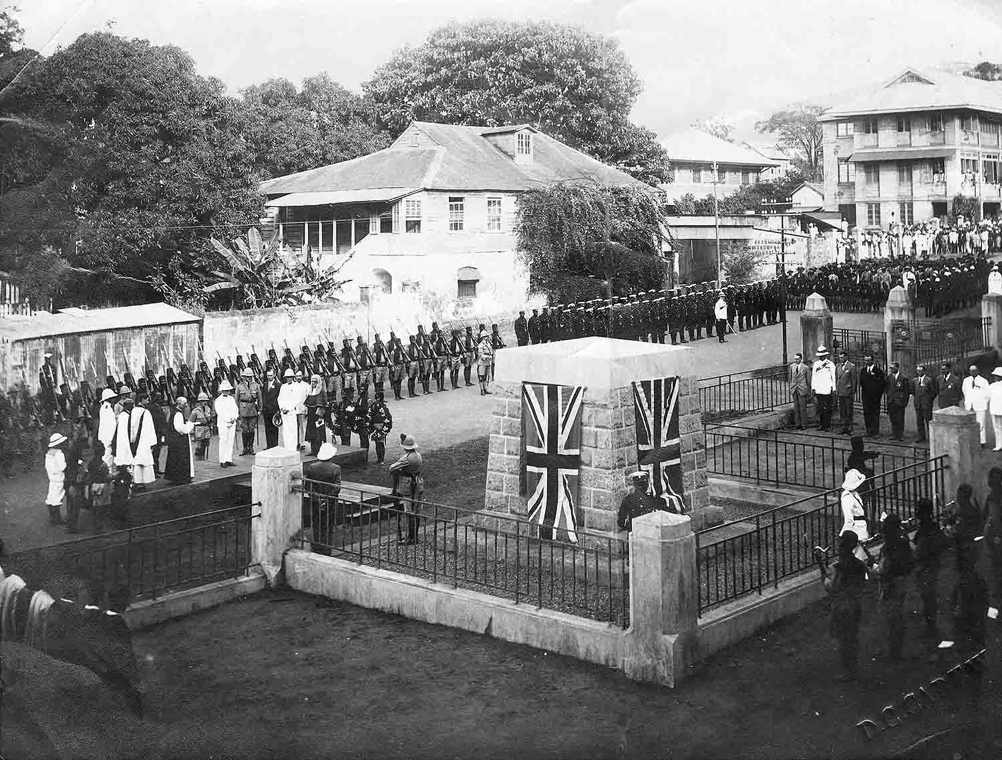
Unveiling of the original Freetown Memorial, Sierra Leone by Captain C E Cookson on 11 March 1931.
Building Memory Together
Finding these lost names meant our historians had to become detectives, really. They spent months tracking down records in archives scattered across continents. But here’s the thing – you can’t tell this story properly from dusty files alone. That’s why we brought in West African heritage experts who went straight to the communities, sitting down with people whose grandfathers might have served, listening to stories that never made it into official records.
Sierra Leone’s role in the First World War? It’s basically invisible in most history books. You’ll find maybe a paragraph, if you’re lucky. The photographic record is thin, the documentation patchy. These men served and died, but somehow their sacrifice got written out of the larger story.
The memorial we’re building changes that. It’s not just about putting up a monument – it’s about correcting the historical record, making sure these names have a permanent place where people can come to remember.
But one memorial in Freetown isn’t enough. We’re planning four smaller sites in the rural provinces where most of these men came from. Same design language, same sense of dignity, but rooted in the actual communities that sent their sons to war. A family shouldn’t have to travel hundreds of miles just to find their ancestor’s name.
The Commonwealth War Graves Commission has never worked this way before. Usually it’s pretty straightforward – we research, we design, we build. This time we flipped it. The communities are telling us what matters, how they want to remember, what feels right to them. It’s messier than the old way, but it’s honest.

Jane Doe is an American architectural editor with a deep-rooted passion for design and the built environment. She holds a degree in Architecture from Columbia University, where she developed a strong foundation in both architectural theory and urban studies. With over a decade of editorial experience, Jane specializes in shaping content that bridges architecture, urbanism, and cultural discourse. Her work spans leading design publications, exhibition texts, and digital platforms, where she is known for her clear, engaging narratives and her ability to translate complex spatial ideas for a broad audience. Jane is particularly interested in issues of equity, sustainability, and the evolving role of cities in a changing world.