

Researchers and studios around the world are building new construction materials made from waste and living matter, including recrystallized asbestos, war debris, sawdust, clay, corn byproducts and fungal roots. Their work rests on a simple distinction: matter is any physical substance with mass, and it becomes a material only when it is given a specific form or useful application. Transforming it therefore goes beyond recycling and reuse, because existing matter is combined into something with new possibilities for construction.
Asbestos shows how a material can become disposable. The mineral was used mostly in finishes, cement and insulation, and it has been gradually banned around the world since the 1970s because of its toxicity. The Australian studio Besley & Spresser, working with Asbeter and Benedetta Pompili Studio, now treats it as a byproduct that the studio describes as harmless and carbon-negative. According to the studio, asbestos can be recrystallized into new, human-safe products, and demolition waste containing it can be recycled into non-hazardous materials.
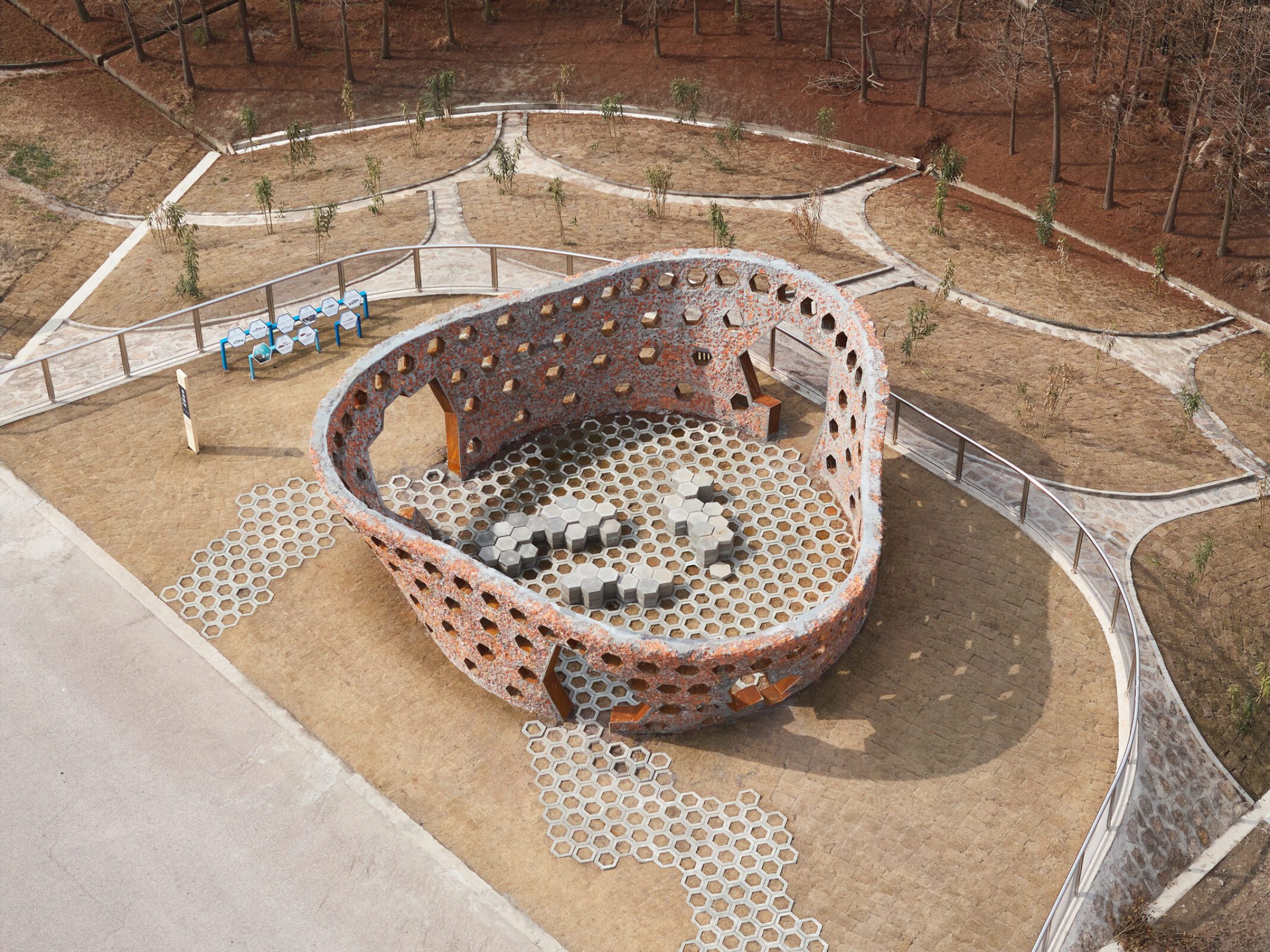
Recycled Brick Coral Reef by HCCH Studio. The wall is cast from recycled red brick fragments (originally intended to include oyster shells as aggregate, which was not implemented), with a rough chiseled surface, and Corten steel plates for openings and doorways. Image © Qingyan Zhu
The studio presented a test installation at the 2025 Lisbon Architecture Triennale as an example of “radical repair” and the rediscovery of urban materials. A different kind of reuse is under way in Ukraine, where researchers at the Kyiv National University of Construction and Architecture (KNUBA) are working with debris from war-damaged buildings. They combine it with industrial and agricultural waste to produce printable concrete for additive manufacturing, a project financed by the United States and international organizations to add options for large-scale housing reconstruction.
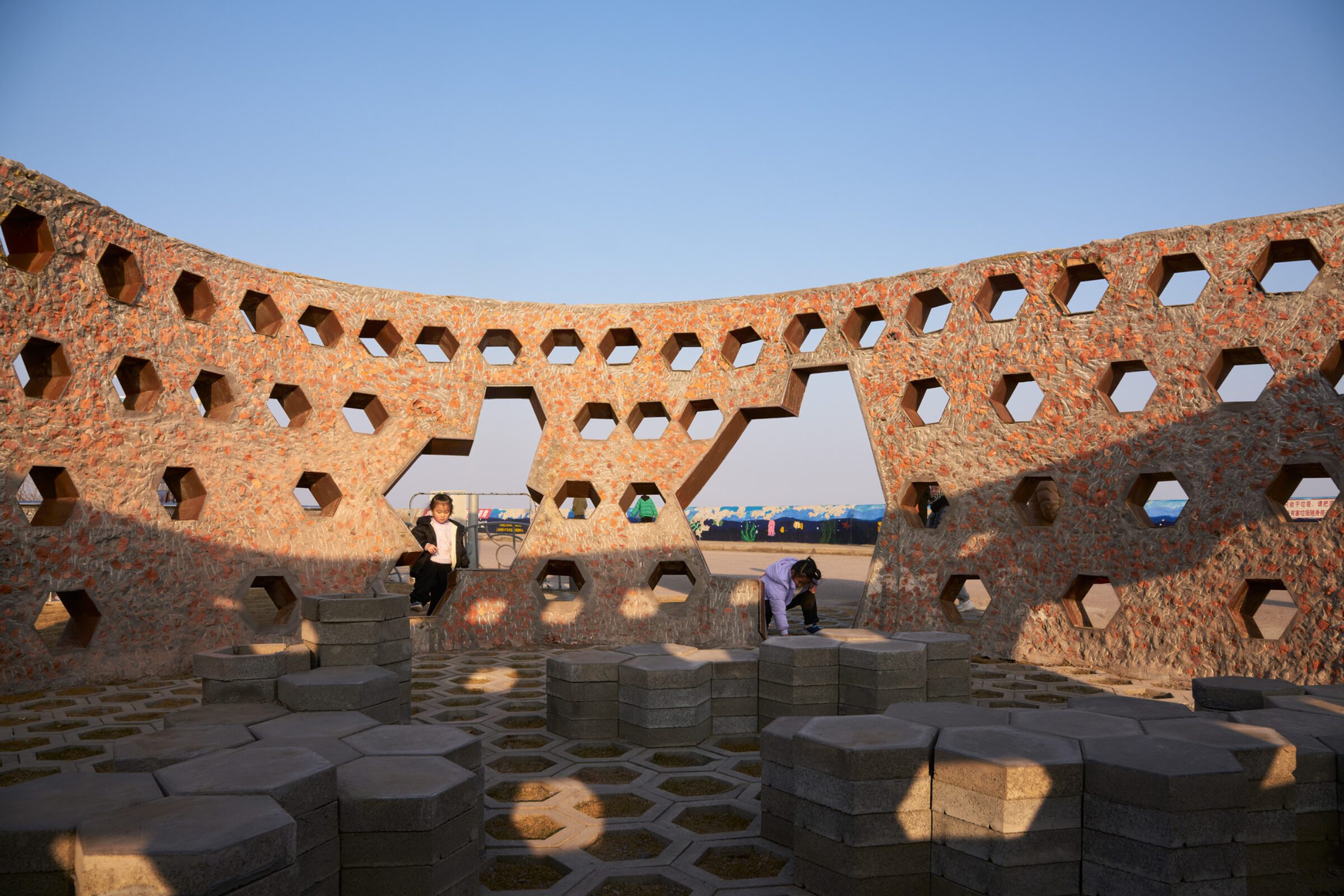
Recycled Brick Coral Reef by HCCH Studio. The wall is cast from recycled red brick fragments (originally intended to include oyster shells as aggregate, which was not implemented), with a rough chiseled surface, and Corten steel plates for openings and doorways. Image © Qingyan Zhu
Wood waste is the starting point for another team, researchers from ETH Zurich and Empa, who are developing a fire-resistant material from sawdust. Sawdust is the powder and tiny chips produced while processing wood, and most of it is burned for energy, which releases carbon dioxide back into the atmosphere. The researchers combine it with the mineral struvite, controlling the struvite’s crystallization with an enzyme extracted from watermelon seeds, to create a composite that is easy to recycle. Projects like these sit within the broader field of recycled building materials.
Concrete is harder to break down for reuse, and that explains why so many projects target it directly. Cement accounts for around 8% of global CO2 emissions and is an essential component of concrete, so researchers are testing ingredients that can match its moldability, strength and capacity for mass production. These range from byproducts of sugarcane to the underground root system of fungi.
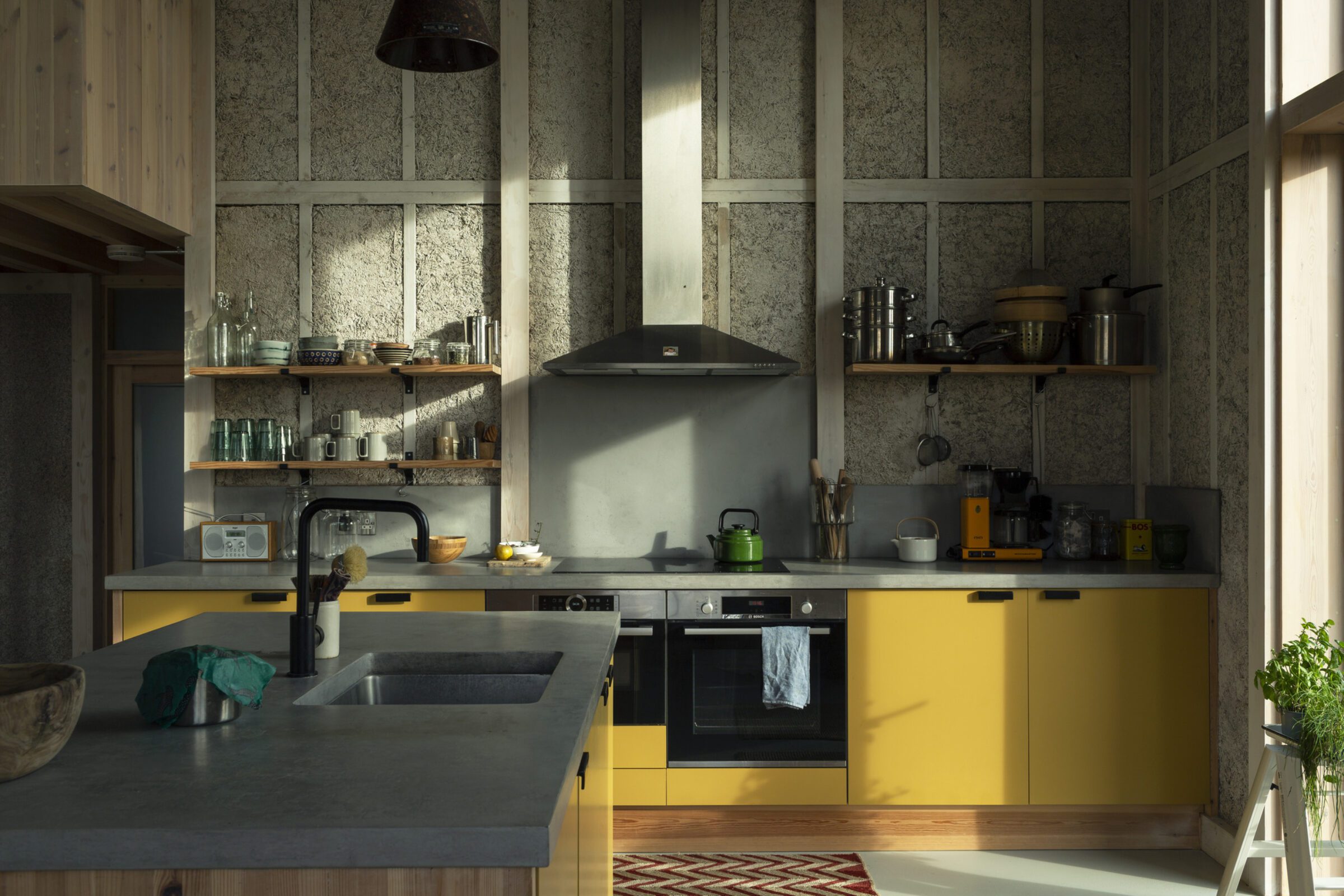
School built in India with Sugarcrete. Image © Husain Akbar
Material research studio Matter at Hand and ceramic manufacturer Darwen Terracotta turn clay into a fluid, concrete-like material by combining it with recycled aggregates, sand and natural fibers. The result is Poured Earth, a castable material that uses sodium silicate or tannins to increase fluidity without adding extra water. In Mexico, the research and production studio MANUFACTURA proposes Corncretl, made from limestone derivatives, corn and recycled nejayote, a calcium-rich byproduct of processing dried corn. The studio was named one of the 20 honorees of the ArchDaily 2026 Next Practices Awards.
Read also: Brick facades
Fungi offer a third route. Researchers at Montana State University use mycelium, the underground root network of fungi, to design load-bearing materials. They let the mycelium act as a “scaffold” to which microorganisms adhere and harden through a process called calcification, which turns living matter into a durable material.
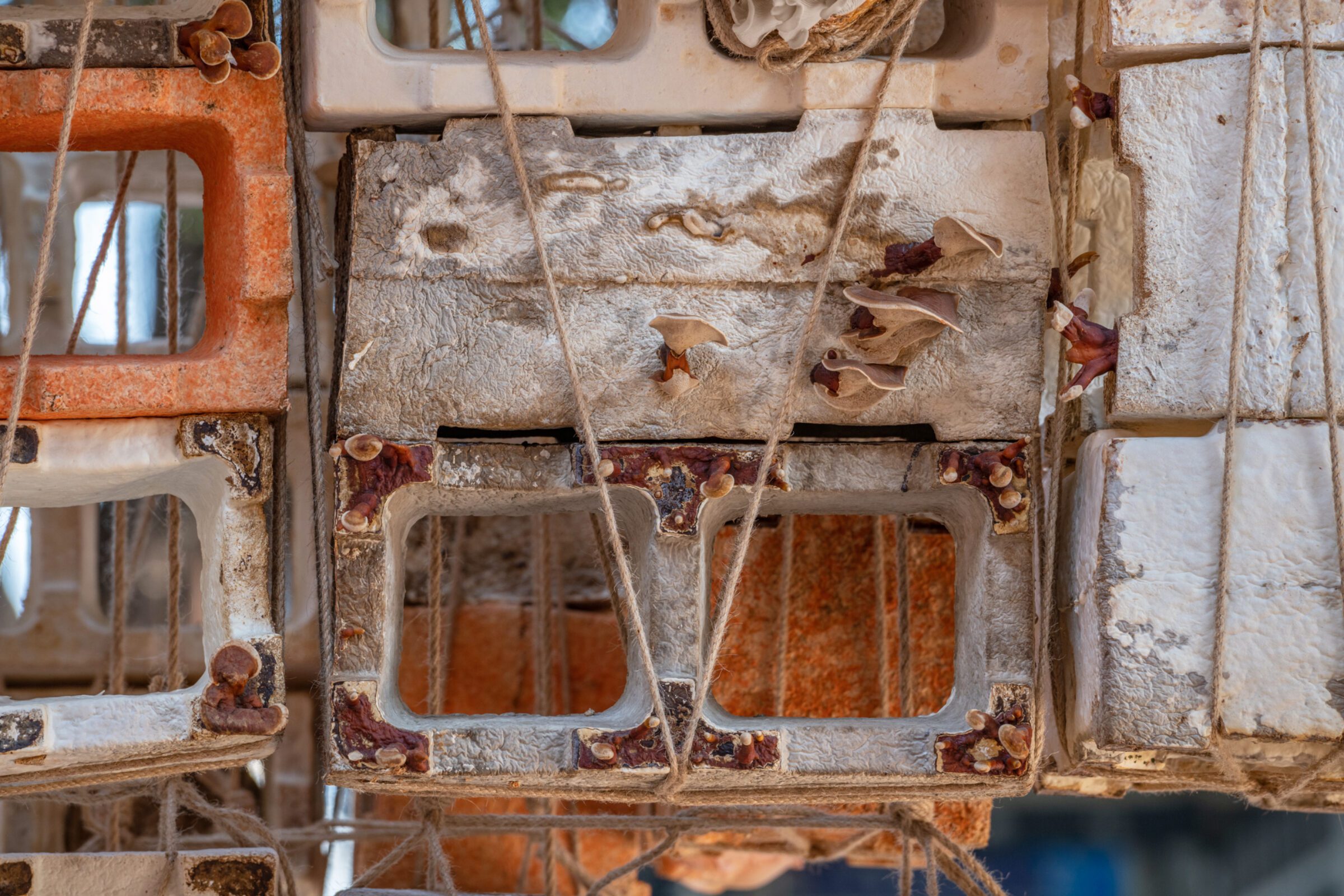
Inverted Architecture Installation by Studio Link-Arc. Hanging mushroom bricks. Image © Yu Bai
Some research aims at a single effect that changes how a whole system performs. Researchers at Nanyang Technological University (NTU) in Singapore, together with the biomimicry design firm bioSEA, are developing tiles that cool buildings without consuming energy. The tiles combine mycelium and bamboo shavings, and their texture mimics elephant skin, whose wrinkles and crevices help elephants regulate temperature. Such tiles also belong to the wider conversation about facade materials.
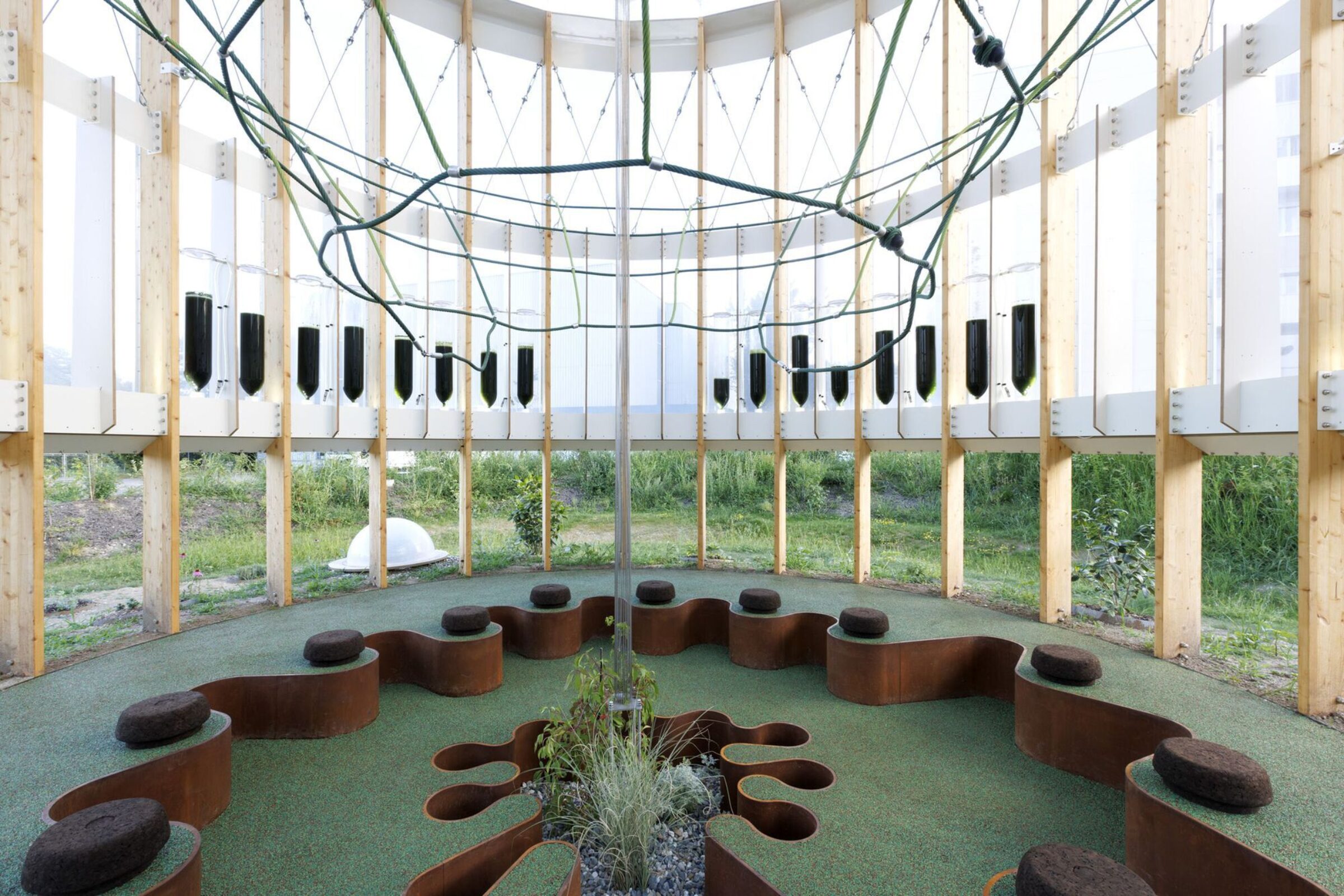
AirBubble Restorative Space by ecoLogicStudio. A biotechnological healthcare garden that combines air-purifying algae cultures with medicinal plants. Image © Pepe Fotografia
At the RIKEN Center for Emergent Matter Science (CEMS) in Japan, researchers are developing a plastic that dissolves in seawater, intended to prevent microplastics from harming ocean life. The new material is a supramolecular plastic made of two ionic monomers that bacteria can consume and that salt water quickly destabilizes.
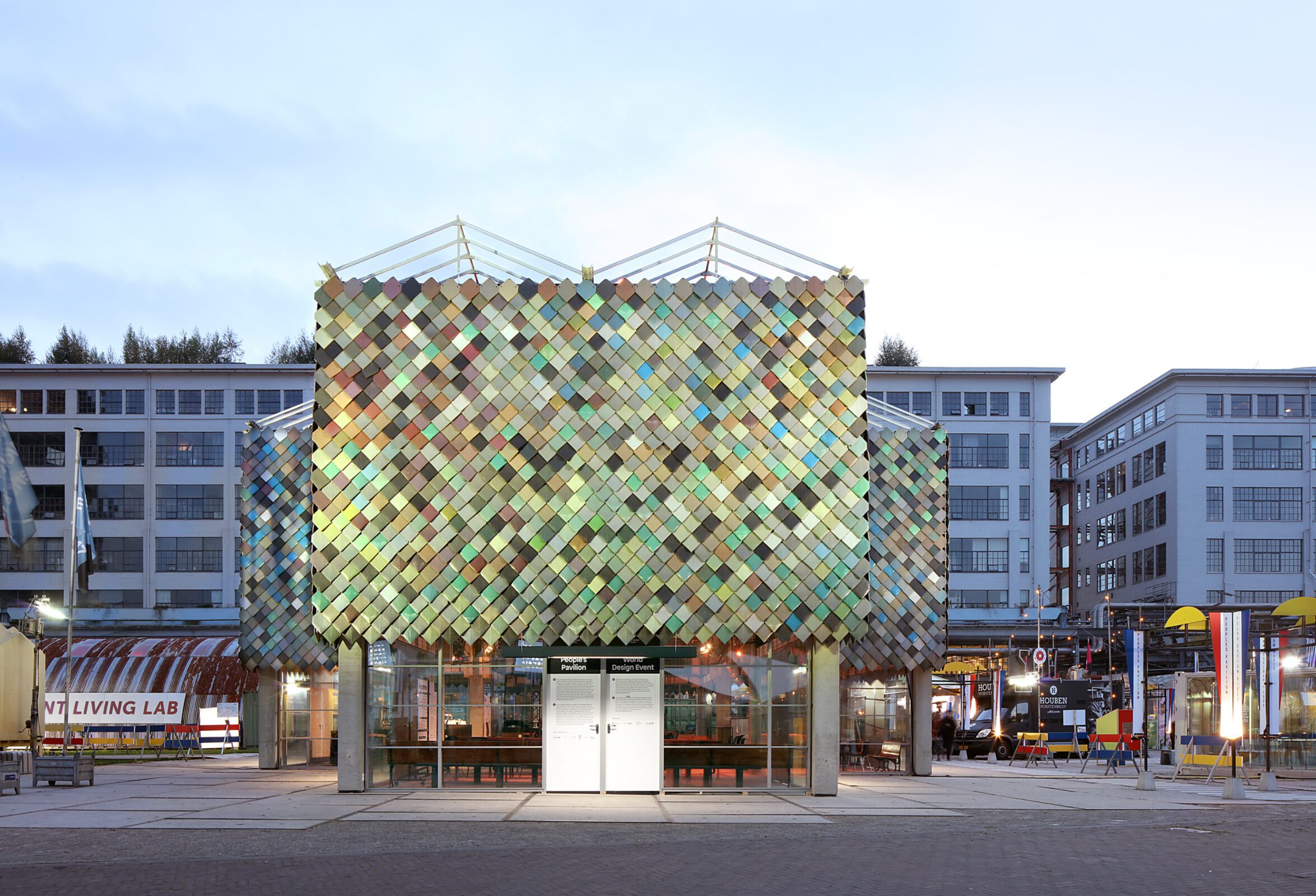
People’s Pavilion by bureau SLA and Overtreders W. Recycled plastic cladding. Image © Filip Dujardin
Beyond individual materials, other initiatives work on the systems around them. The related efforts include:
- Circular construction hubs: in New York, London and Brussels, city governments are converting former industrial infrastructure into sites that collect, store and redistribute building materials and demolition waste.
- CarbonBudget: a digital tool from the architecture firm HENN that calculates whether a European building project’s emissions fit the Paris Agreement’s 1.5°C target, using inputs such as location and building area.
- Shamballa: a new open-air laboratory in Italy dedicated to sustainable living and advanced architectural 3D printing, hosting research centers that form an experimental “ecosystem” for bio-construction.

Jane Doe is an American architectural editor with a deep-rooted passion for design and the built environment. She holds a degree in Architecture from Columbia University, where she developed a strong foundation in both architectural theory and urban studies. With over a decade of editorial experience, Jane specializes in shaping content that bridges architecture, urbanism, and cultural discourse. Her work spans leading design publications, exhibition texts, and digital platforms, where she is known for her clear, engaging narratives and her ability to translate complex spatial ideas for a broad audience. Jane is particularly interested in issues of equity, sustainability, and the evolving role of cities in a changing world.