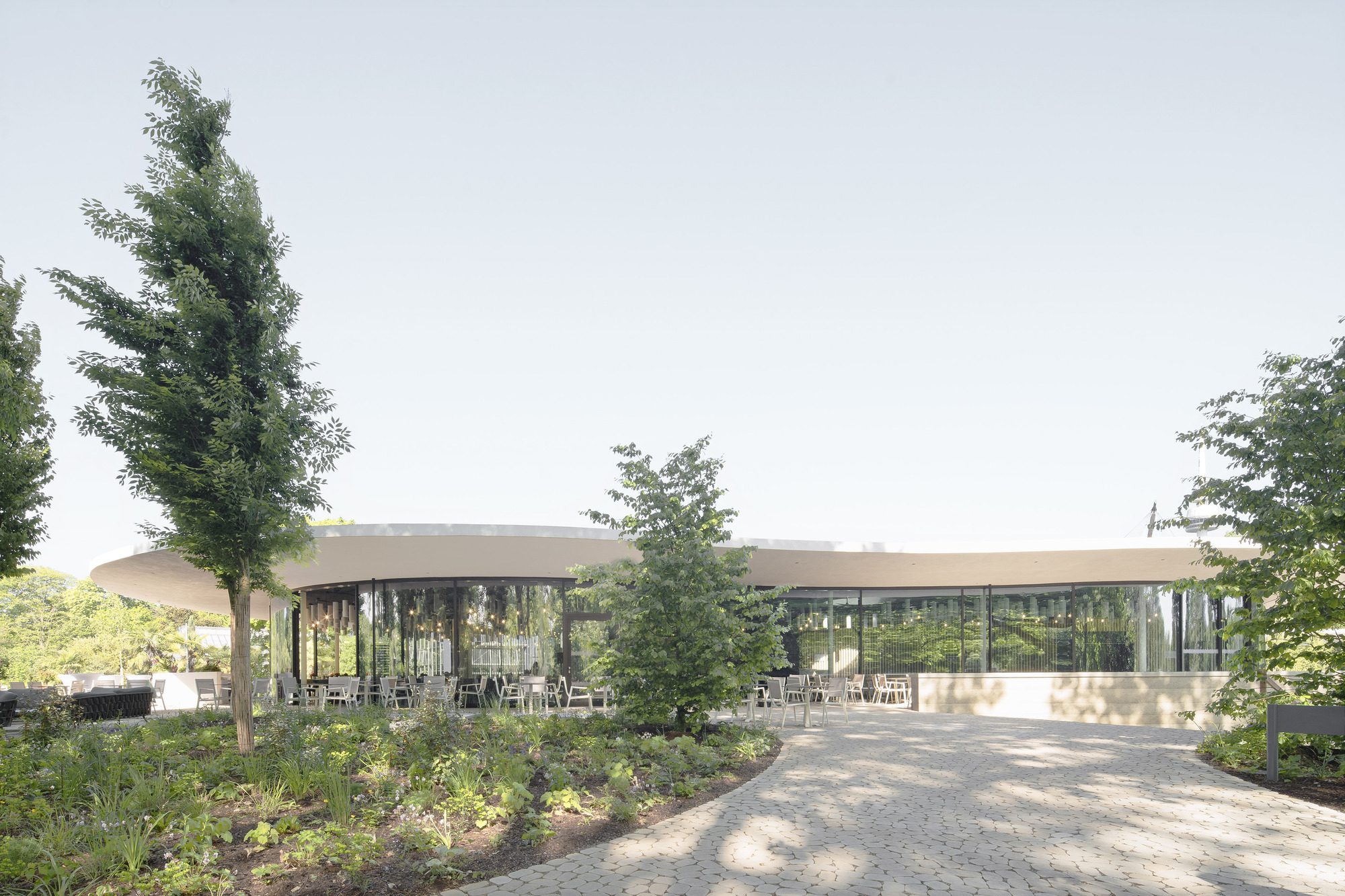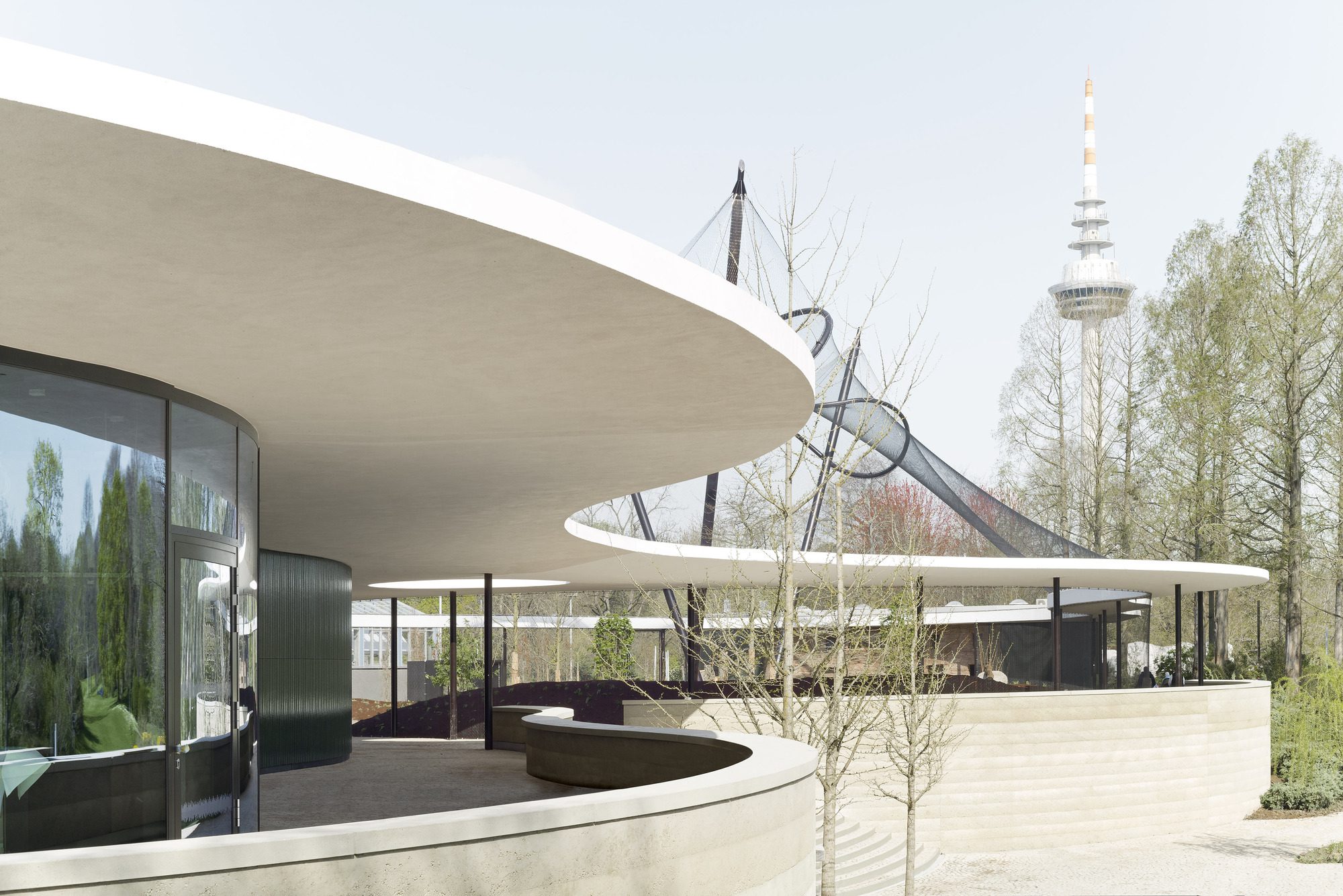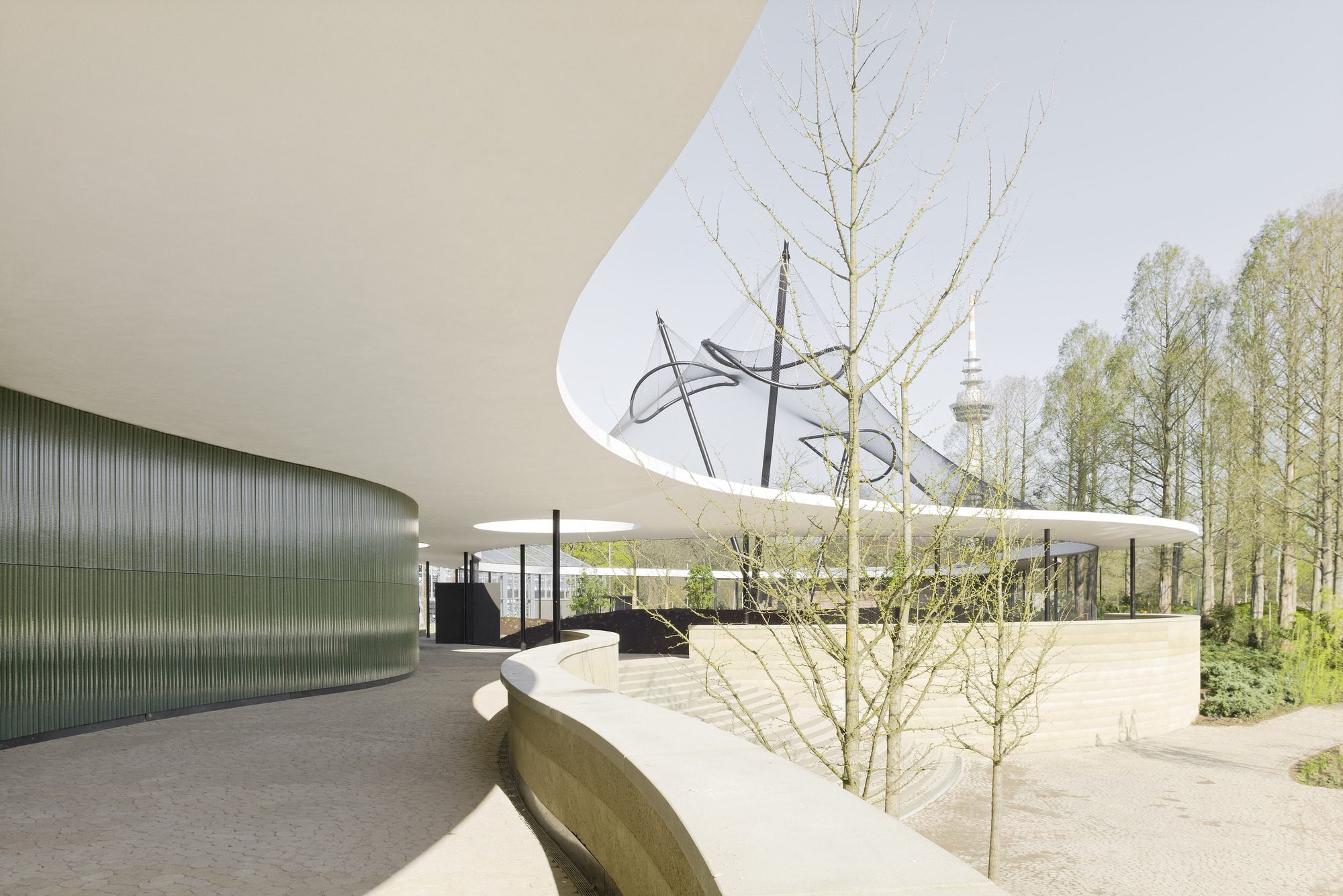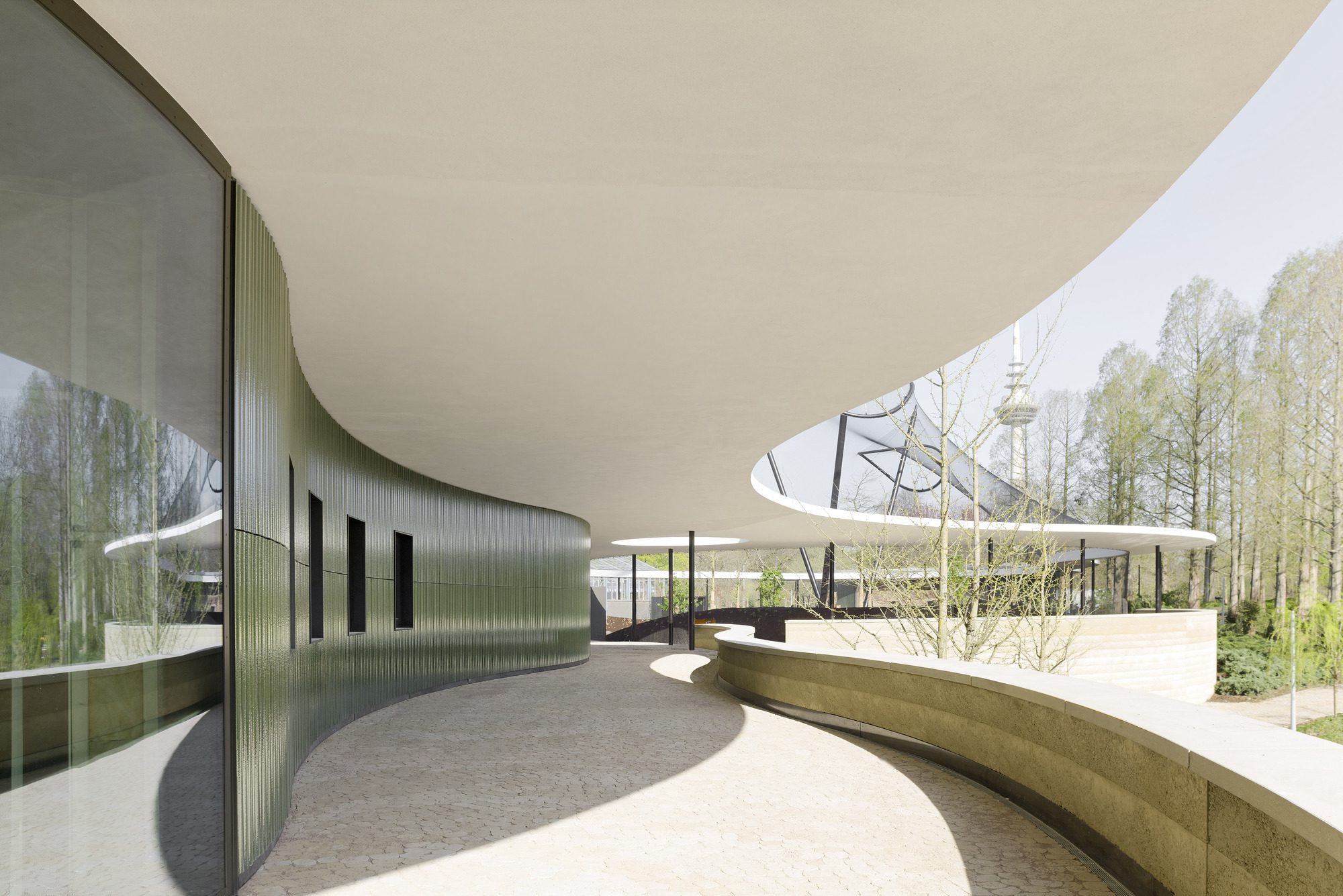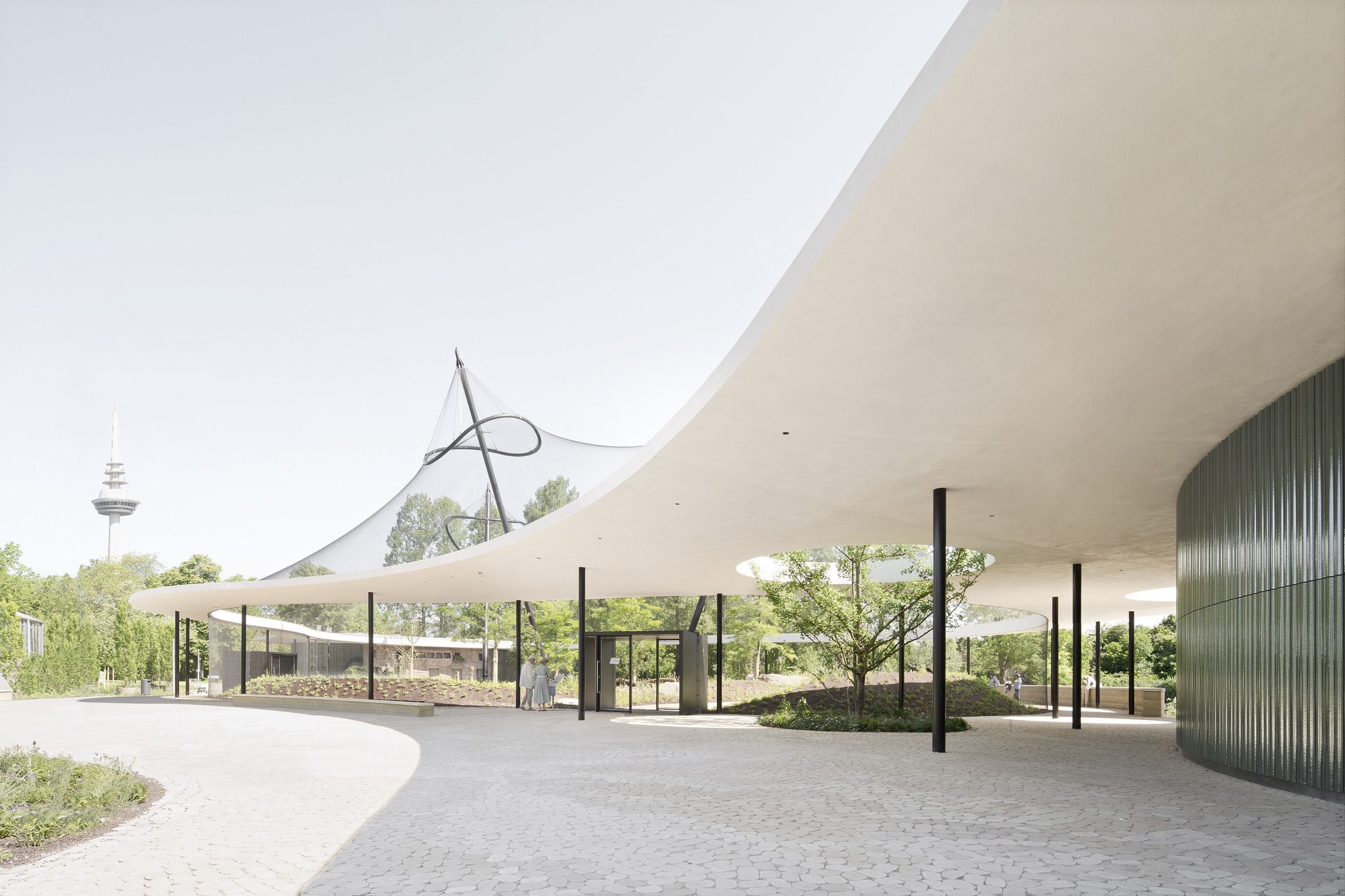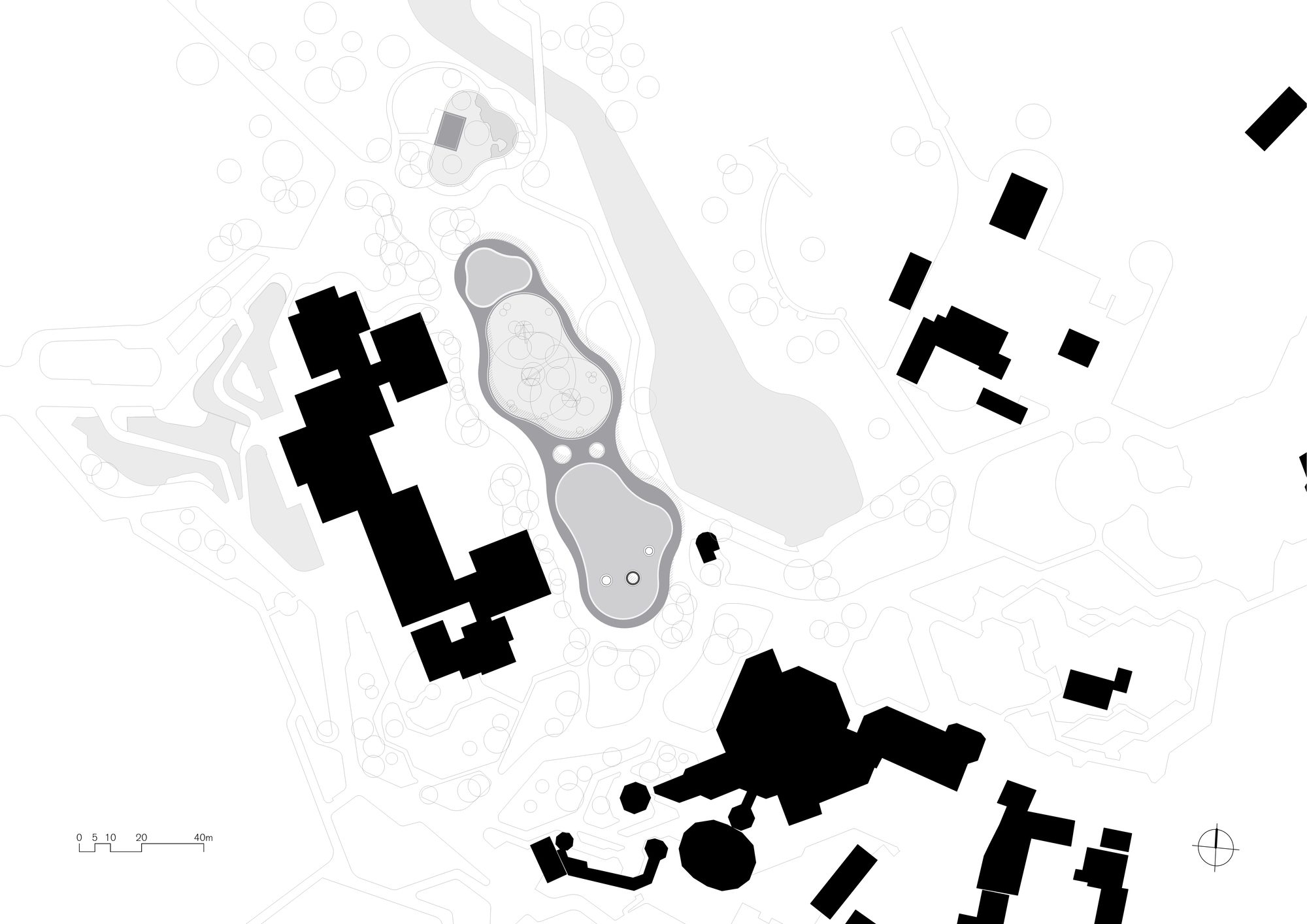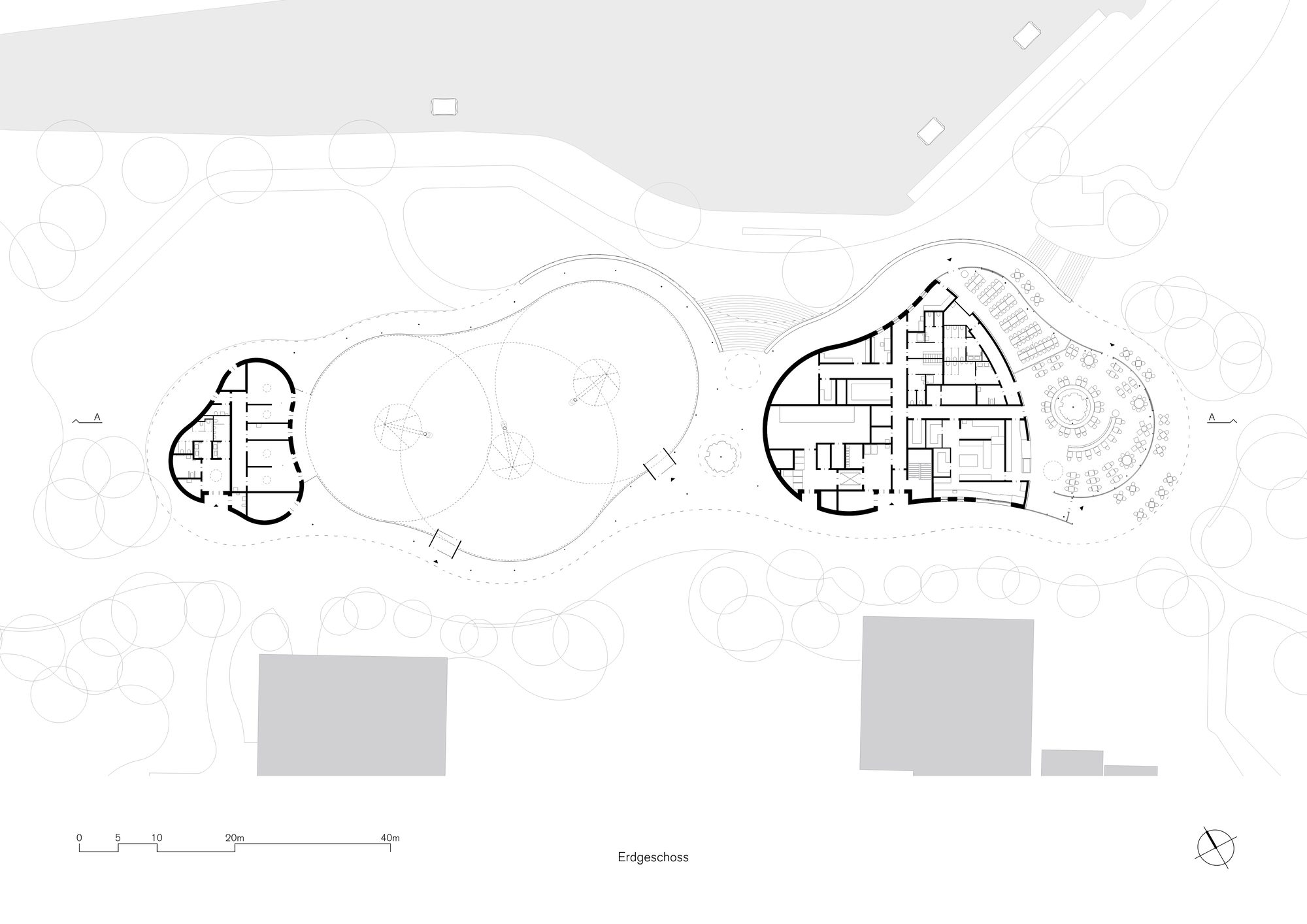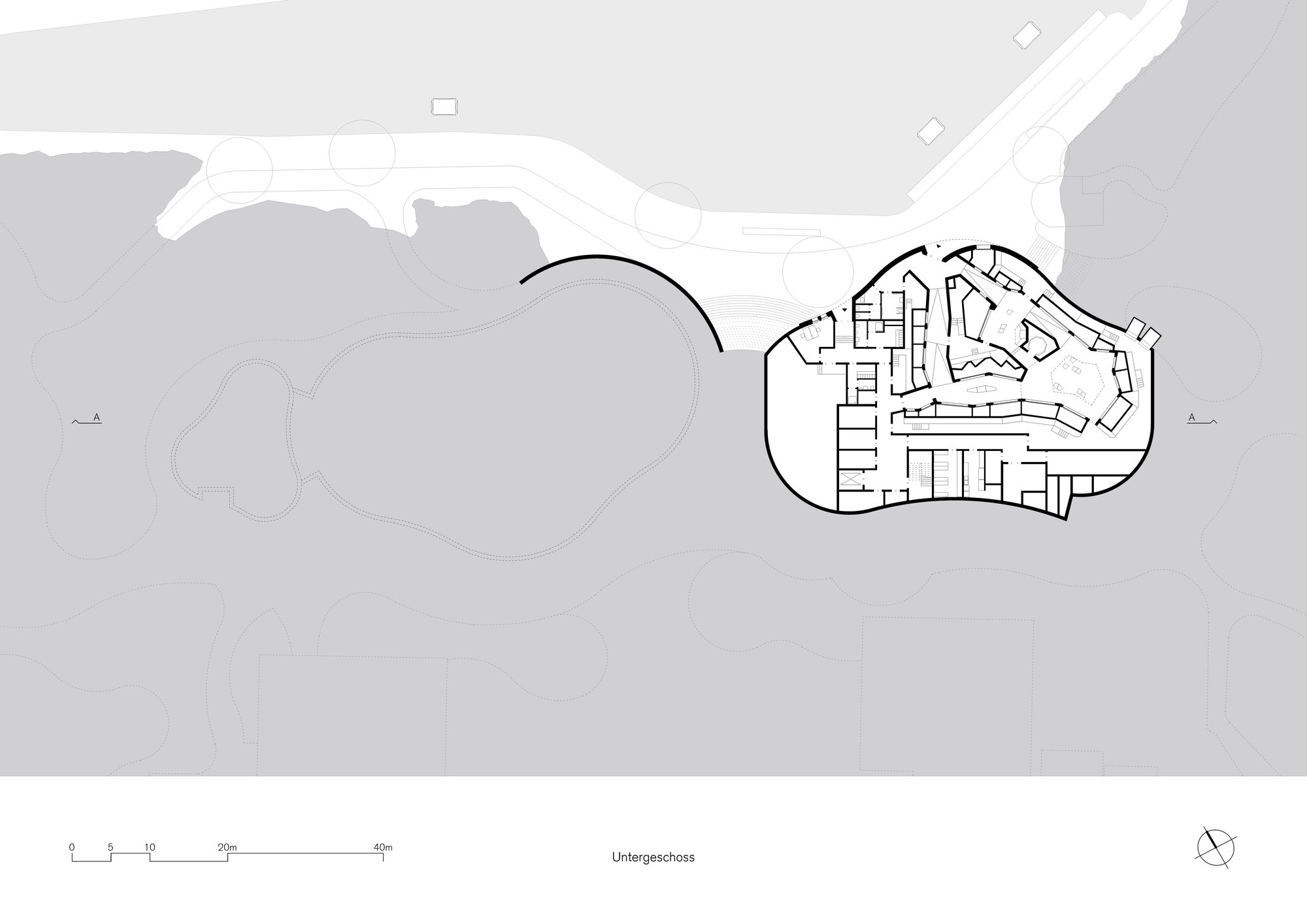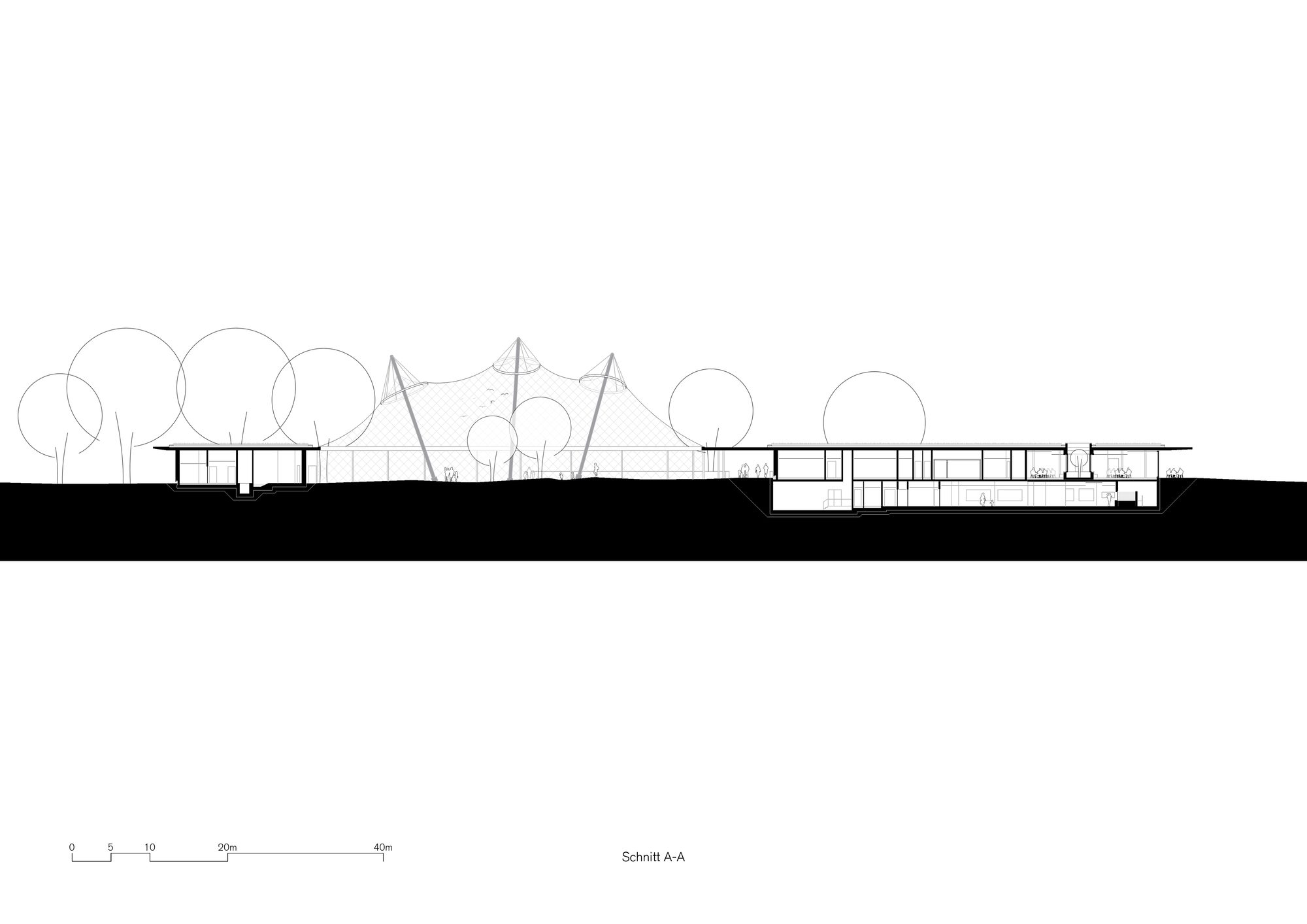


Green Experience Center in Luisenpark , One of the special qualities of Luisenpark is that the landscape elements allow the structural elements to recede into the background. Therefore, in our design, the new buildings were not developed as buildings in the classical sense, but as organically shaped, single-story pavilions that are surrounded by the surrounding park.
© Brigida González
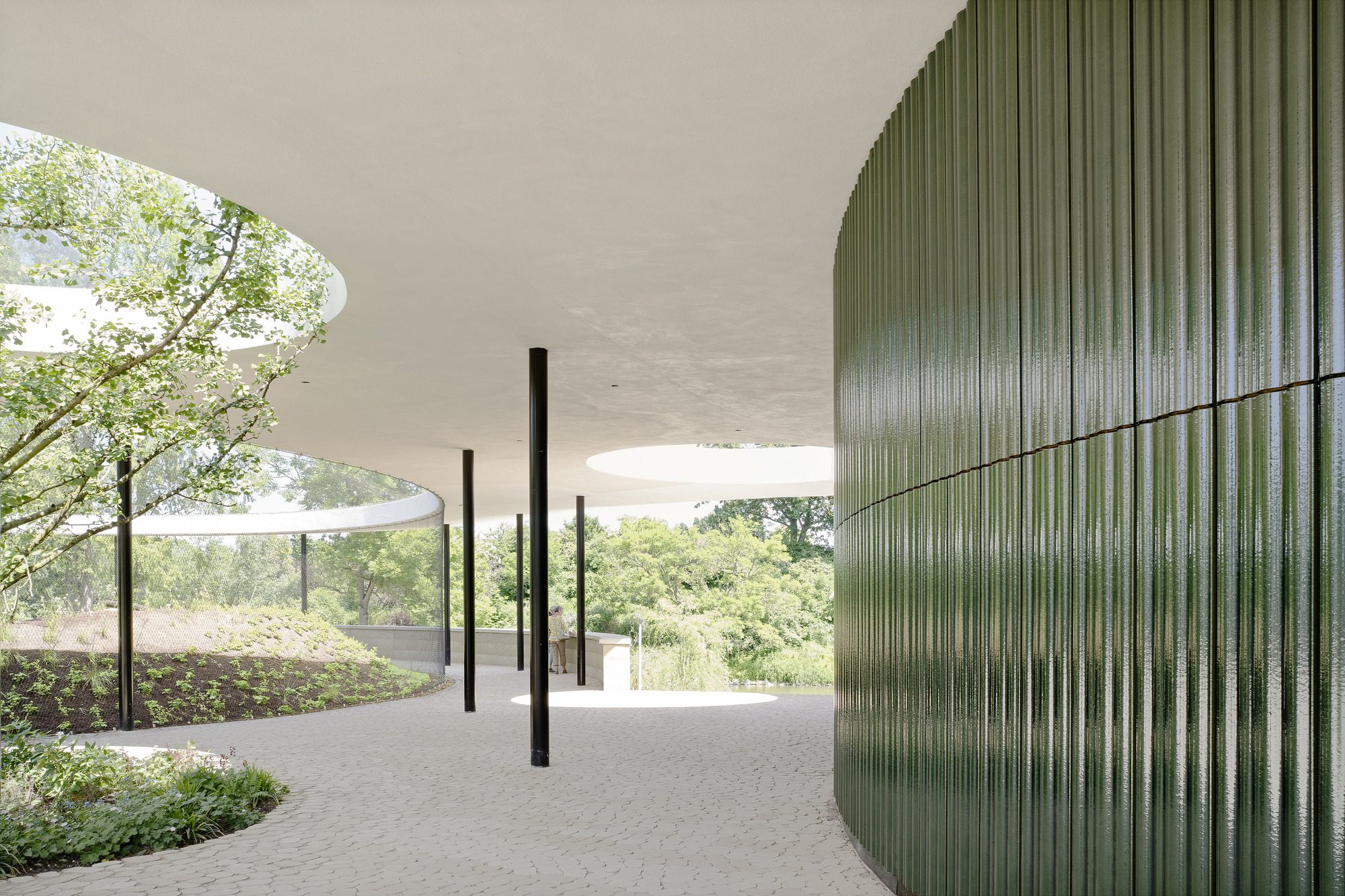
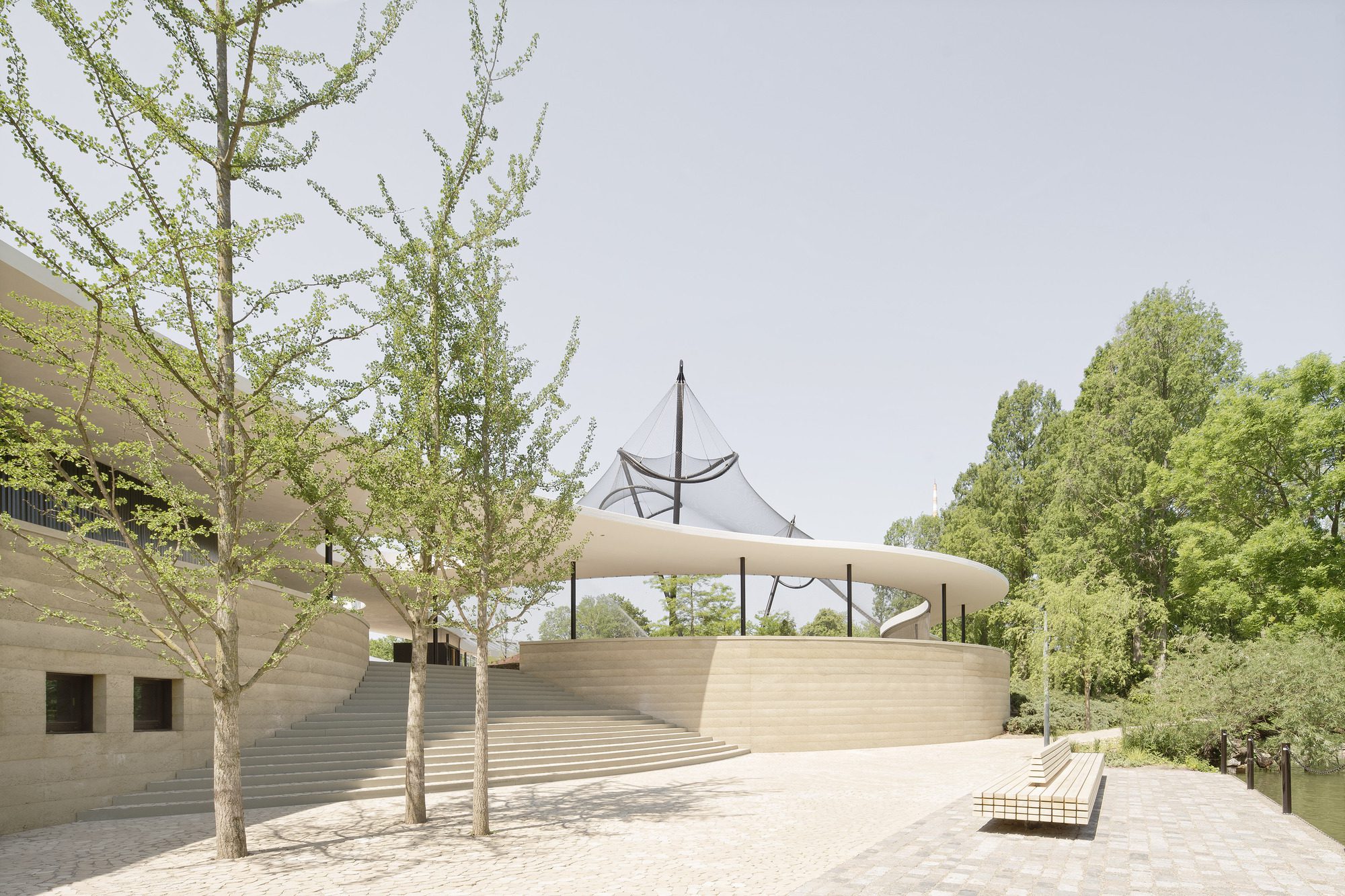
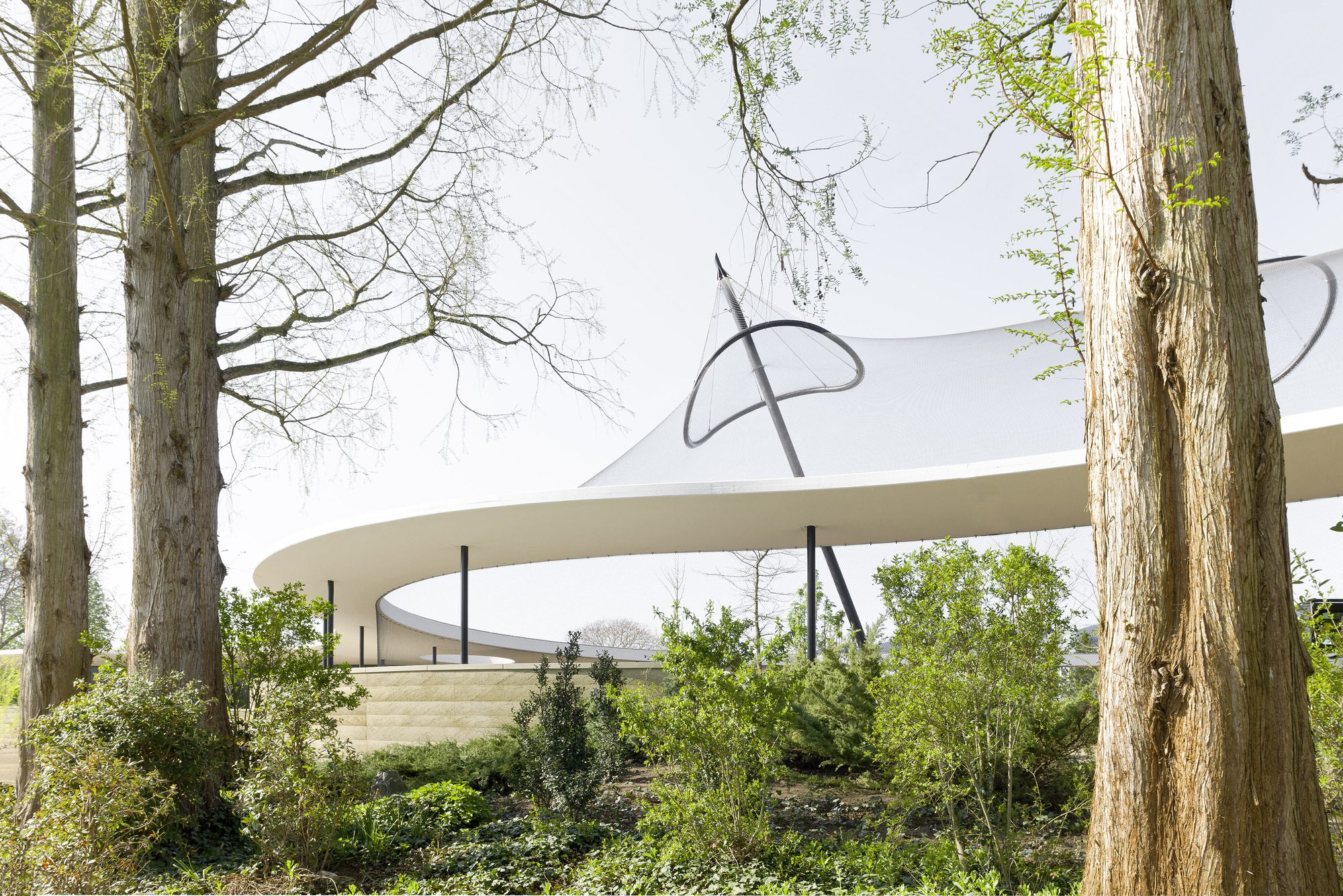
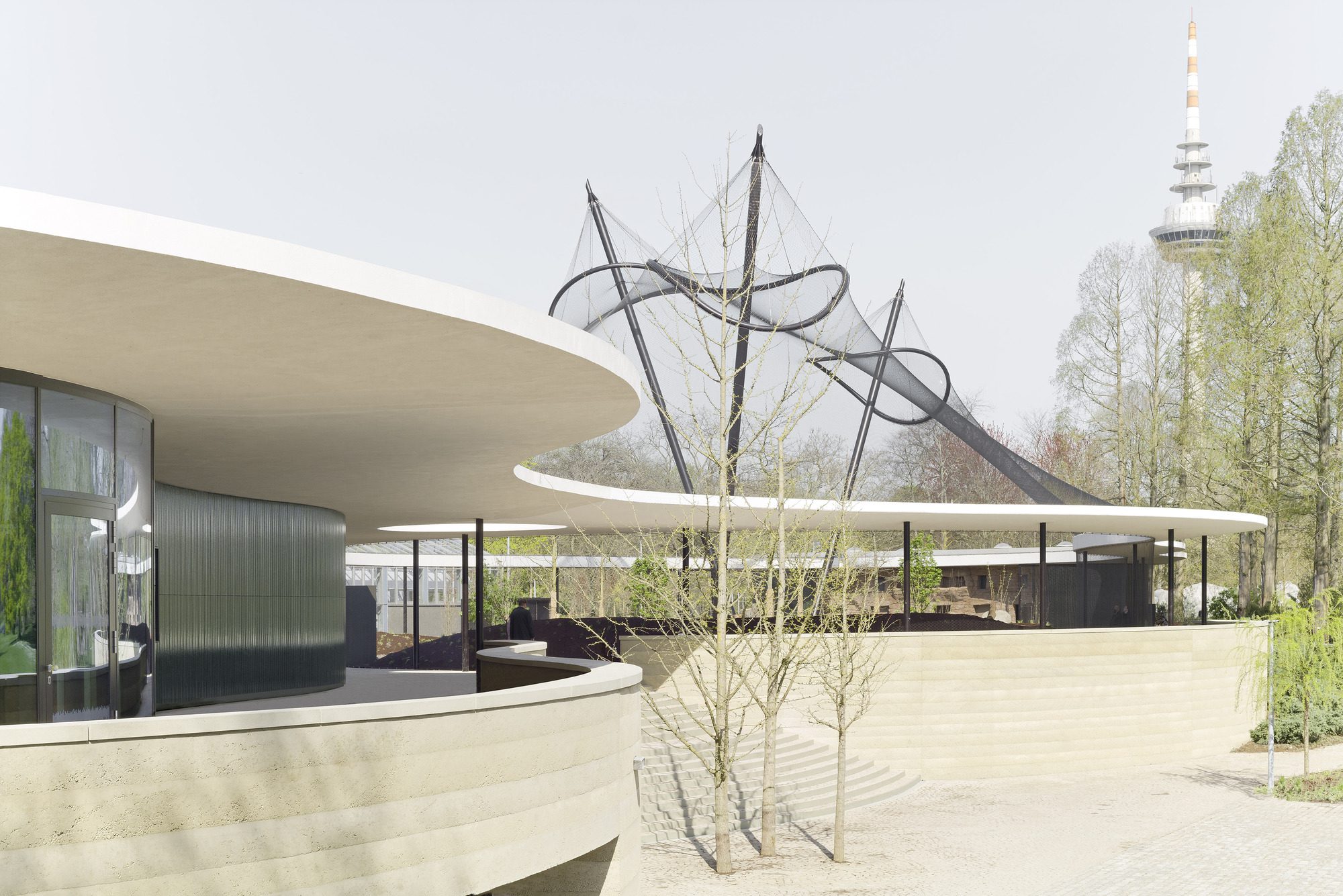
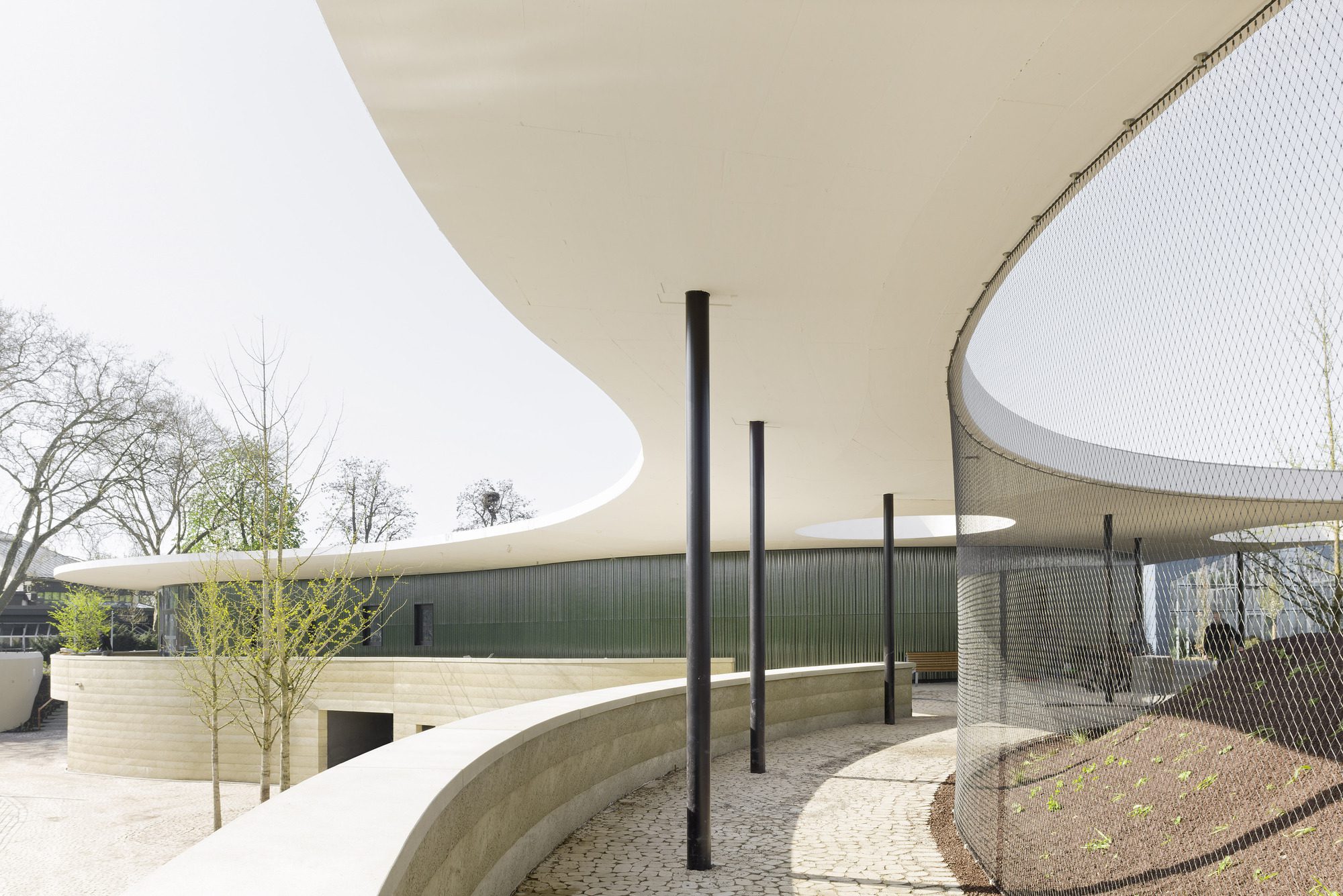
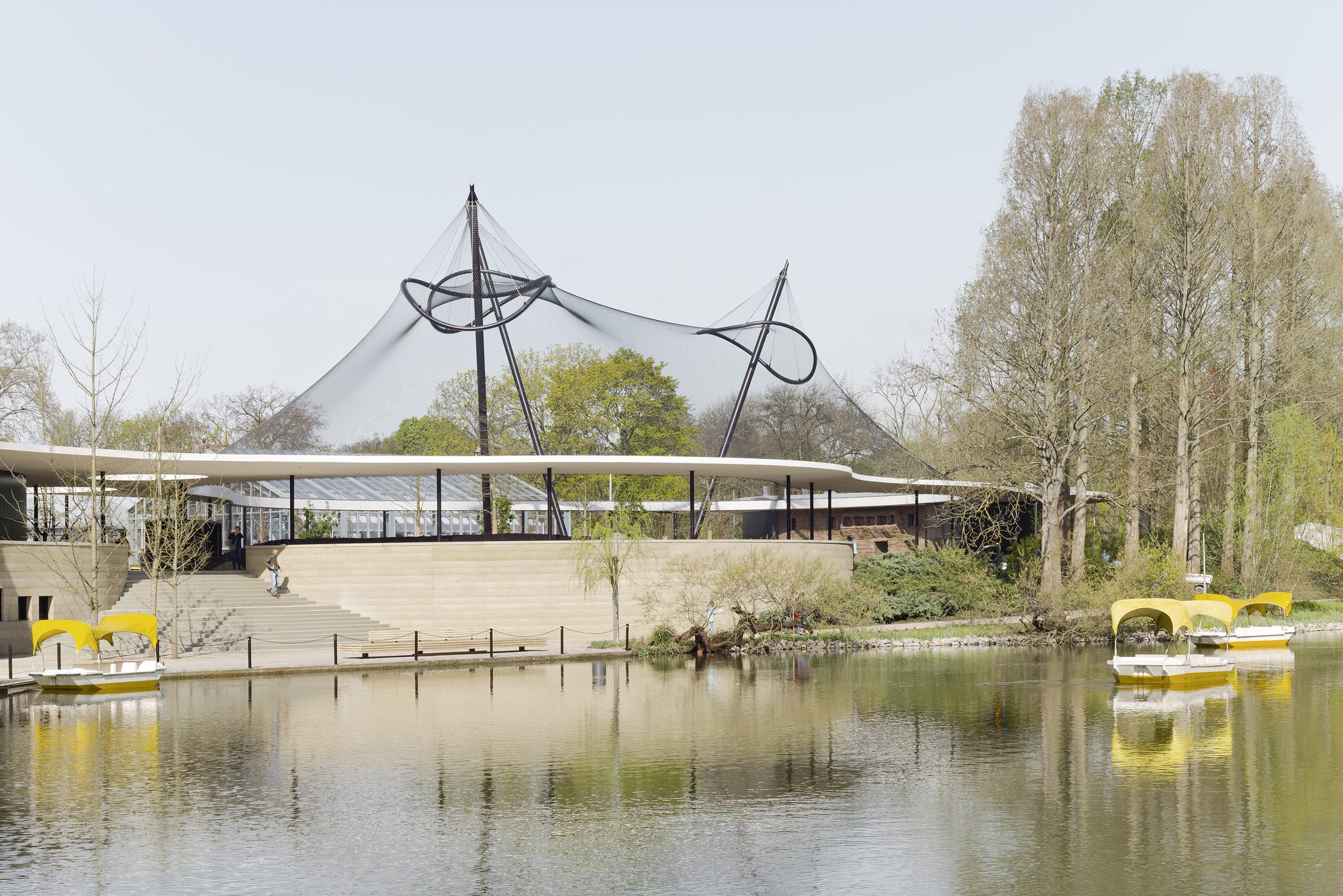
An elegantly curved roof structure resting on filigree supports covers the floor-to-ceiling glazed interiors, creating a flowing transition between interior and exterior space. Finely shining, dark green glazed ceramic elements enclose the adjoining room zones. The flat silhouette of the slender roof edge slides under the overhanging branches of the trees. Circumferential canopies offer park visitors protection from sun and rain.
© Brigida González
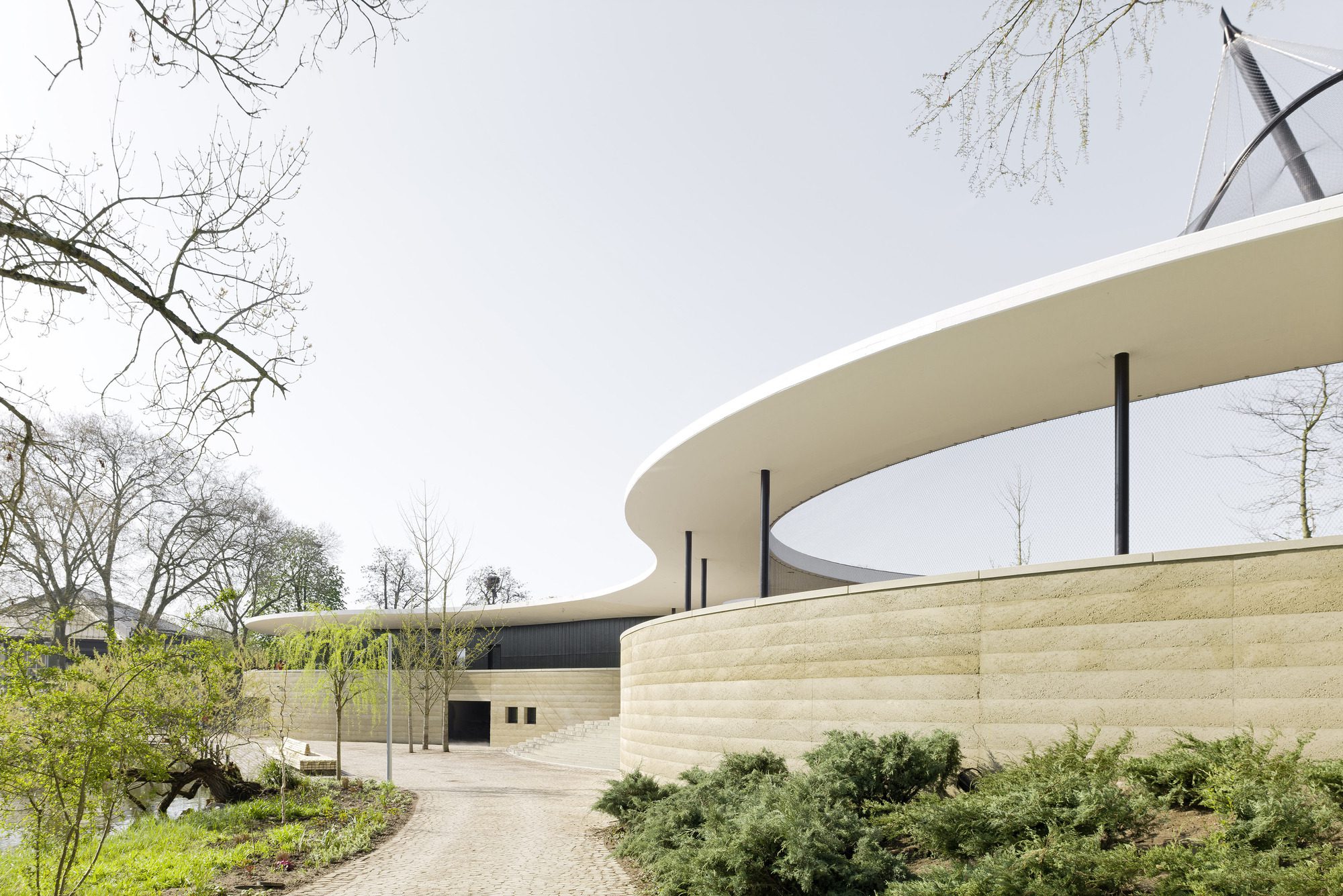
The curved roof structure, which is about 120 meters long and up to 30 meters wide, connects the many functional areas of the building. At its south end, the new park restaurant formulates an inviting gesture for arriving visitors. The dining area is framed by a curved glass façade and looks out over the adjacent Kutzerweiher pond. Large sliding doors allow the restaurant to be extended under the cantilevered canopy during the summer months.
© Brigida González
Adjacent to the north of the restaurant is a walk-in free-flight aviary, for which a 1,300 m2 opening was cut into the roof pane. The aviary is covered by an 18-meter high cable net construction supported by 3 pylons. The visitors’ path through the aviary leads through a modeled landscape with a watercourse and two ponds. The stable and care building occupies the northern end of the roof.
© Brigida González
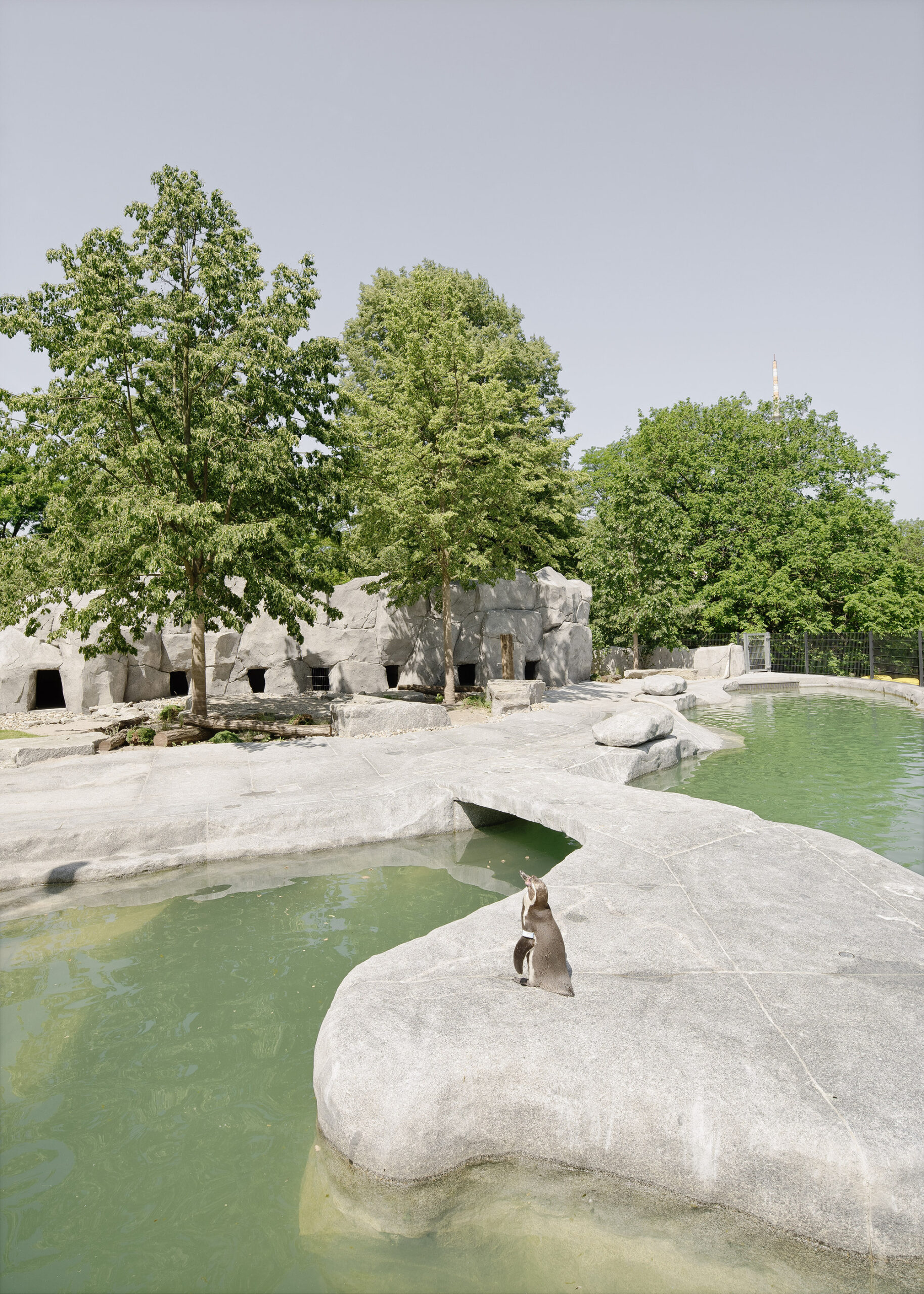
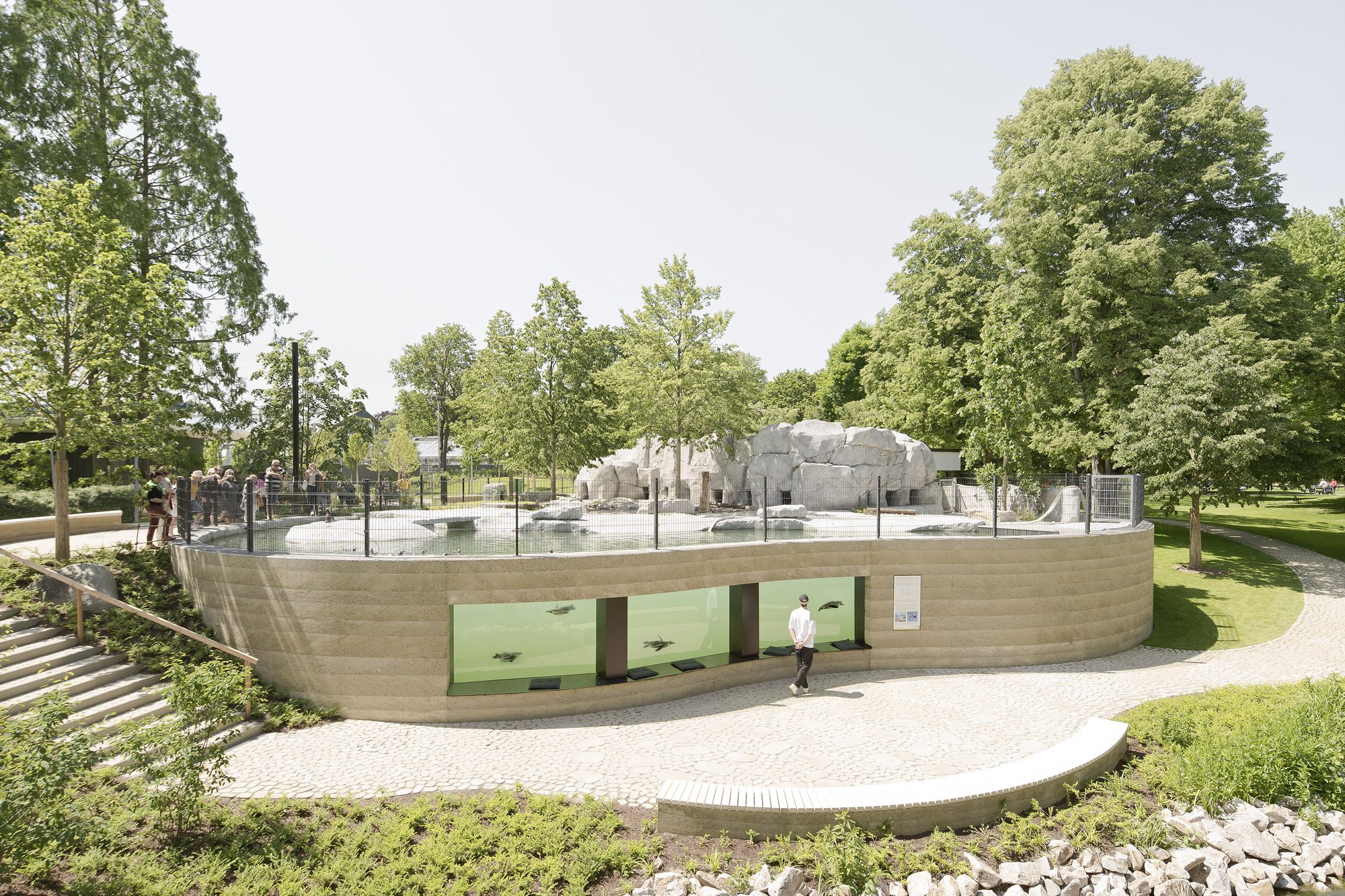
Slightly set off from the main roof, a 580 m2 penguin installation was realized, whose contour also follows a dynamically curved design language. The landscape here was modeled by a mixture of real granite and artificial rock. A pool with a capacity of 250 m3 was created for the penguins so that they can be observed above and below water.
© Brigida González
The drop in elevation to the Kutzerweiher, four meters below, was intercepted by a rammed concrete wall that follows the shore of the pond with a soft curve. Due to its porosity and the clearly visible layers of the stamped concrete placed in layers, it is reminiscent of the sediment layers of a quarry. The wall thus transforms from a structural to a landscape element.
© Brigida González
Through a deep cut in the stamped concrete wall, visitors enter the polygonal underwater world from the shore of the pond. The sand-colored screed here was deliberately only sanded, the walls were given a slightly glimmering scratch coat, and the ceiling was painted in a midnight blue color. This creates a mineral-influenced, contemplative place, where fish from all continents are displayed in 21 aquarium tanks.
© Brigida González
The implementation of the amoeba-like family of buildings has given the Luisenpark a new and unmistakable face with an identity-creating ensemble effect for the Federal Horticultural Show BUGA 2023. In the 2nd construction phase, the Green School and the Leisure House are to extend this family of buildings.
Project Info
Architects: Bez+Kock Architekten
Area: 4125 m²
Year: 2023
Country: Mannheim, Germany
Photographs: Brigida González
Manufacturers: AGROB BUCHTAL, Jakob, Domoferm, Franz Nüsing, Geze GmbH, Hörmman, Knauf, Köhnlein , NBK North America, Paul Bauder, Remmers, Schäfer
Lead Architects: Martin Bez, Thorsten Kock
Construction Management: Planungsgruppe Wörmann GmbH
Structural Engineering: wh-p GmbH Beratende Ingenieure
HVAC: Henne & Walter GbR
Electrical Planning: Raible + Partner GmbH
Building Physics: Müller BBM GmbH
Climate and Energy Consultant: Transsolar Klima Engineering
Lighting Consultants: Bartenbach GmbH
Landscape Design: Koeber Landschaftsarchitektur
Competition Team: Anna Piontek, Iris Schulenberg
Project Team: Erik Bossog, Anna-Katharina Piontek, Thorsten Hannig, Jana Lang, Almut Reuter, Katharina Rindtorff
Fire Protection: Müller BBM GmbH