


Creating development near the shoreline is a particularly difficult and responsible task. Pressure from investors, for whom a large and distinctive building is to their liking, not infrequently results in oversized buildings. In the case of Apartamenty Bałtycki, the overriding goal of the project was to dialogue with both the architecture of the characteristic pre-war villas of Swinoujscie and the landscape of the coastal dune where the development was located.
© Sylwia Gudaczewska
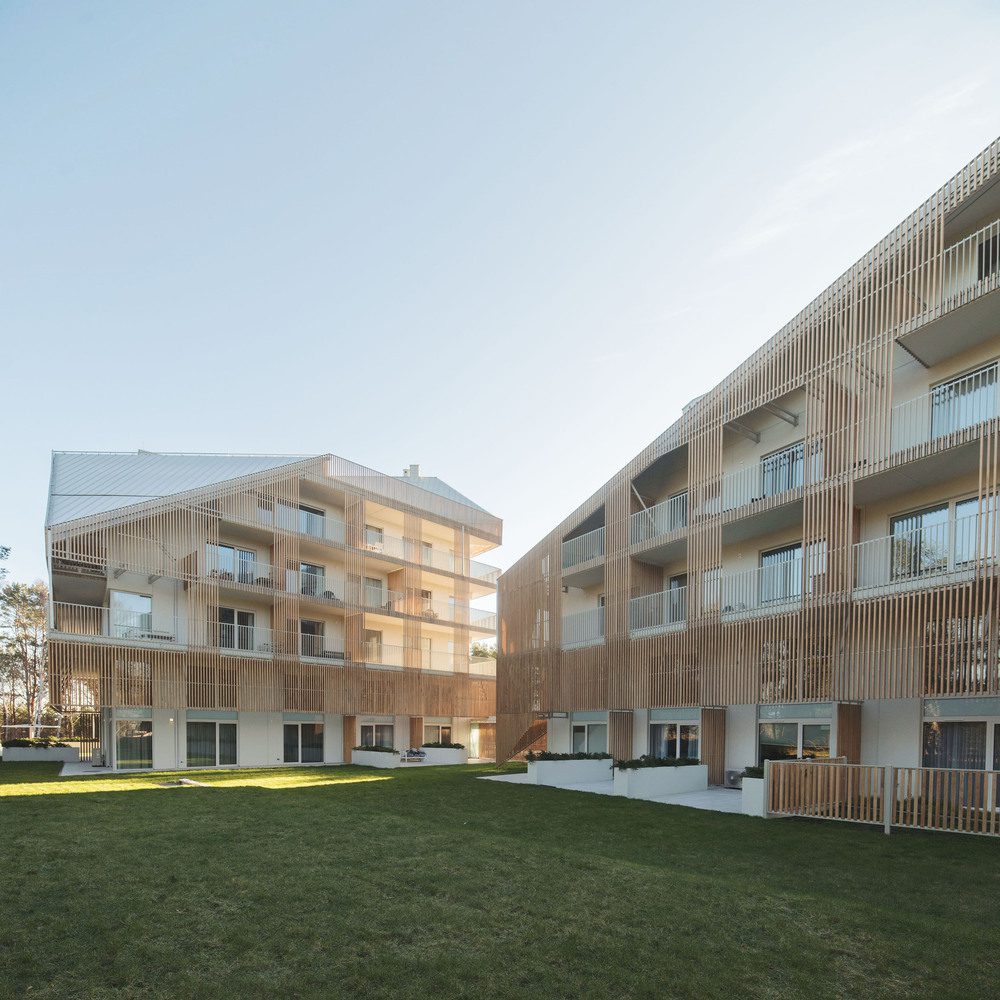
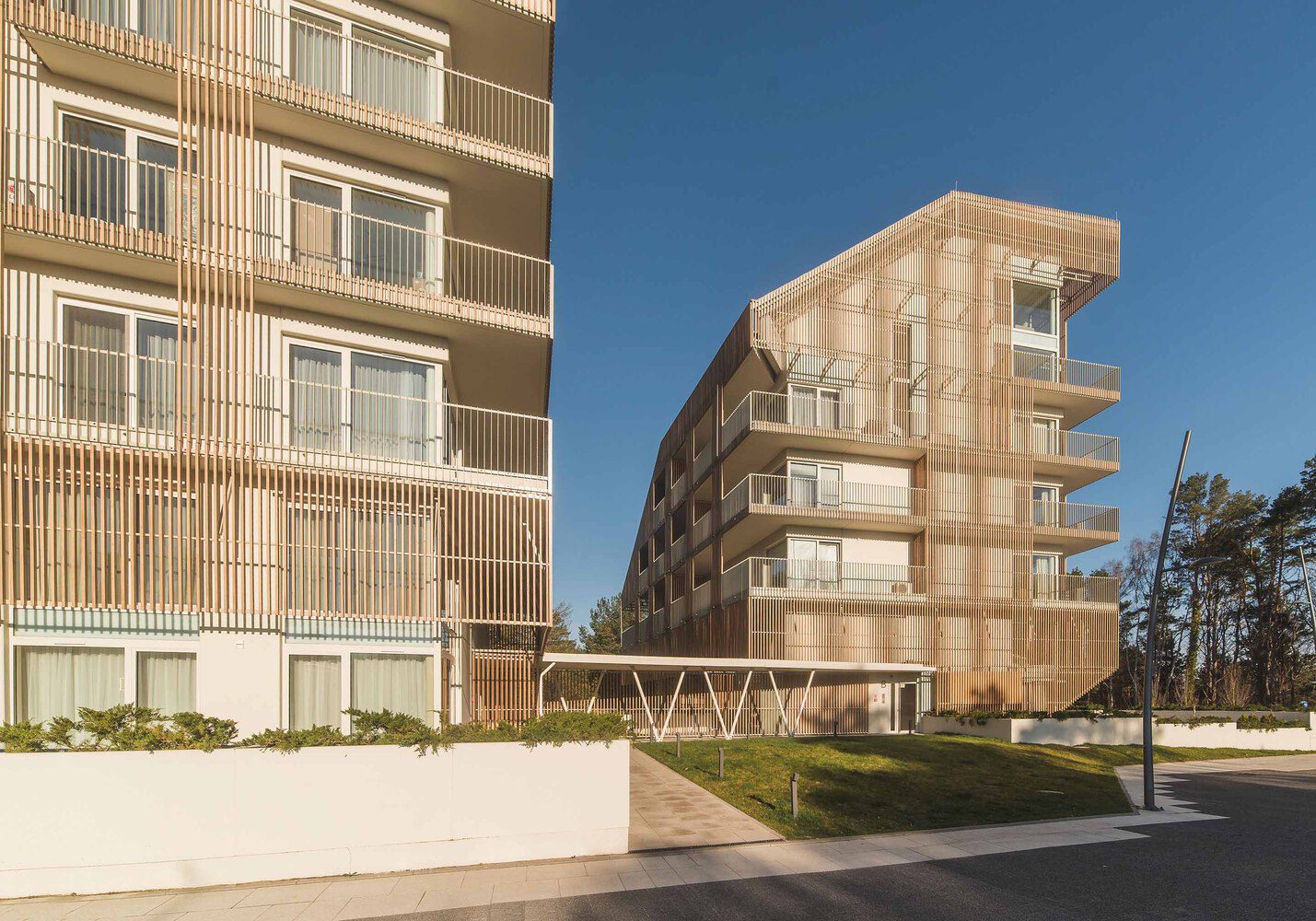
On a small, irregular plot, located 300 meters from the beach, two apartment buildings of five and seven stories were designed. Their scale and outlines allude to the surrounding pre-war architecture of the resort. The buildings have been based on trapezoidal projections, and the contours of individual elevations or roof slopes have been shaped in a similar way. The resulting forms reflect the variation of building lines along the organic Promenade of Health, along which the apartment buildings have grown. The contours of their blocks, in turn, correspond to the nearby building of the former “Fregata” Nursing Home, which is listed in the register of monuments.
© Sylwia Gudaczewska
Creating development near the shoreline is a particularly difficult and responsible task. Pressure from investors, for whom a large and distinctive building is to their liking, not infrequently results in oversized buildings. In the case of Apartamenty Bałtycki, the overriding goal of the project was to dialogue with both the architecture of the characteristic pre-war villas of Swinoujscie and the landscape of the coastal dune where the development was located at the time of its construction.
© Sylwia Gudaczewska
The Bałtycki Apartments are two buildings that have tied together several different construction philosophies. The underground part, which consists of utility rooms and garages, was created from concrete poured on site. Everything above ground is a clever combination of prefabricated concrete, steel and wood. Thus, the skeleton and walls, but also the roof, staircases and balconies were created from prefabricated elements. The task was not made easier by the use of unusual forms – truncated roofs or trapezoidal rooms whose layouts vary from floor to floor. The puzzle was extremely demanding not only from a design perspective – 5 independent construction offices worked on the project, which required control over design logistics and meticulous coordination of contractors.
- Architects: Maxberg
- Country: Świnoujście, Poland
- Area: 632 m²
- Year: 2022
- Photographs: Sylwia Gudaczewska
- Lead Architect: Karol Nieradka
