

The best places to find architecture jobs are the specialist job boards run by the architecture press and professional institutes, such as Archinect, Dezeen Jobs, RIBA Jobs and AJ Jobs, plus LinkedIn, practices’ own careers pages and direct approaches to firms you admire. Remote and freelance work exists, but mostly for technical roles such as BIM, visualisation and documentation. This guide is for architecture students, graduates and early-career architects. It lists where jobs are posted by region, what remote and freelance work realistically looks like, and how to apply so your application gets read, with verified data on pay, demand and how long it takes to qualify.
Where architecture jobs are posted
Architecture jobs reach candidates through five main channels:
- Specialist architecture job boards run by design magazines and professional bodies. They carry fewer listings than general sites but nearly all are relevant.
- General job sites and LinkedIn, used especially by large multidisciplinary firms and developers.
- Practices’ own websites. Many studios post vacancies only on their careers page or social media.
- University careers services and portfolio reviews, which connect students with firms for placements and graduate roles.
- Speculative applications and networking. A concise, targeted email with a short portfolio to a practice you genuinely want to join can work, particularly for small studios that rarely advertise.
What kind of jobs do architects have? Beyond design roles in architecture practices, architecture graduates work as BIM coordinators and computational designers, visualisers, project managers, urban designers and planners, heritage and conservation specialists, sustainability consultants, client-side advisers for developers and public bodies, and in teaching and research. Some of these roles are open to people without a professional licence.

Students at a careers fair: university and professional events are one of the main routes into architecture jobs. Photo: USDA, public domain, via Wikimedia Commons. Image: USDAgov (Public domain (verified))
Job boards by region
International and English-language
Archinect Jobs, founded in 1997, is one of the largest architecture-specific boards and is strongest for the US, while Dezeen Jobs, run by the London design magazine, advertises roles worldwide and sends listings in a daily newsletter, according to a job-board comparison. LinkedIn and Indeed carry many listings from large firms, often with more competition per role.
United Kingdom
RIBA Jobs, run by the Royal Institute of British Architects, and AJ Jobs, from the Architects’ Journal, are the main UK specialist boards, followed by the jobs section of Building Design. In the UK, the title “architect” is protected by law and can only be used by people on the ARB register, so check whether a role asks for an “architect” or an “architectural assistant”.
Europe
Many European countries have national boards in the local language, such as competitionline in the German-speaking countries and Architectenweb in the Netherlands, and listings often require the local language. Applying for work in another EU country is easier for EU citizens, whose qualifications are recognised under EU rules.
United States, Middle East and Asia-Pacific
In the US, alongside Archinect, local chapters of the American Institute of Architects often run job listings for their region. In the Gulf and Asia-Pacific, general boards and LinkedIn dominate, and many roles are advertised through international firms with offices in the region, so following those firms’ careers pages is effective.
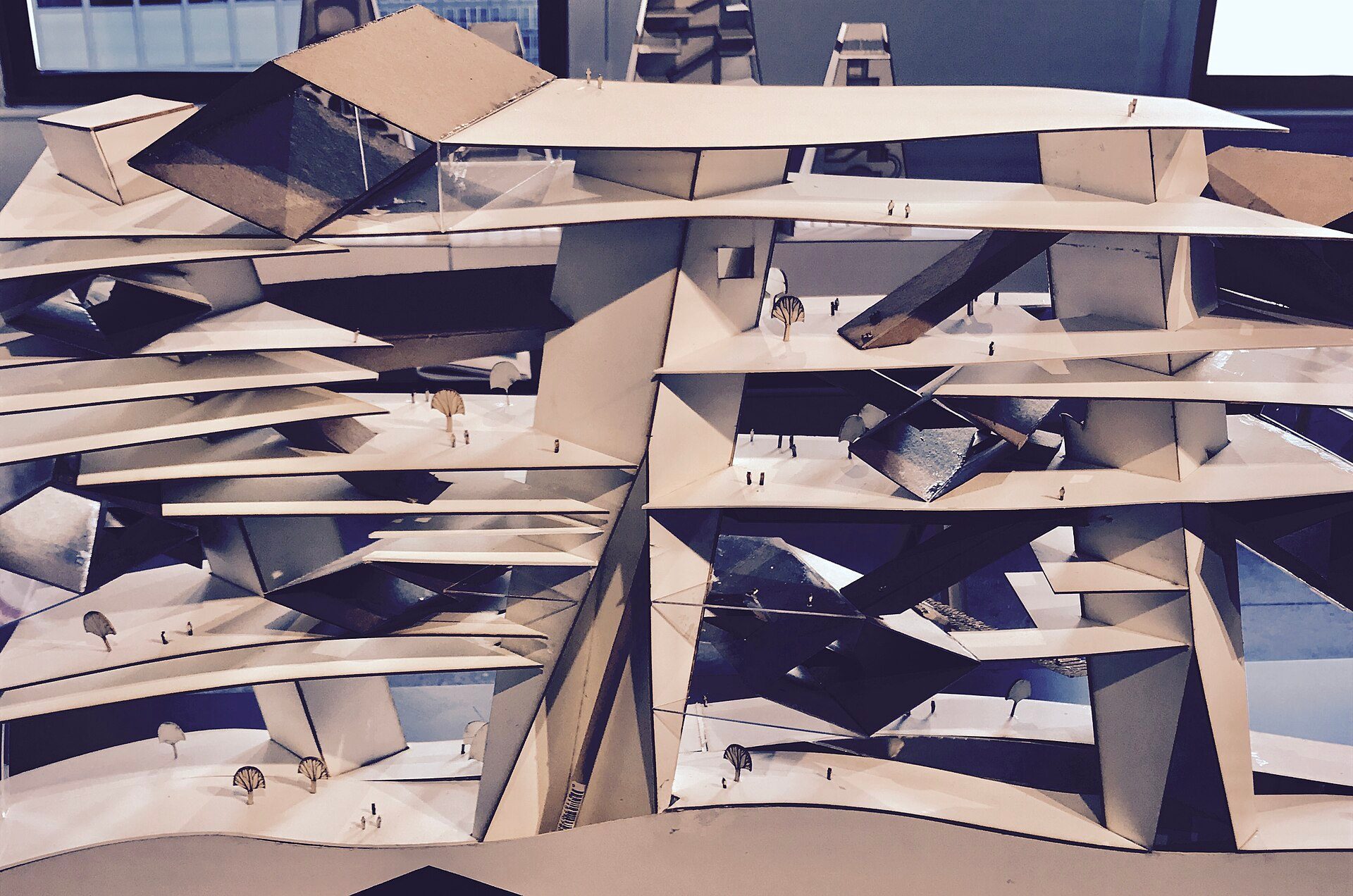
A student's architecture model: physical and digital models are central to a graduate portfolio. Photo: Angeline Apsarton, CC BY-SA 4.0, via Wikimedia Commons. Angeline Apsarton, source, CC BY-SA 4.0
Remote roles
Fully remote architecture jobs are less common than in software or marketing, because design teams, site visits and client meetings still rely on being in the same place. Hybrid roles are common. The roles most often offered remotely are BIM modelling and coordination, 3D visualisation and rendering, construction documentation, and specification writing. For remote applications, show that you can work independently with cloud-based tools, and check the legal side: in many countries, design work on a project must be overseen by a licensed architect in that jurisdiction, and employers may only hire in countries where they can run payroll.
Freelance platforms
General freelance marketplaces such as Upwork, Fiverr and, in Europe, Malt carry architecture work, mostly for visualisation, drafting, 3D modelling and small residential designs. They can help you build experience and a portfolio, but rates are competitive and clients vary. Before freelancing, check whether the work legally requires a licensed architect or registered professional to sign drawings in the client’s jurisdiction, use a written contract that states scope and fees, and consider professional indemnity insurance.

A coworking space in Brussels: remote and freelance architecture work is mostly in BIM, visualisation and documentation. Photo: WAO Coworking, CC BY-SA 4.0, via Wikimedia Commons. WAO Coworking, source, CC BY-SA 4.0
Is it hard to get hired as an architect? Demand and pay
It depends heavily on the economy and on location: architecture is sensitive to the construction cycle. In the United States, the Bureau of Labor Statistics projects architect employment to grow 4% from 2025 to 2035, about as fast as the average for all occupations, with about 6,900 openings a year, and gives a median annual wage of US$99,280 in May 2025, according to the BLS Occupational Outlook Handbook. Competition is strongest for well-known design studios; graduates with strong technical skills (Revit and other BIM tools, visualisation, sustainability analysis) tend to find work faster.
Is architecture a good career? It offers varied, creative and socially meaningful work, but the training is long, starting salaries are modest compared with some professions requiring similar study, and workloads can be heavy. It suits people who enjoy design, technical problem-solving and working with others over long projects.
Does it take 7 years to be an architect?
Often longer. In the US, licensure requires an accredited degree, a structured experience programme and the Architect Registration Examination; NCARB reports that new architects took 12.3 years on average in 2025, from starting college to licence, as summarised in NCARB by the Numbers 2026. In the UK, the traditional Part 1, 2 and 3 route usually takes about seven years, though the Architects Registration Board is reforming the qualification framework. You can work in architecture well before you qualify, as an assistant or in specialist roles.
Applying effectively
- Target, don’t spray. Apply to fewer practices whose work you know, and say why their projects interest you.
- Send a short portfolio. A 10-15 page PDF under about 10 MB, with your best and most relevant projects first; keep the full portfolio for interview. Our guide to architecture careers and portfolios covers layout and content.
- Write a one-page CV that lists software skills and the stage of projects you worked on.
- Show technical drawings, not only renders. Practices hire people who can produce buildable information.
- Follow up once, politely, after a week or two.
- Keep learning. Short courses in BIM, sustainability or visualisation strengthen applications for both office and remote roles.
Next step: pick three boards relevant to your country, set up job alerts, list ten practices you would like to work for, and send each a tailored application with a short portfolio.

Luca Moretti is a content strategist with a foundation in urban design and architecture. Based in Milan, he focuses on writing that bridges aesthetics, material culture, and everyday spatial experiences.