

Memphis design is the colourful, pattern-heavy style of furniture and objects launched in Milan in 1981 by the Memphis Group, a collective of designers led by Ettore Sottsass. It mixed cheap plastic laminates with expensive materials, bold geometric shapes with clashing colours and patterns, and rejected the restrained “good taste” of modernist design. This guide, for interior designers, architects and students, explains where Memphis came from, who was involved, how to recognise its visual language, its best-known objects, why it has returned, and how to use its ideas in interiors today without turning a room into a museum piece.
The Memphis Group in 1980s Milan
Memphis began in December 1980, when Sottsass, then in his sixties and already famous for his work for Olivetti, gathered a group of younger designers in his Milan apartment to discuss the future of design. According to the group’s history as summarised on Wikipedia, Bob Dylan’s “Stuck Inside of Mobile with the Memphis Blues Again” was playing during that first meeting; the name also evoked Memphis, Tennessee, and the ancient Egyptian capital. Sources differ on the exact evening (6 or 11 December); the company that now produces Memphis pieces dates it to 11 December 1980.
The group presented its first collection in Milan in 1981, during the city’s furniture fair season, and the furniture, lamps, ceramics, glass and textiles caused a sensation. Memphis grew out of the Italian radical design movement of the 1960s and 1970s and the experimental Studio Alchimia, but it aimed at a wider public and at real production. Sottsass left in 1985 to concentrate on his firm, Sottsass Associati, and the group disbanded in 1987.
Ettore Sottsass and members
Sottsass (1917-2007) was the leader and elder figure. The core of the group was a generation of young designers working in Milan, including Michele De Lucchi, Matteo Thun, Aldo Cibic, Marco Zanini, Martine Bedin, Nathalie Du Pasquier and George Sowden, with the critic Barbara Radice as the group’s writer and art director. International designers and architects contributed pieces, among them Michael Graves and Peter Shire from the United States, Shiro Kuramata from Japan and Javier Mariscal from Spain, as well as Italian designers such as Andrea Branzi and Alessandro Mendini.

Michele De Lucchi, a founding member of Memphis, at the 74th Berlin International Film Festival in 2024. Photo: Harald Krichel, CC BY-SA 4.0, via Wikimedia Commons. Harald Krichel, source, CC BY-SA 4.0
Many members went on to major careers. Michele De Lucchi, seen above at the 2024 Berlin International Film Festival, became one of Italy’s leading architects and designers; Matteo Thun built an international architecture practice; Nathalie Du Pasquier became a painter.
Visual language: how to recognise Memphis design
Memphis design is easy to spot once you know its ingredients:
- Colour: saturated primaries and pastels used together (red, yellow, blue alongside pink, mint and lilac), often with black and white.
- Pattern: printed plastic laminates with squiggles, dots, dashes and imitation terrazzo or “speckle” textures, applied flat to furniture surfaces.
- Shape: simple geometric volumes (cylinders, cones, spheres, blocks) stacked and combined so that each part stays readable, often at odd angles.
- Material: cheap, industrial materials such as plastic laminate, which had been used for kitchen and bar counters, put next to marble, lacquered wood or glass, deliberately mixing “high” and “low”.
- Function: objects that still work (bookcases, lamps, tables) but put character, humour and symbolism ahead of efficiency.
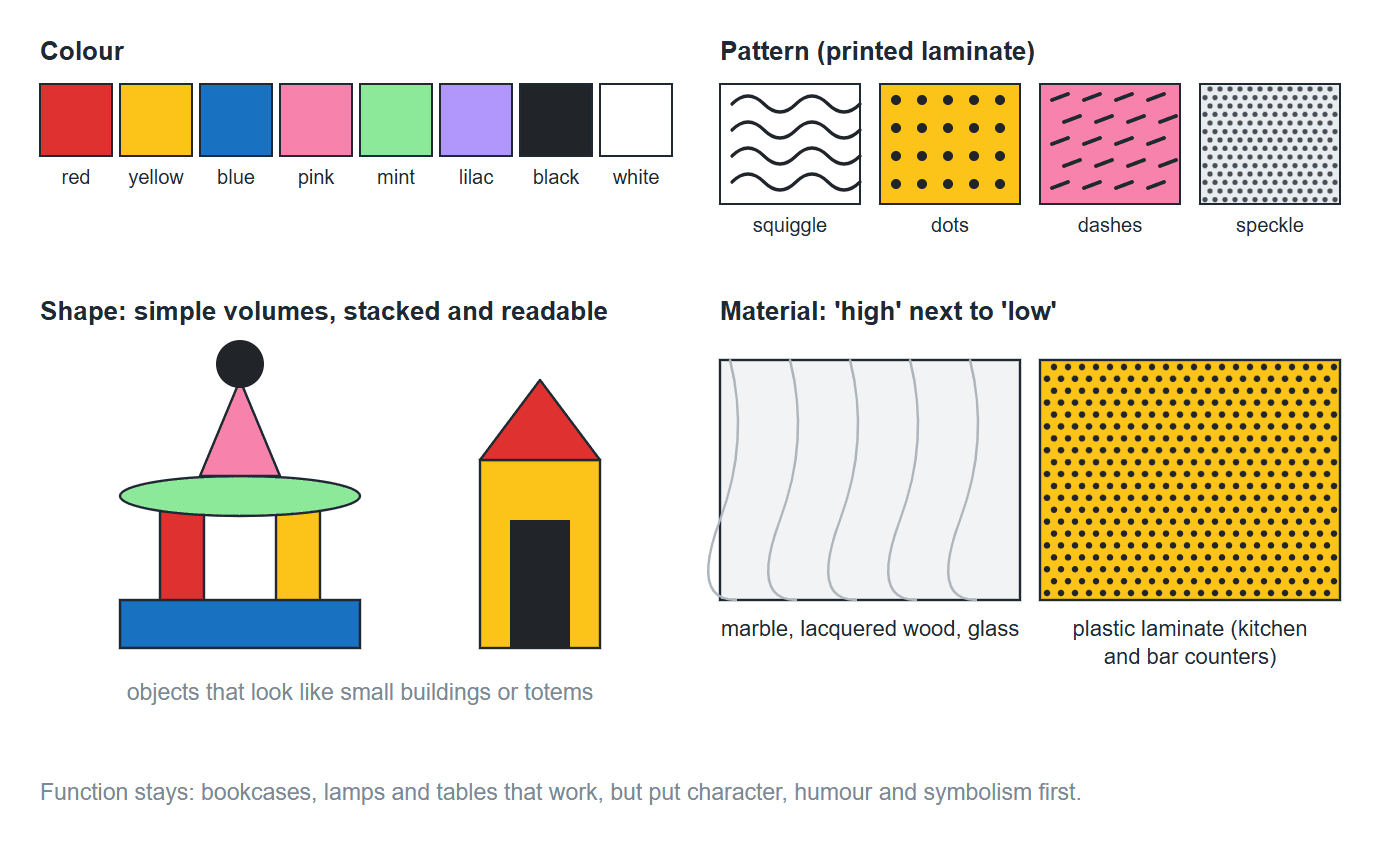
The Memphis visual language on one board: saturated primaries with pastels, printed laminate patterns (squiggles, dots, dashes, speckle), simple geometric volumes stacked so each stays readable, and cheap laminate set against marble, lacquer or glass. Diagram: Arch2O
Behind the look was a serious argument: that objects carry meaning and emotion, and that design should communicate rather than disappear into neutral “good form”. That is why Memphis pieces often look like small buildings or totems.
Iconic objects
A handful of pieces define the style. Sottsass’s Carlton room divider and bookcase (1981), a totem of plastic-laminated shelves set at angles with a figure-like top, is the best known; his Casablanca sideboard (1981) uses the same language. Martine Bedin’s Super lamp, a semicircle on wheels studded with coloured bulbs, was first designed in 1978 and became part of the 1981 collection. Michael Graves’s Plaza dressing table (1981) brought his postmodern architecture into furniture, and Michele De Lucchi designed chairs and lamps that read like toys. Original pieces are now collected by museums and private collectors: in November 2016, about 100 Memphis pieces from David Bowie’s collection were sold at Sotheby’s in London, as Dezeen reported ahead of the sale.
Memphis was closely linked to postmodern architecture. Graves’s Portland Building in Oregon (1982), described in its history as the first major realised example of architectural postmodernism, uses the same oversized motifs, flat colour and play with classical references at the scale of a city block.

Michael Graves's Portland Building in Oregon (1982), an architectural cousin of Memphis. Photo: philosophygeek, CC BY-SA 2.0, via Wikimedia Commons. Flickr.com user "philosophygeek", source, CC BY-SA 2.0
The Groninger Museum in the Netherlands (1994) brought several Memphis-era designers together in one building: Alessandro Mendini led the project and designed its golden tower, and Michele De Lucchi designed one of the pavilions, alongside Philippe Starck and Coop Himmelb(l)au, as the museum’s own account describes. It is one of the best places to see Memphis thinking at architectural scale.

The Groninger Museum's yellow tower and tiled pavilions on the canal, Groningen, 2021. Photo: Ziko van Dijk, CC BY-SA 4.0, via Wikimedia Commons. Ziko van Dijk, source, CC BY-SA 4.0
The revival
After the group disbanded, its look spread through 1980s and early-1990s popular culture, from television sets to graphic design, and then fell out of fashion. Since the 2010s it has returned: fashion houses drew on it (Dior’s 2011-12 couture collection and Missoni’s Winter 2015 collection are often cited), the Bowie sale drew wide attention, and a new generation of designers and illustrators adopted its colours and squiggles. Pieces are again produced under the Memphis name by Memphis S.r.l. in La Morra, Italy, whose website lists designs such as the Carlton. In interiors, the revival usually appears as single statement pieces, terrazzo-style surfaces, curved and geometric forms and confident colour, rather than whole rooms in the original style.
Using Memphis ideas today
Memphis design works best in interiors as an attitude rather than a costume. Practical ways to use it:
- Choose one hero piece. A single original or licensed Memphis piece, or a contemporary object in its spirit, carries a calm room. Several competing pieces quickly become a theme park.
- Use colour blocking on architecture. Paint a door frame, a niche or a stair string in a strong colour against neutral walls, or use two contrasting colours on simple geometric volumes.
- Bring in pattern through surfaces. Printed laminate, terrazzo, patterned tiles or a rug can introduce the Memphis vocabulary in small areas, such as a kitchen splashback or a joinery front.
- Mix high and low. Combine inexpensive laminate or painted MDF with a stone top or glass, as the original pieces did.
- Keep function honest. Shelves still need to hold books and seats still need to be comfortable; the playfulness should be in form and colour, not at the expense of use.
- Respect originals and rights. Original Memphis designs are protected in many countries; buy licensed pieces or design your own in the spirit of the movement rather than copying specific objects.
Memphis sits among the boldest interior design styles of the late 20th century, and it works best when used sparingly against calmer backgrounds. A good next step is to look at original pieces in a design museum or the Groninger Museum, and then sketch how one Memphis idea (a colour block, a laminate pattern or a stacked geometric form) could lift a project you are working on.
Sources and further reading
- Memphis Group history (Wikipedia, linked above) and Memphis S.r.l. (memphis.it).
- Radice, B. Memphis: Research, Experiences, Results, Failures and Successes of New Design (Rizzoli, 1984).
- Groninger Museum, museum building; Portland Building history (linked above).

Sophie Tremblay is a Montreal-based architectural editor and designer with a focus on sustainable urban development. A McGill University architecture graduate, she began her career in adaptive reuse, blending modern design with historical structures. As a Project Editor at Arch2O, she curates stories that connect traditional practice with forward-thinking design. Her writing highlights architecture's role in community engagement and social impact. Sophie has contributed to Canadian Architect and continues to collaborate with local studios on community-driven projects throughout Quebec, maintaining a hands-on approach that informs both her design sensibility and editorial perspective.