

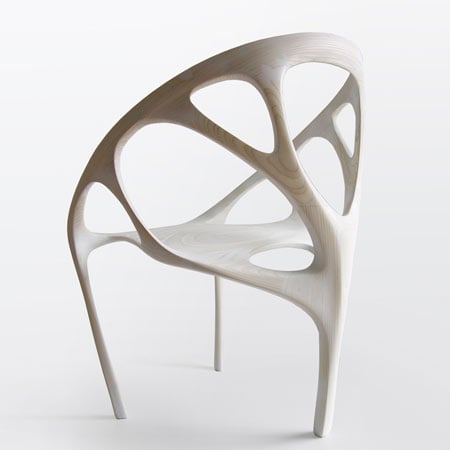
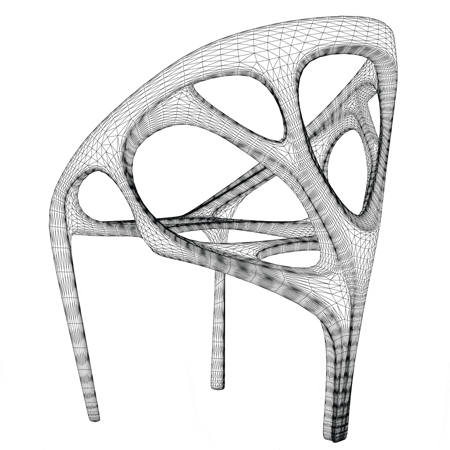
Daniel Widrig, a London based designer known for his bold digital approaches, has produced a rather unique three-legged chair optimized through digital dynamics simulation as used in the aerospace, automotive, and bio mechanics industries. The design, named ‘Brazil‘, is one of his many geometrically complex artifacts, and was first introduced in Martin-Gropius-Bau in Berlin. The design is broken down into pieces that are cut with a 5-axes CNC wood machine, producing an organic artifact that depends solely on the lines and curves needed to transform powers and to make things as comfortable as possible.
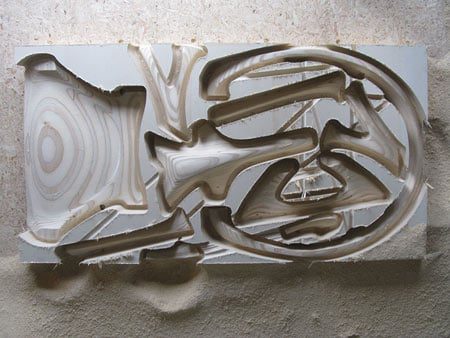
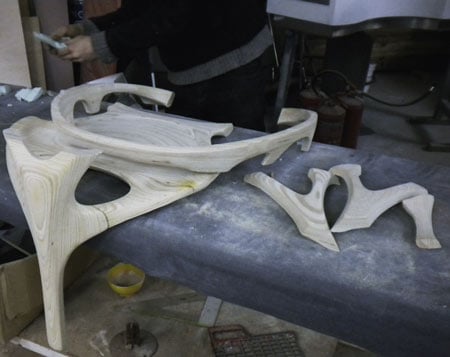
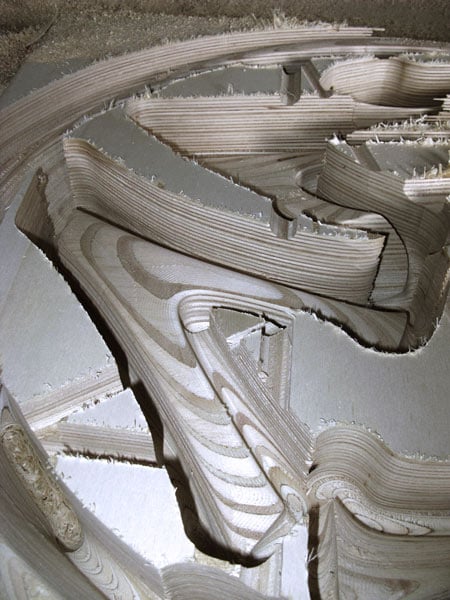
The prototyping and engineering process of the chair was a collaboration with Filippo Moroni of Monolito. Unlike traditional chairs, or even most other geometries oriented designers’ chairs, the ‘Brazil’ chair is made to rather save time and materials through its construction process, as the designer explains “To save materials and production time, its geometry is split into multiple components that are digitally nested onto sheets of laminated wood and CNC machined. The component are then assembled, glued and hand finished. Through the CNC milling, the layered structure of the laminated wood is exposed and underlines the topography of the chair’s surface.”

Hazem Raad is an editor at Arch2O with a keen interest in the intersection of urban planning, politics, and technology in the Middle East. Holding a Master of Science in Urban Planning from The Bartlett's Development Planning Unit at University College London, his editorial lens is shaped by critical inquiry into contestation, border-making practices, and the role of big data in urban governance. Hazem’s writing explores how spatial dynamics and digital infrastructures intersect with socio-political realities, bringing analytical depth and regional nuance to Arch2O’s urban discourse.