

‘Urban Living’ Plaza in Yiwu
Aedas proposes a one-stop urban lifestyle complex for Yiwu, a historical trading town of China. Currently Yiwu is the world’s largest small commodity wholesale market. The proposal by Aedas looks to keep this tradition going, scaled up slightly to global trends and the urban lifestyle.
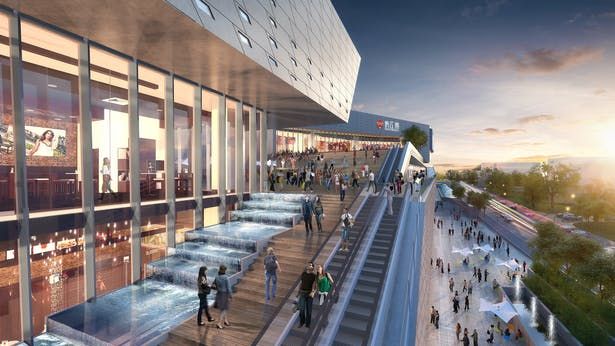
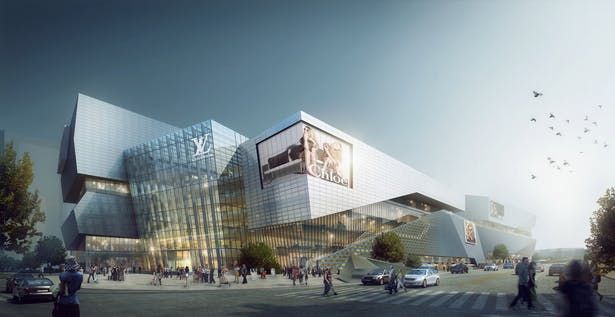
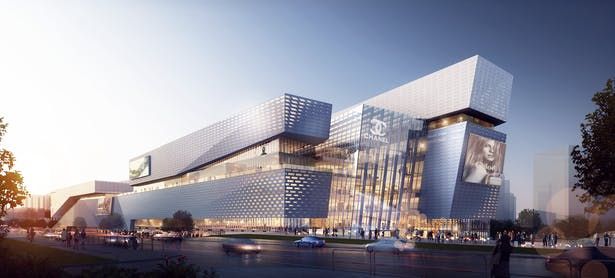
Being an ancient river-side settlement located in a fast growing economy like China, Yiwu’s ‘Urban Living’ Plaza is a mix and match of the old and new. The building form inspired by the Chinese symbol ‘川’ (meaning ‘river’) is characterised by bold lines that seem to flow into each other, giving it a modern feel. Meanwhile the facade, inspired by the historic city wall of Yiwu, is embellished by Chinese bricks on the side facing Beiwen Road. Moreover, the circulation route outside the plaza resembles the ancient Chaoyang Gate and combined with the internal circulation, seamlessly brings people to the upper retail floors and the outdoor rooftop platform.
Set to be completed by the year 2016 with a staggering built area of 146,000 square meters, the project combines a plethora of experiences under one roof. Located in the heart of the city, the programme provides space for shopping, dining, cultural and leisure activities in the complex while at the same time providing open recreational space in the form of a landscaped square outside the complex as well.
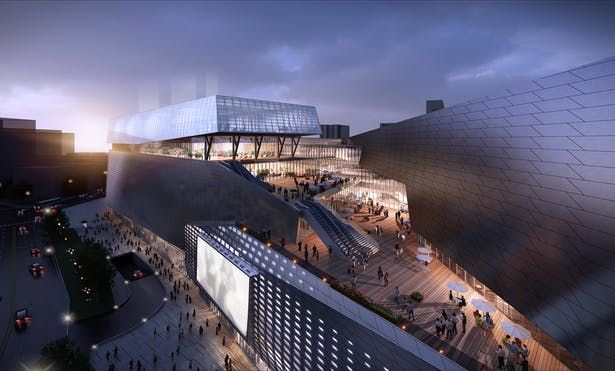
courtesy of Aedas
By: Shamita Chaudhry

Shamita Chaudhary is a former assistant editor at Arch2O and the driving force behind India’s sustainable construction movement. An architect and circular economy expert, she founded the Malba Project in 2021 to combat construction and demolition (C&D) waste in Indian cities through research, advocacy, and practical action—an effort born during a striking 2018 trip to Manali . Over at Arch2O, Shamita leveraged her editorial acumen to spotlight circular design strategies and environmental stewardship. Her writing and insights challenge architects to rethink not only how we build, but how we dismantle—and rebuild—toward a more regenerative future.