

Dancing Droplets
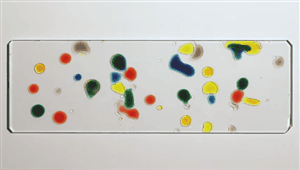
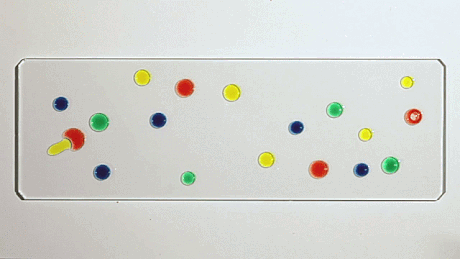
A recent study conducted by a trio of researchers from Stanford – Nate Circa, Manu Prakash, and Adrien Benusiglio – explained the curious attraction found between droplets of similar colored food coloring and the strange hostile behavior towards those of different colors, a phenomenon that Nate Circa stumbled upon quite accidentally a few years ago.
Their research found food coloring to be a 2 component fluid – consisting of water and propylene glycol. The 2 chemical compounds coexisted retaining their separate molecular identities.
The dynamic interaction between these 2 molecular components, however, enabled these inanimate droplets to mimic the biological behavior of living cells.
This seemingly complex behavior, as bizarre and fascinating as it sounds, is known as artificial chemotaxis, making it looks like dancing droplets.
Courtesy of Nate Circa, Manu Prakash, and Adrien Benusiglio
The trio explains this dual phenomenon as something that is not exclusive to food coloring but can be exhibited by a variety of fluids that share the same relationship.
The series of experiments conducted by them, however, are worthy of being exhibited in a museum.
Using chemical processes to create live art is something that hasn’t been explored all that much and in this age of scientific advancement, is worthy of being a revolutionary style in itself.
Read also: Industrial Design Students from New Zealand Invent a Smart Couch that Adapts to You
Courtesy of Nate Circa, Manu Prakash, and Adrien Benusiglio


Shamita Chaudhary is a former assistant editor at Arch2O and the driving force behind India’s sustainable construction movement. An architect and circular economy expert, she founded the Malba Project in 2021 to combat construction and demolition (C&D) waste in Indian cities through research, advocacy, and practical action—an effort born during a striking 2018 trip to Manali . Over at Arch2O, Shamita leveraged her editorial acumen to spotlight circular design strategies and environmental stewardship. Her writing and insights challenge architects to rethink not only how we build, but how we dismantle—and rebuild—toward a more regenerative future.