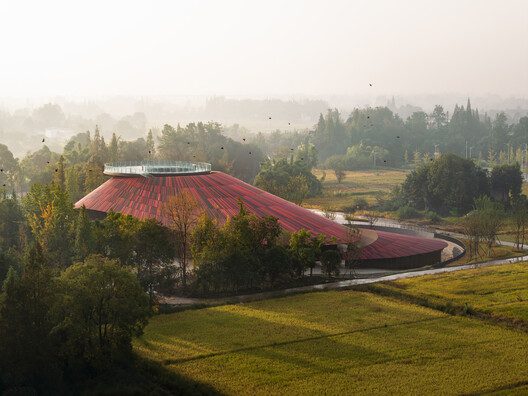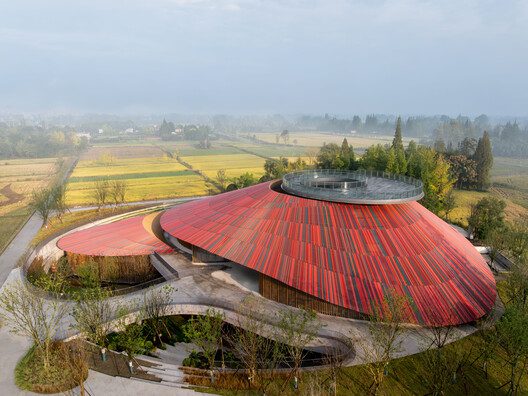


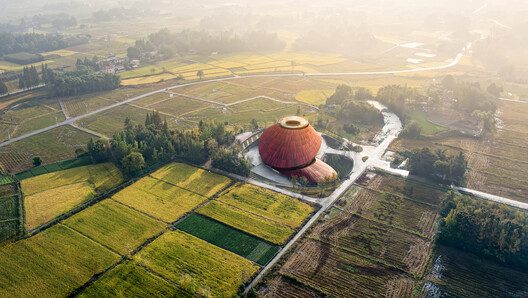
The Douban museum is located in Ande Town, within the prime irrigation area of Dujiangyan, where traditional farming culture intersects with modern sauce production, echoing the organic texture of the Western Sichuan Linpan. Surrounded by woodlands and bamboo with dotted farmhouses, it possesses a strong ecological foundation. Protecting this ecology became the project’s guiding principle.
© 404NFSTUDIO
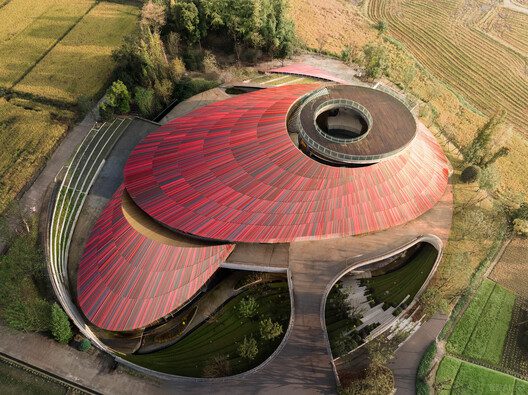
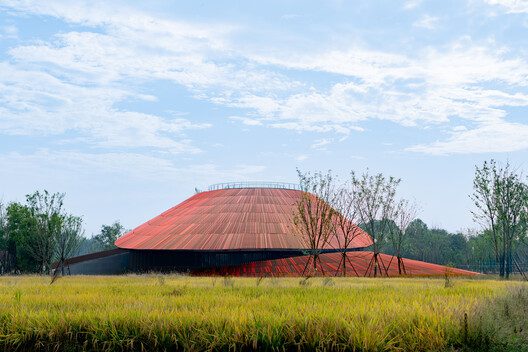
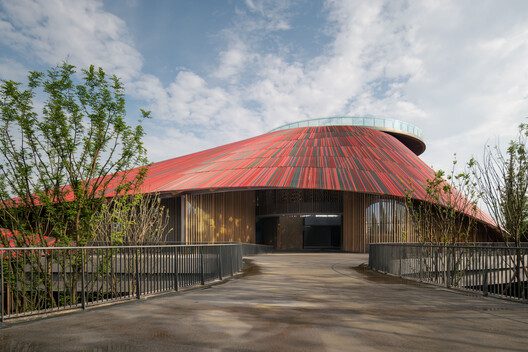
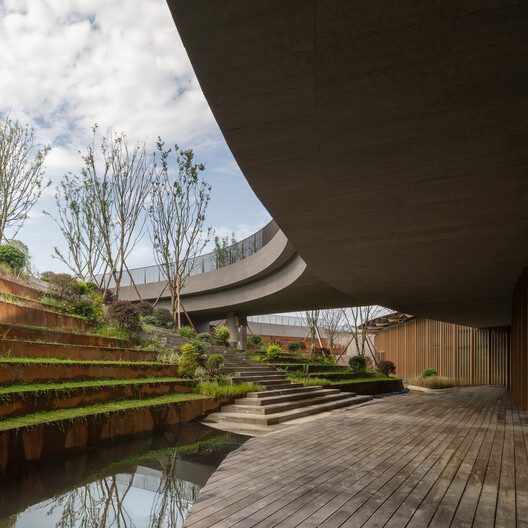
Initially, trees with DBH over 20cm and clumping bamboo were marked for preservation. The design weaves the building mass around them, creating a symbiotic “house amidst bamboo” scene. To minimize visual impact, main functional spaces are placed underground. Only about one-third of the volume—housing the lobby and exhibition halls—remains above ground, “breaking down the large into small.” The building height is kept under 15 meters, letting surrounding metasequoias crown the roof.
© 404NFSTUDIO
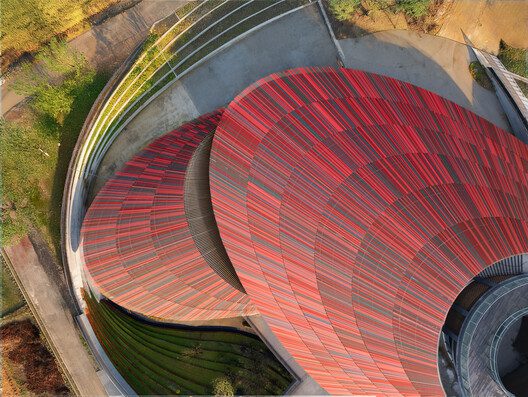
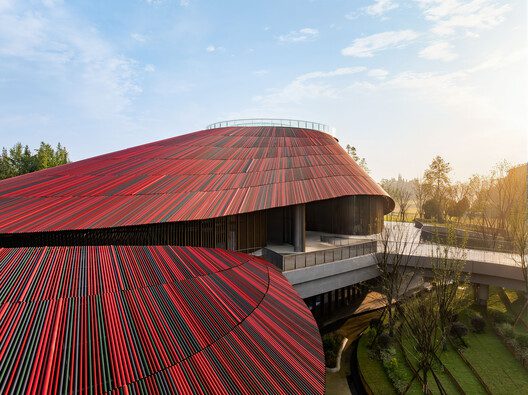
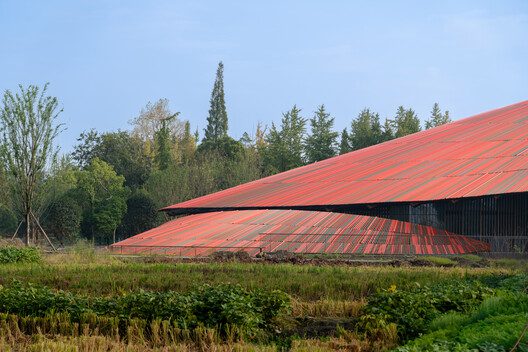
The museum reinterprets the lightweight, elegant pitched roofs of Chengdu Plain dwellings, known for “deep cantilevers and slender eaves.” Responding to the north-south sloping terrain, the main roof takes an elliptical, bean-like curved form. A smaller northern roof rises from the ground, while a southern one embeds into a sunken courtyard. These three planes overlap, expressing the lightness of Western Sichuan architecture. Traditional grey tiles are replaced by innovative “colorful pepper” elements, inspired by chili peppers’ color shift from green to red to black during drying. After six months of prototyping, four key colors were selected and distributed randomly across the roof: red (30%), deep red (36%), dark green (14%), and dark gray (20%),allowing the red roof to blend naturally with the surrounding environment.
© 404NFSTUDIO
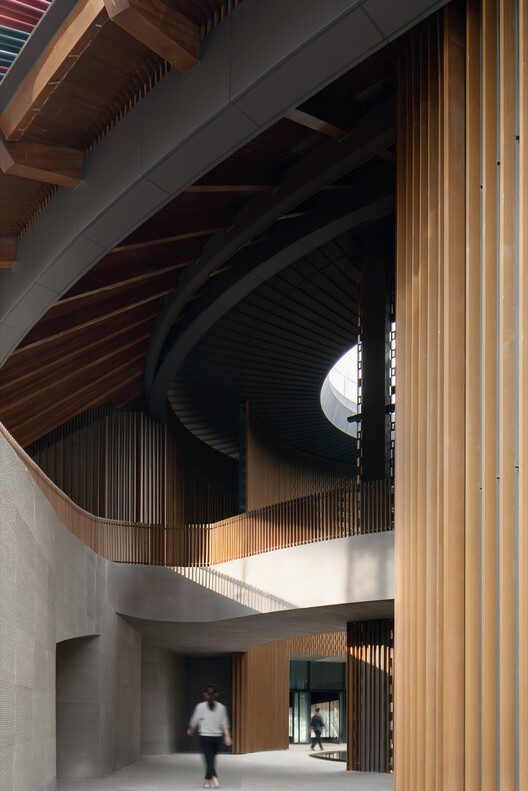
Structurally, Glulam beams replace the traditional “Chuandou” timber frame. Bamboo-wood strips are used for roof sheathing and fascia, recalling tradition while meeting modern standards. Double-curved steel ring beams on steel columns support the timber roof, accommodating large spans and optimizing wood’s mechanical properties.
© 404NFSTUDIO
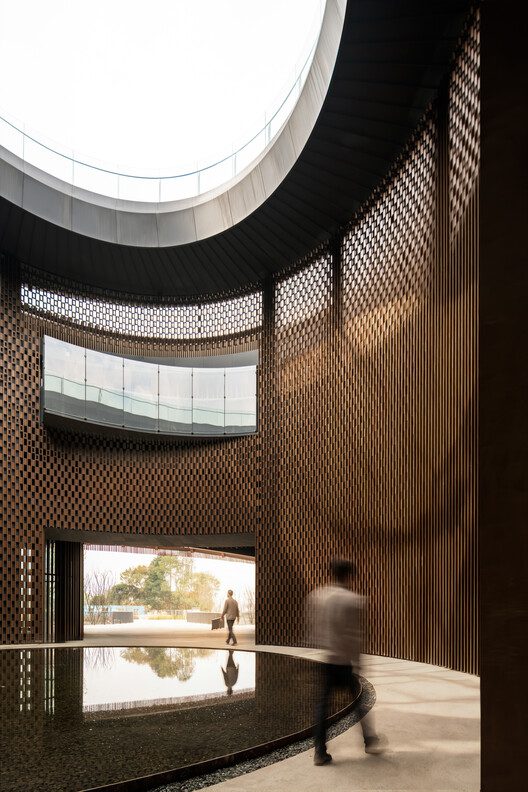
The courtyards and skywells of Western Sichuan Linpan dwellings are more than just the ritualistic “Si Shui Gui Tang” (Four Waters Returning to the Hall); the eaves, corridors, and main halls surrounding them are vital spaces for daily life. The central area continues the Linpan “courtyard” typology. Enclosed yet open to the sky, it breaks horizontal limits and creates verticality, serving as the circulatory core. Visitors arrive this space, enter the lobby, and after viewing the exhibitions, return here before walking out towards the fields. Gathering around the central water feature for conversation recreates the lively “Bai Longmenzhen” (social chatting) scene typical of Sichuan courtyards.
Project Info:
Architects: CSWADI
Country: China, Chengdu
Area: 6765 m²
Year: 2025
Photographs: 404NFSTUDIO
Architectural Design: Xu Wenqi, Zhang Rujie, Wang Yixuan
Design Principals: Zheng Yong, Chen Jiale
Structural Design: Long Weiguo, Lei Yu, Chen Di, Li Bo, Ou Jiajia, Chen Yuanyi
Plumbing & Drainage Design: Ma Tengfei, Fan Xu, Han Yong, Fan Yuefei, Guo Libao, An Fei
Hvac Design: Li Quan, Ren Xingye, Zhong Lei, Nie Xian, Fang Yu
Electrical Design: Li Hui, Wang Xingnan, Li Qian, Ao Faxing, Xu Jianbing, Wang Shaowei, Wu Huan
Curtain Wall Design: Yin Bingli, Zhang Guoqing, Wei Hailong
Building Technology: Chen Jun, Luo Jing, Dou Mei
Landscape Design: Yudao Landscape Design