

Christian churches in South Korea range from the red-brick Gothic Revival of Myeongdong Cathedral (1898) to bold contemporary buildings in concrete, brick and glass that open their ground floors to the city. Protestant and Catholic Christians together made up about 28 per cent of the population in the 2015 census, and that large, active community has commissioned some of the country’s most inventive recent architecture. This guide, for architects, students and travellers, gives the dated background, the features that define contemporary Korean church design, and ten recent churches worth seeing.
The live version of this page described South Korea as “overwhelmingly Christian”; that is not the case. In Statistics Korea’s 2015 census, as reported by The Korea Times, 56.1 per cent of people reported no religion, 19.7 per cent were Protestant, 15.5 per cent Buddhist and 7.9 per cent Catholic (the census was a sample survey and some religious bodies dispute the figures). Christianity is still a highly visible presence in Korean cities, where illuminated crosses mark churches on many streets, and it has produced numerous magnificent places of worship.

©SeongJoon Cho/Bloomberg
Origins and context: Christianity and church building in Korea
Catholicism reached Korea in the late 18th century, and the site of Myeongdong Cathedral in Seoul is linked to the first Catholic community, which gathered there in 1784. Protestant missionaries arrived in the 1880s; Saemoonan Church, founded in Seoul on 27 September 1887 under the American missionary Horace G. Underwood, describes itself as the first organised Protestant church in Korea. Christianity grew fastest after the Korean War, particularly from the 1960s to the 1980s, alongside rapid urbanisation, and many congregations grew very large.
The first great church building of this history is Myeongdong Cathedral. Designed under the direction of the French missionary priest Eugène Coste and dedicated on 29 May 1898, it is a Gothic Revival church built of locally fired red and grey brick and is now a designated historic site, according to its history. It set the model for brick Gothic churches across Korea for decades, and many older Christian churches in South Korea follow its pattern.
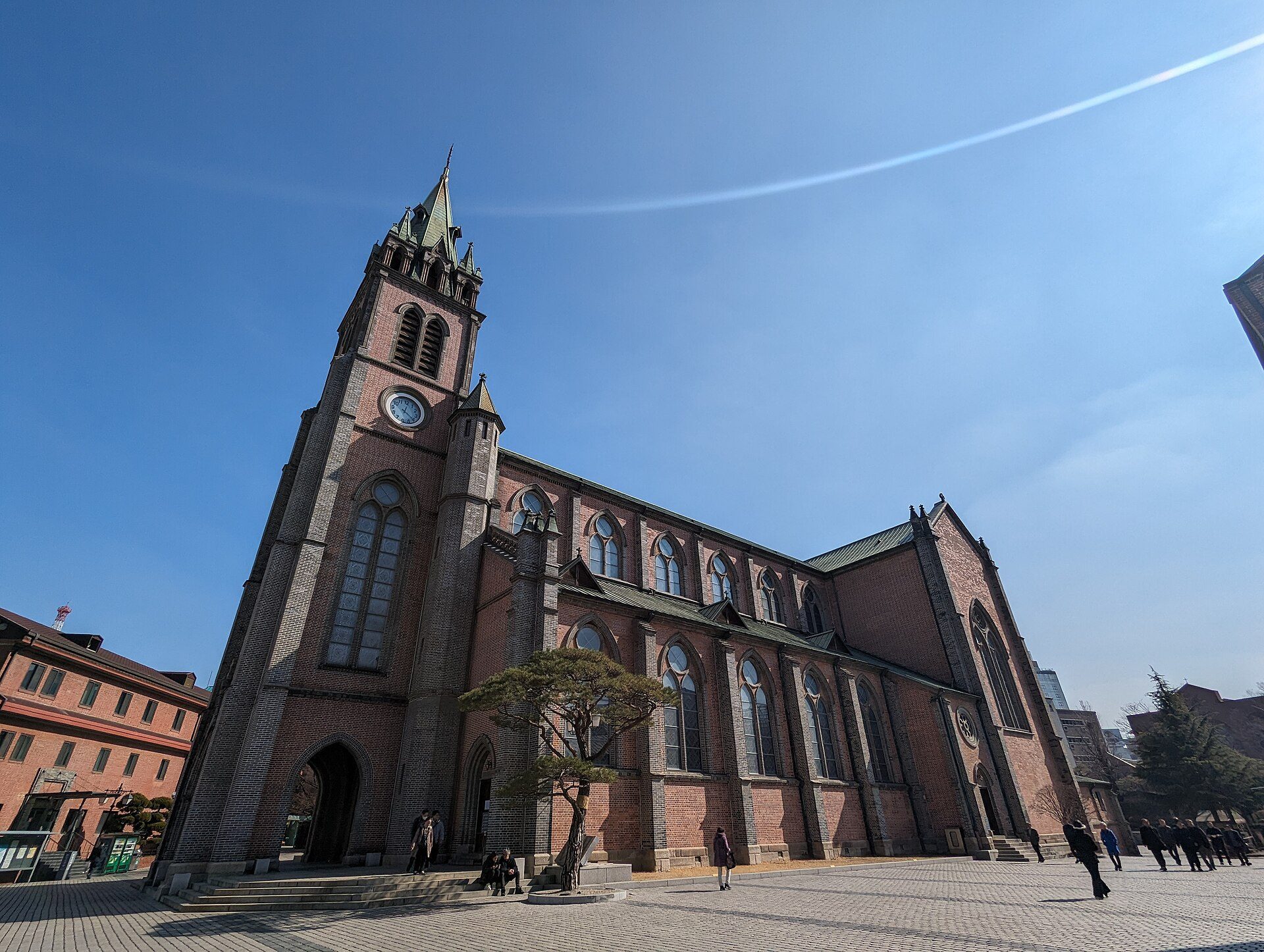
Myeongdong Cathedral in Seoul, dedicated in 1898, photographed in 2024. Photo: Sean Young, CC BY 4.0, via Wikimedia Commons. Sean Young (@assanges), source, CC BY 4.0
The Exquisite Charm of South Korean Churches
Contemporary Christian churches in South Korea have moved away from the historic models of towering spires and cross-shaped plans. Many share a few clear features:
- Multi-purpose buildings on tight urban plots. Worship halls are often stacked above or below cafés, education rooms and community spaces, because land is expensive and congregations run many weekday activities.
- Ground floors open to the street. Lobbies, plazas and cafés invite neighbours in and give something back to dense neighbourhoods.
- A cross tower as landmark. Instead of a spire, a slender tower or a cross cut into a wall identifies the building among apartment blocks and signs.
- Simple materials and light. Exposed concrete, brick and white render, with light used symbolically through slots, perforations and clerestories.
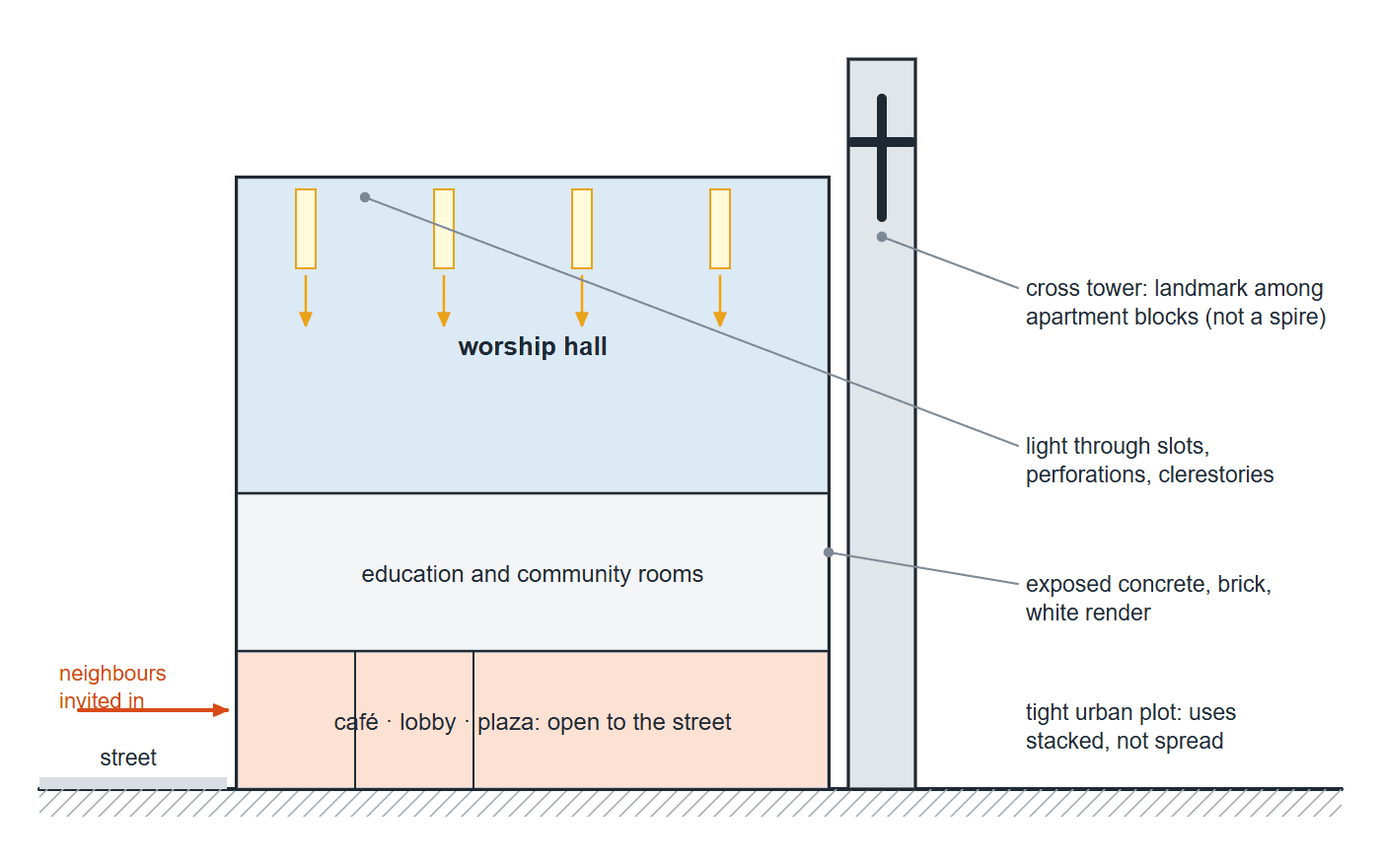
Features shared by many contemporary South Korean churches, on one schematic section: a multi-purpose building on a tight urban plot, a ground floor open to the street, education and community rooms stacked with the worship hall, a cross tower as landmark, and light admitted through slots and clerestories. Diagram: Arch2O
The list below shows how Korean architects have developed these ideas in recent years, using contemporary design approaches rather than historical styles.
Also Read: Gothic Architecture: 9 Iconic Cathedrals from the Depths of History.
1) Daejun Holy Light Church / Lee Eunseok + Atelier KOMA

©Joonhwan Yoon
This church faces the city with a curved, perforated facade and a large cross cut into its wall. A continuous route runs from the main road through the lobby hall to a park behind the building, and the foyer works as a wide indoor plaza for adults and children. On a narrow site, the architects stacked the worship hall, fellowship spaces and classrooms in an organised sequence, opening the building horizontally to the neighbourhood.
Also Read: 12 Absolutely Interesting Facts about Sagrada Familia


2) The Closest Church / Heesoo Kwak and IDMM Architects

©Kyungsub Shin
The Closest Church stands on a busy intersection in Unyang-dong, Gimpo. Its corner facade is split between two contrasting elements: a heavy, fractured concrete mass facing the apartment blocks, and a translucent glass face that opens views to the park and shows the worship activity inside.


3) The Joyful Church / The Beck Group

©Seung-Hoon Yum
The Joyful Church commissioned The Beck Group to accommodate its growing Sunday services, religious education and weekday social programmes on a large hillside site in Pohang’s new town district. The design combines Christian symbolism with references to Korean culture, and had to work with steep, wooded slopes and restrictive zoning.


4) Saemoonan Church / Seoinn Design Group + Lee Eunseok

©Juneyoung Lim
The new building of Saemoonan Church in central Seoul, completed in 2019 for Korea’s first organised Protestant congregation, was organised around four ideas: the church’s historical roots, an open gate as a symbol of welcome, Christ as light, and water as a symbol of unity and baptism. Its curved, gateway-like form faces the city and makes the church’s public role visible in the heart of Seoul.


5) Immanuel Church / Kim Seunghoy (Seoul National University) + KYWC Architects

©Kang Ilmin, Kim Jongoh
Immanuel Church stands on a corner of a newly developed district of Cheongju, where buildings are covered in brightly coloured signs. The architects’ challenge was to give the church a calm, dignified presence among them; brick volumes and a restrained bell tower set it apart without competing for attention.


6) Woori Vision Church / Oh Jongsang

©Oh Jongsang
On a large plot, the architect placed a long, open concrete frame in front of the brick sanctuary. The frame works as a gate that can be entered from any direction, offering hospitality to the surrounding community and leading through a courtyard to the chapel, instead of a closed glass entrance. A tall cross tower at one end identifies the church and balances the high chapel against the low frame.


7) Onnuri Methodist Church / JUNGLIM Architecture

©Namgoong Sun
Near Haeundae Beach in Busan, this church sits in a lively district where planned main streets meet older, organically grown roads. The architects drew on the waves of the nearby sea for its curved white forms, set beside a slender cross tower and arranged to be easily reached from surrounding streets and markets.


8) Gwangju Dongmyeong Church / Seoinn Design Group

©Seoinn Design Group
This design for a church in Gwangju abandons traditional church form for clean modern volumes: a square tower holding a cross, a continuous band of windows along the building and a facade of white tiles. The image shown is a rendering; we could not confirm whether the design was built.


9) JA Curve Church / ZIP Partners Architecture

©Choi Hyuk-jae
JA Curve Church sits on Jeju Island among pine forests and citrus orchards, at the edge of the town but with easy access to it. Its long, low, curving white form follows the landscape rather than dominating it.


10) Taejeon Church / Oh Jongsang

©Oh Jongsang
Taejeon Church is surrounded by small houses and parks. The architect designed a simple box of exposed concrete and brick, with a cross set into the facade rather than a separate tower. A café with outdoor seating occupies the ground-floor plaza, sheltered by the concrete volume above, and a rooftop lawn gives the congregation and neighbours open space in a dense setting.


Christian churches in South Korea at a glance
| Church | City | Architect | Note |
|---|---|---|---|
| Myeongdong Cathedral | Seoul | Eugène Coste (supervising priest-architect) | Dedicated 1898; Gothic Revival; historic site |
| Saemoonan Church (new building) | Seoul | Seoinn Design Group + Lee Eunseok | Congregation founded 1887; building completed 2019 |
| Daejun Holy Light Church | Not stated in source | Lee Eunseok + Atelier KOMA | Open lobby-plaza through to park |
| The Closest Church | Gimpo | Heesoo Kwak + IDMM Architects | Split concrete/glass corner facade |
| The Joyful Church | Pohang | The Beck Group | Large hillside campus |
| Immanuel Church | Cheongju | Kim Seunghoy + KYWC Architects | Brick volumes in a new district |
| Woori Vision Church | Not stated in source | Oh Jongsang | Open concrete gate-frame |
| Onnuri Methodist Church | Busan (Haeundae) | JUNGLIM Architecture | Wave-inspired forms |
| Gwangju Dongmyeong Church | Gwangju | Seoinn Design Group | Design shown as rendering; built status unconfirmed |
| JA Curve Church | Jeju | ZIP Partners Architecture | Low curved form in the landscape |
| Taejeon Church | Not stated in source | Oh Jongsang | Concrete and brick box, rooftop lawn |
Source: Saemoonan Church and Myeongdong Cathedral histories (linked); other entries from architects' project texts published on Arch2O (as of 25 October 2026).
To see the contrast between historic and contemporary church design, visit Myeongdong Cathedral and Saemoonan Church in central Seoul on the same day. For other Korean architecture on Arch2O, see the Korean grasshopper café and the opening of the Lotte World Tower in Seoul.
Sources and further reading
- Statistics Korea, 2015 Population and Housing Census (religion), as reported by The Korea Times.
- Saemoonan Church history; Myeongdong Cathedral history (linked above).
- Project descriptions are paraphrased from the architects’ published texts on Arch2O.

Aly Bayoumi is an editor with a sharp eye for detail and a deep commitment to clarity and precision. Passionate about architecture and design, he sees every project as an opportunity to shape compelling narratives that bring creative visions to life. With a focus on accuracy and engaging storytelling, Aly combines editorial expertise with a dedication to elevating the voices and ideas that shape the built environment.