

Rem Koolhaas, the director for the Venice Architecture Biennale 2014, made an announcement this morning at a press conference held by biennale president Paolo Baratta at the event’s headquarters in San Marco, Venice. Koolhaas has revealed that the title for next year Architecture Biennale will be “Fundamentals” – Here’s the full statement from Rem Koolhaas:
Fundamentals will be a Biennale about architecture, not architects. After several Biennales dedicated to the celebration of the contemporary, Fundamentals will focus on histories – on the inevitable elements of all architecture used by any architect, anywhere, anytime (the door, the floor, the ceiling, etc.) and on the evolution of national architectures in the last 100 years. In three complementary manifestations – taking place in the Central Pavilion, the Arsenale, and the National Pavilions – this retrospective will generate a fresh understanding of the richness of architecture’s fundamental repertoire, apparently so exhausted today.
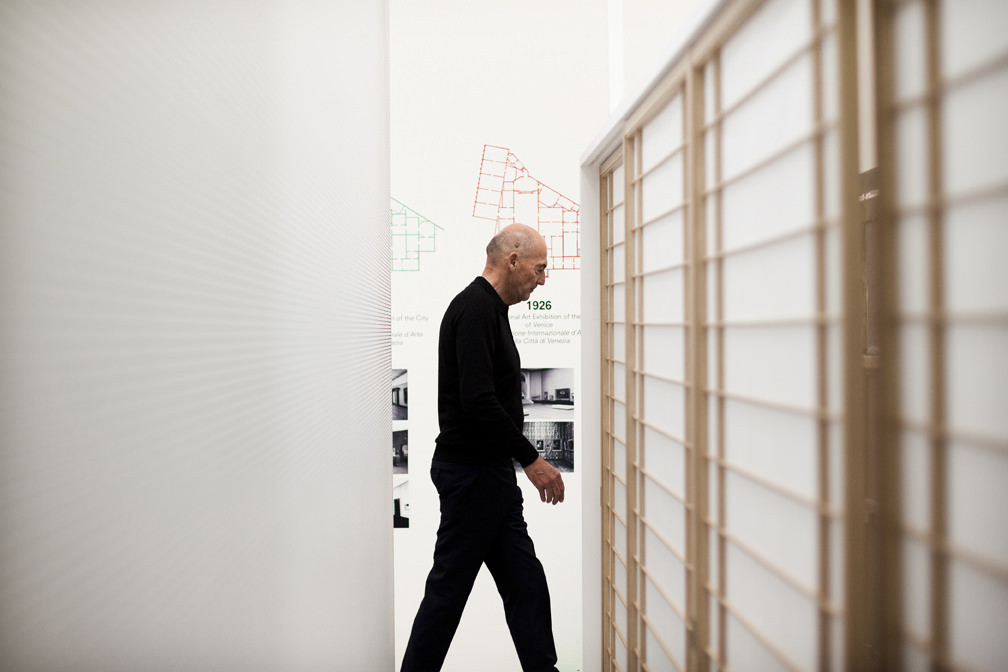
Koolhaas preparing the exhibitions. ImageCourtesy of la Biennale di Venezia
In 1914, it made sense to talk about “Chinese” architecture, “Swiss” architecture, and “Indian” architecture. One hundred years later, under the influence of wars, diverse political regimes, different states of development, national and international architectural movements, individual talents, friendships, random personal trajectories, and technological developments, architectures that were once specific and local have become interchangeable and global. National identity has seemingly been sacrificed to modernity.
Having the decisive advantage of starting work a year earlier than the Biennale’s typical schedule, we hope to use this extra time to introduce a degree of coordination and coherence among the National Pavilions. Ideally, we would want the represented countries to engage a single theme – Absorbing Modernity: 1914-2014 – and to show, each in their own way, the process of the erasure of national characteristics in favor of the almost universal adoption of a single modern language in a single repertoire of typologies.
The First World War – the beginning of modern globalization – serves as a starting point for the range of narratives. The transition to what seems like a universal architectural language is a more complex process than we typically recognize, involving significant encounters between cultures, technical inventions, and imperceptible ways of remaining “national”. In a time of ubiquitous google research and the flattening of cultural memory, it is crucial for the future of architecture to resurrect and expose these narratives.
By telling the history of the last 100 years cumulatively, the exhibitions in the National Pavilions will generate a global overview of architecture’s evolution into a single, modern aesthetic, and at the same time uncover within globalization the survival of unique national features and mentalities that continue to exist and flourish even as international collaboration and exchange intensify…

Ibrahim Abdelhady is an architect, academic, and media entrepreneur with over two decades of experience in architecture and digital publishing. He is the Founder and CEO of Arch2O.com, a leading platform in architectural media, renowned for showcasing innovative projects, student work, and critical discourse in design. Holding dual PhDs in Architecture, Dr. Abdelhady combines academic rigor with industry insight, shaping both future architects and architectural thought. He actively teaches, conducts research, and contributes to the global architecture community through his writing, lectures, and media ventures. His work bridges the gap between practice and academia, pushing the boundaries of how architecture is communicated in the digital age.